Open-Top Box Project: A One Period Polynomial Modeling Exercise
Students cut four equal squares from the corners of a 16 in by 10 in sheet, fold the sides up, and end up with a tray whose volume is a cubic function of the corner cut. The finished tray has to fit a shelf. That condition puts the largest volume out of reach, so the correct answer is not the biggest number in the table.
Browse our collection of free polynomial worksheets and answer keys for operations, factoring, division, graphing, and zeros.
Start here: the express worksheet
I usually start with this worksheet first as it fits one class period, needs no graphing technology, and asks students to do the reasoning for the challenge at hand.
The Open-Top Box, express edition
Students fill in three dimensions, write the volume as a product of three brackets, complete a five row table, and circle the largest volume. Then the shelf rule applies and they cross out the row they just circled. The final two questions ask them to account for that.
- No inequality notation. Students apply the shelf rule by crossing rows out of the table rather than by solving 10 − 2x ≤ 5.
- No estimating needed. The peak of the curve sits at exactly x = 2.
- Every volume in the table is a whole number or a half, which simplifies the calculations for this worksheet.
- Expanding into standard form, the formal domain and the effect of changing the shelf are all set as optional bonus questions if you are in the mood to challenge yourself today.
All downloads
Ten files, free to print and copy for your own classroom. The bundle contains all of them in one document if you would rather hand out a single PDF.
Complete project bundle
The express worksheet and key, the full poster board packet and key, the rubric, extension questions, the advanced version, and the letter sheet materials, in the order you would use them.
Download the complete bundle (PDF)One period exercise and answer key
The version described above, with a two page key that includes the completed table, a 30 minute lesson outline, and the errors I see most often.
Poster board packet and answer key
The same sheet and the same shelf, written up as a full project. Adds inequality notation, the complete nine row table, the formal domain, a constraint check and a written defence.
Rubric and student self check
Five criteria at four points each. The written justification carries the same weight as the algebra. Includes a twelve line self check for the day the work is due. The criteria are written to suit any of the three sheet sizes.
Download the rubric (PDF)Extension questions with answers
Eight investigations on the same 16 in by 10 in sheet, so nothing needs setting up again.
- Every cut giving exactly 112 in³, using the Factor Theorem
- What happens to the answer when the sheet is scaled
- Why a square sheet always wants a cut of s/6
- Fixed area, free choice of shape: which rectangle wins
Advanced version, 36 in by 24 in
The maximum is irrational and there is a cubic to divide by hand.
- Exact maximum of 640 + 448√7 in³ at x = 10 − 2√7
- Solving V(x) = 1620 to three roots, one of them impossible
- A pallet constraint that the maximum survives, unlike the shelf on the smaller sheet
8.5 in by 11 in packet, guide and worked solution
The original version of this project, on a sheet that comes straight out of a printer. The maximum is irrational, so students refine a table twice to reach it. The teacher guide covers all 27 questions, and the worked solution shows a complete response including the build and measure step.
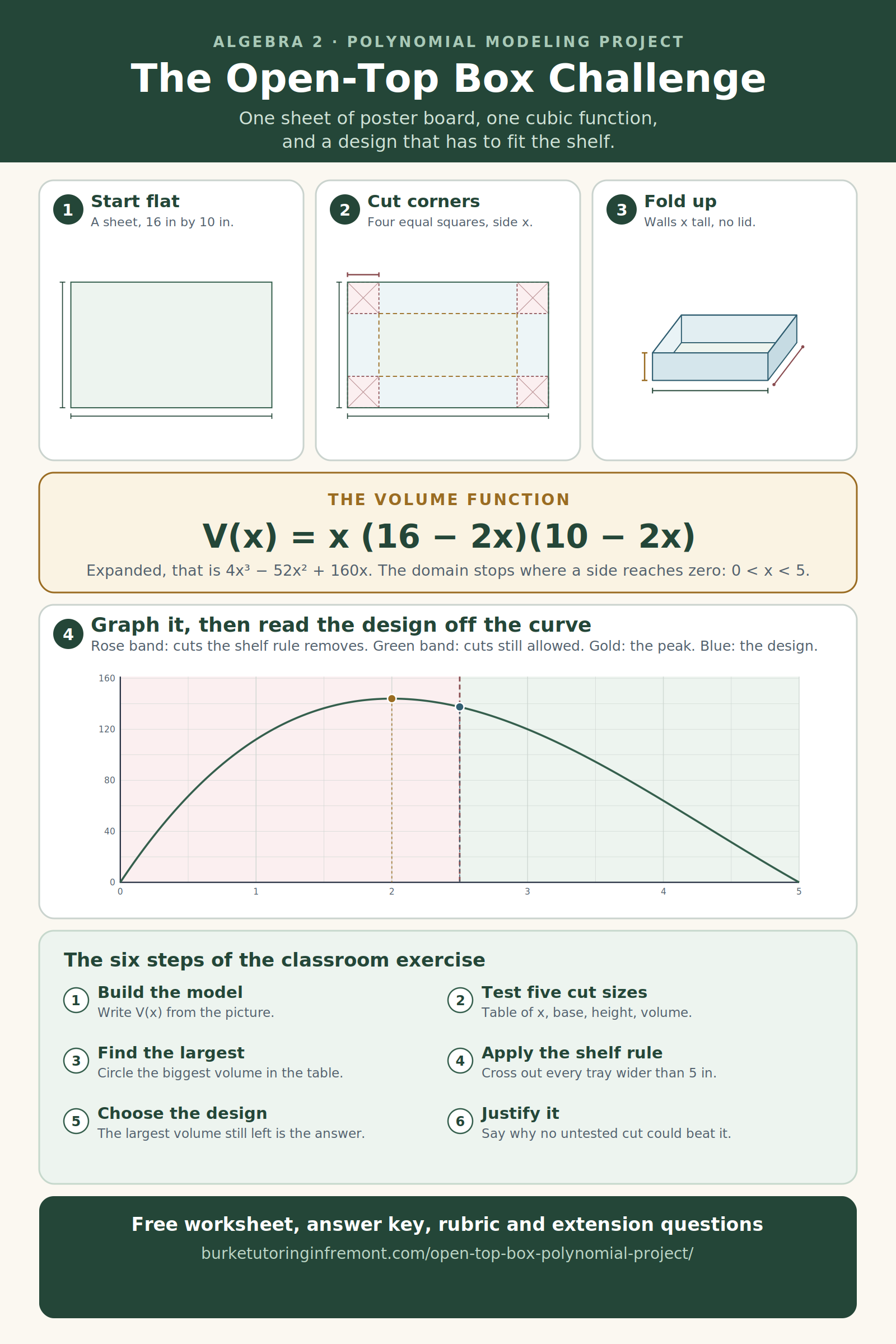
The diagram: flat sheet to volume function
One page showing the whole construction, from the uncut sheet through the folded tray to the graph. Project it, print it at poster size, or place it on a lesson page. The full size file is 1600 by 2400 pixels.
The mathematics behind the exercise
Set out here in full, so you can see what your students are walking into before you hand the worksheet out.
The model
Squares of side x are removed from each corner. Both ends of every side lose x, so the base measures (16 − 2x) by (10 − 2x) and the walls stand x tall.
V(x) = x(16 − 2x)(10 − 2x) = 4x³ − 52x² + 160x
The domain
The zeros are 0, 5 and 8. Only the first two describe something a sheet can do, since a cut of 8 in would remove more material than the 10 in side contains. The short side runs out first, so the model lives on 0 < x < 5.
The peak
V′(x) = 12x² − 104x + 160 factors as 4(x − 2)(3x − 20), so the critical values are x = 2 and x = 20/3. Only x = 2 lies in the domain, giving a maximum of exactly 144 in³.
Reading the answer from the shape of the curve
V turns once on the domain and that turn is a maximum, so V decreases for every x above 2. Every feasible cut is 2.5 or larger, and therefore lies past the turn. The largest feasible volume is consequently at the smallest feasible cut, and the design is x = 2.5 in: a base of 11 in by 5 in, walls 2.5 in tall, holding 137.5 in³.
That argument accounts for cut sizes nobody tabulated, which is what separates a justification from a list of tested values. The shelf condition costs 6.5 in³, or about 4.5 percent, relative to a tray that would not enter the shelf at all.
| Corner cut | Base (in) | Volume (in³) | Enters a 5 in opening? | Outcome |
|---|---|---|---|---|
| 1 in | 14 × 8 | 112 | No, 3 in too wide | Ruled out |
| 1.5 in | 13 × 7 | 136.5 | No, 2 in too wide | Ruled out |
| 2 in | 12 × 6 | 144 | No, 1 in too wide | Largest volume, still ruled out |
| 2.5 in | 11 × 5 | 137.5 | Yes, exactly | The design |
| 3 in | 10 × 4 | 120 | Yes | Fits, holds less |
Writing the volume as a product of three brackets, and expanding it in the bonus question, both rest on multiplying binomials. If you need to brush up on some of those steps please check out the worksheet: polynomial operations worksheet covering addition, subtraction and multiplication. Reading the three zeros directly from the factored form is the same skill practised in the factoring polynomials guide. The extension question asking for every cut that gives 112 in³ requires dividing a cubic by a known linear factor, which is covered in the polynomial long division and synthetic division worksheet.
Running it in class
A 30 minute outline for the express worksheet. The full packet takes a period and a half, and its own teaching notes are in the answer key.
| Minutes | What happens |
|---|---|
| 0 to 5 | Hold up two trays cut earlier with visibly different corner sizes and ask which holds more. Take a vote and leave it unsettled. |
| 5 to 15 | Steps 1 to 3, in pairs. Circulate for students writing 16 − x instead of 16 − 2x, which is the error I see most. |
| 15 to 22 | Steps 4 and 5. Students circle the largest volume, then apply the shelf rule and cross that row out. |
| 22 to 32 | Questions 4 to 7, individually. Question 7 is worth discussing as a class before the period ends. |
Where students get stuck
These are the difficulties I encounter most often when I use this task. The answer keys give suggested responses for each.
Writing V = x(16 − x)(10 − x) is common, and it is worth addressing out loud rather than individually. Put both versions on the board, work out the base at x = 2 each way, and hold a folded tray against a ruler.
Some students write 0 < x < 8. Asking them to draw the tray at x = 6 usually settles it faster than an explanation does.
This is the difficulty the design brief is meant to surface, so I do not warn students in advance. I find that my students remember better if they trial and error through their own mistakes and frustrations instead of just being given the answer or strategy.
At x = 2 the depth fits exactly, so I ask them to show for both conditions to be satisfied.
With five rows, checking them all is a legitimate argument, which makes question 7 harder to motivate than it appears. The question I use is: what if cuts could be any size at all, not only halves?
Measured volume comes in below predicted volume for physical reasons. That difference is a result to explain, not an error to correct.
If your class would benefit from examining this kind of reasoning in someone else's work first, the polynomial error analysis worksheet works through nine cases to learn through correcting others' mistakes.
Three levels of the same task
All three use the same construction, so a class can move between them without relearning the setup. Students who complete the express worksheet already know the answer for the poster board packet, which lets them concentrate on the reasoning rather than the arithmetic.
Express, 16 in by 10 in
One period. Five cut sizes, half inch measurements, no inequality notation and no estimation. The peak sits at exactly x = 2 and the design at x = 2.5.
Algebra 1 onwards, or a first encounter with modeling.
Full packet, 16 in by 10 in
A period and a half. Same numbers, but students derive the domain, convert the brief into inequalities, complete a nine row table, graph the function and write a justification.
Algebra 2, and the natural follow on from level 1.
Advanced, 36 in by 24 in
The maximum is 640 + 448√7 in³ at x = 10 − 2√7. Students also solve V(x) = 1620 by hand and obtain three roots, one of them wider than the sheet.
Honours classes and precalculus review.
The 8.5 in by 11 in letter sheet edition sits between levels 2 and 3. It has an irrational maximum reached by refining a table, and its main advantage is that the sheet comes straight from a printer.
Standards alignment
The emphasis falls on modeling and constraints rather than on procedural fluency, which is what makes this task suitable as an end of unit exercise rather than as practice.
| Standard | Where it appears |
|---|---|
| HSA.CED.A.2 | Step 2, writing V(x) from the drawing. |
| HSA.CED.A.3 | Steps 5 and 6, representing the brief as a constraint and judging which solutions remain viable. This is the central standard for the task. |
| HSA.SSE.A.2 | The bonus question, moving between factored and standard form. |
| HSA.APR.B.3 | The bonus question on the largest possible cut, and question 1 of the extension sheet. |
| HSF.IF.B.4 | The graph, reading the maximum and the direction of the curve either side of it. |
| HSF.IF.B.5 | The domain question, relating x to the quantity it describes. |
| HSF.IF.C.7c | Plotting the polynomial from a table of values. |
| HSG.MG.A.3 | Applying geometry to a design problem carrying physical constraints. |
| MP.3 and MP.4 | Questions 4 and 7, constructing an argument and modeling with mathematics. |
Standard codes and wording are taken from the Common Core State Standards for Mathematics. For a second modeling task in a similar vein, the Illustrative Mathematics task library is a reasonable place to look, and Desmos is the quickest way to project the curve if you prefer not to draw it. The National Council of Teachers of Mathematics publishes further material on modeling in secondary classrooms.
Reuse and citation
Print the files, copy them for your students, and share them with your department. For a public website or a blog post, please link the image back to this page rather than reposting the PDFs, so that the current answer keys stay attached to any corrections.
Embed the diagram
Citing this exercise
Related polynomial practice
Working a level below this? The quadratics rectangle and geometry worksheet builds area functions from diagrams in the same way this exercise builds a volume function, and the quadratics worksheet collection sets out the full sequence.

Berke Sahbazoglu
Berke has tutored mathematics and science for more than 10 years, across 6,000 tutoring hours with 200 students, and writes the practice materials he uses with Algebra I and Algebra II students in Fremont, Newark and Union City. He holds a BA in Biochemistry from Washington University in St. Louis. He wrote the first version of this exercise after working with students who could locate the maximum of a cubic but could not explain why it was the maximum, and the design brief in these worksheets are intended to force students to visualize the model instead of just relying on calculations or equations.
Page updates
13 August 2026. Published the express worksheet and answer key, the poster board packet and answer key, the rubric, extension questions, the advanced version, the letter sheet materials, the complete bundle and the full size diagram. The accuracy review covered the factored and expanded forms on all three sheet sizes, every zero, the exact critical values, all table values, the irrational maximum on the advanced sheet, the three roots of V(x) = 1620 and the fixed area comparisons.
Individual Algebra 2 support
Burke Tutoring provides in home mathematics tutoring in Fremont, Newark and Union City, covering polynomial functions, modeling, graphing and test preparation. Call (510) 453-0350.