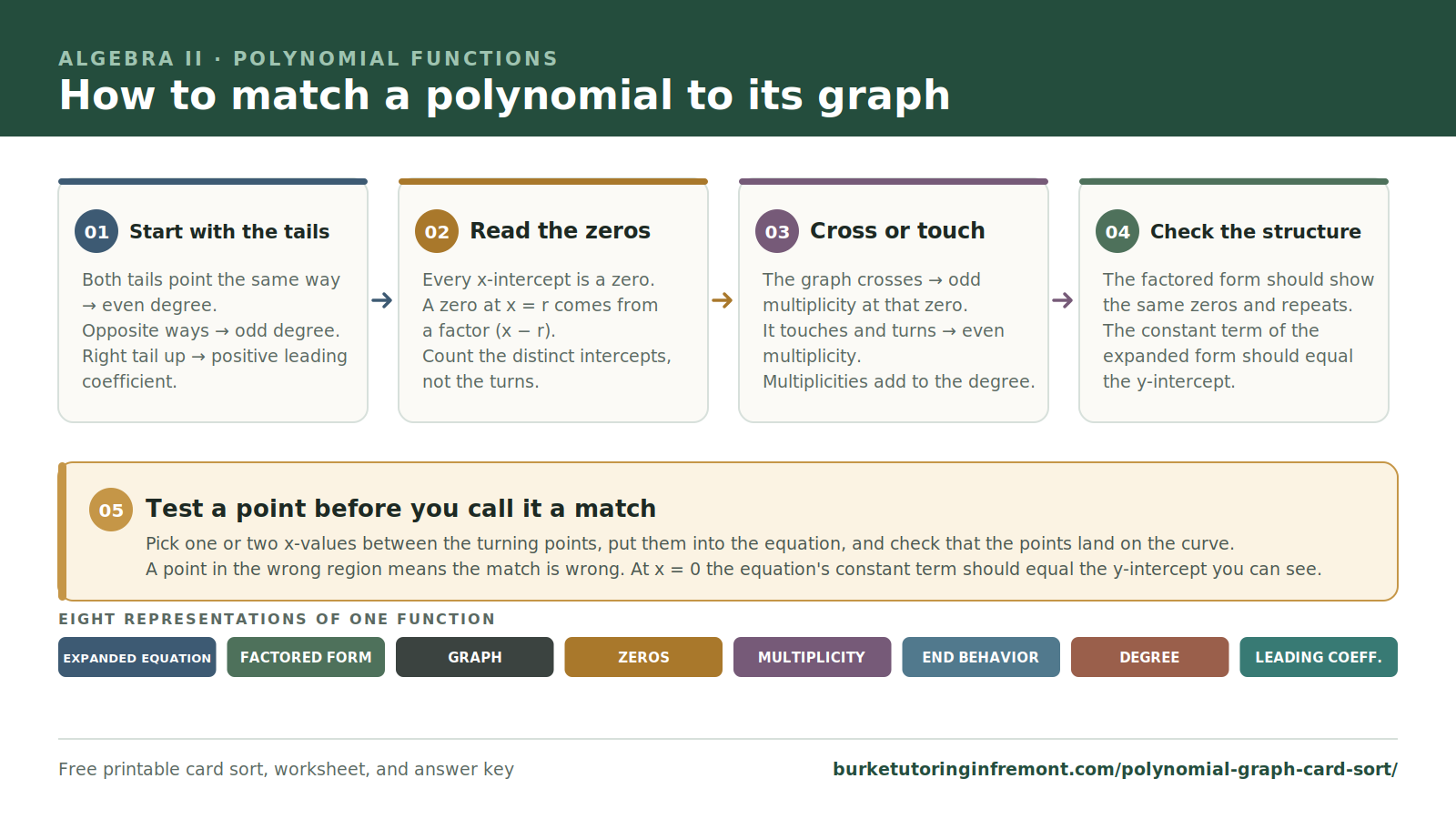
Students match one polynomial across eight views: equation, factored form, graph, zeros, multiplicity, end behavior, degree, and leading coefficient. The free pack includes three levels, printable cards, a no-cut worksheet, teacher directions, and complete answer keys.
All 14 function families were recalculated and every graph was checked against its equation before publication. Free to print; no signup or email required.
Choose cut-out cards for stations and partner work, or use the no-cut version when students need a conventional worksheet. The teacher key covers both formats.
PDF · CUT-OUT ACTIVITY
Printable card sort
All three levels, category-labeled cards, dashed cut lines, and a recording sheet before each set.
18 pages, US Letter, print single-sided at 100%
112 cards across three levels
Readable in grayscale — every card is text-labeled
No sign-up and no email address. The card IDs are scrambled separately by category, so students can record matches without the code pattern giving away the answer.
Eight views of the same polynomial
A match is only complete when every representation tells the same story. The category colors help students organize a large set; they do not identify which cards belong together.
Expanded equationCoefficients and degree in standard form
Factored formZeros and repeated factors visible
GraphIntercepts, cross/touch behavior, and tails
ZerosThe distinct x-values where f(x)=0
MultiplicityHow many times each factor repeats
End behaviorWhat the left and right tails do
DegreeParity, possible turns, and overall behavior
Leading coefficientThe sign and vertical scale of the graph
The decision map is free to display in a classroom or embed in a lesson page with credit and a link back to this activity.
Three levels in one printable pack
The number of card types stays the same. What changes is the amount of structure students must track at once.
1
Introductory quadratic and cubic
Four functions with integer zeros and visually clear crosses and touches.
Degrees 2 and 3
Leading coefficient ±1
Two double-root examples
2
Standard Algebra 2
Five functions with mixed multiplicities and positive or negative leading coefficients.
Degrees 3 and 4
Double and triple roots
Leading coefficients ±1 and ±2
3
Fourth- and fifth-degree challenge
Five functions that require students to distinguish repeated roots with similar-looking local behavior.
Degrees 4 and 5
Multiplicities up to 4
Fractional leading coefficient included
What one complete match looks like
This walkthrough uses a function that is not in any of the three printable levels, so nothing here gives away a card. The three marked points are the evidence a student should be able to point to.
Crosses at x = -1
Touches and turns at x = 3
y-intercept at (0, 9)
Equationy = x³ - 5x² + 3x + 9
Factoredy = (x + 1)(x - 3)²
Zeros{-1, 3}
Multiplicity-1 has m=1; 3 has m=2
End behaviorLeft down; right up
Degree3
Leading coefficient+1
Graph evidenceCrosses at -1, touches at 3
Independent check: the y-intercept is 9, which agrees with the constant term in the expanded equation and with (1)(-3)² in factored form. Test a second point between the turns — at x = 2, the equation gives 3, and the graph sits just above the axis there. A student holding the right graph with the wrong multiplicity or leading-coefficient card fails one of those two checks.
Before you print
The sort assumes a few skills are already there. If they aren't, students match by shape alone and the activity stops teaching anything.
What students need first
Factoring a quadratic and a simple cubic, reading an x-intercept off a graph, and knowing that a factor (x - r) gives you the zero x = r. If factoring is still shaky, start with the factoring polynomials flowchart guide and come back to this.
What the sort teaches
That one feature is never enough. Three of the five standard functions have degree 4, and two of those have identical end behavior, so stopping at the first plausible card puts you in the wrong family and you have to back up and find a second piece of evidence.
Where it fits in a unit: after factoring and before graphing from scratch. If you're not sure which level to hand out, run the polynomial skills diagnostic test first.
Three practical ways to run it
20-30 minutes
Partner card sort
Place the eight category stacks face up. Partners build one family at a time and cannot place a match until both students can name the evidence.
One class period
Station rotation
Use one level at each station. At the final station, students choose one disputed match and write a short defense using multiplicity or end behavior.
Substitute ready
No-cut worksheet
Give students the graph-letter version and the two written justifications. It needs no scissors, envelopes, or advance sorting.
The mistake I see most often
Students don't check their work against end behavior. They spot two intercepts, grab the first card showing those zeros, and move on. So when a match goes wrong, and it will, I have them test a point: pick one or two x-values between the turns, put them in the equation, and see where the point lands. If it isn't anywhere near the curve on the graph card, something in that row is wrong, and they've found it themselves instead of waiting on me or on the key. That routine is printed on every recording sheet and worksheet in the download.
Four wrong matches the distractors are built to catch
They count the intercepts
The challenge set has a fifth-degree function showing only two x-intercepts. Count intercepts, call it a quadratic, and nothing about the tails works after that.
A flattened crossing is not a touch
This is the one that costs the most time. In the standard set, x = -1 is a triple root of (x + 1)³(x - 2). The graph flattens right out as it passes through, so it reads as a touch, and the even-multiplicity card goes down next to it. Odd multiplicity always crosses, however flat it gets on the way.
Degree won't give you the tails
Parity tells you whether the two tails match. It says nothing about which way they point — that's the leading sign. Every level carries a positive and a negative version of the same degree for exactly this reason.
Same shape, wrong size
Leading coefficients of ±1, ±2, and +1/2 are scattered through the set and none of them change the shape. Short of a test point, there's no way to tell 2(x + 3)(x - 1)² from (x + 3)(x - 1)².
Best debrief question: “Which match could you prove from a second clue?” Students who rely only on intercepts often miss a wrong multiplicity or end-behavior card.
About repeated property cards: Some functions share the same degree, leading coefficient, or end behavior. Identical cards and identical no-cut options are interchangeable; the teacher key shows one valid arrangement, and either order should be accepted.
Answer key preview: introductory level
The full key for all three levels is in the teacher PDF. This is the introductory set, so you can see the format before you send 31 pages to the copier.
Introductory level: four complete polynomial function families
Graph
Expanded equation
Factored form
Zeros
Multiplicity
End behavior
Degree
Leading coeff.
A
y = x² + x - 2
y = (x + 2)(x - 1)
{-2, 1}
both m = 1
left up; right up
2
+1
B
y = -x² + 2x - 1
y = -(x - 1)²
{1}
x = 1: m = 2
left down; right down
2
-1
C
y = x³ - 3x - 2
y = (x + 1)²(x - 2)
{-1, 2}
x = -1: m = 2; x = 2: m = 1
left down; right up
3
+1
D
y = -x³ + 2x² + 5x - 6
y = -(x + 2)(x - 1)(x - 3)
{-2, 1, 3}
all m = 1
left up; right down
3
-1
Rows A and B share a degree, and rows A and C share a leading coefficient, so those two cards are interchangeable between the rows that use them.
The student may be copying signs instead of solving each factor equation.
Multiplicity
Odd multiplicity crosses; even multiplicity touches and turns.
HSA.APR.B.3
The student sees the intercept but not how the graph behaves there.
Degree and tails
Even degree has matching tail directions; odd degree has opposite directions.
HSF.IF.C.7c
The student may know the degree but not connect parity to a graph.
Leading coefficient
The sign determines the right-tail direction once degree parity is known.
HSF.IF.C.7c
The student may be treating degree alone as enough to determine end behavior.
Multiple representations
Expanded, factored, graphical, and verbal descriptions must agree.
MP2; MP3
The student may be pattern-matching from one feature instead of checking the whole structure.
This is a classroom-made, criterion-referenced activity, not a standardized or norm-referenced assessment. Use the pattern of mismatches and the written explanations to plan reteaching.
Reuse the activity and embed the decision map
Teachers and families may print, copy, and adapt these files for their own students at no cost. Please link to this guide rather than reposting the PDFs, so the current answer key and any correction stay with the activity.
It is a classification activity in which students match several representations of the same polynomial function. This set uses eight: expanded equation, factored form, graph, zeros, multiplicity, end behavior, degree, and leading coefficient.
Should students start with the graph or the factored form?
Either can work, but the strongest routine moves back and forth. Students can read zeros and cross/touch behavior from the graph, then use the factors to confirm the zeros and multiplicities. Degree and leading sign provide a separate check on the tails.
Can I use the activity without cutting cards?
Yes. The uncut worksheet shows graphs labeled by letter and lists the other representations in a different order. Students write the matching graph letter in each answer box.
How long does each version take?
The introductory set usually fits in 20-30 minutes. The standard and challenge sets generally take 30-50 minutes when students are required to explain at least two matches.
Does color reveal the answers?
No. Color identifies the representation category only. Every expanded equation has the same category color, for example, while the card codes and option numbers are independently scrambled.
What if two cards show the same degree or leading coefficient?
That is intentional. Identical property cards are mathematically interchangeable, so either code or option order is correct as long as each copy is used once. The teacher key presents one valid arrangement.
Which level should a class start with?
Level 1 fits students who have just met multiplicity, level 2 fits a standard Algebra 2 unit review, and level 3 fits honors classes or precalculus review. Most classes can run level 1 as a warm-up and level 2 the same period.
May I share this with colleagues or post it in an LMS?
You may print and share it directly with your own students. For a public website, resource list, or blog post, link to this page instead of reposting the PDF so visitors receive the current version and correction log.
Page updates
August 5, 2026: Rebuilt all four PDFs and the decision map. Corrected the introductory no-cut worksheet, which asked for graph letters A-E on a level that only has graphs A-D, enlarged every worksheet graph, moved the answer keys to landscape so all eight columns are readable, and added the test-point checking routine to the recording sheets, the worksheets, the teacher guide, and the decision map. On this page: replaced the sample function so it no longer duplicates an introductory card, rebuilt the sample graph so the curve runs off the frame instead of flattening at the top and bottom, and added a prerequisites section, an answer-key preview, and a citation block.
August 4, 2026: Published the three-level cut-out activity, no-cut worksheet, teacher key, complete bundle, and embeddable graph-matching decision map.
Accuracy review: Recomputed all 14 expanded forms from their factors, confirmed the zeros and multiplicities of every function, checked every degree, leading coefficient, and end-behavior match against the key, and confirmed that each card code and each numbered no-cut option is used exactly once per level.
Berke is the founder and a tutor at Burke Tutoring in Fremont. He has tutored math and science for more than 10 years and develops Algebra I and Algebra II practice activities from problem patterns he has used with students in Fremont, Newark, and Union City.
Burke Tutoring provides in-home math tutoring in Fremont, Newark, and Union City, including polynomial functions, factoring, graphing, and test review. Call (510) 453-0350 to talk through what your student needs.