Factoring Polynomials Flowchart, Guide, and Worksheets
Browse our collection of free polynomial worksheets and answer keys for operations, factoring, division, graphing, and zeros.
Use this factoring polynomials flowchart to decide what to try first, study each pattern, and work through three printable worksheet levels with fully explained answers.
Published · Last updated · Every question checked for accuracy before publishing
- Level
- Algebra I and Algebra II, typically grades 8-11
- Skills
- GCF, trinomials, AC method, grouping, special products, cubes, quadratic form, and factoring completely
- Includes
- Decision flowchart, method chart, six worked examples, 36 practice problems in three levels, and complete worked solutions
- Downloads
- Complete bundle, one-page flowchart, reference sheet, student worksheets, and separate teacher answer key
- Time
- Use the guide as a lesson, or assign one worksheet at a time for 20-35 minutes
The factoring polynomials flowchart begins with the greatest common factor. Next, count the terms and look for a recognizable structure: special products for two terms, trinomial methods for three, grouping for four, or a substitution such as u = x² when the powers behave like a quadratic. Keep factoring until every factor is prime, then multiply back to check.
Download the Factoring Flowchart and Worksheet Pack
Everything is formatted for US letter paper. The bundle contains the flowchart, reference sheet, all three worksheets, and the worked answer key.
The entire resource in one teacher-ready PDF.
Download complete bundle (PDF)Simple student-friendly guide in a cleaner one-page layout.
Download the flowchart (PDF)Patterns, AC method steps, and a complete-factor checklist.
Download the reference sheet (PDF)Foundations, mixed methods, and challenge practice without answers.
Download the worksheets (PDF)Methods and intermediate steps, not just final factors.
Download the answer key (PDF)Factoring Polynomials Flowchart
This factoring polynomials flowchart is intentionally simple for younger students. It starts with the GCF, asks how many terms are left, and then points to the most likely method without crowding the page.
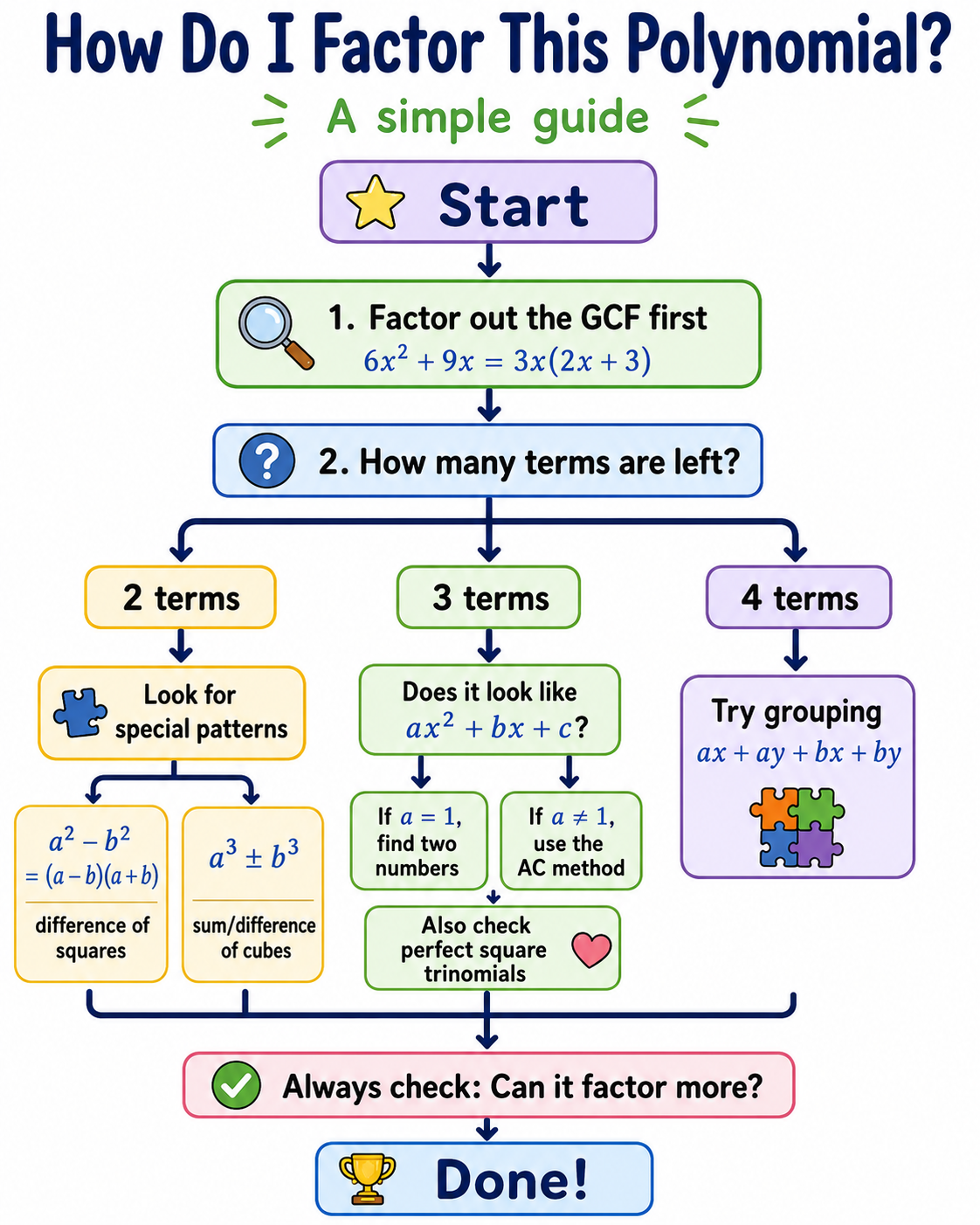
The flowchart and all five PDFs may be printed and handed out freely for classroom and home use, and the image may be republished with credit. Please link back to this page instead of rehosting the PDFs. To credit it, copy the line below:
<a href="https://burketutoringinfremont.com/factoring-polynomials-guide/">Factoring Polynomials Flowchart</a> by Berke Sahbazoglu, Burke Tutoring in FremontStopping one step early. For example, x(x² - 9) is factored, but it is not factored completely. The difference of squares is still waiting: x(x - 3)(x + 3).
Which Factoring Method Fits Each Expression
12x³ - 18x² = 6x²(2x - 3)
a² - b² = (a - b)(a + b)
Use product-and-sum or the AC method.
ab + ac + db + dc = (a + d)(b + c)
a³ ± b³ = (a ± b)(a² ∓ ab + b²)
Let u = x², factor, then substitute back.
| What you see | Try first | Keep in mind |
|---|---|---|
| Any number of terms | GCF | When the leading term is negative, factoring out a negative GCF makes it positive and the rest of the work easier. |
| Two terms | Squares or cubes | A sum of squares does not factor over the integers. |
| Three terms | Perfect square, a = 1, or AC | Check leading product, constant product, and middle-term sum. |
| Four terms | Grouping | The two groups must produce the same binomial factor. |
| x⁴, x², constant | Quadratic form | After substituting back, special products may still be hidden. |
Start with the Greatest Common Factor
I have my students check for a GCF before trying another factoring method. Factoring it out first usually makes the remaining expression easier to see.
18x³ - 72x
= 18x(x² - 4)
Both terms share 18x. The remaining binomial is a difference of squares.
= 18x(x - 2)(x + 2)
Use the smallest exponent of each shared variable. In 12x⁴y² and 18x³y⁵, the variable part of the GCF is x³y².
Factoring Trinomials
When the leading coefficient is 1
For x² + bx + c, find two numbers whose product is c and whose sum is b. Those numbers go directly into the binomial factors.
Product: -35 Sum: -2
The pair is -7 and 5.
x² - 2x - 35 = (x - 7)(x + 5)
The AC method when a is not 1
Multiply a and c, find a factor pair that adds to b, split the middle term, then factor by grouping. The box and AC methods here will help you organize your work.
ac = 18; use 9 and 2 because 9 · 2 = 18 and 9 + 2 = 11.
6x² + 9x + 2x + 3
3x(2x + 3) + 1(2x + 3)
= (3x + 1)(2x + 3)
Factoring by Grouping
Grouping works when separate pairs produce the same binomial factor. If the binomials are opposites, factor out a negative from one group before deciding that the method failed.
x²(x + 3) - 4(x + 3)
Both groups now contain x + 3.
= (x + 3)(x² - 4)
= (x + 3)(x - 2)(x + 2)
Special Products: Squares and Cubes
Special products are pattern shortcuts, but the pattern has to match exactly.
| Pattern | Factored form | Memory check |
|---|---|---|
| Difference of squares | a² - b² = (a - b)(a + b) | Two terms and subtraction only. |
| Perfect-square trinomial | a² + 2ab + b² = (a + b)² a² - 2ab + b² = (a - b)² | The middle term must be exactly ±2ab. |
| Difference of cubes | a³ - b³ = (a - b)(a² + ab + b²) | Same sign in the short factor; all positive in the long factor. |
| Sum of cubes | a³ + b³ = (a + b)(a² - ab + b²) | Same sign, opposite sign, always positive. |
8x³ + 125 = (2x)³ + 5³
= (2x + 5)(4x² - 10x + 25)
The quadratic factor from a cube identity does not factor farther over the integers.
Factoring Polynomials in Quadratic Form
If the exponents are 4, 2, and 0, you can use the quadratic expression and substitute u = x², factor normally, then substitute back and inspect every factor again.
Let u = x²: u² - 13u + 36
= (u - 4)(u - 9)
= (x² - 4)(x² - 9)
= (x - 2)(x + 2)(x - 3)(x + 3)
When a Polynomial Will Not Factor
Some expressions cannot be factored further over the integers. In that setting, the polynomial is called prime, so ‘prime’ or ‘does not factor over the integers’ is the answer.
| Example | Why it stops |
|---|---|
| x² + 9 | A sum of squares. Nothing over the integers or the reals produces it. |
| x² - 5 | Subtraction, but 5 is not a perfect square. |
| x² + 3x + 5 | No integer pair multiplies to 5 and adds to 3. |
| 4x² - 10x + 25 | The long factor left behind by a sum of cubes never factors farther. |
For any ax² + bx + c with integer coefficients, compute b² - 4ac. If that number is a perfect square, integer factors exist. If it is not, the trinomial is prime. For x² + 3x + 5: 9 - 20 = -11, so it is prime.
Practice Worksheets: Three Levels
Use the flowchart beside these three separate assignments. Foundations stays mostly within one or two steps. Mixed Methods removes the method labels. The challenge set includes problems that require more than one factoring method.
12 problems: GCF, a = 1 trinomials, squares, and simple multi-step factoring.
14 problems: AC method, grouping, cubes, quadratic form, and factoring completely.
10 problems with hidden GCFs, repeated special products, and multiple decisions.
Worksheet A: Factoring Foundations
- 6x + 18
- 5x² - 20x
- x² + 7x + 12
- x² - x - 12
- x² - 25
- 4x² - 49
- x² + 10x + 25
- x² - 12x + 36
- 3x² + 12x + 12
- 2x² + 10x + 12
- x³ - 9x
- 4y² + 20y + 24
Worksheet B: Mixed Factoring Methods
- 6x² + 11x + 3
- 8x² - 2x - 3
- 12x² + 11x - 5
- x³ + 3x² - 4x - 12
- 2x³ - 6x² + 5x - 15
- x³ - 27
- 8x³ + 125
- 3x⁴ - 15x²
- x⁴ - 13x² + 36
- 16x⁴ - 81
- 6a²b - 24b
- 4x² - 12xy + 9y²
- 15m²n + 10mn² - 5mn
- 2x³ + 7x² + 3x
Worksheet C: Factoring Challenge
- 12x³ - 75x
- 6x³ + x² - 24x - 4
- 2x⁴ - 10x² + 8
- x⁶ - 64
- 16x⁴ - 40x²y² + 25y⁴
- 18x² - 33x - 30
- 4x⁴ + 4x² - 15
- x⁴ + 2x³ - 9x² - 18x
- 16a⁴ - 81b⁴
- 3x⁵ - 21x³ + 36x
Factoring Polynomials Answer Key
Open a solution only after choosing a method. The separate printable answer key contains the same work in teacher-friendly page format.
Worksheet A Solutions
1. 6x + 18
2. 5x² - 20x
3. x² + 7x + 12
Method: Trinomial, a = 1
Find two numbers with product 12 and sum 7: 3 and 4.
x² + 7x + 12 = (x + 3)(x + 4)
Final: (x + 3)(x + 4)
4. x² - x - 12
Method: Trinomial, a = 1
Find two numbers with product -12 and sum -1: -4 and 3.
x² - x - 12 = (x - 4)(x + 3)
Final: (x - 4)(x + 3)
5. x² - 25
Method: Difference of squares
x² - 25 = x² - 5²
a² - b² = (a - b)(a + b)
Final: (x - 5)(x + 5)
6. 4x² - 49
Method: Difference of squares
4x² - 49 = (2x)² - 7²
Use conjugates.
Final: (2x - 7)(2x + 7)
7. x² + 10x + 25
Method: Perfect-square trinomial
25 = 5² and 10x = 2(x)(5).
x² + 10x + 25 = (x + 5)²
Final: (x + 5)²
8. x² - 12x + 36
Method: Perfect-square trinomial
36 = 6² and -12x = 2(x)(-6).
x² - 12x + 36 = (x - 6)²
Final: (x - 6)²
9. 3x² + 12x + 12
Method: GCF, then perfect square
Factor out 3: 3(x² + 4x + 4).
x² + 4x + 4 = (x + 2)²
Final: 3(x + 2)²
10. 2x² + 10x + 12
Method: GCF, then trinomial
Factor out 2: 2(x² + 5x + 6).
Product 6, sum 5: 2 and 3.
Final: 2(x + 2)(x + 3)
11. x³ - 9x
Method: GCF, then difference of squares
Factor out x: x(x² - 9).
x² - 9 = (x - 3)(x + 3).
Final: x(x - 3)(x + 3)
12. 4y² + 20y + 24
Method: GCF, then trinomial
Factor out 4: 4(y² + 5y + 6).
Product 6, sum 5: 2 and 3.
Final: 4(y + 2)(y + 3)
Worksheet B Solutions
1. 6x² + 11x + 3
Method: AC method
ac = 18. Use 9 and 2.
6x² + 9x + 2x + 3
3x(2x + 3) + 1(2x + 3)
Final: (3x + 1)(2x + 3)
2. 8x² - 2x - 3
Method: AC method
ac = -24. Use -6 and 4.
8x² - 6x + 4x - 3
2x(4x - 3) + 1(4x - 3)
Final: (2x + 1)(4x - 3)
3. 12x² + 11x - 5
Method: AC method
ac = -60. Use 15 and -4.
12x² + 15x - 4x - 5
3x(4x + 5) - 1(4x + 5)
Final: (3x - 1)(4x + 5)
4. x³ + 3x² - 4x - 12
Method: Grouping, then difference of squares
x²(x + 3) - 4(x + 3)
(x + 3)(x² - 4)
Factor x² - 4 again.
Final: (x + 3)(x - 2)(x + 2)
5. 2x³ - 6x² + 5x - 15
Method: Grouping
2x²(x - 3) + 5(x - 3)
The repeated binomial is x - 3.
Final: (x - 3)(2x² + 5)
6. x³ - 27
Method: Difference of cubes
x³ - 27 = x³ - 3³
a³ - b³ = (a - b)(a² + ab + b²)
Final: (x - 3)(x² + 3x + 9)
7. 8x³ + 125
Method: Sum of cubes
8x³ + 125 = (2x)³ + 5³
a³ + b³ = (a + b)(a² - ab + b²)
Final: (2x + 5)(4x² - 10x + 25)
8. 3x⁴ - 15x²
Method: GCF
The greatest common factor is 3x².
x² - 5 does not factor over the integers, so it is prime.
Final: 3x²(x² - 5)
9. x⁴ - 13x² + 36
Method: Quadratic form
Let u = x²: u² - 13u + 36.
(u - 4)(u - 9)
Replace u and factor both differences of squares.
Final: (x - 2)(x + 2)(x - 3)(x + 3)
10. 16x⁴ - 81
Method: Difference of squares, twice
16x⁴ - 81 = (4x²)² - 9².
(4x² - 9)(4x² + 9)
Factor 4x² - 9 again. The sum 4x² + 9 stays prime.
Final: (2x - 3)(2x + 3)(4x² + 9)
11. 6a²b - 24b
Method: GCF, then difference of squares
Factor out 6b: 6b(a² - 4).
a² - 4 = (a - 2)(a + 2).
Final: 6b(a - 2)(a + 2)
12. 4x² - 12xy + 9y²
Method: Perfect-square trinomial
4x² = (2x)² and 9y² = (3y)².
-12xy = 2(2x)(-3y).
Final: (2x - 3y)²
13. 15m²n + 10mn² - 5mn
Method: GCF
The greatest common factor is 5mn.
Divide each term by 5mn.
Final: 5mn(3m + 2n - 1)
14. 2x³ + 7x² + 3x
Method: GCF, then AC method
Factor out x: x(2x² + 7x + 3).
ac = 6. Use 6 and 1.
2x² + 6x + x + 3
Final: x(2x + 1)(x + 3)
Worksheet C Solutions
1. 12x³ - 75x
Method: GCF, then difference of squares
Factor out 3x: 3x(4x² - 25).
4x² - 25 = (2x - 5)(2x + 5).
Final: 3x(2x - 5)(2x + 5)
2. 6x³ + x² - 24x - 4
Method: Grouping, then difference of squares
x²(6x + 1) - 4(6x + 1)
(6x + 1)(x² - 4)
Factor x² - 4.
Final: (6x + 1)(x - 2)(x + 2)
3. 2x⁴ - 10x² + 8
Method: GCF, quadratic form, then squares
2(x⁴ - 5x² + 4)
Let u = x²: 2(u - 1)(u - 4).
Replace u and factor each difference of squares.
Final: 2(x - 1)(x + 1)(x - 2)(x + 2)
4. x⁶ - 64
Method: Difference of squares, then cubes
x⁶ - 64 = (x³ - 8)(x³ + 8).
Factor each cube expression.
Final: (x - 2)(x² + 2x + 4)(x + 2)(x² - 2x + 4)
5. 16x⁴ - 40x²y² + 25y⁴
Method: Perfect-square trinomial
16x⁴ = (4x²)² and 25y⁴ = (5y²)².
-40x²y² = 2(4x²)(-5y²).
4x² - 5y² is prime, so the work stops.
Final: (4x² - 5y²)²
6. 18x² - 33x - 30
Method: GCF, then AC method
Factor out 3: 3(6x² - 11x - 10).
ac = -60. Use -15 and 4.
6x² - 15x + 4x - 10
Final: 3(3x + 2)(2x - 5)
7. 4x⁴ + 4x² - 15
Method: Quadratic form
Let u = x²: 4u² + 4u - 15.
(2u - 3)(2u + 5)
Replace u with x². Neither factor goes farther.
Final: (2x² - 3)(2x² + 5)
8. x⁴ + 2x³ - 9x² - 18x
Method: GCF, grouping, then difference of squares
Factor out x.
x[x²(x + 2) - 9(x + 2)]
x(x + 2)(x² - 9)
Final: x(x + 2)(x - 3)(x + 3)
9. 16a⁴ - 81b⁴
Method: Difference of squares, twice
(4a² - 9b²)(4a² + 9b²)
Factor 4a² - 9b² again.
Final: (2a - 3b)(2a + 3b)(4a² + 9b²)
10. 3x⁵ - 21x³ + 36x
Method: GCF, quadratic form, then difference of squares
Factor out 3x: 3x(x⁴ - 7x² + 12).
Let u = x²: (u - 3)(u - 4).
Replace u and factor x² - 4. The factor x² - 3 is prime.
Final: 3x(x² - 3)(x - 2)(x + 2)
Common Questions
Do I always factor out the GCF first?
Yes. Even when another pattern is obvious, the GCF usually makes that pattern smaller and prevents an incomplete final answer.
What does “factor completely” mean?
Every factor must be prime over the number system your class is using. In a typical Algebra I or Algebra II factoring unit, that means no remaining integer-coefficient factor can be factored farther.
Is the AC method different from the box method?
The arithmetic is the same. AC tells you how to split the middle term; the box method gives you a visual place to organize the four resulting terms.
Why is a sum of squares missing from the chart?
A sum such as x² + 9 does not factor over the real numbers or the integers. It can factor over the complex numbers, but that is usually a later topic.
How can I check a factored answer quickly?
Multiply the factors. For two binomials, check the first-term product, outside-plus-inside middle term, and constant product. The expansion must reproduce the original polynomial exactly.
How do I know a polynomial is prime instead of just hard?
For a trinomial with integer coefficients, compute b² - 4ac. If the result is not a perfect square, no integer factors exist and the answer is prime. For two terms, a sum of squares is always prime over the integers.
Can teachers print and share these worksheets?
Yes. The PDFs may be printed for classroom and home use. Link to this page rather than reposting the files on another website.
Standards, Sources, and How This Was Checked
The guide focuses on recognizing and using algebraic structure rather than memorizing disconnected tricks.
- CCSS.Math.Content.HSA.SSE.A.2: use the structure of an expression to identify ways to rewrite it.
- CCSS.Math.Content.HSA.SSE.B.3.a: factor a quadratic expression to reveal the zeros of the function it defines.
- CCSS.Math.Content.HSA.APR.B.3: identify zeros of polynomials when suitable factorizations are available and use those zeros to sketch graphs.
- All 36 questions were checked for accuracy before publishing, and the problem sets were prepared from previous class notes and assigned homework.
Related Worksheets and Guides
If you want more practice after factoring, these worksheets continue into solving quadratics, error analysis, graphing, and applications.
About the Author

Berke has taught K-12 math and science for more than 10 years, logging over 6,000 tutoring hours with 200+ students. He holds a BA in Biochemistry from Washington University in St. Louis and an MS in Bioinformatics from UMGC.
This guide is organized around the decisions I most often review with students: whether to take out a GCF, how the number of terms affects the method, and whether a factor can be factored again. The three worksheet levels match the order the topic is introduced in most Algebra I and Algebra II classrooms for my previous students.
More: tutor profile · LinkedIn · burketutoringinfremont@outlook.com
Page Updates
- - published the guide, decision flowchart, three practice levels, worked answer key, and five printable downloads.
- - added a section on prime polynomials and the b² - 4ac test, plus a classroom reuse license for the flowchart.
- - Edited for text clarity.
Burke Tutoring offers in-home algebra tutoring in Fremont, Newark, and Union City. Call (510) 453-0350.