Polynomial Division Worksheet: Long Division, Synthetic Division, Factor Theorem, and Remainder Theorem
Browse our collection of free polynomial worksheets and answer keys for operations, factoring, division, graphing, and zeros.
Four free worksheets for long division, synthetic division, the Remainder Theorem, the Factor Theorem, and finding the zeros that are left once a known factor is divided out. Fifty-two questions, fully worked solutions for every one of them, and a one-page decision guide for the questions students sometimes struggle with.
Published · Updated
Download all worksheets & answer key (free PDF, 25 pages)
How to divide a polynomial
This page uses two methods: long division and synthetic division. Long division works with polynomial divisors generally, while synthetic division is a shortcut for linear divisors.
Long division
Polynomial long division follows the same basic cycle as numerical long division: divide, multiply, subtract, and bring down.
Here is (2x3 + 3x2 − 11x − 6) ÷ (x − 2) in full.
There are two common errors I usually see here. The first is subtracting only the leading term of the product instead of the whole thing, which quietly leaves a wrong middle term behind. The second is stopping early, before the degree of the leftover has actually dropped below the degree of the divisor.
Write the subtraction as an addition. Instead of subtracting 2x3 − 4x2, flip every sign and add −2x3 + 4x2 on its own line. It is one extra line per step, and it removes a common error I see with my students. If you want a refresher for this please check out the polynomial subtraction worksheet .
Missing terms and zero placeholders
Columns only line up if every power has something in it. When a polynomial skips a degree, write that power in with a coefficient of zero before anything else happens. So x3 − 8 gets rewritten as x3 + 0x2 + 0x − 8, and then the division is routine:
Skip the placeholders and the arithmetic still works, but every term after the gap sits in the wrong column, and the answer comes out with the right numbers in the wrong places. When a power is missing, write a zero coefficient so the terms stay aligned. This matters even more in synthetic division because only the coefficients are written.
Remainders and how to write the answer
Most divisions do not come out even, and that is fine. Take (3x3 − 5x2 + 7) ÷ (x − 3). The quotient is 3x2 + 4x + 12 with 43 left over. There are two accepted ways to write that, and different teachers want different ones:
| Form | Written out | When it is asked for |
|---|---|---|
| Quotient plus remainder | 3x2 + 4x + 12, R 43 | Short answers, checking work |
| Mixed expression | 3x2 + 4x + 12 + 43/(x − 3) | Rational functions, slant asymptotes, precalculus |
The second form will be relevant when students hit rational functions and have to find a slant asymptote.
Watch Out! Multiply the divisor by the quotient and add the remainder. It should rebuild the original polynomial exactly. Here, (x − 3)(3x2 + 4x + 12) = 3x3 − 5x2 − 36, and adding 43 gives 3x3 − 5x2 + 7. This is a simple yet very effective way of catching mistakes on a quiz or test.
Synthetic division
Synthetic division is long division with the letters stripped out. Because a linear divisor produces one new term per step in a completely predictable pattern, you can drop the x's and work with the coefficients alone.
Here is the same problem, (3x3 − 5x2 + 7) ÷ (x − 3), set up synthetically. Note the zero placeholder for the missing x term.
| 3 | 3 | −5 | 0 | 7 |
| 9 | 12 | 36 | ||
| 3 | 4 | 12 | 43 |
Left column: the value of c from x − c. Top row: the coefficients of the dividend, including the zero. Middle row: each running total multiplied by c. Bottom row: the sums, which are the coefficients of the quotient 3x2 + 4x + 12, with the shaded final entry being the remainder, 43.
| 3 | 3 | −5 | 0 | 7 |
| 9 | 12 | 36 | ||
| 3 | 4 | 12 | 43 |
Quotient: 3x2 + 4x + 12
Remainder: 43
Dividing by x + 4 means c = −4, because x + 4 is x − (−4). Every power needs a coefficient in the top row, zeros included. And the quotient is always one degree lower than the dividend, so a cubic divided by a linear gives a quadratic, which is a fast check on whether you wrote down the right number of terms.
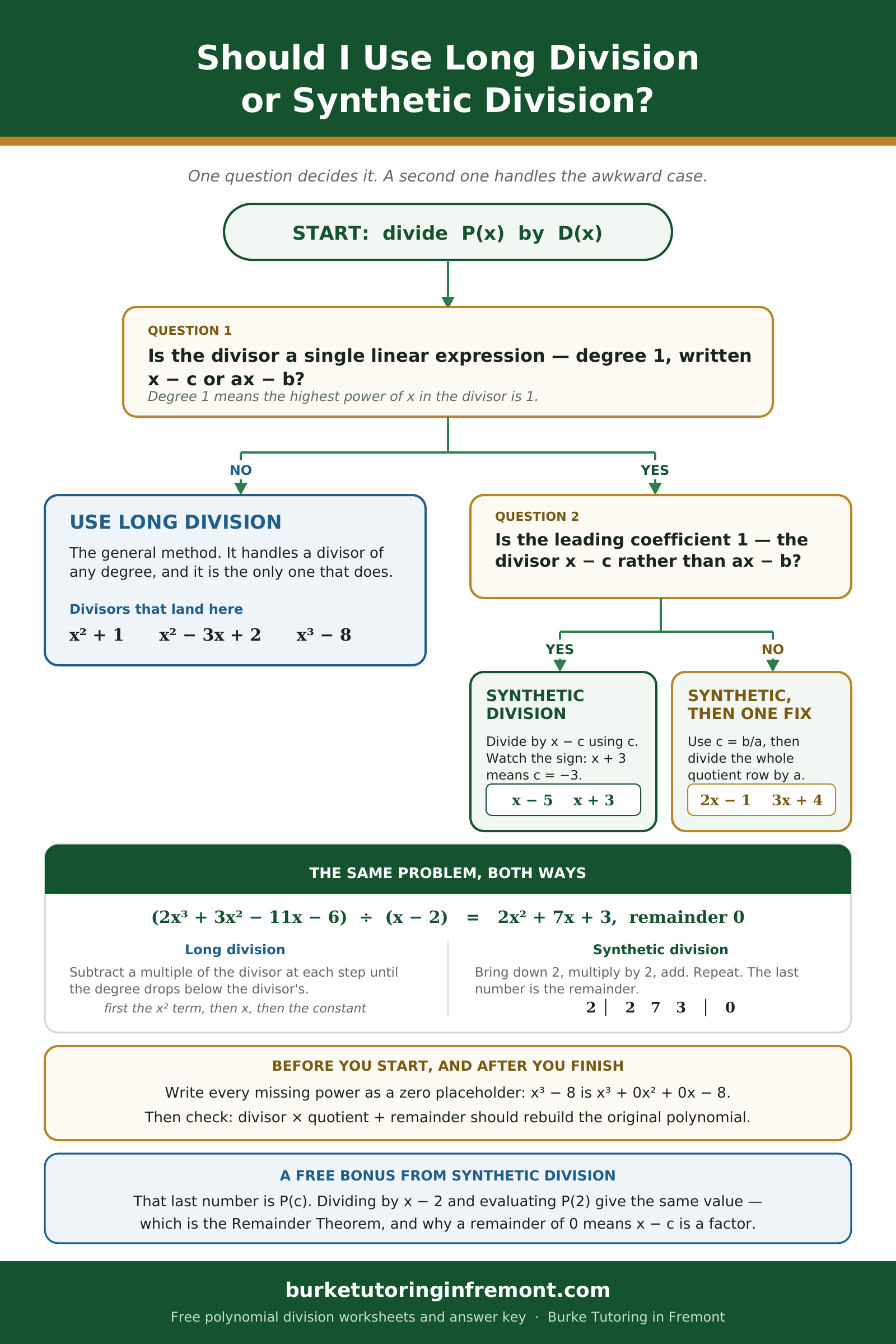
Long division or synthetic division?
If the divisor is linear, synthetic division is available. If it is anything else, long division is the only method that reaches it.
| Divisor looks like | Method | Why |
|---|---|---|
| x − 5, x + 3 | Synthetic | Linear and monic. This is the case synthetic division was built for. |
| 2x − 1, 3x + 4 | Either | Synthetic works with c = b/a, then divide the quotient row by a. Long division skips that extra step. |
| x2 + 1, x2 − 3x + 2 | Long division | Degree 2 or higher. Synthetic division has no way to handle it. |
| x3 − 8 | Long division | Same reason. Choose the method from the divisor: use long division for higher-degree divisors and synthetic division for a linear divisor. |
The Remainder Theorem
Run synthetic division by x − c and the last number you write is P(c). That is the Remainder Theorem, and it is not a coincidence. Division says P(x) = (x − c)Q(x) + R, so substituting x = c wipes out the first term and leaves P(c) = R.
The practical consequence is that you never have to divide just to find a remainder. For P(x) = x4 − 3x2 + 2x − 5 divided by x − 2, evaluate: 16 − 12 + 4 − 5 = 3. The remainder is 3, and no bracket was ever drawn.
It also go the other way. If a problem says the remainder is 12 when x3 + bx + 6 is divided by x − 3, set P(3) = 12, get 3b + 33 = 12, and solve for b = −7. The theorem converts a division question into a one-line equation.
The Factor Theorem and testing candidates
The Factor Theorem is the Remainder Theorem with the remainder set to zero. (x − c) is a factor of P(x) exactly when P(c) = 0, and a value of c that makes P(c) = 0 is a zero of the function, which is also an x-intercept on its graph. These ideas are connected: if P(c)=0, then c is a zero, x−c is a factor, and (c,0) is an x-intercept of the graph..
For P(x) = x3 − 4x2 + x + 6, try x = −1: −1 − 4 − 1 + 6 = 0. So (x + 1) is a factor, and no long division was needed to find that out.
Where do the candidates come from? Not from guessing. Any rational zero of a polynomial with integer coefficients is a factor of the constant term divided by a factor of the leading coefficient. For x3 − 4x2 + x + 6 the constant is 6 and the leading coefficient is 1, so the only candidates worth testing are ±1, ±2, ±3, ±6. The Rational Root Theorem reduces the possible rational zeros to a finite list that can be tested systematically.
Finding the remaining zeros
Once one factor is known, divide it out and the leftover quadratic can be factored or run through the quadratic formula.
Take P(x) = x3 − 4x2 + x + 6 again, with (x + 1) confirmed as a factor. Synthetic division by c = −1:
| −1 | 1 | −4 | 1 | 6 |
| −1 | 5 | −6 | ||
| 1 | −5 | 6 | 0 |
Bottom row: quotient x2 − 5x + 6 with a remainder of 0, which confirms the factor.
That quadratic factors into (x − 2)(x − 3), so P(x) = (x + 1)(x − 2)(x − 3) and the zeros are −1, 2, and 3.After dividing out the known factor, factor the remaining quadratic to obtain the other two zeros.
The degree tells you when to stop. A degree-n polynomial has exactly n zeros counting repeats and complex ones. If a cubic has produced two zeros, one is still missing. If the leftover quadratic has a negative discriminant, the last two zeros are complex or imaginary. The discriminant worksheet covers how to read that quickly.
Standards covered
| Worksheet | Standard | What the standard asks for |
|---|---|---|
| Long division | A-APR.D.6 | Rewrite a rational expression as a quotient plus a remainder over the divisor, using inspection or long division |
| Synthetic division | A-APR.D.6 | The same rewriting, using a computer algebra system or the more efficient hand method for linear divisors |
| Mixed methods | A-APR.D.6, A-APR.B.2 | Choose an efficient method, and connect division to evaluation |
| Remainder and Factor Theorems | A-APR.B.2, A-APR.B.3 | Know and apply the Remainder Theorem; identify zeros when factorizations are available and use them to construct a rough graph |
Full wording for each standard is on the Common Core algebra standards page. For a formal statement of the division algorithm behind all of this, Wolfram MathWorld is a compact reference, and GeoGebra is a quick way to have students confirm that the zeros they found really are where the curve crosses.
Practice problems
Twenty problems drawn from across the four printables. The full set of fifty-two, with worked solutions, is in the downloads below.
Part A · Long division
- (x2 + 9x + 20) ÷ (x + 4)
- (2x3 + 5x2 − 4x − 3) ÷ (x + 3)
- (x3 − 27) ÷ (x − 3). Write the placeholders first.
- (4x3 − 2x2 − 5) ÷ (2x + 1)
- (x4 + 3x3 − 2x + 6) ÷ (x2 + 2)
Part B · Synthetic division
- (x3 − 6x2 + 11x − 6) ÷ (x − 1)
- (2x3 + 7x2 − 5) ÷ (x + 4)
- (x4 − 16) ÷ (x + 2)
- (3x3 − 2x2 + x − 4) ÷ (x − 2)
- (2x3 − 3x2 − 11x + 6) ÷ (2x − 1)
Part C · Choosing a method
- Which method would you use for (x3 + 2x2 − 5x + 1) ÷ (x2 − 3), and why?
- (x3 + 4x2 − 7x − 10) ÷ (x + 5)
- (6x3 + 5x2 − 18x + 8) ÷ (3x − 2)
- A student divides x4 − 5x + 2 by x − 1 and writes the top row as 1, −5, 2. What went wrong, and what is the correct answer?
- (x3 − 2x2 + 3x − 4) ÷ (x2 + 1)
Part D · Remainder and Factor Theorems
- Use the Remainder Theorem to find P(3) for P(x) = x3 − 4x2 + 5x − 2.
- Is (x − 2) a factor of x3 + 2x2 − 11x + 6?
- Find k so that (x + 2) is a factor of x3 + kx2 − 4x + 12.
- Given that x = 1 is a zero of P(x) = x3 − 7x + 6, find the remaining zeros.
- Factor P(x) = 2x3 − 5x2 − 4x + 3 completely, given that (x − 3) is a factor.
Answer key
Part A · Long division
- x + 5
- 2x2 − x − 1
- x2 + 3x + 9
- 2x2 − 2x + 1, remainder −6
- x2 + 3x − 2, remainder −8x + 10
Part B · Synthetic division
- x2 − 5x + 6
- 2x2 − x + 4, remainder −21
- x3 − 2x2 + 4x − 8
- 3x2 + 4x + 9, remainder 14
- Quotient row 2, −2, −12; halved, x2 − x − 6
Part C · Choosing a method
- Long division. The divisor has degree 2, so synthetic division does not apply, no matter what the dividend looks like.
- x2 − x − 2, remainder 0. Since it divides evenly, x3 + 4x2 − 7x − 10 = (x + 5)(x − 2)(x + 1).
- Synthetic with c = 2/3 gives the row 6, 9, −12; divide by 3 for 2x2 + 3x − 4.
- The x3 and x2 terms are missing, so the top row should be 1, 0, 0, −5, 2. The correct answer is x3 + x2 + x − 4 with a remainder of −2.
- x − 2, remainder 2x − 2
Part D · Remainder and Factor Theorems
- P(3) = 27 − 36 + 15 − 2 = 4
- P(2) = 8 + 8 − 22 + 6 = 0, so yes.
- P(−2) = −8 + 4k + 8 + 12 = 4k + 12. Setting that to 0 gives k = −3.
- Dividing by x − 1 leaves x2 + x − 6 = (x + 3)(x − 2), so the remaining zeros are −3 and 2.
- The quotient is 2x2 + x − 1 = (2x − 1)(x + 1), so P(x) = (x − 3)(2x − 1)(x + 1) and the zeros are 3, 1/2, and −1.
Download the printables
Twenty-five pages in total: four student worksheets, a one-page decision guide for the binder, and an eight-page solution set that restates every prompt and shows the working, so it can be graded without the worksheets in hand. Free to print and copy for classroom use.
Choose which files to download
Classroom licence. Print, photocopy, and hand these out to your own students as much as you like, including in a paid classroom setting. Please do not rehost the PDF files on another site or sell them. If you share them with colleagues or link them from a class page, a link back to this page is all we ask.
Questions teachers ask
When can students use synthetic division instead of long division?
Whenever the divisor is linear. That is the whole condition, and it depends on the divisor alone, never on the polynomial being divided. A divisor of x − 5 is the straightforward case. A divisor of 2x − 1 still works if you use c = 1/2 and then divide the quotient row by 2. A divisor of x2 + 1 rules synthetic division out completely.
Why do students keep getting the sign of c wrong?
Because the divisor is written as x + 4 and the number they need is −4. Have them write the divisor as x − c every single time before starting, so x + 4 becomes x − (−4).
Do I have to teach the Remainder Theorem separately from division?
Teaching them together is faster. Once students have run a few synthetic divisions, point at the last number in the bottom row and show that it equals P(c). The theorem then feels like something they already discovered rather than a new rule to memorize, and the Factor Theorem is just the case where that number happens to be zero.
What grade level is this worksheet set for?
Algebra I for the long division and placeholder work, and Algebra II or precalculus for synthetic division, the theorems, and finding remaining zeros. That usually lands between grades 9 and 11. No calculator is required for any question.
Can I use these in my classroom?
Yes. Print, photocopy, and distribute them to your own students freely. Please do not repost the PDF files on another site or resell them. A link back to this page is appreciated if you share them with colleagues.
What comes after polynomial division?
Graphing from the factored form, then rational expressions and rational functions, where the quotient plus remainder form turns into slant asymptotes. The polynomial graph card sort is a good bridge between the zeros students just found and the curves those zeros produce.
More polynomial practice
Need help with polynomial division in Fremont, Newark, or Union City?
Burke Tutoring runs in-home, one-to-one sessions for Algebra I and II. We can help with in-person classes so feel free to call us.
(510) 453-0350
In-home tutoring in
Fremont, Newark, and Union City.

Berke Sahbazoglu
Owner and lead math tutor, Burke Tutoring in Fremont. BA Biochemistry (Washington University
in St. Louis), MS Bioinformatics (UMGC). 10+ years tutoring Algebra I & II, 6,000+ tutoring hours with
more than 200 students. Full bio →
Questions were prepared from previous class notes and assigned homework, and every answer was checked for accuracy before publishing. Published . Last updated .