Free Algebra Guide
Solving Quadratics With The Quadratic Formula
A step-by-step guide to solving quadratics with the quadratic formula, with a fully worked example
Published · Last updated

Written by Berke Sahbazoglu
10+ years teaching Algebra I & II · 6,000+ tutoring hours with 200+ students · B.S. Biochemistry, Washington University in St. Louis · M.S. Bioinformatics, UMGC
Every problem below was solved and checked by hand before publishing. Free to print for classroom & home use.
Want the printable version?
Full guide with the handwritten worked example. No sign-up, no email required.
Solving quadratics with the quadratic formula works on every quadratic equation, including the ones that don't factor nicely. That's usually the moment you reach for it.
For any quadratic in the form ax² + bx + c = 0
x = ( −b ± √(b² − 4ac) ) ⁄ 2a
When to Reach for the Quadratic Formula
Try factoring first; it's usually faster when it works. The formula is the fallback for everything else: when you can't find two numbers that multiply and add to the right values, or when the roots involve a square root that isn't a whole number. It always works, whether or not the quadratic factors nicely.
Where the Formula Comes From
The formula isn't arbitrary — it's what you get if you complete the square on ax² + bx + c = 0 in the general case, once and for all, so you never have to do it again. Students who have worked through completing the square tend to make far fewer sign errors here, because they recognise where the −b and the 2a came from.
The Four Steps
Start by identifying a, b, and c. Make sure the equation is set equal to zero first, then read the coefficients off in order.
Compute the discriminant, b² − 4ac. This one number tells you what kind of roots to expect before you've finished. Positive gives two real roots, exactly zero gives one repeated root, and negative means there are no real roots at all. There's a separate worksheet on the discriminant if that part is the sticking point.
Plug in and simplify the square root. If the number under the root has a perfect-square factor, pull it out. Always simplify before rounding to a decimal.
Split the ± into two roots, then check. Write both answers separately and plug each back into the original equation. If it doesn't come out to zero, something went wrong upstream.
Worked Example: 2x² + 4x − 3 = 0
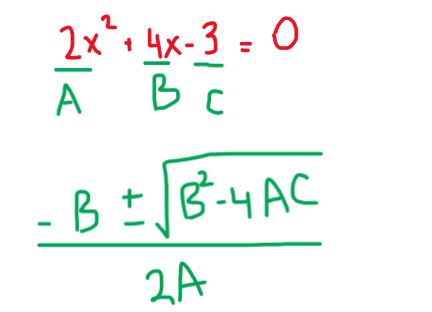
2x² + 4x − 3 = 0
Here's the same problem worked by hand, the way I actually do it with students.
Step 1 — Label a, b, and c
Step 2 — Substitute, and watch the sign
The most common slip in this whole process happens right here: −4 · 2 · (−3) involves two negatives, so the product comes out positive. It's worth pausing on that step specifically.
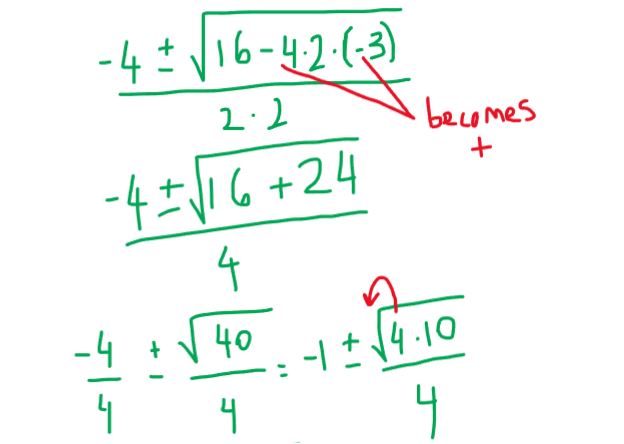
40 is positive, so this equation has two real roots. It isn't a perfect square, so the answer keeps a square root in it rather than reducing to whole numbers.
Step 3 — Simplify the radical, then split into two roots
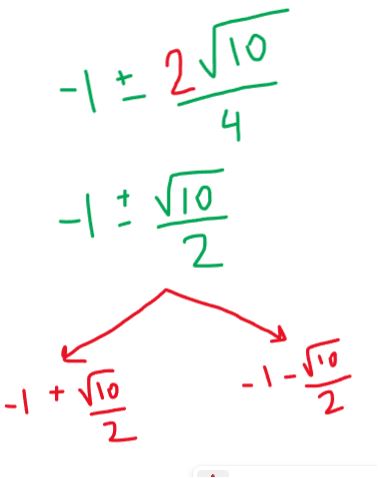
x = −1 + √10⁄2, the same as (−2 + √10)/2, which is about 0.581
x = −1 − √10⁄2, the same as (−2 − √10)/2, which is about −2.581
Step 4 — Check the work
Plugging x ≈ 0.581 back into 2x² + 4x − 3 gives roughly 0.675 + 2.324 − 3, which comes out to zero within rounding. Both roots hold up.
Mistakes I See Most Often
The ± sign is easy to forget, and dropping it silently loses one of the two roots. Sign errors on −b are common too: if b is −4, then −b is +4, not −4. Another frequent slip is dividing only part of the numerator by 2a instead of every term above the line. And it's worth double-checking that the square root is fully simplified before calling the problem done — an unsimplified radical usually means a step got skipped.
20 Practice Problems
Use the formula on each one. Show the discriminant, then give both roots — or state that there are none. Some of these have no real roots, so check the discriminant before you start substituting.
- 1. x² + 5x + 6 = 0
- 2. x² − 3x − 10 = 0
- 3. x² + 2x − 1 = 0
- 4. x² − 6x + 9 = 0
- 5. 2x² + 7x + 3 = 0
- 6. x² + 4x + 1 = 0
- 7. x² − 2x + 5 = 0
- 8. 3x² − 5x − 2 = 0
- 9. x² − 7 = 0
- 10. 2x² − 4x − 3 = 0
- 11. x² + 6x + 4 = 0
- 12. 4x² + 4x + 1 = 0
- 13. x² − 7x + 12 = 0
- 14. 2x² + 3x + 4 = 0
- 15. x² + x − 3 = 0
- 16. 5x² − 6x + 1 = 0
- 17. x² − 8x + 11 = 0
- 18. 3x² + 2x − 1 = 0
- 19. x² − 12 = 0
- 20. 2x² − 6x + 1 = 0
Answer Key with Full Steps
Each one shows the coefficients, the discriminant, and the simplification step, so you can find exactly where your work diverged rather than just checking the final number.
Tutor's note
If a student is getting the discriminant wrong, it's almost always the double-negative step above rather than the formula itself. Have them write out −4 · a · c as its own line before combining anything, so the sign change is visible instead of happening in their head.
Common Questions
Can I use the quadratic formula on every quadratic?
Yes. As long as the equation is in the form ax² + bx + c = 0 and a isn't zero, the formula gives the roots. Factoring is faster when it works, but it doesn't always work.
What does it mean if the discriminant is negative?
There are no real roots — the parabola never touches the x-axis. In Algebra II you'd write the answers using i; in Algebra I you'd stop and say "no real solutions."
Do I have to move everything to one side first?
Yes, and it's the step people skip. x² + 3x = 10 has c = −10, not 10. Get it equal to zero before reading off a, b, and c.
Should the answer be a decimal or a radical?
Exact form (the radical) unless the question asks you to round. A decimal is an approximation, and most teachers mark it down if the exact form was available.
Related Quadratics Worksheets
- Solving quadratics by factoring — try this first when the numbers are friendly.
- The discriminant and the number of roots — practice on step 2 alone.
- Completing the square — where this formula comes from.
- Graphing quadratic functions — the roots are the x-intercepts.
- Vertex and axis of symmetry — the roots sit either side of the axis.
- Finding a parabola's equation from its graph — the same relationships, run backwards.
Guide + handwritten worked example · Free to print for classroom and home use
Still stuck on quadratics?
I tutor Algebra I and II in students' homes across Fremont, Newark, and Union City. Most students who struggle here need about two sessions on sign handling, not a whole unit re-taught.