Discriminant and Number of Roots: How b² − 4ac Tells You How Many Solutions a Quadratic Has
Find the number of real roots before you ever finish solving
Published · Last updated · Aligned to CCSS.MATH.CONTENT.HSA.REI.B.4.b · Free to print for classroom & home use
Want the printable version?
Full worksheet with worked examples, 24 practice problems, and a complete answer key. No sign-up, no email required.
Every quadratic in the form ax² + bx + c = 0 hides one number that answers the question “how many real roots does this have?” That number is the discriminant, and you only need the part of the quadratic formula that lives under the square root.
D = b² − 4ac
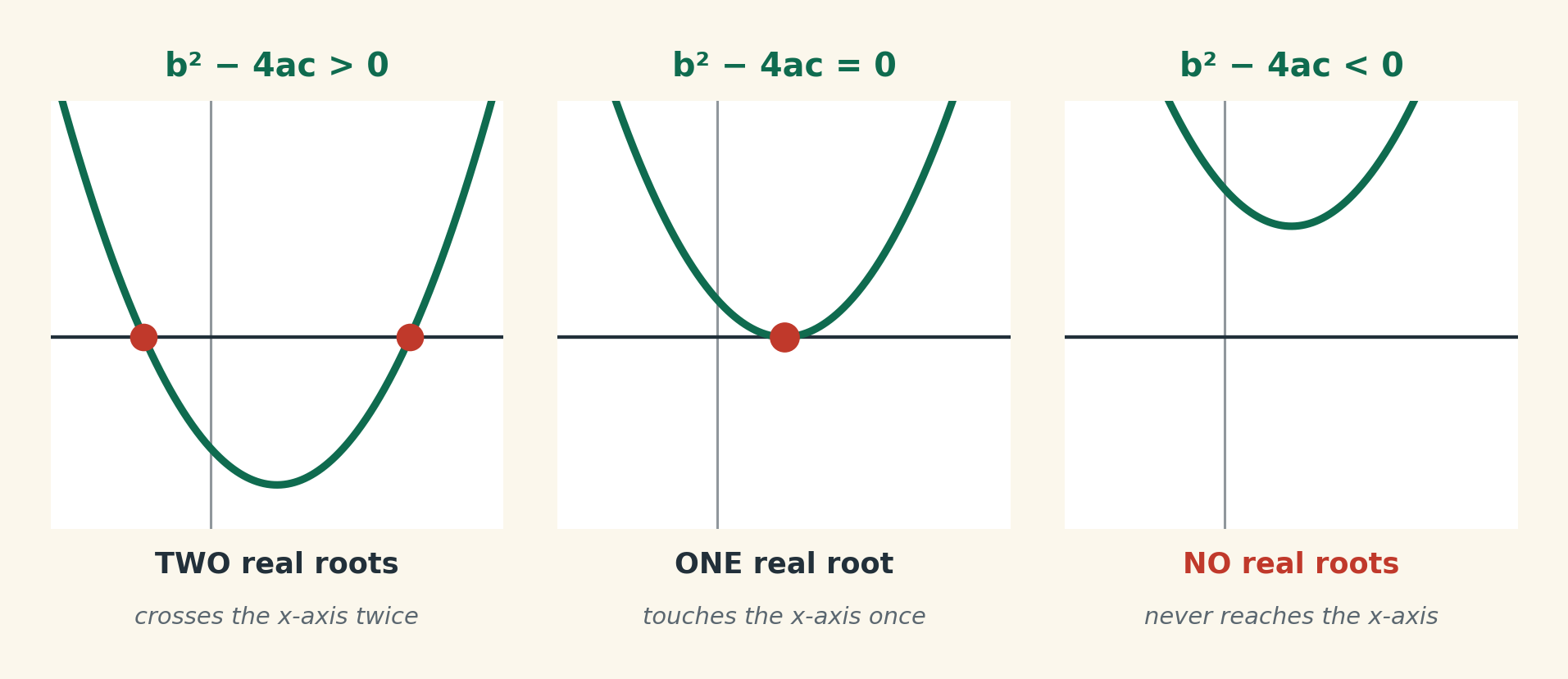
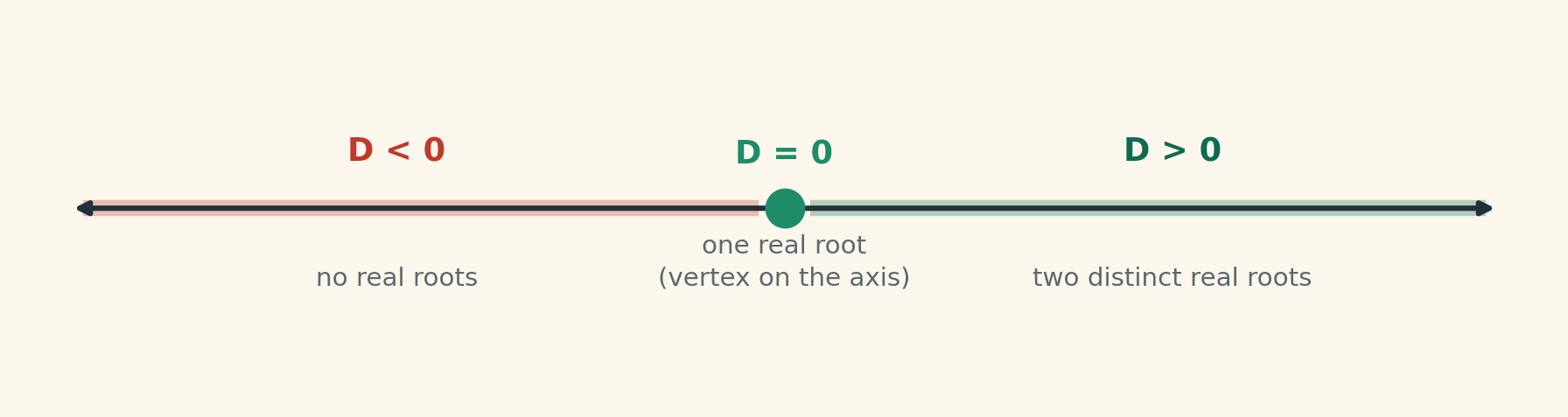
D > 0 → two real roots D = 0 → one real root D < 0 → no real roots
How the Discriminant Number of Roots Rule Works
The quadratic formula is x = ( −b ± √(b² − 4ac) ) ⁄ 2a. Everything that decides the number of roots happens under that square root.
- If b² − 4ac is positive, the square root is a real number, and the ± pushes it out to two different answers.
- If b² − 4ac is exactly zero, the square root is 0. Adding and subtracting 0 changes nothing, so the ± collapses to a single value: x = −b ⁄ 2a. You will also hear this called a double root or repeated root.
- If b² − 4ac is negative, you would be taking the square root of a negative number, which no real number does. There are no real roots.
The Steps
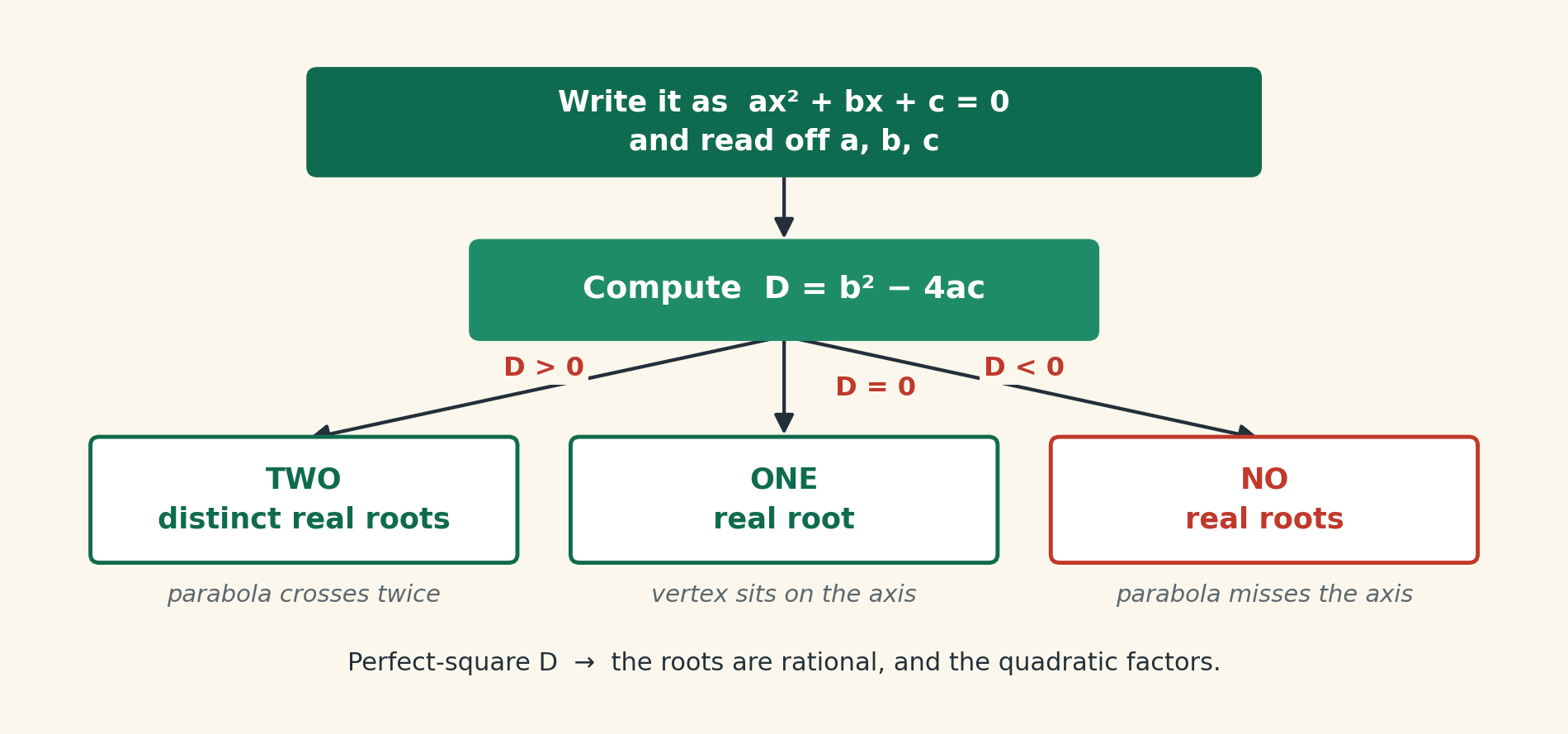
- Set the equation equal to zero. Nothing below is valid until every term is on one side. Move things across first, then read the coefficients.
- Read off a, b, and c — with their signs. A missing term means that coefficient is zero: in x² − 9 = 0, b = 0. A minus sign in front of a term belongs to the coefficient.
- Compute −4ac as its own line, before you combine anything. This is where nearly every discriminant error happens. Writing it separately makes the sign change visible instead of leaving it to happen in your head.
- Add b² and compare to zero. Positive, zero, or negative — that answers the question. If you also need the roots themselves, only now do you go on to the full quadratic formula.
Worked Examples: Positive, Zero, and Negative Discriminants
Example 1 — a positive discriminant
2x² + 4x − 3 = 0
a = 2, b = 4, c = −3. −4ac = −4 · 2 · (−3) = +24. Two negatives multiplied give a positive — that is the step to slow down on. D = b² − 4ac = 16 + 24 = 40.
40 > 0, so there are two distinct real roots. 40 is not a perfect square, so those roots will be irrational and will keep a radical in them.
Example 2 — a zero discriminant
9x² − 12x + 4 = 0
a = 9, b = −12, c = 4. −4ac = −4 · 9 · 4 = −144. D = (−12)² − 144 = 144 − 144 = 0.
D = 0, so there is exactly one real root. x = −b ⁄ 2a = 12 ⁄ 18 = 2/3. Geometrically, the vertex is sitting exactly on the x-axis.
Example 3 — a negative discriminant
x² + 2x + 5 = 0
a = 1, b = 2, c = 5. −4ac = −4 · 1 · 5 = −20. D = 4 − 20 = −16.
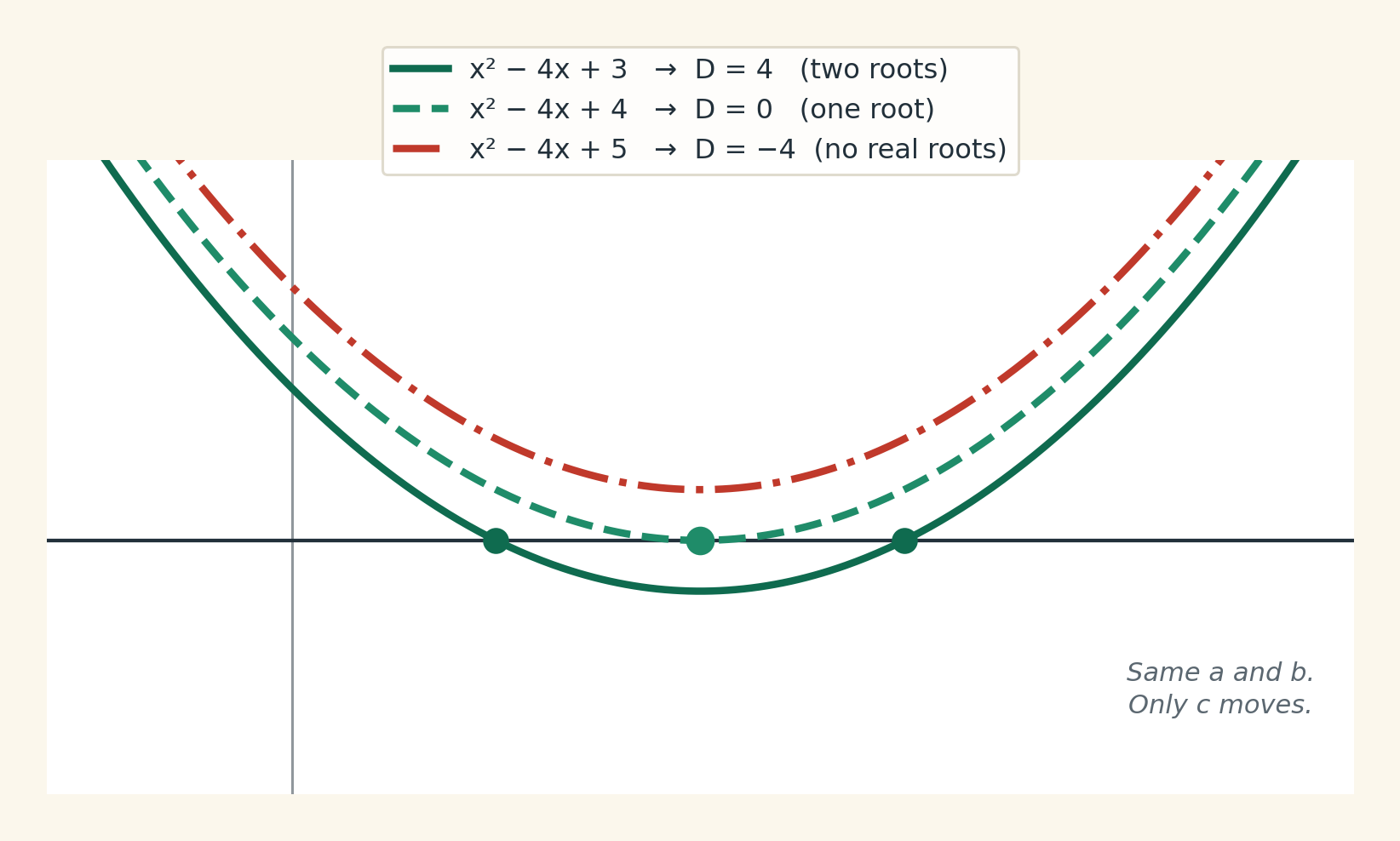
D < 0, so there are no real roots. Stop here — do not write √(−16) and keep going. The parabola opens upward with its vertex above the axis, so it never crosses.
Discriminant Mistakes That Change the Number of Roots
Forgetting to set the equation to zero first. If you read coefficients off x² + 3x = 10, you will get c = 0 instead of c = −10, and the discriminant will be wrong from the start.
Dropping the minus sign on −4ac when c is negative. When c is negative, −4ac is positive and the discriminant gets larger, not smaller. Write that product on its own line.
Squaring b incorrectly when b is negative. (−6)² is +36, not −36. The parentheses matter.
Reading “no real roots” as “no solutions.” A negative discriminant means the parabola never crosses the x-axis. There are still two complex solutions — see Khan Academy's discriminant review if you want the complex-number version — which you'll meet in Algebra II.
Assuming a positive discriminant means nice answers. Positive only promises two real roots. Whether they're rational depends on whether D is a perfect square.
If D is a perfect square (0, 1, 4, 9, 16, 25, …), the roots are rational and the quadratic factors over the integers. If D is positive but not a perfect square, the roots are irrational and factoring will not work — the full quadratic formula is the only route.
Practice Problems: Discriminant and Number of Roots
For each quadratic, compute the discriminant and state the number of real roots. You do not need to find the roots themselves. Answers are in the answer key below.
- x² + 6x + 5 = 0D = ______ Roots: ______
- x² − 4x + 4 = 0D = ______ Roots: ______
- x² + x + 1 = 0D = ______ Roots: ______
- 2x² − 3x − 5 = 0D = ______ Roots: ______
- 3x² + 6x + 3 = 0D = ______ Roots: ______
- x² − 2x + 7 = 0D = ______ Roots: ______
- 5x² + 2x − 1 = 0D = ______ Roots: ______
- x² − 10x + 25 = 0D = ______ Roots: ______
- 4x² − 3x + 2 = 0D = ______ Roots: ______
- x² − 9 = 0D = ______ Roots: ______
- 2x² + 5x + 4 = 0D = ______ Roots: ______
- x² + 8x + 16 = 0D = ______ Roots: ______
- 3x² − 7x + 1 = 0D = ______ Roots: ______
- x² + 4 = 0D = ______ Roots: ______
- 6x² − x − 2 = 0D = ______ Roots: ______
- 4x² + 12x + 9 = 0D = ______ Roots: ______
- x² + 3x − 1 = 0D = ______ Roots: ______
- 2x² − x + 3 = 0D = ______ Roots: ______
- 9x² − 6x + 1 = 0D = ______ Roots: ______
- x² − 5x + 7 = 0D = ______ Roots: ______
Going Further
These run the logic backwards: you're given the number of roots and asked for the coefficient.
21. For what values of k does x² + kx + 9 = 0 have exactly one real root? k = ______
22. For what values of k does 2x² + 8x + k = 0 have two distinct real roots? k ______
23. For what values of k does x² − 6x + k = 0 have no real roots? k ______
24. For what value of k does kx² + 4x + 1 = 0 have exactly one real root? (Assume k ≠ 0.) k = ______
Discriminant Number of Roots: Answer Key
1. x² + 6x + 5 = 0
a = 1, b = 6, c = 5
D = 6² − 4(1)(5) = 36 − 20 = 16 (perfect square)
Answer: Two distinct real roots (both rational) — x = −1, x = −5
2. x² − 4x + 4 = 0
a = 1, b = −4, c = 4
D = (−4)² − 4(1)(4) = 16 − 16 = 0
Answer: Exactly one real root — x = 2
3. x² + x + 1 = 0
a = 1, b = 1, c = 1
D = 1² − 4(1)(1) = 1 − 4 = −3
Answer: No real roots
4. 2x² − 3x − 5 = 0
a = 2, b = −3, c = −5
D = (−3)² − 4(2)(−5) = 9 + 40 = 49 (perfect square)
Answer: Two distinct real roots (both rational) — x = 5/2, x = −1
5. 3x² + 6x + 3 = 0
a = 3, b = 6, c = 3
D = 6² − 4(3)(3) = 36 − 36 = 0
Answer: Exactly one real root — x = −1
6. x² − 2x + 7 = 0
a = 1, b = −2, c = 7
D = (−2)² − 4(1)(7) = 4 − 28 = −24
Answer: No real roots
7. 5x² + 2x − 1 = 0
a = 5, b = 2, c = −1
D = 2² − 4(5)(−1) = 4 + 20 = 24 (not a perfect square)
Answer: Two distinct real roots (irrational)
8. x² − 10x + 25 = 0
a = 1, b = −10, c = 25
D = (−10)² − 4(1)(25) = 100 − 100 = 0
Answer: Exactly one real root — x = 5
9. 4x² − 3x + 2 = 0
a = 4, b = −3, c = 2
D = (−3)² − 4(4)(2) = 9 − 32 = −23
Answer: No real roots
10. x² − 9 = 0
a = 1, b = 0, c = −9
D = 0² − 4(1)(−9) = 0 + 36 = 36 (perfect square)
Answer: Two distinct real roots (both rational) — x = 3, x = −3
11. 2x² + 5x + 4 = 0
a = 2, b = 5, c = 4
D = 5² − 4(2)(4) = 25 − 32 = −7
Answer: No real roots
12. x² + 8x + 16 = 0
a = 1, b = 8, c = 16
D = 8² − 4(1)(16) = 64 − 64 = 0
Answer: Exactly one real root — x = −4
13. 3x² − 7x + 1 = 0
a = 3, b = −7, c = 1
D = (−7)² − 4(3)(1) = 49 − 12 = 37 (not a perfect square)
Answer: Two distinct real roots (irrational)
14. x² + 4 = 0
a = 1, b = 0, c = 4
D = 0² − 4(1)(4) = 0 − 16 = −16
Answer: No real roots
15. 6x² − x − 2 = 0
a = 6, b = −1, c = −2
D = (−1)² − 4(6)(−2) = 1 + 48 = 49 (perfect square)
Answer: Two distinct real roots (both rational) — x = 2/3, x = −1/2
16. 4x² + 12x + 9 = 0
a = 4, b = 12, c = 9
D = 12² − 4(4)(9) = 144 − 144 = 0
Answer: Exactly one real root — x = −3/2
17. x² + 3x − 1 = 0
a = 1, b = 3, c = −1
D = 3² − 4(1)(−1) = 9 + 4 = 13 (not a perfect square)
Answer: Two distinct real roots (irrational)
18. 2x² − x + 3 = 0
a = 2, b = −1, c = 3
D = (−1)² − 4(2)(3) = 1 − 24 = −23
Answer: No real roots
19. 9x² − 6x + 1 = 0
a = 9, b = −6, c = 1
D = (−6)² − 4(9)(1) = 36 − 36 = 0
Answer: Exactly one real root — x = 1/3
20. x² − 5x + 7 = 0
a = 1, b = −5, c = 7
D = (−5)² − 4(1)(7) = 25 − 28 = −3
Answer: No real roots
Going Further — Answers
21. x² + kx + 9 = 0
D = k² − 4(1)(9) = k² − 36. Set k² − 36 = 0.
Answer: k = 6 or k = −6
22. 2x² + 8x + k = 0
D = 64 − 8k. Two distinct real roots requires 64 − 8k > 0, so 8k < 64.
Answer: k < 8
23. x² − 6x + k = 0
D = 36 − 4k. No real roots requires 36 − 4k < 0, so 4k > 36.
Answer: k > 9
24. kx² + 4x + 1 = 0
D = 16 − 4k. Exactly one real root requires 16 − 4k = 0.
Answer: k = 4
When a student gets the discriminant wrong, it's almost never the formula — it's the sign on −4ac when c is negative. Have them write −4 · a · c on its own line every single time, even when it feels unnecessary. The habit costs three seconds and eliminates most of the errors on this page.
Discriminant FAQ
What does the discriminant tell you?
The discriminant, b² − 4ac, tells you how many real roots a quadratic equation has before you finish solving it: positive means two real roots, zero means exactly one real root, and negative means no real roots.
What does it mean when the discriminant is zero?
A discriminant of zero means the quadratic has exactly one real root, found with x = −b ⁄ 2a. Graphically, the parabola's vertex sits exactly on the x-axis.
Can a quadratic have no real roots?
Yes. When the discriminant b² − 4ac is negative, the quadratic has no real roots because the parabola never crosses the x-axis. It still has two complex roots, covered in Algebra II.
Is a repeated root counted as one root or two?
When the discriminant is zero the quadratic has one distinct real root, but that root has multiplicity two, so it is often called a double root or repeated root. Most Algebra I answer keys ask for the count of distinct real roots, which is one.
↓ Download the printable worksheet
Guide + worked examples + answer key · Free to print for classroom and home use

Berke Sahbazoglu has taught K-12 math and science for more than 10 years — 6,000+ tutoring hours with 200+ students. He holds a BS in Biochemistry from Washington University in St. Louis and an MS in Bioinformatics from UMGC. Every problem and answer on this page was worked and checked by hand before publishing.
Need help with Algebra I or II? He tutors in Fremont, Newark, and Union City.
© 2026 Burke Tutoring In Fremont · Fremont, Newark & Union City, CA