Polynomial Multiple Representations Worksheet (Free PDF + Answer Key)
Students complete the missing parts of a polynomial organizer: equations, tables, graphs, zeros, multiplicity, end behavior, and a plain-language description. There is no answer bank, so one clue has to lead to the next.
Browse our collection of free polynomial worksheets and answer keys for operations, factoring, division, graphing, and zeros.
Download the complete activity
The student file has eight incomplete organizers. The teacher key completes every box, explains why each answer is the only one that fits, and includes setup, scoring, differentiation, and accuracy notes.
Multiple-representations activity
Reference graphic, then eight organizers with a different set of clues on each page.
- 10 pages, US Letter
- Guided, standard, and challenge levels
- One independent check on every function
Instructions and answer key
Completed forms, tables, graphs, zeros, multiplicities, tails, and descriptions — plus a uniqueness note on every page.
- 10 pages, US Letter
- Pacing and nine-point scoring guide
- Each box marked given to student or student completes
Six Ways organizer
A one-page landscape reference for projection, notebooks, or a classroom wall.
- Six connected representations
- Completed sample not used in the activity
- Readable on screen and in print
Complete bundle
The student activity followed by the teacher directions and full answer key.
- 20 pages in copier order
- One file for an LMS or department share
- No signup and no email address
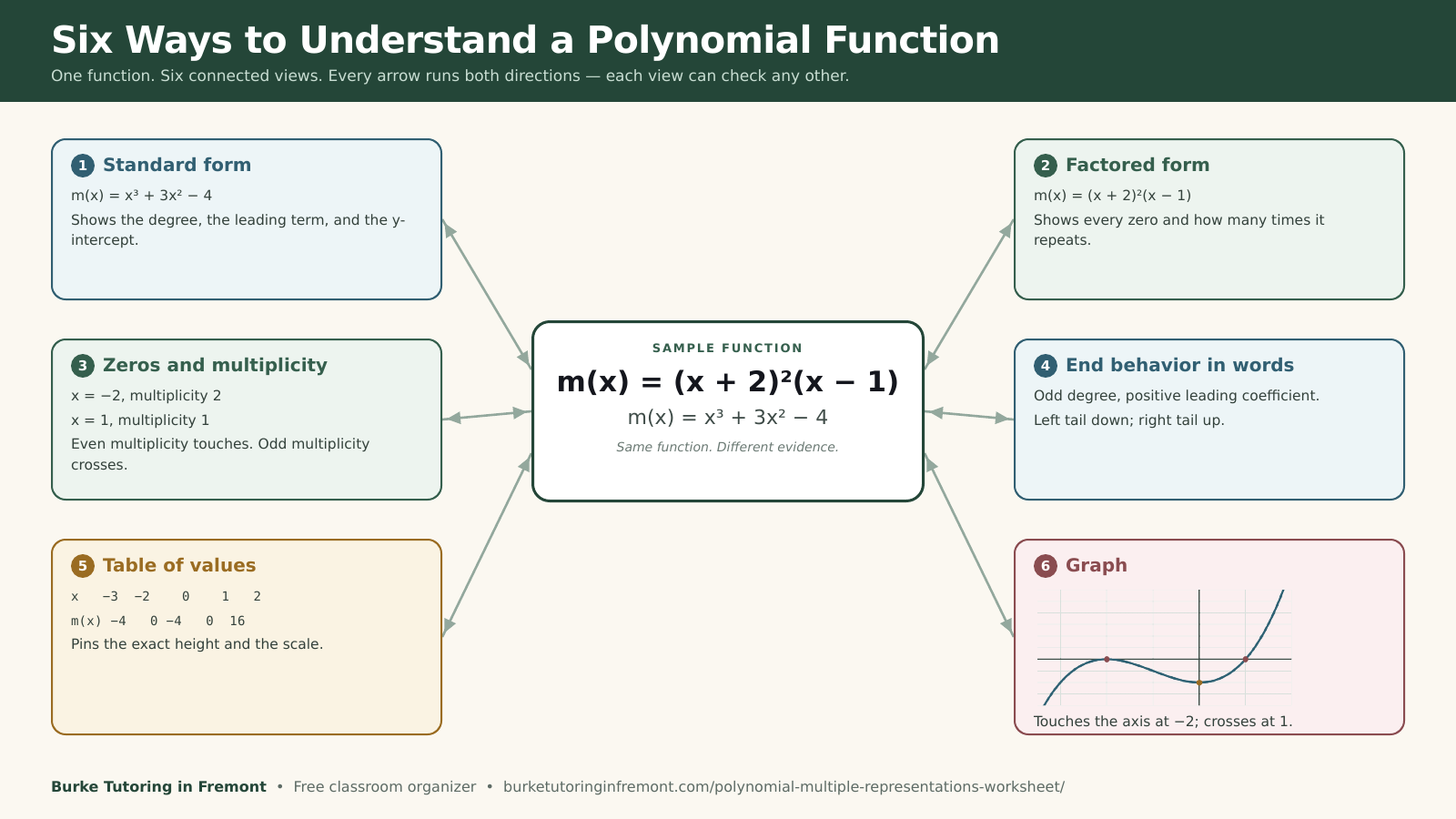
Six Ways to Understand a Polynomial Function
This is the reference page students keep beside the activity. It groups eight details into six useful views: the two equation forms, a table, a graph, zeros with multiplicity, and end behavior explained in words. Every arrow runs both directions, because any one view can be used to check any other.
Not another card sort
The polynomial graph card sort asks students to recognize which finished pieces belong together. This activity starts after that. A box is empty, and the student has to make the missing representation.
Generate, do not guess
No scrambled choices. Students factor, expand, calculate, sketch, and describe.
Clues change each page
One function begins with equations. Another begins with a graph and table. The challenge pages may begin with only structure and one point.
Scale has to be proved
Zeros and tails do not determine the leading coefficient's size. A point or table value supplies the missing evidence.
Writing is part of the math
The verbal box asks what the graph actually does: where it crosses, where it turns, and where the tails go.
Every page includes a check
Students choose an extra x-value and make sure the equation agrees with the graph or table.
Missing boxes reveal gaps
A correct graph with the wrong expanded form points to a different issue than a wrong multiplicity description.
Zeros, multiplicity, and end behavior practice
Three skills carry most of the weight in an Algebra 2 polynomial unit, and every organizer in this activity exercises all three at once rather than isolating them on separate worksheets.
Zeros and factors both directions
Students move from the factor (x + 2) to the zero x = -2, and back from a marked x-intercept to the factor that produced it. Writing the small equation x + 2 = 0 before recording the zero prevents the most common sign error in the unit.
Multiplicity decides the shape
Odd multiplicity crosses the axis. Even multiplicity touches and turns. A triple root still crosses, but it flattens on the way through, which is why students so often mislabel it as a touch. Functions F and G both include one.
End behavior gives the sign, not the size
Degree parity tells you whether the two tails match. The leading sign tells you which way the right tail goes. Neither tells you whether the leading coefficient is 1, 2, or one half — which is why sparse pages always supply a point.
Degree ties it together
When the multiplicities add up to the stated degree, no extra factor can hide inside the function. That is the argument that makes an answer unique rather than merely consistent, and the teacher key spells it out for all eight functions.
Three levels, eight organizers
The number of representations stays the same. What changes is how much students must reconstruct.
Guided: A-B
Quadratic and cubic functions. Students begin with two complete representations and learn the page routine.
- Integer coefficients
- Simple and double roots
- Graph-to-equation practice
Standard: C-E
Cubic and quartic functions. The supplied clues hide more of the algebra.
- Positive and negative leading coefficients
- Up to four distinct zeros
- One-point scale checks
Challenge: F-H
Fourth- and fifth-degree functions with repeated roots. Two of the three carry a fractional leading coefficient.
- Double and triple roots
- Flattened crossings
- Minimal starting information
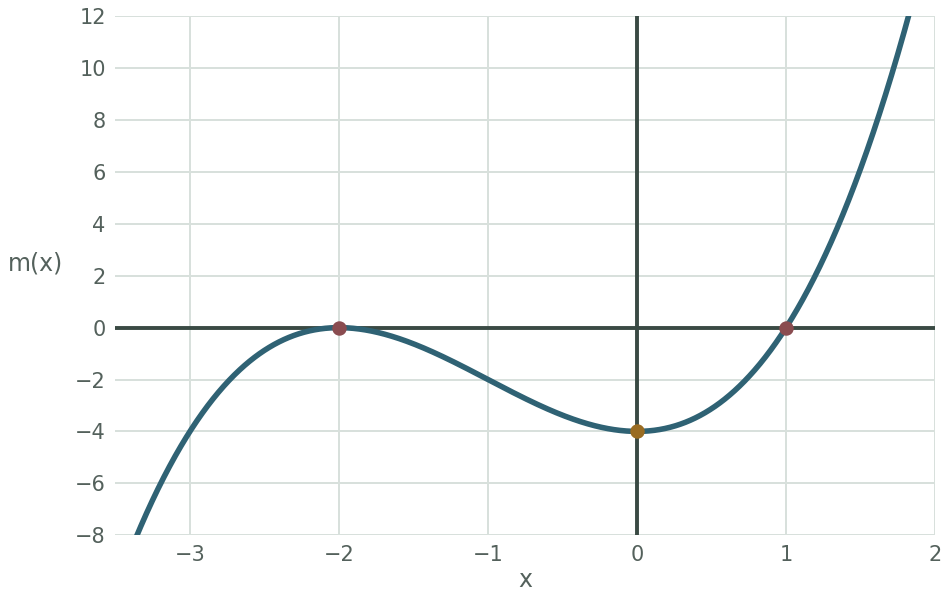
What one completed organizer looks like
This sample function is not in the printable set. The point is to show how the boxes check one another, not to hand out an answer.
How I would use it in class
Do not assign all eight pages automatically. Pick the pages that force the representation your students keep avoiding.
After the graph card sort
Use A and B the same day as the graph card sort. Students move from recognizing complete families to producing missing pieces while the connections are still fresh.
Partner work
One student completes an algebra box while the other completes a graph or description box. They trade, check, and agree on one test point.
Quick assessment
Use C or G without notes. The supplied degree and point make the leading coefficient recoverable, so the task has one exact answer.
Extension question
Ask students which supplied clue could be removed without making the function ambiguous. They have to think about what each representation actually determines.
The mistake I would watch first
Students often build the correct factors but stop at k = 1 because the tail directions look right. Tail behavior tells you whether k is positive or negative. It does not tell you whether k is 1, 2, or 1/2. That is why the sparse organizers include a point such as h(0) = 4.
The routine that catches it
Before a student calls an organizer finished, they pick one or two x-values between the turning points, substitute them into their own equation, and check whether those points land near the curve they drew. If a point sits in the wrong region, they have caught their own mistake without anyone marking it. Every page has a line reserved for exactly this.
Four errors the missing boxes expose
Factor sign becomes zero sign
A factor x + 2 gives x = -2, not x = 2. Writing the small equation first slows this error down.
Triple root called a touch
A triple root flattens, but its multiplicity is odd, so the graph still crosses the axis.
Degree used without leading sign
Degree parity tells whether the tails match. The leading sign tells whether the right tail rises or falls.
Graph drawn at the wrong scale
Intercepts can all be correct while the curve misses the y-intercept and table. One test point catches it.
Answer key preview: guided and first standard page
The teacher PDF includes the completed organizer, the graph, and a short uniqueness note for every function. Here are the first three rows in compact form.
| Function | Standard | Factored | Zeros / multiplicity | End behavior |
|---|---|---|---|---|
| A | x² + x - 2 | (x + 2)(x - 1) | -2 and 1; both m = 1 | left up; right up |
| B | -x³ + 3x + 2 | -(x + 1)²(x - 2) | -1 has m = 2; 2 has m = 1 | left up; right down |
| C | 2x³ - 6x + 4 | 2 · (x + 2)(x - 1)² | -2 has m = 1; 1 has m = 2 | left down; right up |
Fractional leading coefficients are written as (1/2) · (x + 2)²(x - 1)³ rather than 1/2(x + 2)²(x - 1)³, so the coefficient can never be misread as a denominator.
Before you print
Students need first
Factoring, expanding, reading x-intercepts, and the basic odd/even multiplicity rule. For a quick structure review, use the factoring polynomials flowchart guide.
Choose a starting level
If you are not sure where the gaps are, begin with the polynomial skills diagnostic test. A and B are not automatically the best pages for every class.
Standards and skill map
| Skill | What students do | Connection |
|---|---|---|
| Zeros and factors | Move between x = r and the factor (x - r). | HSA-APR.B.3; HSA-SSE.A.2 |
| Multiplicity | Use repeated factors to explain crossing, touching, and flattening. | HSA-APR.B.3 |
| Polynomial graphs | Use zeros, test points, degree, and leading sign to sketch. | HSF-IF.C.7c |
| Multiple representations | Check equations, tables, graphs, and words against one another. | MP2; MP3 |
Free references for a quick review
These are useful background lessons for students who need a review before completing the organizers. They are separate from the printable activity.
Illustrative Mathematics: Multiplicity
An openly licensed Algebra 2 lesson that builds multiplicity from repeated factors and then uses it, with end behavior, to sketch graphs from factored form.
Open the Illustrative Mathematics lessonMathBitsNotebook: Zeros and Multiplicity
A compact Algebra 2 reference on reading zeros, multiplicity, and the resulting crossing or touching behavior directly from a polynomial graph.
Review zeros and multiplicity at MathBitsNotebookReuse the organizer and embed the graphic
Print it, project it, or place it in a lesson page. For a public website, link the image back here so teachers can find the complete activity, current answer key, and any corrections.
Citing this activity
Related polynomial practice
Common questions
How is this different from a polynomial card sort?
A card sort supplies all of the answers and asks students to match them. This worksheet deliberately leaves boxes empty. Students have to create the missing equation, table, graph, or explanation.
Are the sparse clue sets uniquely solvable?
Yes. Whenever zeros, multiplicities, and end behavior are supplied without an equation, the page also supplies the degree and one point. The degree rules out any hidden factor, and the point fixes the leading coefficient. The teacher key states that argument on every page.
Which pages should a standard Algebra 2 class use?
C through E work well as a one-period review. A and B offer more support. F through H are better for honors, precalculus review, or an extension.
Do students need graphing technology?
No. The coordinate windows and table values are chosen so every printed point fits on the grid by hand. A calculator can be used to check arithmetic, but it is not required.
How do I tell which boxes were given to students?
Every box on the teacher key is labelled either given to student or student completes, matching the student page exactly, so you can see at a glance what was scaffolded and what was assessed.
May I share the PDFs with my department or post them in an LMS?
Yes. Print and share them with students and colleagues. For a public resource page, link to this page instead of reposting the files so the answer key stays attached to any future corrections.
Page updates
August 6, 2026: Revision. Added the degree as a stated clue on functions C and G so every sparse page is provably unique; added a “why this is the only answer” note to all eight answer-key pages; relabelled key boxes as given to student or student completes; wrote fractional leading coefficients as (1/2) · (…) to remove the denominator ambiguity; trimmed two table columns that fell outside the printed grid; rebuilt the Six Ways graphic with corrected box order, arrowheads, a legible graph panel, and no clipped text; tightened page layout in both PDFs; and replaced the review links.
August 6, 2026: Published the student activity, teacher guide and answer key, complete bundle, classroom organizer PDF, full-size embeddable graphic, and completed sample graph. Accuracy review included all expanded forms, table values, zeros, multiplicities, end behavior, y-intercepts, and plotted curves.
Need one-on-one Algebra 2 help?
Burke Tutoring provides in-home math tutoring in Fremont, Newark, and Union City, including polynomial functions, factoring, graphing, and test review. Call (510) 453-0350.