AP Physics 1 · Unit 3 · Work, energy, and power
AP Physics 1 Work, Energy, and Power MCQ Practice: 20 Multiple-Choice Questions
Written in the format of the 2015 to 2024 exams, with explanations and a printable PDF
This AP Physics 1 work, energy, and power MCQ practice set has 20 multiple-choice questions on Unit 3: kinetic energy, work, potential energy, conservation of energy, and power. The questions follow the layout of the multiple-choice section on the 2015 to 2024 exams, including two questions that share one graph and two questions with two correct answers. Each question has an answer and explanation you can open after you choose. For the concepts behind them, use the kinetic and potential energy guide and the work, energy, and power guide. Several questions reuse motion from Unit 1, and their explanations also link to the kinematics pages.
Browse all AP Physics 1 Unit 3 worksheets, study guides, and practice tests.

Written by Berke Sahbazoglu · Owner and tutor, Burke Tutoring In Fremont · BA Biochemistry, Washington University in St. Louis · 10+ years tutoring math and science, including AP Physics 1 · Full bio
Published November 3, 2026 · Last updated November 3, 2026 · Free to print and use in class
| Course | AP Physics 1, Unit 3 (work, energy, and power), topics 3.1 to 3.5 |
|---|---|
| Questions | 20 multiple-choice questions: 18 with one correct answer and 2 with two correct answers |
| Format | Four answer choices per question, as on the 2015 to 2024 exams |
| Time | 36 minutes, the pace of the 2015 to 2024 exam |
| Answers | Explanation under each question, plus an answer key for the whole set |
| Printable | PDF in the exam booklet layout, with an answer sheet and answer key |
| Assumptions | g = 9.8 m/s2, air resistance negligible unless a question says otherwise |
Printable PDF
All 20 questions laid out like the exam booklet, with an answer sheet and the answer key with explanations at the back. 24 pages, US Letter.
Download the PDF01 / Before you start
How the AP Physics 1 multiple-choice section works
From 2015 to 2024, Section I of the AP Physics 1 exam had 50 multiple-choice questions in 90 minutes and counted for half of the exam score. Each question had four answer choices. Some questions shared a figure or a data table, and five questions had two correct answers, both of which had to be selected for credit.
This practice set follows that format at a smaller size: 20 questions in 36 minutes, the same pace of 1.8 minutes per question. Questions 13 and 14 share one graph, and Questions 19 and 20 have two correct answers each.
| AP Physics 1 exam, 2015 to 2024 | This practice set | |
|---|---|---|
| Questions | 50 | 20 |
| Time | 90 minutes | 36 minutes |
| Answer choices | 4 per question | 4 per question |
| Questions with two correct answers | 5 | 2 (Questions 19 and 20) |
| Questions that share a figure | Yes, in sets | Questions 13 and 14 |
The redesigned exam that began in May 2025 dropped the two-answer questions, so every question now has one correct answer. Starting with the May 2027 exam, Section I has 42 questions in 85 minutes, as listed on College Board’s AP Physics 1 exam page. The two-answer questions here still work as practice if you treat each choice as its own true-or-false statement.
What the 20 questions cover
The questions cover all five topics in Unit 3 of AP Physics 1, which College Board’s course framework weights at 18 to 23 percent of the exam score. The last column links to the section of this site’s Unit 3 guides that teaches each topic.
| Unit 3 topic | Questions | Review on this site |
|---|---|---|
| 3.1 Translational kinetic energy | 1, 9 | Kinetic energy in the kinetic and potential energy guide |
| 3.2 Work | 2, 3, 4, 5, 19 | Work done by a constant force and the work-energy theorem in the work, energy, and power guide |
| 3.3 Potential energy | 6, 7, 8 | Gravitational and spring potential energy in the kinetic and potential energy guide |
| 3.4 Conservation of energy | 11, 12, 13, 14, 15, 16, 18 | Conservation of energy, with and without friction in the work, energy, and power guide |
| 3.5 Power | 10, 17, 20 | Power in the work, energy, and power guide |
How to use this set. Work all 20 questions in one sitting, with a calculator and the AP Physics 1 equation sheet open. Write down each answer before you open its explanation. Each explanation gives the reasoning for the correct choice, shows why the most tempting wrong choices fail, and links to a related page on this site or to a related question in this set.
To review the forces and motion these energy questions build on, browse the AP Physics 1 dynamics worksheets and the kinematics worksheets and answer keys.
02 / Questions 1 to 10
AP Physics 1 work and energy multiple-choice questions 1 to 10
Questions 1 to 10 cover kinetic energy, work done by constant and changing forces, elastic and gravitational potential energy, and power. Use g = 9.8 m/s2 and treat air resistance as negligible.
Directions: Each question below is followed by four answer choices. Select the best answer in each case.
Question 1 Kinetic energy from a velocity-time graph Topic 3.1
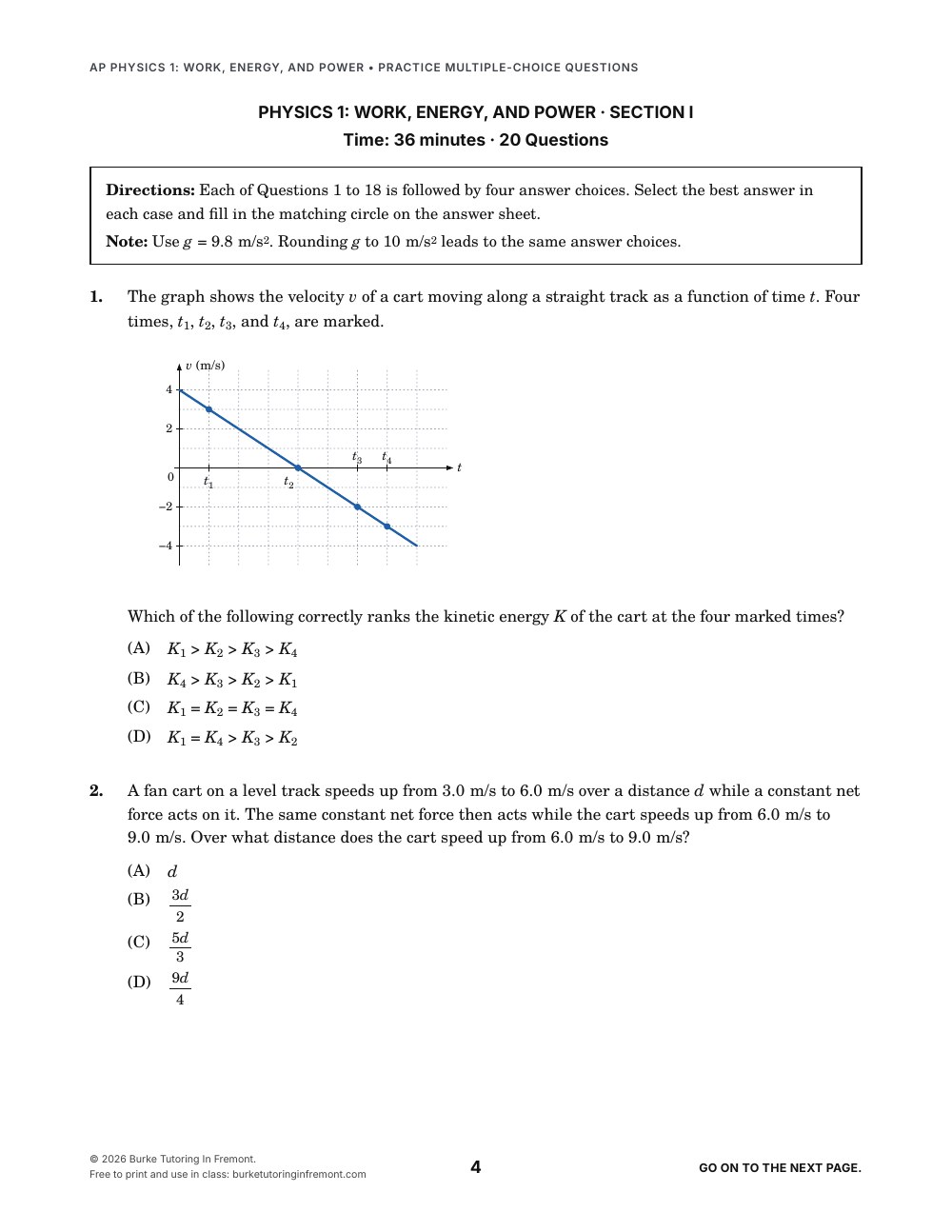
1.The graph shows the velocity v of a cart moving along a straight track as a function of time t. Four times, t1, t2, t3, and t4, are marked.
Which of the following correctly ranks the kinetic energy K of the cart at the four marked times?
- (A)K1 > K2 > K3 > K4
- (B)K4 > K3 > K2 > K1
- (C)K1 = K2 = K3 = K4
- (D)K1 = K4 > K3 > K2
Answer and explanation for Question 1
Answer: (D)
Kinetic energy is ½mv2. Squaring the velocity removes its sign, so the kinetic energy depends only on the speed. From the graph, the speed is 3.0 m/s at t1, 0 at t2, 2.0 m/s at t3, and 3.0 m/s at t4.
The cart moves in the positive direction at t1 and in the negative direction at t4, but its speed is the same at both times, so K1 = K4. The cart is momentarily at rest at t2, so K2 = 0 is the smallest value.
Why not (A)? Choice (A) ranks the signed velocities. A negative velocity gives a positive kinetic energy, the same as a positive velocity of equal size.
Why not (C)? The acceleration is constant, so the velocity changes by the same amount every second. The speed changes too, and so does the kinetic energy.
Why not (B)? Kinetic energy depends on the speed at each instant, and the time already spent moving does not enter. Between t1 and t2 the cart slows to a stop, so its kinetic energy decreases.
Review: Kinetic energy, K = ½mv2 in the kinetic and potential energy guide, which shows why the sign of the velocity drops out.
Question 2 Equal speed gains over different distances Topic 3.2
2.A fan cart on a level track speeds up from 3.0 m/s to 6.0 m/s over a distance d while a constant net force acts on it. The same constant net force then acts while the cart speeds up from 6.0 m/s to 9.0 m/s. Over what distance does the cart speed up from 6.0 m/s to 9.0 m/s?
- (A)d
- (B)3 d over 2
- (C)5 d over 3
- (D)9 d over 4
Answer and explanation for Question 2
Answer: (C)
By the work-energy theorem, the net work done on the cart equals its change in kinetic energy. A constant net force F acting over a distance does work F times that distance. For the first stage, Fd = ½m(6.02 − 3.02) = ½m(27 m2/s2). For the second stage, Fd2 = ½m(9.02 − 6.02) = ½m(45 m2/s2). Dividing gives d2/d = 45/27 = 5/3.
Kinematics gives the same ratio. The same net force gives the same acceleration, so each 3.0 m/s gain takes the same time. The average speed is 4.5 m/s during the first stage and 7.5 m/s during the second, so the second distance is 7.5/4.5 = 5/3 as long.
Why not (A)? Equal speed gains under the same force take equal times. The cart moves faster during the second stage and covers more ground in that time.
Why not (D)? 9/4 is the ratio of the final kinetic energies, (9.0/6.0)2. The work done in each stage equals the change in kinetic energy during that stage.
Why not (B)? 3/2 is the ratio of the final speeds. Work depends on the change in the square of the speed.
Review: The work-energy theorem in the work, energy, and power guide, and the constant-acceleration equations in the kinematics study guide. Multiplying v2 = v02 + 2aΔx by ½m gives ½mv2 − ½mv02 = maΔx, the work-energy theorem for a constant net force.
Question 3 Work done by a rope pulling at an angle Topic 3.2
3.A student pulls a sled 16 m across level snow at constant speed. The rope exerts a force of 45 N on the sled, directed 35° above the horizontal, as shown.
Key
- Force exerted on the sled by the rope, 45 N
- Angle between the rope and the horizontal, 35°
- Horizontal reference line
- Direction the sled moves
Which of the following gives the work done on the sled by the rope and the work done on the sled by friction during the 16 m pull?
| Work done by the rope | Work done by friction | |
|---|---|---|
| (A) | 410 J | −410 J |
| (B) | 590 J | −590 J |
| (C) | 590 J | 0 J |
| (D) | 720 J | −720 J |
Answer and explanation for Question 3
Answer: (B)
Only the component of the rope’s force along the displacement does work: W = Fd cos θ = (45 N)(16 m)(cos 35°) ≈ 590 J.
The sled moves at constant speed, so its kinetic energy does not change and the net work done on it is zero. The gravitational force and the normal force are perpendicular to the displacement and do no work. That leaves friction, which must do about −590 J.
Why not (D)? 720 J uses the full 45 N. The rope’s vertical component, about 26 N, is perpendicular to the displacement and does no work.
Why not (A)? 410 J uses sin 35°, which gives the vertical component of the force, the part that does no work.
Why not (C)? Friction acts opposite the sled’s motion, so it does negative work. At constant speed that negative work cancels the work done by the rope.
Review: A sled pulled by a rope at an angle, worked example 1 in the work, energy, and power guide, which finds the work done by each force on a sled that speeds up.
Question 4 Change in kinetic energy from a force-position graph Topic 3.2
4.A cart moves in the positive x direction along a straight, horizontal track. The graph shows the net force F exerted on the cart as a function of its position x.
What is the change in the kinetic energy of the cart as it moves from x = 0 to x = 6.0 m?
- (A)10 J
- (B)16 J
- (C)18 J
- (D)26 J
Answer and explanation for Question 4
Answer: (A)
The work done by a changing force equals the area between the force-position graph and the x-axis, with area below the axis counted as negative. From 0 to 2.0 m the area is a triangle, ½(2.0 m)(6.0 N) = 6.0 J. From 2.0 m to 4.0 m it is a rectangle, (2.0 m)(6.0 N) = 12 J. From 4.0 m to 6.0 m the force is −4.0 N, so the work is (2.0 m)(−4.0 N) = −8.0 J.
The net work is 6.0 J + 12 J − 8.0 J = 10 J, so by the work-energy theorem the kinetic energy increases by 10 J. The cart gains 18 J by x = 4.0 m, more than the 8.0 J it loses over the last 2.0 m, so it does reach x = 6.0 m.
Key
- Net force on the cart
- 0 to 2.0 m: triangle, +6.0 J
- 2.0 to 4.0 m: rectangle, +12 J
- 4.0 to 6.0 m: below the axis, −8.0 J
Why not (C)? 18 J leaves out the last 2.0 m. The force there points opposite the motion, so it does negative work and the cart slows down.
Why not (D)? 26 J counts the area below the axis as positive work.
Why not (B)? 16 J treats the first 2.0 m as a rectangle. The force grows from zero, so that area is a triangle, half of 12 J.
Review: Work from a force versus position graph in the work, energy, and power guide, where worked example 2 follows a cart pushed by a changing force.
Question 5 Work done on an elevator rider Topic 3.2
5.A person stands on the floor of an elevator that moves upward at constant speed. Which of the following correctly describes the work done on the person by the normal force from the floor and by the gravitational force from Earth while the elevator rises?
- (A)The normal force does no work, because it is perpendicular to the floor.
- (B)Neither force does work, because the person’s kinetic energy does not change.
- (C)The normal force does positive work that is greater in magnitude than the negative work done by the gravitational force.
- (D)The normal force does positive work, and the gravitational force does negative work of the same magnitude.
Answer and explanation for Question 5
Answer: (D)
The sign of the work done by a force depends on the angle between the force and the displacement. The person moves upward. The normal force points upward, along the displacement, so it does positive work. The gravitational force points downward, opposite the displacement, so it does negative work.
The speed is constant, so the person’s kinetic energy does not change and the net work is zero. The two works must have equal magnitudes, which matches the forces: at constant velocity the normal force equals the person’s weight.
Why not (A)? The normal force is perpendicular to the floor, and so is the person’s displacement. The normal force and the displacement point the same way.
Why not (B)? Zero net work means the works add to zero. Each force can still do work.
Why not (C)? Positive net work would increase the person’s kinetic energy. That happens only while the elevator speeds up.
Review: Work done by a constant force in the work, energy, and power guide, and the elevator worked example in the dynamics study guide, which finds the normal force on a rider from Newton’s second law.
Compare: Question 3, where the rope and friction also do equal and opposite amounts of work at constant speed.
Question 6 Energy stored in two springs Topic 3.3
6.The graph shows the magnitude of the force F needed to stretch each of two springs, X and Y, as a function of the stretch x.
Key
- Spring X
- Spring Y
Each spring is stretched by a force of magnitude 12 N. Which of the following correctly compares the elastic potential energies stored in the two springs?
- (A)Spring Y stores twice as much energy, because it stretches twice as far under the same force.
- (B)Spring X stores twice as much energy, because it is stiffer.
- (C)The springs store the same energy, because the forces are equal.
- (D)Spring Y stores four times as much energy, because elastic potential energy is proportional to the square of the stretch.
Answer and explanation for Question 6
Answer: (A)
The energy stored in a spring equals the work done to stretch it, which is the area under its force-stretch graph. At 12 N, spring X is stretched 4.0 cm and spring Y is stretched 8.0 cm. Both areas are triangles with a height of 12 N, so UX = ½(12 N)(0.040 m) = 0.24 J and UY = ½(12 N)(0.080 m) = 0.48 J.
The same result follows from Us = ½kx2. From the slopes, spring Y has half the spring constant of spring X, 150 N/m compared with 300 N/m, and twice the stretch, so it stores ½ × 22 = 2 times as much energy.
Why not (D)? Energy proportional to the square of the stretch compares one spring at two stretches. Here the springs have different spring constants, and spring Y’s smaller spring constant cancels half of the factor of 4.
Why not (B)? The stiffer spring stores more energy when both springs are stretched the same distance. Here both feel the same force, so spring X stretches only half as far.
Why not (C)? The stored energy depends on the force and on the distance it acts over. Spring Y is stretched twice as far by the same force.
Review: Spring potential energy in the kinetic and potential energy guide, which also finds stored energy from the area under a force graph.
Compare: Question 4, which also finds work from the area under a force graph.
Question 7 Gravitational potential energy far from Earth Topic 3.3
7.A space probe of mass m is moved from the surface of Earth to a point a distance 2R from Earth’s center, where R is the radius of Earth. The acceleration due to gravity at Earth’s surface is g. What is the change in the gravitational potential energy of the probe-Earth system?
- (A)one fourthmgR
- (B)one halfmgR
- (C)mgR
- (D)2mgR
Answer and explanation for Question 7
Answer: (B)
Far from Earth’s surface the gravitational force changes with distance, so use the general expression UG = −GmEm/r, where mE is the mass of Earth. The change is ΔUG = −GmEm/(2R) − (−GmEm/R) = GmEm/(2R).
At the surface, g = GmE/R2, so GmE = gR2. Substituting gives ΔUG = ½mgR. The change is positive because the probe moves away from Earth.
Why not (C)? mgR applies mgΔy over the whole distance R. That expression assumes the gravitational force stays equal to mg, but at 2R from Earth’s center the force has dropped to ¼mg.
Why not (A)? ¼mgR uses the gravitational force at 2R for the whole trip. The force decreases from mg to ¼mg along the way, so the answer lies between ¼mgR and mgR.
Why not (D)? 2mgR multiplies mg by the final distance from Earth’s center. The probe moves only a distance R, and the force on it drops below mg as soon as it leaves the surface.
Review: Gravitational potential energy far from Earth in the kinetic and potential energy guide, and gravity and satellite orbits in the circular motion guide.
Question 8 Choosing the system for a falling ball Topic 3.3
8.A ball is released from rest and falls toward the ground. Air resistance is negligible. Student 1 chooses the ball alone as the system. Student 2 chooses the ball and Earth as the system. In the energy balance for each student’s chosen system, which of the following accounts for the increase in the ball’s kinetic energy?
| Student 1 (ball alone) | Student 2 (ball and Earth) | |
|---|---|---|
| (A) | Decrease in gravitational potential energy | Decrease in gravitational potential energy |
| (B) | Decrease in gravitational potential energy | Positive external work done by gravity |
| (C) | Positive external work done by gravity | Decrease in gravitational potential energy |
| (D) | Positive external work done by gravity | Positive external work done by gravity |
Answer and explanation for Question 8
Answer: (C)
Gravitational potential energy belongs to a system of objects that interact through gravity. A system that contains only the ball has no gravitational potential energy. Earth is outside that system, so gravity is an external force on it, and the positive work gravity does on the ball is the external work that increases the ball’s kinetic energy.
When Earth is inside the system, the gravitational force between the ball and Earth is internal. No external force does work on the ball-Earth system, so its total energy stays constant, and the gain in kinetic energy equals the loss of gravitational potential energy. Both descriptions predict the same kinetic energy.
Why not (B)? Choice (B) swaps the two descriptions. The ball alone has no gravitational potential energy, and inside the ball-Earth system gravity is an internal force, so its effect appears as a change in potential energy.
Why not (D)? Gravity still does positive work on the ball when Earth is in the system, but that work is internal to the system. The ball-Earth energy balance counts it as the decrease in gravitational potential energy, so listing it as external work as well would count the same energy twice.
Review: Energy bar charts and choosing the system in the kinetic and potential energy guide, and practice problem 17 in the work, energy, and power guide, where two students describe the same fall in these two ways.
Question 9 Kinetic energy for 35° and 55° launches Topic 3.1
9.Two identical balls, X and Y, are launched from level ground with the same speed. Ball X is launched at 35° above the horizontal, and ball Y is launched at 55° above the horizontal. Both balls land the same horizontal distance from their launch points. Air resistance is negligible. Which of the following correctly compares the kinetic energies of the balls at the highest points of their paths and just before they land?
| At the highest point | Just before landing | |
|---|---|---|
| (A) | KX = KY | KX = KY |
| (B) | KX > KY | KX > KY |
| (C) | KX < KY | KX = KY |
| (D) | KX > KY | KX = KY |
Answer and explanation for Question 9
Answer: (D)
At the highest point the vertical component of the velocity is zero, and the horizontal component has not changed, because no horizontal force acts on a ball. With launch speed v0, each ball’s kinetic energy there is ½m(v0 cos θ)2, or cos2 θ times its launch kinetic energy K0. That gives cos2 35° ≈ 0.67 for ball X and cos2 55° ≈ 0.33 for ball Y, so KX > KY. Ball Y rises higher, so more of its kinetic energy becomes gravitational potential energy of the ball-Earth system.
Both balls land at the height they were launched from, so the gravitational potential energy of each ball-Earth system returns to its starting value, and each ball lands with its launch kinetic energy. The balls are identical and were launched with the same speed, so KX = KY just before landing.
Why not (A)? Equal ranges do not mean equal horizontal velocities. Ball Y stays in the air longer, so it covers the same distance with a smaller horizontal velocity.
Why not (B)? Neither ball has a net change in height, so each lands with the kinetic energy it was launched with.
Why not (C)? Choice (C) reverses the comparison at the top. Ball Y’s velocity is mostly vertical at launch, and the vertical component is zero at the top.
Review: Question 14 of the kinematics MCQ set, which finds the speed at the top of a projectile’s path, and free fall and projectile motion in the kinematics study guide, where the range v02 sin(2θ)/g is the same at 35° and 55°.
Question 10 Change in kinetic energy at constant power Topic 3.5
10.A car is moving along a straight, level road. Starting at time t = 0, its engine delivers constant power to the car’s translational motion, and losses to friction and air resistance are negligible. Which of the following graphs best represents the change in the car’s kinetic energy ΔK since t = 0 as a function of time t?
Answer and explanation for Question 10
Answer: (A)
Power is the rate at which energy is transferred: P = ΔE/Δt. With no losses, all of the energy the engine delivers to the car’s motion becomes kinetic energy, so the kinetic energy increases by the same amount each second. That gives ΔK = Pt, a straight line through the origin.
The car’s speed grows more and more slowly, because the driving force F = P/v gets smaller as the car speeds up. The clock starts while the car is already moving, because at zero speed F = P/v would require an unlimited force.
Why not (B)? A curve that bends upward describes a constant net force. Then the energy delivered each second, Fv, grows as the car speeds up. At constant power, the force decreases as the speed increases.
Why not (C)? A curve that bends downward would mean the engine delivers less energy each second as time goes on. At constant power it delivers the same energy each second.
Why not (D)? The kinetic energy keeps increasing as long as the engine delivers energy and nothing removes it.
Review: Power: how fast energy is transferred in the work, energy, and power guide, and Question 4 of the kinematics MCQ set, where a sprinter’s velocity graph bends the same way as this car’s speed.
03 / Questions 11 to 20
AP Physics 1 conservation of energy and power multiple-choice questions 11 to 20
Questions 11 to 20 apply conservation of energy to projectiles, a spring launcher, a track, a rough ramp, and a loop, and finish with power. Questions 13 and 14 share one graph, and Questions 19 and 20 have two correct answers each.
Directions: Each question below is followed by four answer choices. Select the best answer in each case.
Question 11 Matching landing speeds from two heights Topic 3.4
11.Two balls, P and Q, are launched toward level ground, as shown. Ball P leaves the edge of a flat roof 8.0 m above the ground with a speed of 6.0 m/s, directed 30° below the horizontal. Ball Q leaves the top of a wall 3.0 m above the ground, directed 45° above the horizontal. Air resistance is negligible.
Key
- Launch velocity of ball P, 6.0 m/s at 30° below the horizontal
- Launch direction of ball Q, 45° above the horizontal
- Height of the roof, 8.0 m
- Height of the wall, 3.0 m
- Path of each ball to the ground
With what speed must ball Q be launched for both balls to reach the ground with the same speed?
- (A)6.0 m/s
- (B)12 m/s
- (C)14 m/s
- (D)16 m/s
Answer and explanation for Question 11
Answer: (B)
For each ball-Earth system, K + Ug stays constant from launch to landing, so ½mv2 = ½mv02 + mgh, which gives v2 = v02 + 2gh for the landing speed. The mass cancels, and the launch direction does not appear, because kinetic energy depends only on speed.
Ball P lands with v2 = (6.0 m/s)2 + 2(9.8 m/s2)(8.0 m) = 193 m2/s2. For ball Q to match, vQ2 + 2(9.8 m/s2)(3.0 m) = 193 m2/s2, so vQ2 = 134 m2/s2 and vQ ≈ 11.6 m/s, or 12 m/s.
Why not (A)? With equal launch speeds, ball P would land faster, because it falls 5.0 m farther.
Why not (C)? 14 m/s is ball P’s landing speed. Ball Q starts 3.0 m above the ground, so it also gains speed on the way down and needs less than 14 m/s at launch.
Why not (D)? 16 m/s adds 6.0 m/s to the 9.9 m/s an object gains falling 5.0 m from rest. Speeds do not add this way. The squares of the speeds do, because they are proportional to kinetic energy.
Review: Three balls thrown from a cliff at the same speed, worked example 4 in the kinetic and potential energy guide, and projectiles launched from or onto a platform in the projectile motion guide.
Question 12 Spring launcher at the edge of a table Topic 3.4
12.A spring launcher is fixed at the edge of a horizontal table. When its spring is compressed a distance x and released, a ball leaves the launcher horizontally and lands a horizontal distance D from the edge of the table, as shown. Friction and air resistance are negligible.
Key
- Spring, compressed a distance x before launch
- Path of the ball
- Landing distance D, measured from the edge of the table
The spring is then compressed a distance 2x, and the same ball is launched. How far from the edge of the table does the ball land?
- (A)D
- (B)√2 D
- (C)2D
- (D)4D
Answer and explanation for Question 12
Answer: (C)
The spring’s elastic potential energy becomes the ball’s kinetic energy: ½kx2 = ½mv2, so v = x√(k/m). The launch speed is proportional to the compression, so doubling the compression doubles the launch speed.
The ball leaves horizontally from the same height, so its time in the air depends only on the height of the table and does not change. Moving twice as fast horizontally for the same time, the ball lands twice as far away, at 2D.
Why not (D)? The spring stores four times as much energy, but the landing distance depends on the launch speed, which grows with the square root of the energy.
Why not (A)? The time in the air is the same, but the ball covers more ground in that time because it moves faster.
Why not (B)? √2 D would follow if the stored energy were proportional to the compression. Elastic potential energy is proportional to its square.
Review: Spring potential energy in the kinetic and potential energy guide, and Question 13 of the kinematics MCQ set, which compares horizontal launches from two heights.
Questions 13 and 14 refer to the following material.
A 0.50 kg cart rolls along a track with hills and valleys. Friction and air resistance are negligible. The graph shows the kinetic energy K of the cart as a function of its horizontal position x as it moves from x = 0 to x = 6.0 m.
Question 13 Track shape from a kinetic energy graph Topic 3.4
13.Which of the following graphs best represents the height y of the track as a function of horizontal position x?
Answer and explanation for Question 13
Answer: (A)
With negligible friction, the mechanical energy of the cart-Earth system is constant, so K + Ug is the same at every position. Where the kinetic energy is low, the gravitational potential energy is high, and so is the track. The height graph is the kinetic energy graph turned upside down.
The cart has the least kinetic energy, 1.0 J, at x = 2.0 m, the top of the hill, and the most, 5.0 J, at x = 4.0 m, the bottom of the valley. It has 4.0 J at x = 0 and 3.0 J at x = 6.0 m, so the track at x = 6.0 m is higher than at x = 0.
Key
- Kinetic energy of the cart
- 1.0 J at x = 2.0 m: least kinetic energy, so the top of the hill
- 5.0 J at x = 4.0 m: most kinetic energy, so the bottom of the valley
- 4.0 J at x = 0 and 3.0 J at x = 6.0 m: the track ends higher than it starts
Why not (B)? Choice (B) copies the kinetic energy graph. The cart moves fastest at the bottom of a valley, so peaks in kinetic energy mark low points of the track.
Why not (C)? Choice (C) reverses the start and end heights. The cart has less kinetic energy at x = 6.0 m than at x = 0, so it ends higher than it started.
Why not (D)? In choice (D) the starting point is lower than the valley at x = 4.0 m. The cart has more kinetic energy at x = 4.0 m than anywhere else, so that point must be the lowest.
Review: Practice problem 21 in the kinetic and potential energy guide, which ranks a cart’s speeds at points along a track with hills.
Question 14 Height difference from a kinetic energy graph Topic 3.4
14.What is the vertical distance between the highest and lowest points of the track between x = 0 and x = 6.0 m?
- (A)0.20 m
- (B)0.41 m
- (C)0.82 m
- (D)1.0 m
Answer and explanation for Question 14
Answer: (C)
The highest point of the track is where the kinetic energy is least, 1.0 J at x = 2.0 m. The lowest point is where the kinetic energy is greatest, 5.0 J at x = 4.0 m. Mechanical energy is conserved, so the gravitational potential energy of the cart-Earth system is 5.0 J − 1.0 J = 4.0 J greater at the highest point.
Then mgΔy = 4.0 J, and Δy = (4.0 J)/((0.50 kg)(9.8 m/s2)) = 0.82 m.
Why not (D)? 1.0 m uses the largest kinetic energy, 5.0 J, instead of the difference in kinetic energy between the highest and lowest points.
Why not (A)? 0.20 m uses the 1.0 J difference between x = 0 and x = 6.0 m. Neither of those points is the highest or the lowest.
Why not (B)? 0.41 m uses the 2.0 J difference between x = 4.0 m and x = 6.0 m.
Review: Gravitational potential energy, ΔUg = mgΔy in the kinetic and potential energy guide.
Compare: Question 13, which uses the same graph to find the shape of the track.
Question 15 Energy bar charts for a box on a rough ramp Topic 3.4
15.A box is released from rest at the top of a rough ramp and slides to the bottom. The system consists of the box, the ramp, and Earth. The bar chart shows the kinetic energy K, the gravitational potential energy Ug, and the change in internal energy ΔEint of the system at the instant the box is released. Gravitational potential energy is zero when the box is at the bottom of the ramp.
Which of the following bar charts could represent the energies of the system when the box reaches the bottom of the ramp?
Answer and explanation for Question 15
Answer: (D)
No external force does work on the box-ramp-Earth system, so its total energy stays at 4 units. At the bottom of the ramp, Ug = 0. As the box slides, kinetic friction between the box and the ramp converts some energy into internal energy of both objects, so ΔEint is greater than zero and the kinetic energy is less than 4 units.
Only choice (D) has K + Ug + ΔEint = 4 units with ΔEint greater than zero: 3 units of kinetic energy and 1 unit of internal energy.
Why not (A)? All 4 units become kinetic energy only if the ramp has no friction. This ramp is rough.
Why not (B)? Here the total drops from 4 units to 3. The energy that friction takes from the box’s motion stays in the system as internal energy of the box and the ramp.
Why not (C)? The total here is 5 units, more than the system started with. No external work adds energy to this system.
Review: Energy bar charts and choosing the system in the kinetic and potential energy guide, and conservation of energy, with and without friction in the work, energy, and power guide.
Compare: Question 19, where a block slides down a rough incline at constant speed.
Question 16 Normal force at the top of a loop against release height Topic 3.4
16.A small cart is released from rest at a height h above the bottom of a vertical circular loop of radius R, as shown. Friction is negligible. A student repeats the release from different heights. For each release in which the cart stays on the track, the student finds the magnitude FN of the normal force exerted on the cart by the track at the top of the loop.
Key
- Cart at its release point
- Release height h, measured from the bottom of the loop
- Radius of the loop, R
Which of the following graphs best represents FN as a function of h?
Answer and explanation for Question 16
Answer: (B)
At the top of the loop, the normal force and the gravitational force both point down, toward the center, so FN + mg = mv2/R. The top is 2R above the bottom, so conservation of energy for the cart-Earth system gives ½mv2 = mg(h − 2R). Then mv2/R = 2mg(h − 2R)/R, and FN = mg(2h/R − 5).
That is a straight line with slope 2mg/R. It reaches zero at h = 2.5R, the lowest release height for which the cart stays on the track. It reaches mg at h = 3R and 3mg at h = 4R.
Why not (A)? Choice (A) sets FN equal to mv2/R, leaving out gravity. At the top, gravity also points toward the center and supplies part of the centripetal force, so the line starts at 2.5R instead of 2R.
Why not (C)? FN depends on v2, but v2 increases in proportion to the release height, so the graph is a straight line, not a curve.
Why not (D)? Choice (D) uses the equation for the top of a hill, FN = mg − mv2/R, where the normal force points up, away from the center. At the top of a loop the track is above the cart and pushes down, toward the center.
Review: Practice problem 26 in the work, energy, and power guide, which finds the lowest starting height for a roller coaster loop, and the rule behind circular motion problems in the circular motion guide.
Question 17 Average power from lift data Topic 3.5
17.A crane lifts four loads, one at a time, at constant speed. The table gives the mass m of each load, the height h it is lifted, and the time t the lift takes.
| Lift | Mass m (kg) | Height h (m) | Time t (s) |
|---|---|---|---|
| 1 | 200 | 10 | 8.0 |
| 2 | 800 | 6.0 | 15 |
| 3 | 300 | 12 | 10 |
| 4 | 400 | 15 | 20 |
For which lift is the average power delivered to the load by the crane greatest?
- (A)Lift 1
- (B)Lift 2
- (C)Lift 3
- (D)Lift 4
Answer and explanation for Question 17
Answer: (C)
Each load rises at constant speed, so its kinetic energy does not change, and the work done by the crane equals the increase in gravitational potential energy, mgh. The average power is that work divided by the time: P = mgh/t.
This gives about 2.5 kW for Lift 1, 3.1 kW for Lift 2, 3.5 kW for Lift 3, and 2.9 kW for Lift 4. For Lift 3, P = (300 kg)(9.8 m/s2)(12 m)/(10 s) ≈ 3,500 W.
Why not (A)? Lift 1 is the fastest, but it moves the lightest load, so the crane does the least work.
Why not (B)? Lift 2 moves the heaviest load, but only 6.0 m, and it takes 15 s.
Why not (D)? The crane does the most work in Lift 4, about 59 kJ, but that lift also takes the longest time.
Review: Two motors, the same work, different power, worked example 5 in the work, energy, and power guide.
Question 18 Height where half the kinetic energy remains Topic 3.4
18.A ball is launched straight up from the ground and rises to a maximum height H. Air resistance is negligible. At what height above the ground does the ball have half of the kinetic energy it had at launch?
- (A)H over 4
- (B)H over 2
- (C)H over root 2
- (D)3 H over 4
Answer and explanation for Question 18
Answer: (B)
For the ball-Earth system, K + Ug stays constant. At launch, Ug = 0 and K = K0. At the top, K = 0 and Ug = mgH, so mgH = K0.
The kinetic energy decreases by the same amount, mg, for each meter the ball rises, so it falls in proportion to height. Half of K0 is gone when mgy = ½K0 = ½mgH, which gives y = H/2. At that height the speed is v0/√2, about 0.71v0.
Why not (D)? 3H/4 is where the ball’s speed is half its launch speed. Half the speed leaves only a quarter of the kinetic energy.
Why not (C)? The factor √2 belongs to the speed at H/2, which is v0/√2. Kinetic energy and height trade off in direct proportion.
Why not (A)? At H/4 the ball has used only a quarter of its kinetic energy, so three quarters remain.
Review: Question 18 of the kinematics MCQ set, which finds the height where the speed is half the launch speed, and practice problem 20 in the kinetic and potential energy guide, which finds a ball’s speed partway up.
Directions: For Questions 19 and 20, two of the answer choices are correct. Select both correct answers. A question earns credit only when both are selected.
Question 19 A block sliding down an incline at constant speed Topic 3.2
19.A block slides down a rough incline at constant speed. Which of the following statements about the block’s motion down the incline are true? Select two answers.
- (A)The net work done on the block is zero.
- (B)The work done on the block by the normal force is negative.
- (C)The mechanical energy of the block-Earth system remains constant.
- (D)The work done on the block by friction has the same magnitude as the work done on the block by the gravitational force.
Answer and explanation for Question 19
Answers: (A) and (D)
The speed is constant, so the kinetic energy does not change, and by the work-energy theorem the net work is zero. Three forces act on the block. The normal force is perpendicular to the incline and to the displacement, so it does no work. The gravitational force does positive work, because the block moves downhill. Friction points up the incline, opposite the motion, and does negative work. For the total to be zero, the work done by friction must have the same magnitude as the work done by gravity.
Why not (B) and (C)? The normal force is perpendicular to the displacement, so its work is zero. The block-Earth system loses gravitational potential energy while its kinetic energy stays the same, so its mechanical energy decreases. That energy becomes internal energy of the block and the incline.
Review: Inclined plane problems in the dynamics study guide, and practice problem 25 in the kinetic and potential energy guide, which finds the thermal energy friction produces on a ramp.
Compare: Question 3, where friction cancels the work done by a rope, and Question 15, where friction on a ramp shows up as internal energy.
Question 20 Pushing a crate at twice the speed Topic 3.5
20.A worker pushes a crate across a rough, level floor with a horizontal force, moving it a distance d at a constant speed v. The worker then pushes the same crate the same distance d across the same floor at a constant speed 2v. Which of the following quantities are twice as large during the second push as during the first? Select two answers.
- (A)The work done on the crate by the worker
- (B)The power delivered to the crate by the worker
- (C)The rate at which the internal energy of the crate and floor increases
- (D)The kinetic energy of the crate
Answer and explanation for Question 20
Answers: (B) and (C)
The force of kinetic friction, μkmg, does not depend on speed, and at constant speed the worker’s force equals the friction force. The worker exerts the same force during both pushes. Over the same distance, the work done by the worker, Fd, is the same, but the second push takes half as long, so the power P = Fv doubles.
At constant speed, all of the energy the worker supplies becomes internal energy of the crate and the floor, so the internal energy also grows twice as fast. The crate’s kinetic energy, ½m(2v)2, is four times as large.
Why not (A) and (D)? The work is the same, because the force and the distance are the same. The kinetic energy is four times as large, because it depends on the square of the speed.
Review: Power: how fast energy is transferred in the work, energy, and power guide, where P = Fv, and static and kinetic friction in the dynamics study guide.
Compare: Question 17, which also compares power as work divided by time.
04 / Check your work
Answer key for all 20 questions
Use this table to score a timed attempt. Questions 19 and 20 earn their point only when both correct answers are selected. Each question’s explanation is in the answer block under that question.
Show the answer key
| Question | Answer | Topic |
|---|---|---|
| Question 1 | (D) | 3.1 Translational kinetic energy |
| Question 2 | (C) | 3.2 Work |
| Question 3 | (B) | 3.2 Work |
| Question 4 | (A) | 3.2 Work |
| Question 5 | (D) | 3.2 Work |
| Question 6 | (A) | 3.3 Potential energy |
| Question 7 | (B) | 3.3 Potential energy |
| Question 8 | (C) | 3.3 Potential energy |
| Question 9 | (D) | 3.1 Translational kinetic energy |
| Question 10 | (A) | 3.5 Power |
| Question 11 | (B) | 3.4 Conservation of energy |
| Question 12 | (C) | 3.4 Conservation of energy |
| Question 13 | (A) | 3.4 Conservation of energy |
| Question 14 | (C) | 3.4 Conservation of energy |
| Question 15 | (D) | 3.4 Conservation of energy |
| Question 16 | (B) | 3.4 Conservation of energy |
| Question 17 | (C) | 3.5 Power |
| Question 18 | (B) | 3.4 Conservation of energy |
| Question 19 | (A) and (D) | 3.2 Work |
| Question 20 | (B) and (C) | 3.5 Power |
Free printable · No signup
AP Physics 1 work, energy, and power MCQ practice PDF
The PDF is laid out like the exam booklet: a cover, an instructions page with a short equation box, an answer sheet, and the 20 questions on pages 4 to 12. The answer key is on page 13, and explanations for all 20 questions follow it. It is sized for US Letter. Teachers and study groups are welcome to print and distribute it in class. A link back to this page is appreciated but not required.
More AP Physics 1 practice on this site
For written answers on Unit 3, work through the AP Physics 1 work, energy, and power FRQ set, which has eight free-response questions with scoring guides. For more problems with answers, the kinetic and potential energy guide has 27 practice problems and a one-page cheat sheet, and the work, energy, and power guide has 27 more problems and its own cheat sheet. For multiple-choice practice on earlier units, try the dynamics MCQ set and the kinematics MCQ set.
Working through AP Physics 1 multiple-choice questions with a tutor
I tutor AP Physics 1 in person across Fremont, Newark, and Union City. A session on Unit 3 multiple-choice questions can focus on choosing the system before writing an energy equation, deciding which forces do work on that system, and checking an answer against a limiting case such as zero friction. Bring a recent unit test so we can start from the questions that cost you points.
Call or text to talk about your student’s class.
(510) 453-0350Serving Fremont, Newark, and Union City. AP coursework is priced separately from standard in-home subjects. See class rates.
About these questions
These are original practice questions written for this page, not released exam questions. Some use familiar physics setups, such as a sled pulled by a rope or a cart on a loop, with numbers, wording, and answer choices written for this set. They cover AP Physics 1 Unit 3, topics 3.1 to 3.5, and follow the multiple-choice format of the 2015 to 2024 exams. This page is an independent study resource. AP is a trademark registered by the College Board, which is not affiliated with and does not endorse this resource.