Physics · Dynamics · Circular motion and gravitation
AP Physics 1 Circular Motion: Ferris Wheels, Banked Curves, Pendulums, and Orbits
Guide, two animations, 12 AP-style questions, cheat sheet, and answer key
An object moving in a circle at constant speed is accelerating, because the direction of its velocity keeps changing. That acceleration points to the center of the circle, and so does the net force on the object. This guide applies that rule to five setups from AP Physics 1: a rider on a Ferris wheel, a car on a banked curve, a pendulum at the bottom of its swing, a pendulum whose string is cut, and a satellite in a circular orbit. It ends with 12 practice questions in the multiple-choice and free-response formats of the AP exam, with explanations and scoring guides.
Browse all AP Physics 1 dynamics worksheets and study guides, including topic guides, practice tests, and free printable PDFs.

Written by Berke Sahbazoglu · Owner and tutor, Burke Tutoring In Fremont · BA Biochemistry, Washington University in St. Louis · 10+ years tutoring math and science, including AP Physics 1 · Full bio
Published October 31, 2026 · Last updated October 31, 2026 · Free to print and use in class
| Course | AP Physics 1 Unit 2, topics 2.6 (gravitational force) and 2.9 (circular motion), and high school or honors physics. Calculations with friction on a banked curve go beyond the AP exam and are marked as enrichment. See the topic list. |
|---|---|
| Setups | Ferris wheel, banked curve with and without friction, pendulum at the bottom and top of its swing, a pendulum string cut mid-swing, and satellites in circular orbits |
| Interactive | Ferris wheel animation with a live graph of the seat’s push, and a banked road animation that shows the friction a car needs at any speed |
| Practice | 8 multiple-choice and 4 free-response questions in the AP exam formats, with explanations and scoring guides |
| Printables | Worksheet with answer key and scoring guides, one-page cheat sheet, and the cheat sheet as an image |
| Assumptions | g = 9.8 m/s2, constant speed unless a problem says otherwise, ideal strings, no air resistance, and circular orbits |
01 / The rule
The rule behind circular motion problems
Velocity is a vector, so a change in direction is a change in velocity, even when the speed stays the same. For an object moving in a circle of radius r at constant speed v, the acceleration points toward the center of the circle and has magnitude v2/r. This is called centripetal acceleration. Problem 5 in the vectors and relative velocity guide works out the change in velocity for a car that turns a corner without changing its speed.
ac = v squared over r
Centripetal acceleration, pointing toward the center.
v = 2 pi r over T
Speed from the period T, the time for one trip around.
f = 1 over T
Frequency, in revolutions per second.
ΣFcenter = m v squared over r
Add the parts of the forces that point toward the center. The sum must equal mv2/r.
| Path of the object, at constant speed | |
| The object at four moments | |
| Velocity, tangent to the circle | |
| Acceleration and net force, toward the center | |
| Center of the circle |
The velocity is tangent to the circle and the acceleration points to the center at every moment. At constant speed the two are perpendicular.
Centripetal force is a net force
The phrase centripetal force names a job, and the real forces on the object do that job: tension, gravity, normal forces, and friction. Draw only those forces on a free-body diagram, and put mv2/r on the ma side of Newton’s second law. An outward centrifugal force does not belong on an AP free-body diagram either. A passenger in a turning car feels pressed toward the outside because their body tends to keep moving in a straight line while the car turns under them.
Four steps for a circular motion problem
- Find the circle. Locate the center and the radius of the path the object actually follows. For a car on a banked curve or a conical pendulum, the circle is horizontal and its center is level with the object.
- Draw the free-body diagram. Show only real forces, each with the object that exerts it.
- Choose axes. Point one axis at the center of the circle. Make the second axis perpendicular to the first, usually vertical.
- Apply Newton’s second law on each axis. Toward the center, the net force equals mv2/r. Along the other axis, the net force is zero when the speed is constant.
When the speed changes. An object that speeds up or slows down on a circle also has a tangential acceleration along its path, and its total acceleration is the vector sum of the tangential and centripetal parts. On a pendulum, the tangential part speeds the bob up on the way down and slows it on the way up.
02 / Setup 1
Ferris wheel problems: apparent weight at the top and bottom
A rider on a Ferris wheel moves in a vertical circle at constant speed. Two objects push or pull on the rider: Earth, with the gravitational force mg straight down, and the seat. A scale under the rider would read the seat’s upward push, FN, which is the rider’s apparent weight. That push changes around the circle because the direction of the acceleration changes.
| Wheel, turning at constant speed | |
| Rider on a level seat | |
| Gravitational force, Fg = mg, the same everywhere | |
| Seat pushing up, FN: what a scale under the rider would read | |
| Seat pushing sideways toward the center (friction or the seat back), drawn at the side position only |
Gravity is the same at every position. The seat’s upward push is smaller than mg at the top, larger at the bottom, and equal to mg level with the center, where the seat also pushes the rider toward the center.
| Position | Acceleration points | Newton’s second law | Seat’s upward push, FN | Rider feels |
|---|---|---|---|---|
| Bottom | Up | FN − mg = m v squared over R | mg + m v squared over R | Heavier |
| Top | Down | mg − FN = m v squared over R | mg − m v squared over R | Lighter |
| Level with the center | Horizontal, toward the center | Vertical: FN − mg = 0. Horizontal: the seat pushes sideways with m v squared over R. | mg | Normal weight, pushed sideways |
At the top, the seat’s push drops to zero when v = √(gR). At that speed gravity alone supplies the net force, and the rider would float just above the seat. A wheel turning faster would need a lap bar to push the rider down. Worked example 1 compares that speed with the speed of a real-size wheel.
The same physics in other vertical circles
- A car going over the crest of a hill is at the top of a circle: FN = mg − m v squared over r, so the car presses on the road with less force than its weight.
- A car driving through a dip in the road is at the bottom of a circle: FN = mg + m v squared over r.
- A roller coaster car at the top of a loop, upside down, has the track above it. Gravity and the normal force both point down, toward the center: FN + mg = m v squared over r.
Worked example 1 · Ferris wheel
How heavy does a rider feel at the top and the bottom?
A Ferris wheel with a radius of 12 m turns once every 24 s. A 55 kg rider sits on a level seat. Find (a) the rider’s speed and centripetal acceleration, (b) the force the seat exerts on the rider at the top and at the bottom, and (c) the seat’s force when the rider is level with the center of the wheel.
- (a) Speed and acceleration. v = 2πR/T = 2π(12)/24 = 3.14 m/s. ac = v2/R = (3.14)2/12 = 0.822 m/s2, about 8% of g.
- (b) Bottom. The acceleration points up, so FN − mg = mac. FN = (55)(9.8) + (55)(0.822) = 539 + 45.2 = 584 N.
- (b) Top. The acceleration points down, so mg − FN = mac. FN = 539 − 45.2 = 494 N.
- (c) Level with the center. The acceleration is horizontal, so the vertical forces balance and the seat pushes up with 539 N. The seat also pushes horizontally toward the center with mac = 45.2 N, through friction or the seat back. The seat’s total force is √(5392 + 45.22) = 541 N, tilted 4.8° from vertical toward the center.
- Check. The rider would float at the top if v = √(gR) = √((9.8)(12)) = 10.8 m/s, which is one turn every 2π(12)/10.8 = 6.95 s. This wheel takes 24 s per turn, so the seat pushes up at every point of the ride.
Answer: (a) 3.14 m/s and 0.822 m/s2. (b) 494 N at the top and 584 N at the bottom, compared with a weight of 539 N. (c) 539 N up and 45.2 N toward the center, or 541 N in total.
Ferris wheel animation
Set the wheel’s radius, the time for one turn, and the rider’s mass, then press Play. The arrows on the rider are drawn to one scale, and the graph under the wheel traces the scale reading over one full turn, starting at the bottom. Drag the position slider to stop the rider anywhere on the wheel. If the wheel turns fast enough that the seat cannot hold the rider near the top, the scale reads zero there and a lap bar pushes the rider down.
Graph: force in newtons over one turn, starting at the bottom.
| Scale reading: the seat’s upward push, which cannot be negative | |
| Total vertical force from the seat and lap bar, with up positive. It appears only when the lap bar is needed and drops below zero where the lap bar pushes down. | |
| mg, the rider’s weight |
| Gravitational force, Fg | |
| Seat’s upward push, FN: the scale reading | |
| Lap bar’s downward push, drawn only when the seat alone cannot hold the rider | |
| Seat’s sideways push toward the center | |
| Net force on the rider, toward the center | |
| Rider on a level seat |
Reduced motion is on for this device, so Play is replaced by Next position, which moves the wheel one eighth of a turn at a time.
03 / Setup 2
Banked road problems: the no-friction speed and the friction a car needs
A road that tilts toward the inside of a curve is banked. A car on the curve moves in a horizontal circle, so its acceleration points horizontally toward the center of the curve. Choose one axis horizontal, pointing to the center, and one vertical. This differs from a block on an incline, where the axes run along and perpendicular to the slope.
The speed that needs no friction
At one speed, the car needs no friction at all. The normal force is perpendicular to the road, so it tilts toward the center by the bank angle θ. Its vertical part holds the car up, and its horizontal part supplies the net force toward the center:
FN cos θ = mg
Vertical: no vertical acceleration.
FN sin θ = m v squared over r
Horizontal: net force toward the center.
tan θ = v squared over r g
Divide the two equations. Mass cancels.
v0 = √rg tan θ
The no-friction speed, also called the design speed.
The no-friction speed does not depend on the car’s mass, so a truck and a compact car share it. At this speed the normal force is mg/cos θ, which is larger than mg. A block resting on an incline has FN = mg cos θ, which is smaller than mg; the two differ because the car on the banked curve accelerates horizontally.
Faster or slower than the no-friction speed
Static friction acts along the road surface, up or down the slope. The tires roll without sliding across the road, so the friction is static, and its size can be anything from zero up to μsFN. Its direction depends on how the car’s speed compares with v0:
| Speed | Without friction the car would | Static friction points |
|---|---|---|
| v > v0 | Slide up the slope, toward the outside of the curve | Down the slope |
| v = v0 | Follow the curve | No friction needed |
| v < v0 | Slide down the slope, toward the inside of the curve | Up the slope |
| Road surface, rising toward the outside of the curve; the center of the curve is to the left | |
| Direction to the center of the curve, horizontal | |
| Bank angle θ | |
| Gravitational force, Fg | |
| Normal force, FN, perpendicular to the road | |
| Static friction, Ff, along the road: none at the design speed (left), down the slope when faster (middle), up the slope when slower (right) |
Rear views of the same car at three speeds, with forces drawn to scale. Friction is zero at the no-friction speed, points down the slope when the car is faster, and points up the slope when it is slower.
On a flat curve, θ = 0, static friction alone supplies the net force toward the center. The car holds the curve as long as mv2/r ≤ μsmg, so mass cancels again:
vmax = √μsgr
Fastest speed on a flat curve.
Enrichment · Beyond the AP Physics 1 exam
Calculating friction on a banked curve
The AP Physics 1 course description limits banked curves that need friction to qualitative descriptions, such as which way friction points and why. The calculations in this box go beyond the exam.
| Speed | Horizontal (toward the center) | Vertical |
|---|---|---|
| v > v0 | FN sin θ + Ff cos θ = m v squared over r | FN cos θ − Ff sin θ = mg |
| v < v0 | FN sin θ − Ff cos θ = m v squared over r | FN cos θ + Ff sin θ = mg |
Solving the faster case for the two unknowns gives Ff = m(v2cos θ/r − g sin θ) and FN = m(g cos θ + v2sin θ/r). The car holds the curve as long as Ff ≤ μsFN. Setting Ff equal to μsFN gives the fastest speed the curve allows:
vmax = √r g times tan theta plus mu s, over 1 minus mu s tan theta
Fastest speed on a banked curve. With μs tan θ ≥ 1 there is no upper limit.
On real highways. Road engineers call the bank superelevation and size curves with the same balance of forces. The Federal Highway Administration’s guide to calculating a curve’s design speed relates the speed, the radius, the superelevation, and a side friction factor in one equation written in miles per hour and feet. The physics matches this box: with e = tan θ for the bank and f = Ff/FN for friction, the exact relation is (e + f)/(1 − ef) = v2/(gr). For a 6 percent bank and f = 0.14, the product ef is about 0.008, so the highway equation leaves that term out and works with e + f alone.
Worked example 2 · Banked curve
A car takes an exit ramp faster than its no-friction speed
An exit ramp curves with a radius of 60 m and is banked at 12°. (a) At what speed can a car round the curve with no friction? (b) A 1500 kg car rounds the curve at 18 m/s. Which way does static friction on the car point? Parts (c) and (d) are enrichment: (c) find the static friction force and the normal force on the car, and (d) with a coefficient of static friction of 0.40, decide whether the car can hold the curve at 18 m/s and find the fastest speed at which it can.
- (a) No friction. v0 = √(rg tan θ) = √((60)(9.8) tan 12°) = √125.0 = 11.2 m/s.
- (b) Direction of friction. The car is faster than 11.2 m/s. Without friction it would slide up the slope, toward the outside of the curve, so static friction points down the slope. Its horizontal part adds to the net force toward the center.
Enrichment · Beyond the AP Physics 1 exam
- (c) Set up both axes. Horizontal: FN sin 12° + Ff cos 12° = mv2/r = (1500)(18)2/60 = 8,100 N. Vertical: FN cos 12° − Ff sin 12° = mg = 14,700 N.
- (c) Solve. Eliminating the normal force gives Ff = m(v2cos θ/r − g sin θ) = 1500(5.40 × 0.9781 − 9.8 × 0.2079) = 4,870 N, down the slope. Eliminating friction gives FN = m(g cos θ + v2sin θ/r) = 1500(9.8 × 0.9781 + 5.40 × 0.2079) = 16,100 N.
- (d) Compare with the friction available. The car needs a coefficient of at least Ff/FN = 4,867/16,063 = 0.303, and the road supplies up to μs = 0.40, so the car holds the curve. Setting Ff = μsFN gives the fastest speed: vmax = √(rg(tan θ + μs)/(1 − μs tan θ)) = √((60)(9.8)(0.2126 + 0.40)/(1 − (0.40)(0.2126))) = 19.8 m/s.
- Check. Mass cancels from both v0 and vmax, so a loaded truck has the same speed limits on this ramp. The friction it needs is larger, and so is the friction available.
Answer: (a) 11.2 m/s. (b) Down the slope. (c) Static friction 4,870 N; normal force 16,100 N. (d) Yes, since 0.303 is less than 0.40; the fastest speed is 19.8 m/s.
Banked road animation
Set the bank angle, the radius of the curve, the car’s speed, the coefficient of static friction, and the car’s mass, then press Play. The top view shows the car on the curve, and the rear view shows the forces on it drawn to scale. When the car needs more friction than the road can supply, the missing part of the friction arrow turns red and dashed, and the car slides. The slide in the top view shows its direction, not a calculated path. The mass slider changes every force but neither speed limit. For the AP exam, read the friction arrow for its direction and relative size; the friction values in the readouts are enrichment.
| Road. Top view: the curve seen from above. Rear view: the road surface, rising toward the outside of the curve | |
| Car’s velocity (top view) | |
| Path of a car that slides (top view) | |
| Gravitational force, Fg | |
| Normal force, FN | |
| Static friction the car needs, Ff | |
| Friction needed beyond what the road can supply | |
| Net force needed to follow the curve, mv2/r, toward the center | |
| Direction to the center of the curve (rear view) |
Reduced motion is on for this device, so Play is replaced by Next position, which moves the car one eighth of the way around at a time.
04 / Setup 3
Pendulum problems: tension at the bottom and the top of the swing
A pendulum bob moves along part of a circle whose radius is the string length L, so circular motion applies at every point of the swing, even though the bob covers only part of the circle. Two forces act on the bob: tension FT along the string, toward the pivot, and gravity mg. When the string makes an angle θ with the vertical, the component of gravity along the string is mg cos θ, pointing away from the pivot. Toward the pivot:
FT − mg cos θ = m v squared over L
Newton’s second law along the string, toward the pivot. The speed v comes from conservation of energy.
| Position | Speed | Tension | Net force |
|---|---|---|---|
| Lowest point, θ = 0 | Largest | FT = mg + m v squared over L, greater than mg | Straight up, toward the pivot |
| Highest point, θ = θ0 | Zero | FT = mg cos θ0, less than mg | Along the arc, toward the lowest point, with size mg sin θ0 |
| Pivot | |
| Arc of the swing | |
| Bob at the bottom (center) and at its highest point (left), where it is momentarily at rest | |
| Tension, FT, along the string toward the pivot | |
| Gravitational force, Fg | |
| Net force at the highest point: along the arc, toward the bottom |
At the bottom, the tension is larger than gravity and the net force points up. At the highest point, the tension is smaller than gravity and the net force points along the arc, toward the bottom.
The speed at the bottom comes from conservation of energy. A bob released from rest at angle θ0 drops a height h = L(1 − cos θ0), so v2 = 2gh = 2gL(1 − cos θ0). Substituting gives the tension at the bottom in terms of the release angle, FT = mg(3 − 2 cos θ0). For a bob released with the string horizontal, θ0 = 90°, the tension at the bottom is 3mg.
Worked example 3 · Pendulum
Tension in a pendulum string at two points of the swing
A 0.50 kg bob hangs from a string 1.2 m long. The bob is pulled aside until the string makes a 40° angle with the vertical, then released from rest. Find (a) the speed of the bob at the lowest point, (b) the tension at the lowest point, and (c) the tension at the instant of release.
- (a) Height drop. h = L(1 − cos 40°) = 1.2(1 − 0.766) = 0.281 m. Energy: v = √(2gh) = √(2 × 9.8 × 0.281) = 2.35 m/s.
- (b) Lowest point. The acceleration points up, toward the pivot: FT − mg = mv2/L. FT = (0.50)(9.8) + (0.50)(2.35)2/1.2 = 4.90 + 2.29 = 7.19 N, which is 1.47 times the bob’s weight.
- (c) Release point. The bob is at rest, so the forces along the string balance: FT = mg cos 40° = (4.90)(0.766) = 3.75 N.
- Check. The formula FT = mg(3 − 2 cos θ0) gives (4.90)(3 − 1.532) = 7.19 N at the bottom, matching (b).
Answer: (a) 2.35 m/s. (b) 7.19 N. (c) 3.75 N.
The conical pendulum
A bob that moves in a horizontal circle while its string traces out a cone is a conical pendulum. The circle has radius r = L sin θ, and its center is level with the bob, directly below the pivot. The vertical part of the tension holds the bob up, FT cos θ = mg, and the horizontal part supplies the net force toward the center, FT sin θ = m v squared over r. Dividing gives tan θ = v squared over r g, the same result as the banked curve, with the tension in the role of the normal force.
05 / Setup 4
When the string is cut: a pendulum becomes a projectile
Cutting the string removes the tension. From that instant, gravity is the only force on the bob, so it moves as a projectile, starting with the velocity it had at the cut. That velocity is tangent to the circle, so the bob leaves along the tangent and curves downward. Nothing pushes it outward along the line of the string.
- Cut at the lowest point. The velocity is horizontal, so the bob is a horizontally launched projectile starting from the height of the lowest point. The fall time is t = √(2H/g), and the horizontal distance is d = vt.
- Cut at the highest point. The bob is at rest, so it falls straight down, like an object dropped from a height.
- Cut partway up the swing. The velocity points up at an angle, so the bob rises and then falls along a parabola. It does not reach the height of the original turning point, because it still has a horizontal velocity at the top of its path, and that kinetic energy is not converted to height.
| Arc of the swing before the cut | |
| Where the string is cut | |
| Velocity at the bottom, horizontal, with the bob moving right | |
| Path after a cut at the bottom: a parabola that starts horizontal | |
| Path after a cut at the highest point (left): straight down from rest | |
| Floor |
The bob leaves along the tangent to the circle. Cut at the bottom, it starts horizontally and follows a parabola. Cut at the highest point, it starts from rest and drops straight down.
Worked example 4 · String cut at the bottom
Where does the bob land?
The pendulum from worked example 3 swings so that its lowest point is 0.90 m above the floor. The string is cut just as the bob passes through the lowest point. How far from the point directly below the cut does the bob land, and how fast is it moving when it lands?
- Velocity at the cut. From worked example 3, the bob moves horizontally at 2.35 m/s at the lowest point.
- Fall time. The vertical motion starts with zero vertical velocity: 0.90 = ½(9.8)t2, so t = √(2 × 0.90/9.8) = 0.429 s.
- Horizontal distance. d = vt = (2.35)(0.429) = 1.01 m.
- Landing speed. Vertical velocity at the floor: gt = (9.8)(0.429) = 4.20 m/s. Speed: √(2.352 + 4.202) = 4.81 m/s.
- Check with energy. The bob drops 0.90 m after the cut: v2 = 2.352 + 2(9.8)(0.90) = 23.1, so v = 4.81 m/s, matching the answer above.
Answer: The bob lands 1.01 m from the point directly below the cut, moving at 4.81 m/s.
06 / Setup 5
Gravity and satellite orbits
Newton’s law of gravitation gives the attractive force between two objects with masses m1 and m2 whose centers are a distance r apart. Near a planet of mass M, the gravitational field strength at distance r from the planet’s center is g = GM/r2, the force per kilogram on any object placed there. At Earth’s surface it is 9.8 N/kg, and farther out it decreases in proportion to 1/r2.
Fg = G m 1 m 2 over r squared
Universal gravitation, with r measured between centers.
g = G M over r squared
Gravitational field strength at distance r from the center.
v = √G M over r
Speed in a circular orbit of radius r.
T2 = 4 pi squared over G Mr3
Period of a circular orbit, Kepler’s third law.
Why a satellite stays in orbit
For a satellite in a circular orbit, gravity is the only force, and it points to the planet’s center, which is also the center of the orbit. Setting the gravitational force equal to mass times centripetal acceleration gives GMm/r2 = mv2/r. The satellite’s mass m cancels, so v = √(GM/r): every satellite at a given orbital radius moves at the same speed, whatever its mass. Substituting v = 2πr/T gives T2 = (4π2/GM)r3, so a satellite farther out moves more slowly and takes longer to complete each orbit.
The orbit radius r is measured from the planet’s center. When a problem gives an altitude h above the surface, use r = R + h, where R is the planet’s radius.
| Planet of mass M and radius R | |
| Circular orbit | |
| Satellite | |
| Velocity, tangent to the orbit | |
| Gravitational force from the planet, the only force on the satellite, toward the center | |
| Orbit radius r, measured from the center of the planet | |
| Altitude h above the surface, so r = R + h |
Gravity, the only force on the satellite, points to the planet’s center. The orbit radius r runs from that center, so it equals the planet’s radius plus the altitude.
Why astronauts float
Astronauts in orbit float because they and their spacecraft fall around the planet together, with the same acceleration. The floor does not need to push on them, so a scale under them would read zero. Gravity at the space station’s altitude is still close to 90% of its strength at the surface, as worked example 5 shows. The free fall guide uses the same definition: an object is in free fall when gravity is the only force acting on it.
Worked example 5 · Satellite orbit
The speed and period of the space station’s orbit
Treat the International Space Station’s orbit as a circle 400 km above Earth’s surface. Use G = 6.67 × 10⁻¹¹ N·m2/kg2, Earth’s mass M = 5.97 × 1024 kg, and Earth’s radius R = 6.37 × 10⁶ m. Find (a) the station’s speed, (b) its orbital period, and (c) the gravitational field strength at its altitude.
- Orbit radius. r = R + h = 6.37 × 10⁶ + 0.40 × 106 = 6.77 × 10⁶ m. Using the altitude alone would make r about 17 times too small.
- (a) Speed. v = √(GM/r) = √((6.67 × 10⁻¹¹)(5.97 × 1024)/(6.77 × 106)) = 7.67 × 10³ m/s, or 7.67 km/s.
- (b) Period. T = 2πr/v = 2π(6.77 × 10⁶)/(7.67 × 103) = 5.55 × 10³ s, or 92.4 minutes.
- (c) Field strength. g = GM/r2 = 8.69 N/kg, which is 89% of the 9.8 N/kg at the surface.
- Check. NASA’s space station facts and figures page lists an orbit about every 90 minutes at five miles per second. These results, 92 minutes and 4.77 miles per second, agree at the precision NASA gives.
Answer: (a) 7.67 km/s. (b) 92.4 minutes. (c) 8.69 N/kg, 89% of the field at Earth’s surface.
07 / Learn from the errors
Where students lose points on circular motion
These six errors lead to wrong answers even when the algebra is right. Each one ends with a check you can run on your own work.
1. Drawing a centripetal force on the free-body diagram
Centripetal force is the net force toward the center, and it is made of the real forces already on the diagram. Adding an arrow for it counts the same force twice. An outward centrifugal force does not belong on the diagram either.
Check: every arrow should name the object that exerts it, such as “seat on rider” or “Earth on satellite.” Remove any arrow with no object behind it.
2. Setting the normal force equal to mg in a vertical circle
FN = mg holds only when the vertical acceleration is zero. At the top and bottom of a Ferris wheel, a hill, or a dip in the road, the acceleration is vertical, so FN is smaller or larger than mg.
Check: write Newton’s second law toward the center before you write a value for FN.
3. Treating a banked curve like an incline
On an incline, the acceleration runs along the slope and FN = mg cos θ. On a banked curve, the acceleration is horizontal, and at the no-friction speed FN = mg/cos θ.
Check: when the motion is a horizontal circle, choose horizontal and vertical axes.
4. Using mg for the tension at the bottom of a swing
At the lowest point the bob accelerates up, toward the pivot, so the tension is mg + m v squared over L. At the highest point the tension drops below mg.
Check: at the lowest point, a tension equal to mg means the bob is not moving there.
5. Sending a cut pendulum bob outward along the string
After the cut, the bob keeps the velocity it had, which is tangent to the circle. Nothing pushes it outward, so it does not move along the line of the string.
Check: start the path in the direction of the velocity arrow, then let gravity bend it down.
6. Measuring an orbit from the planet’s surface
In Fg = GMm/r2 and v = √(GM/r), the distance r runs from the planet’s center. An altitude is measured from the surface.
Check: if a problem gives an altitude h, write r = R + h before you substitute.
08 / Practice
12 AP-style circular motion practice questions
These questions follow the formats of the AP Physics 1 exam. Questions 1 to 8 are multiple choice with four answer choices each. Questions 9 to 12 are free response, one of each type on the exam. The kinematics FRQ page explains what each free-response type asks you to do and how the scoring guides award points.
Allow about 16 minutes for Questions 1 to 8 and 95 minutes for Questions 9 to 12, which follows the pace of the current exam. Use g = 9.8 m/s2, and work each question on paper before you open its explanation or scoring guide. The printable worksheet has the same 12 questions in an exam-style booklet.
Section I: multiple choice
Question 1Ferris wheel
1.A Ferris wheel of radius R rotates at constant speed. A rider of mass m sits on a level seat, moves with speed v, and remains in contact with the seat for the whole ride. What is the magnitude of the force exerted on the rider by the seat when the rider is at the highest point of the circle?
- (A)mg + m v squared over R
- (B)mg − m v squared over R
- (C)mg
- (D)m v squared over R
Show the answer and explanation
Answer: (B)
At the top, the rider’s acceleration v squared over R points down, toward the center. Taking down as positive, Newton’s second law gives mg − FN = m v squared over R, so FN = mg − m v squared over R. Choice (A) is the force at the bottom of the wheel, where the acceleration points up. Choice (C) would require zero acceleration, and choice (D) treats the seat as the only force on the rider.
Question 2Ferris wheel
2.A rider sits on a level seat of a Ferris wheel that rotates counterclockwise at constant speed. At the instant shown, the rider is level with the center of the wheel. Which of the following best describes the direction of the total force exerted on the rider by the seat?
- (A)Straight up
- (B)Horizontally toward the center of the wheel
- (C)Upward and toward the center of the wheel
- (D)Upward and away from the center of the wheel
Show the answer and explanation
Answer: (C)
The rider moves in a circle at constant speed, so the net force points horizontally toward the center. Gravity points straight down. The seat must supply an upward part equal to mg, so that the vertical forces balance, and a horizontal part toward the center equal to m v squared over R. Together these point up and toward the center. Choice (B) gives the direction of the net force, which includes gravity, and choice (A) leaves out the horizontal part.
Question 3Banked road
3.A car rounds a curve on a road banked at angle θ. At speed v0 the car can round the curve with no friction force from the road. The car then rounds the same curve at a constant speed greater than v0 without sliding. Which of the following describes the static friction force exerted on the car by the road?
- (A)It points up the slope, toward the outside of the curve.
- (B)It is zero, because the bank alone keeps the car on the curve.
- (C)It points horizontally, toward the center of the curve.
- (D)It points down the slope, toward the inside of the curve.
Show the answer and explanation
Answer: (D)
Faster than v0, the car needs a larger net force toward the center than the normal force alone supplies at this bank angle. Without friction the car would slide up the slope, toward the outside of the curve, so static friction acts down the slope, and its horizontal component adds to the net force toward the center. Friction acts along the road surface, so on a banked road it cannot point horizontally, which rules out (C). Choice (A) describes a car moving slower than v0.
Question 4Banked road
4.A highway curve is banked so that a car moving at 20 m/s can round it with no friction force from the road. A second curve has the same bank angle and twice the radius. At what speed can a car round the second curve with no friction force from the road?
- (A)14 m/s
- (B)20 m/s
- (C)28 m/s
- (D)40 m/s
Show the answer and explanation
Answer: (C)
With no friction, tan θ = v squared over r g, so v = √rg tan θ. With the bank angle unchanged, v is proportional to √r. Doubling the radius multiplies the speed by √2: (20 m/s)(1.41) = 28 m/s. Choice (D) treats the speed as proportional to the radius, and choice (B) assumes the speed does not depend on the radius.
Question 5Pendulum
5.A pendulum bob swings back and forth on a string. At each end of the swing, the string makes an angle of 40° with the vertical. Air resistance is negligible. At the instant the bob reaches the highest point of its swing, where it is momentarily at rest, which of the following best describes the direction of the net force on the bob?
- (A)The net force is zero.
- (B)Along the string, toward the pivot
- (C)Straight down
- (D)Perpendicular to the string, toward the lowest point of the swing
Show the answer and explanation
Answer: (D)
At the highest point the speed is zero, so the centripetal acceleration v squared over L is zero and the forces along the string balance: FT = mg cos 40°. The component of gravity perpendicular to the string, mg sin 40°, is unbalanced, so the net force points along the arc, toward the lowest point. The bob is at rest for only an instant, so the net force is not zero, which rules out (A). Choice (C) would require the tension to be zero, which happens only when the string is horizontal at the end of the swing.
Question 6String cut
6.A small ball on a string swings as a pendulum. The string is cut at the instant the ball passes through the lowest point of its swing while moving to the right. Air resistance is negligible. Which of the following describes the path of the ball after the string is cut?
- (A)A parabola that starts out moving horizontally to the right
- (B)A straight line down to the floor
- (C)A straight line to the right, at constant speed
- (D)The circular arc of the swing, until the ball stops, and then a straight drop
Show the answer and explanation
Answer: (A)
Once the string is cut, gravity is the only force on the ball, so it moves as a projectile. Its velocity at the cut is horizontal and to the right, so it starts out horizontally and curves downward along a parabola, like an object launched horizontally. Without tension nothing holds the ball on the circle, which rules out (D). Choice (C) ignores gravity, and choice (B) ignores the ball’s velocity at the cut.
Question 7String cut
7.Two identical pendulums, A and B, hang from pivots at the same height above the floor and swing with the same amplitude. The string of pendulum A is cut as its bob passes through the lowest point of the swing. The string of pendulum B is cut when its bob is at the highest point of its swing, where it is momentarily at rest, as shown. Air resistance is negligible. Which bob reaches the floor first?
- (A)Bob A, because it starts lower and neither bob has a vertical component of velocity when its string is cut
- (B)Bob A, because it is moving faster than bob B when its string is cut
- (C)The bobs reach the floor at the same time, because neither bob has a vertical component of velocity when its string is cut
- (D)Bob B, because it falls straight down instead of moving sideways
Show the answer and explanation
Answer: (A)
After each cut, gravity is the only force, and the time to reach the floor depends only on the vertical motion. Both bobs start with zero vertical velocity: bob A is moving horizontally and bob B is at rest. Bob A starts lower, at the bottom of the swing, so it has less distance to fall and lands first. Choice (B) names the right bob for the wrong reason, since horizontal speed does not change the fall time. Choice (C) ignores the difference in starting heights.
Question 8Satellite orbits
8.Two satellites move in circular orbits around the same planet. The orbital radius of satellite 2 is 4 times the orbital radius of satellite 1. What is the ratio of the orbital period of satellite 2 to the orbital period of satellite 1?
- (A)4
- (B)8
- (C)16
- (D)64
Show the answer and explanation
Answer: (B)
Gravity supplies the centripetal force: G M m over r squared = 4 pi squared m r over T squared, so T2 = 4 pi squared over G Mr3. The period is proportional to r3/2, and 43/2 = 8. Choice (D) is the ratio of the squared periods, and choice (C) treats the period as proportional to r2.
Section II: free response
| Question | Type | Points |
|---|---|---|
| 9 | Mathematical Routines | 10 |
| 10 | Translation Between Representations | 12 |
| 11 | Experimental Design and Analysis | 10 |
| 12 | Qualitative/Quantitative Translation | 8 |
Question 9Mathematical RoutinesA car on a banked curve · 10 points
9.A car of mass m travels at constant speed around a curve of radius R. The road is banked at angle θ above the horizontal, as shown in Figure 1, which is a view from behind the car. The coefficient of static friction between the tires and the road is μs.
Figure 1
Note: Figure not drawn to scale.
Part A
Derive an expression for the speed v0 at which the car can round the curve with no friction force exerted on it by the road. Express your answer in terms of R, θ, and physical constants, as appropriate. Begin your derivation by writing a fundamental physics principle or an equation from the reference information.
Calculate v0 for a curve with R = 50 m and θ = 15°.
Part B
The car now rounds the curve at a constant speed v that is greater than v0, without sliding. The dot in Figure 2 represents the car, and the dashed line is parallel to the surface of the road. On the dot, draw and label the forces (not components) exerted on the car. Each force must be represented by a distinct arrow starting on, and pointing away from, the dot. Draw the relative lengths of all arrows to reflect the relative magnitudes of the forces.
Figure 2
Part C
A truck of mass 2m rounds the same curve at the same speed v. Indicate whether the smallest coefficient of static friction that keeps the truck from sliding is greater than, less than, or equal to the smallest coefficient that keeps the car from sliding.
- Greater than
- Less than
- Equal to
Justify your answer.
Review: The banked road section derives the no-friction speed and shows which way friction points above and below it. The banked road animation draws the forces to scale at any speed.
Scoring guide for Question 9 (10 points)
Equivalent correct methods earn the same points.
| A1 | For a vertical equation in which the vertical component of the normal force balances gravity, such as FN cos θ = mg | 1 point |
|---|---|---|
| A2 | For a horizontal Newton’s second law equation with the horizontal component of the normal force as the net force toward the center, such as FN sin θ = m v naught squared over R | 1 point |
| A3 | For combining the two equations to eliminate FN, such as tan θ = v naught squared over g R | 1 point |
| A4 | For a correct expression: v0 = √gR tan θ | 1 point |
| A5 | For a speed consistent with Part A(i): v0 = 11.5 m/s | 1 point |
Example response
Vertical: FN cos θ − mg = 0. Horizontal, toward the center: FN sin θ = m v naught squared over R.
Dividing the second equation by the first: tan θ = v naught squared over g R, so v0 = √gR tan θ.
v0 = √(9.8 m/s2)(50 m) tan 15° = 11.5 m/s
| B1 | For a downward gravitational force and a normal force perpendicular to the road surface, pointing away from it, each labeled, with no forces other than these and friction (an arrow labeled “centripetal force” loses this point) | 1 point |
|---|---|---|
| B2 | For a static friction force parallel to the road surface, pointing down the slope, labeled | 1 point |
| B3 | For a normal force arrow that is longer than the gravitational force arrow | 1 point |
Example response
Scoring note: B3 follows from the vertical forces. The vertical part of the normal force balances gravity and also the downward vertical part of friction, so FN cos θ = mg + Ff sin θ, which makes FN greater than mg. The length of the friction arrow is not scored.
| C1 | For indicating “Equal to” with an attempt at a relevant justification | 1 point |
|---|---|---|
| C2 | For a justification that the gravitational force and the net force needed toward the center are both proportional to the mass, so the friction force needed and the normal force are both proportional to the mass and the smallest coefficient, Ff/FN, does not depend on mass | 1 point |
Example response
Equal to. On the same curve at the same speed, the truck needs twice the net force toward the center, and gravity pulls on it twice as hard, so every force in its free-body diagram is twice the matching force on the car. The truck needs twice the friction, but it also presses on the road with twice the normal force, so the smallest coefficient that works, μs = Ff/FN, is the same for both.
Question 10Translation Between RepresentationsA scale on a Ferris wheel · 12 points
10.A student of mass m sits on a scale that rests on a level seat of a Ferris wheel. The wheel has radius R and rotates counterclockwise with a constant period T, as shown in Figure 1. The seat and the scale stay level for the whole ride, and the student remains in contact with the scale throughout. Point P is the lowest point of the student’s circle, point Q is level with the center of the wheel, and point S is the highest point.
Figure 1
Note: Figure not drawn to scale.
Part A
The dots in Figure 2 represent the student at point S and at point P. On each dot, draw and label the forces (not components) exerted on the student. Each force must be represented by a distinct arrow starting on, and pointing away from, the dot. Draw the relative lengths of all arrows to reflect the relative magnitudes of the forces.
Figure 2
Part B
Derive an expression for the reading of the scale when the student is at point S. Express your answer in terms of m, R, T, and physical constants, as appropriate. Begin your derivation by writing a fundamental physics principle or an equation from the reference information.
Part C
On the axes in Figure 3, sketch a graph of the scale reading Fscale as a function of time t for one full revolution, starting at t = 0 when the student is at point P. The dashed line represents mg.
Figure 3
Part D
The operator makes the wheel turn faster, so the period decreases, and the student still remains in contact with the scale. Indicate whether the scale reading when the student is at point Q increases, decreases, or remains the same.
- Increases
- Decreases
- Remains the same
Justify your answer, and explain how your answer is consistent with your graph in Part C.
Review: The Ferris wheel section lists the seat’s push at each position, and the Ferris wheel animation draws the graph asked for in Part C.
Scoring guide for Question 10 (12 points)
Equivalent correct methods earn the same points.
| A1 | For drawing on each dot only a downward gravitational force and an upward force from the scale, labeled, with no other forces (an arrow labeled “centripetal force” loses this point) | 1 point |
|---|---|---|
| A2 | For an upward arrow at point S that is shorter than the downward arrow at point S | 1 point |
| A3 | For an upward arrow at point P that is longer than the downward arrow at point P, with the gravitational force arrows the same length on both diagrams | 1 point |
Example response
| B1 | For applying Newton’s second law at point S with the net force toward the center, which is down, such as mg − FN = mac | 1 point |
|---|---|---|
| B2 | For a centripetal acceleration written in terms of R and T, such as ac = v squared over R with v = 2 pi R over T | 1 point |
| B3 | For a correct expression: Fscale = m(g − 4 pi squared R over T squared) | 1 point |
Example response
At S the acceleration points down, toward the center: mg − FN = mv squared over R.
With v = 2 pi R over T: FN = mg − 4 pi squared m R over T squared. The scale reads FN.
| C1 | For a graph with maximum values above the mg line at t = 0 and t = T | 1 point |
|---|---|---|
| C2 | For a minimum value at t = T/2 that is below the mg line and above zero | 1 point |
| C3 | For a smooth curve that equals mg at t = T/4 and t = 3T/4 and is symmetric about T/2 | 1 point |
Example response
Scoring note: A curve with the correct values at 0, T/4, T/2, 3T/4, and T earns full credit; the exact shape between those times is not scored.
| D1 | For indicating “Remains the same” with an attempt at a relevant justification | 1 point |
|---|---|---|
| D2 | For explaining that at point Q the acceleration points horizontally toward the center, so it has no vertical component and the vertical forces balance at any rotation rate | 1 point |
| D3 | For connecting to the graph: the curve crosses the mg line when the student is at point Q, one quarter of a period after P. With a shorter period the student reaches Q sooner, the maximum is higher, and the minimum is lower | 1 point |
Example response
Remains the same. At point Q the student’s acceleration points horizontally, toward the center of the wheel, so the vertical forces still balance and the scale reads mg. Turning faster increases the horizontal force the student needs, which comes from friction with the scale or from the seat back, not from the scale’s upward push. On the graph from Part C, the curve crosses the mg line when the student is at Q. The reading at Q remains mg, but Q is reached earlier, one quarter of the new, shorter period after P. The peak at P is higher and the dip at S is lower.
Question 11Experimental Design and AnalysisTension at the bottom of a swing · 10 points
The following information applies to Parts A and B.
11.Students study the tension in a pendulum string at the lowest point of the swing. A small metal sphere of unknown mass m hangs from a light string attached to a force sensor, as shown in Figure 1. The distance from the pivot to the center of the sphere is L = 0.75 m. The force sensor records the tension FT in the string throughout each swing.
Figure 1
Note: Figure not drawn to scale.
The students must determine m without using a balance. The only other equipment available is a meterstick and a protractor.
Part A
Describe an experimental procedure the students could use to collect data that would allow them to determine m using a linear graph. Include the quantities they would vary and the quantities they would measure.
Briefly describe one way the students could reduce the experimental uncertainty in their measurements.
Part B
Indicate the quantities the students could plot on the horizontal and vertical axes to produce a linear graph from which m can be determined.
Briefly describe how m is related to a feature of the graph from Part B(i). You may include an equation.
The following information applies to Parts C and D.
In a second experiment, the students add a photogate at the lowest point of the swing, as shown in Figure 2, to measure the speed v of the sphere as it passes. They release the sphere from several different heights and record v and the tension FT at the lowest point. Table 1 shows the data.
Figure 2
Note: Figure not drawn to scale.
Table 1
| v (m/s) | FT (N) |
|---|---|
| 1.0 | 2.21 |
| 1.5 | 2.58 |
| 2.0 | 3.01 |
| 2.5 | 3.65 |
| 3.0 | 4.34 |
The students make a graph with FT plotted on the vertical axis.
Part C
Label the horizontal axis of Figure 3 with a measured or calculated quantity, with units if it has any. Choose a quantity that makes the graph linear and lets you determine m.
On the grid in Figure 3, make a graph that can be used to determine m.
- Add a numerical scale to the horizontal axis.
- Plot the data points.
- Work out the values you plot on scratch paper.
Figure 3
Draw a best-fit line through the data you plotted in Part C(ii).
Part D
Use your best-fit line from Part C(iii) to calculate an experimental value for m.
Review: The pendulum section derives the tension at the lowest point, and worked example 3 uses conservation of energy for the speed there.
Scoring guide for Question 11 (10 points)
Equivalent correct methods earn the same points.
| A1 | For a procedure that releases the sphere from rest at several different measured release heights (or angles) and records the largest tension reading, at the lowest point, for each | 1 point |
|---|---|---|
| A2 | For a valid way to reduce uncertainty, such as releasing from each height several times and averaging the largest readings, measuring heights to the center of the sphere, or using a wide range of release heights | 1 point |
Example response
Pull the sphere aside and release it from rest at a measured height h above its lowest position, measured with the meterstick to the center of the sphere. Record the largest tension reading, which occurs as the sphere passes through the lowest point. Repeat for at least five release heights, releasing from each height three times and averaging the largest readings.
| B1 | For axes that give a linear graph, such as the largest tension FT on the vertical axis and the release height h on the horizontal axis | 1 point |
|---|---|---|
| B2 | For relating m to a feature of the graph, such as: the vertical intercept equals mg, so m = (intercept)/g; or the slope equals 2 m g over L, so m = slope times L over 2 g | 1 point |
Example response
Energy conservation gives v2 = 2gh at the lowest point, and there FT − mg = m v squared over L. Together: FT = mg + 2 m g over Lh. A graph of FT (vertical) against h (horizontal) is a straight line with vertical intercept mg, so m = (intercept)/g.
Scoring note: Other linear choices earn credit with a matching relationship, such as FT against (1 − cos θ0), where θ0 is the release angle; that graph has slope 2mg and intercept mg.
| C1 | For labeling the horizontal axis with a quantity that makes the graph linear, such as v2, in m2/s2 | 1 point |
|---|---|---|
| C2 | For a linear numerical scale on the horizontal axis that lets the data use at least half of the grid | 1 point |
| C3 | For plotting the five data points correctly for the chosen quantity | 1 point |
| C4 | For a straight best-fit line that follows the trend of the data, with points on both sides of the line | 1 point |
Example response
Values plotted
| v2 (m2/s2) | FT (N) |
|---|---|
| 1.00 | 2.21 |
| 2.25 | 2.58 |
| 4.00 | 3.01 |
| 6.25 | 3.65 |
| 9.00 | 4.34 |
| D1 | For relating the slope of the best-fit line to m, such as slope = m over L, using two points on the line rather than two data points | 1 point |
|---|---|---|
| D2 | For an experimental value of m between 0.18 kg and 0.22 kg, with units | 1 point |
Example response
Two points on the best-fit line: (0, 1.96 N) and (9.00 m2/s2, 4.35 N). Slope = difference in tension over 9.00 = 0.266 kg/m.
At the lowest point FT = mg + m over Lv2, so the slope equals m over L and m = (slope)L = (0.266 kg/m)(0.75 m) = 0.20 kg.
Scoring note: The vertical intercept, about 1.96 N, equals mg, which gives m = 1.96/9.8 = 0.20 kg. A correct calculation from the intercept also earns both points.
Question 12Qualitative/Quantitative TranslationTwo satellites, two orbits · 8 points
12.Satellite X moves in a circular orbit of radius R around planet P, which has mass MP. Satellite Y has twice the mass of satellite X and moves in a circular orbit of radius 2R around the same planet, as shown in Figure 1. The only force on each satellite is the gravitational force exerted by planet P.
Figure 1
Note: Figure not drawn to scale.
Part A
Indicate whether the speed of satellite Y is greater than, less than, or equal to the speed of satellite X.
- Greater than
- Less than
- Equal to
Without deriving or using equations, justify your answer. Address both the different masses and the different orbital radii of the satellites.
Part B
Derive expressions for the speed vX of satellite X and the speed vY of satellite Y. Express your answers in terms of MP, R, and physical constants, as appropriate. Begin your derivation by writing a fundamental physics principle or an equation from the reference information.
Part C
Explain how your expressions from Part B support your reasoning in Part A, including the role of the satellites’ masses.
Review: The orbits section derives the orbital speed, and worked example 5 applies it to the space station.
Scoring guide for Question 12 (8 points)
Equivalent correct methods earn the same points.
| A1 | For indicating “Less than” with an attempt at a relevant justification | 1 point |
|---|---|---|
| A2 | For explaining that the satellite’s mass does not affect its motion, because the gravitational force on a satellite is proportional to its mass, so satellites at the same distance have the same acceleration | 1 point |
| A3 | For explaining that the planet’s gravitational pull per kilogram is weaker at the larger radius by more than the reduction in the acceleration needed to follow the larger circle, so satellite Y must move more slowly | 1 point |
Example response
Less than. The larger mass of satellite Y does not matter: the planet pulls on each kilogram of a satellite equally at a given distance, so a heavier satellite gets the same acceleration as a lighter one in the same place. The radius does matter. At twice the distance, the planet’s pull on each kilogram is a quarter as strong. A circle twice as large needs only half the acceleration at the same speed, but the pull drops by more than that, so satellite Y can stay on its circle only by moving more slowly than satellite X.
| B1 | For setting the gravitational force equal to the satellite’s mass times its centripetal acceleration, such as G M P m over r squared = m v squared over r | 1 point |
|---|---|---|
| B2 | For vX = √G M P over R | 1 point |
| B3 | For vY = √G M P over 2 R, which equals v X over root 2 | 1 point |
Example response
G M P m over r squared = m v squared over r, so v = √G M P over r.
vX = √G M P over R and vY = √G M P over 2 R = v X over root 2 ≈ 0.71vX.
| C1 | For explaining that the satellite’s mass cancels and does not appear in the expressions, which agrees with the reasoning that mass does not affect orbital speed | 1 point |
|---|---|---|
| C2 | For explaining that the speed is proportional to 1/√r, so the larger radius gives the smaller speed, which agrees with Part A | 1 point |
Example response
The satellite’s mass m cancels from both sides, so neither expression contains it, which matches the reasoning that a heavier satellite at the same distance moves the same way. The expressions show v proportional to 1/√r: doubling the radius divides the speed by √2, so vY is less than vX, as Part A argued.
Free printables · No signup
Circular motion worksheet and cheat sheet (PDF)
All three files are sized for US Letter. Teachers and study groups are welcome to print and distribute them in class. A link back to this page is appreciated but not required.
For a mixed review of Unit 2, try the 20-question dynamics MCQ practice set with explanations, then the dynamics FRQ practice questions with point-by-point scoring guides.
- AP Physics 1 circular motion worksheet21 pages. Directions and an answer grid, Questions 1 to 8, Questions 9 to 12 with their figures and blank axes, and the answer key with scoring guides on pages 14 to 21.
- Circular motion cheat sheetOne page. The rule and the four steps, Ferris wheels, banked curves, pendulums, string cuts, orbits, and five checks.
- Cheat sheet as an imageThe same page as a 1700 × 2200 pixel JPG for slides, class websites, and note apps.
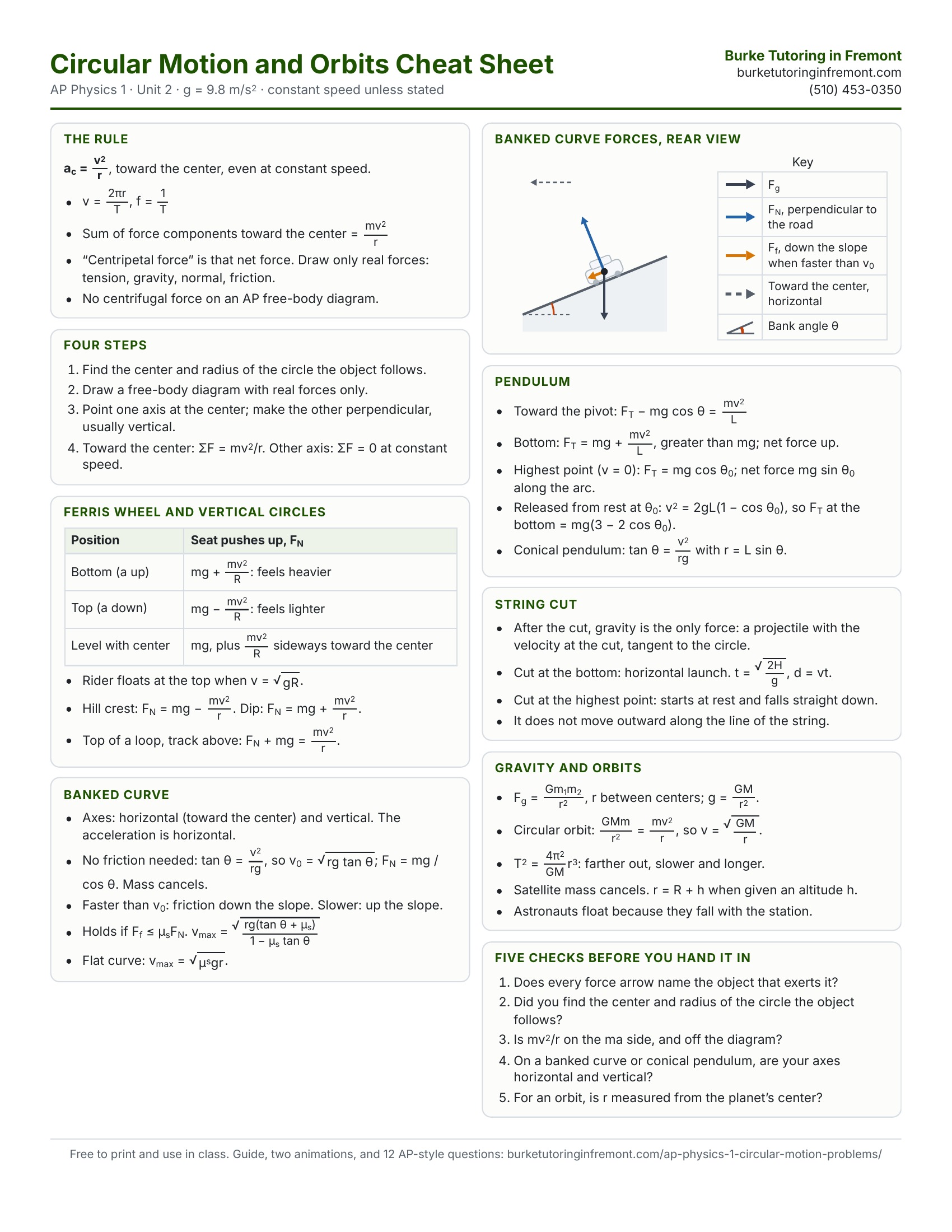
Circular Motion and Orbits Cheat Sheet
AP Physics 1 · Unit 2 · g = 9.8 m/s2 · constant speed unless stated
The rule
ac = v squared over r, toward the center, even at constant speed.
- v = 2 pi r over T, f = 1 over T
- Sum of force components toward the center = m v squared over r
- “Centripetal force” is that net force. Draw only real forces: tension, gravity, normal, friction.
- No centrifugal force on an AP free-body diagram.
Four steps
- Find the center and radius of the circle the object follows.
- Draw a free-body diagram with real forces only.
- Point one axis at the center; make the other perpendicular, usually vertical.
- Toward the center: ΣF = mv2/r. Other axis: ΣF = 0 at constant speed.
Ferris wheel and vertical circles
| Position | Seat pushes up, FN |
|---|---|
| Bottom (a up) | mg + m v squared over R: feels heavier |
| Top (a down) | mg − m v squared over R: feels lighter |
| Level with center | mg, plus m v squared over R sideways toward the center |
- Rider floats at the top when v = √gR.
- Hill crest: FN = mg − m v squared over r. Dip: FN = mg + m v squared over r.
- Top of a loop, track above: FN + mg = m v squared over r.
Banked curve
- Axes: horizontal (toward the center) and vertical. The acceleration is horizontal.
- No friction needed: tan θ = v squared over r g, so v0 = √rg tan θ; FN = mg / cos θ. Mass cancels.
- Faster than v0: friction down the slope. Slower: up the slope. The AP exam treats this case qualitatively.
- Flat curve: vmax = √μsgr.
- Enrichment, beyond the AP exam: on a banked curve, vmax = √r g times tan theta plus mu s, over 1 minus mu s tan theta
Pendulum
- Toward the pivot: FT − mg cos θ = m v squared over L
- Bottom: FT = mg + m v squared over L, greater than mg; net force up.
- Highest point (v = 0): FT = mg cos θ0; net force mg sin θ0 along the arc.
- Released from rest at θ0: v2 = 2gL(1 − cos θ0), so FT at the bottom = mg(3 − 2 cos θ0).
- Conical pendulum: tan θ = v squared over r g with r = L sin θ.
String cut
- After the cut, gravity is the only force: a projectile with the velocity at the cut, tangent to the circle.
- Cut at the bottom: horizontal launch. t = √2 H over g, d = vt.
- Cut at the highest point: starts at rest and falls straight down.
- It does not move outward along the line of the string.
Gravity and orbits
- Fg = G m 1 m 2 over r squared, r between centers; g = G M over r squared.
- Circular orbit: G M m over r squared = m v squared over r, so v = √G M over r.
- T2 = 4 pi squared over G Mr3: farther out, slower and longer.
- Satellite mass cancels. r = R + h when given an altitude h.
- Astronauts float because they fall with the station.
Five checks before you hand it in
- Does every force arrow name the object that exerts it?
- Did you find the center and radius of the circle the object follows?
- Is mv2/r on the ma side, and off the diagram?
- On a banked curve or conical pendulum, are your axes horizontal and vertical?
- For an orbit, is r measured from the planet’s center?
Print it, or keep this page open while you work. Download the cheat sheet PDF or the image version.
Keep going
Circular motion draws on Unit 1 as well as Unit 2. The AP Physics 1 kinematics study guide covers the projectile motion in worked example 4 and Questions 6 and 7, and the free fall problems guide covers objects dropped from rest, like a bob cut loose at the top of its swing. The vectors and relative velocity guide shows why a change in direction counts as acceleration. For more free-response practice in the AP format, the kinematics FRQ set has eight more questions with scoring guides.
Working through circular motion with a tutor
I tutor AP Physics 1 in person across Fremont, Newark, and Union City. A session on this unit can focus on finding the center of the circle before writing any equations, drawing free-body diagrams with real forces only, and choosing axes for banked curves and pendulums. Bring a recent assignment or test so we can start from the problems that cost you points.
Call or text to talk about your student’s class.
(510) 453-0350Serving Fremont, Newark, and Union City. AP coursework is priced separately from standard in-home subjects. See class rates. If trigonometry or algebra is what slows the physics down, see math tutoring in Fremont.
Curriculum reference
Scope follows the College Board’s AP Physics 1 Course and Exam Description. This guide covers topic 2.6 (gravitational force) and topic 2.9 (circular motion, including circular orbits and the relation between orbital period and radius) from Unit 2, Force and Translational Dynamics, which is weighted at 18% to 23% of the multiple-choice section. The course description expects quantitative analysis only of banked curves that need no friction, and it limits curves that need friction to qualitative descriptions. For that reason the friction calculations in the banked road section, including parts (c) and (d) of worked example 2, are marked as enrichment. The pendulum speeds use conservation of energy from Unit 3, and the energy and angular momentum of orbiting satellites belong to topic 6.6. This guide is an independent study resource. AP is a trademark registered by the College Board, which is not affiliated with and does not endorse this resource.