AP Physics 1 · Unit 2 · Force and Translational Dynamics
AP Physics 1 Dynamics Worksheets and Study Guides
Three guides, two practice tests, and printable PDFs with answer keys
This page brings together the dynamics material on this site for Unit 2 of AP Physics 1. Three guides teach Newton's laws, free-body diagrams, inclines, friction, pulleys, circular motion, and gravitation with worked examples, animations, and practice questions. Two practice sets then test the unit in the multiple-choice and free-response formats. Every worksheet is a free printable PDF with an answer key, and no sign up is needed.

Written by Berke Sahbazoglu · Owner and tutor, Burke Tutoring In Fremont · BA Biochemistry, Washington University in St. Louis · 10+ years tutoring math and science, including AP Physics 1 · Full bio
Published · Last updated · Free to print and use in class
- practice problems and questions in the guides
- 51
- exam-style questions in two practice tests
- 28
- interactive animations
- 4
- printable PDFs
- 8

8 free PDFs. Three one-page cheat sheets, three worksheets with answer keys, and two exam-style practice booklets, all sized for US Letter.
01 / Learn the unit
AP Physics 1 dynamics study guides
The three guides are listed in a recommended order. Each one has worked examples, practice with answers on the page, printable PDFs, and at least one animation you can adjust. The pulley and circular motion guides build on the free-body diagrams and force components taught in guide 1.
Several problems also use the constant-acceleration equations from Unit 1, which are collected on the AP Physics 1 kinematics worksheets and study guides page.
-
Start here
AP Physics 1 dynamics study guide: Newton's laws, inclines, and friction
Newton's three laws, the forces in Unit 2, free-body diagrams drawn the way the AP exam expects, the normal force in five situations, blocks on inclines, and static and kinetic friction.
- 27 practice problems, including 3 challenge problems, with answers on the page
- 4 worked examples and an incline animation with a live free-body diagram and a friction versus angle graph
- 11-page worksheet with answer key and a one-page cheat sheet (PDF)
AP topics 2.2 to 2.5, 2.7
-
Pulley problems: Atwood machines, tables, and inclines
What ideal strings and pulleys do, the system method and the object method, and three setups: two blocks hanging over a pulley, a block on a table pulled by a hanging block, and a block on an incline pulled by a hanging block, with and without friction.
- 12 questions in the AP formats, 8 multiple choice and 4 free response, with explanations and scoring guides
- 3 worked examples and a pulley animation with a live speed graph
- 24-page worksheet with answer key and scoring guidelines, plus a cheat sheet (PDF)
AP topics 2.1, 2.3, 2.5, 2.7
-
Circular motion problems: Ferris wheels, banked curves, pendulums, and orbits
Why an object moving in a circle at constant speed is accelerating, then five setups: a Ferris wheel rider, a car on a banked curve, a pendulum at the bottom and top of its swing, a pendulum whose string is cut, and a satellite in a circular orbit.
- 12 questions in the AP formats, 8 multiple choice and 4 free response, with explanations and scoring guides
- 5 worked examples, a Ferris wheel animation, and a banked road animation
- 21-page worksheet with answer key and scoring guidelines, plus a cheat sheet (PDF)
The course description limits banked curves that need friction to qualitative reasoning, so the friction calculations in the banked road section are marked as enrichment.
AP topics 2.6, 2.9
02 / Test yourself
AP Physics 1 dynamics practice tests: MCQ and FRQ
Both sets are original questions written in the current exam formats, with answers on the page and a printable booklet. Take them after the guides, or start with the multiple-choice set to find which guide to review first.
-
AP Physics 1 dynamics MCQ practice: 20 questions
Twenty multiple-choice questions in the format used since the May 2025 exam redesign: four answer choices and one correct answer each, timed at 40 minutes. Questions 14 and 15 share one figure.
- Answer and explanation under each question, with a link to the page that teaches the idea
- Answer key table with the AP topic for each question
- 22-page PDF booklet with an answer sheet and explanations
AP topics 2.1 to 2.7, 2.9
-
AP Physics 1 dynamics FRQ practice: 8 questions
Two sets of four free-response questions. Each set has one question of each exam type: mathematical routines, translation between representations, experimental design and analysis, and qualitative/quantitative translation.
- 40 points and 95 minutes per set
- Point-by-point scoring guide under each question
- 32-page PDF booklet with scoring guidelines from page 18 and a score tracker
AP topics 2.1 to 2.7, 2.9
03 / Find your problem
Which dynamics guide fits your problem?
Match the wording of a homework or test question to a row, then open the linked section.
| If the question asks you to | Open |
|---|---|
| Find the net force or the acceleration of one object, or name the other force in a third-law pair | Newton's three laws of motionDynamics study guide |
| Find a scale reading or apparent weight in an elevator that speeds up or slows down | Worked example 1: a scale in a slowing elevatorDynamics study guide |
| Draw a free-body diagram, or find the normal force when a rope or a push acts at an angle | Forces and free-body diagramsDynamics study guideWorked example 2: pulling a box with a rope at an angleDynamics study guide |
| Find the acceleration of an object sliding on a frictionless ramp, or the normal force on it | Inclined plane problemsDynamics study guide |
| Decide whether static friction holds an object in place, or find the friction force on a sliding object | Static and kinetic frictionDynamics study guide |
| Decide whether a block on a rough incline slides, and find its acceleration if it does | Worked example 4: will the block slide?Dynamics study guideIncline animationDynamics study guide |
| Choose between treating connected blocks as one system and writing an equation for each block | The system method and the object methodPulley problems guide |
| Find the acceleration and the tension for two blocks hanging over a pulley | The Atwood machinePulley problems guide |
| Find the acceleration of a block on a table pulled by a hanging block, with or without friction | Block on a table with a hanging blockPulley problems guide |
| Find which way a block on an incline moves when a hanging block pulls it | Block on an incline with a hanging blockPulley problems guide |
| Find how heavy a rider feels at the top or bottom of a Ferris wheel, or the normal force on a car on a hill or in a dip | Ferris wheel problemsCircular motion guide |
| Find the speed at which a car can round a banked curve without friction | Banked road problemsCircular motion guide |
| Find the tension in a pendulum string at the bottom or the top of the swing | Pendulum problemsCircular motion guide |
| Find where a pendulum bob lands after its string is cut | When the string is cutCircular motion guide |
| Find the gravitational force between two objects, or the speed and period of a satellite in a circular orbit | Gravity and satellite orbitsCircular motion guide |
| Practice with exam timing | 20 multiple-choice questions40 minutes8 free-response questions95 minutes per set of four |
Free printables · No signup
Free dynamics worksheets and answer keys (PDF)
The five pages share 8 PDFs, all sized for US Letter: 3 one-page cheat sheets, 3 worksheets with answer keys, and 2 practice test booklets. Teachers and study groups are welcome to print and distribute them in class. A link back to this page is appreciated but not required.
Cheat sheets
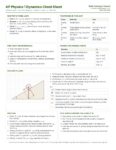 Dynamics cheat sheetNewton's three laws, the forces in Unit 2, free-body diagram rules, normal force cases, inclines, friction, and five checks.
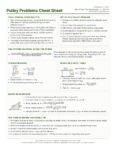 Pulley problems cheat sheetIdeal string rules, the system equation, formulas for all three setups, and five checks.
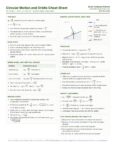 Circular motion cheat sheetThe rule and the four steps, Ferris wheels, banked curves, pendulums, string cuts, orbits, and five checks.
Worksheets and answer keys
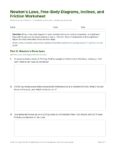 Newton's laws, inclines, and friction worksheetAll 27 problems with work space, in five parts. Worked answer key on pages 10 and 11.
 Pulley problems worksheetQuestions 1 to 8 in multiple choice and 9 to 12 in free response, with figures and blank axes. Answer key and scoring guidelines on pages 14 to 24.
 Circular motion worksheetQuestions 1 to 8 in multiple choice and 9 to 12 in free response, with figures and blank axes. Answer key and scoring guidelines on pages 14 to 21.
Practice test booklets
For teachers
AP Physics 1 Unit 2 topic map
College Board divides Unit 2, Force and Translational Dynamics, into nine topics, and the unit counts for 18% to 23% of the multiple-choice section score. The table shows where each topic is taught on this site and which practice questions test it.
| Topic | Students learn to | Where to study and practice it |
|---|---|---|
| 2.1 Systems and center of mass | Treat connected objects as one system, locate its center of mass, and relate the motion of the center of mass to the net external force | The system method and the object methodPulley problems guideQuestion 13: where two students on ice meetMCQ practice setQuestion 5: an Atwood machine on a spring scaleFRQ practice set |
| 2.2 Forces and free-body diagrams | Identify every force exerted on an object and draw each one on a free-body diagram | Forces and free-body diagramsDynamics study guideQuestions 3 and 17MCQ practice setQuestion 1: pulling and pushing a crateFRQ practice set |
| 2.3 Newton's third law | Pair the forces two objects exert on each other, including the pull of an ideal string | Third law: forces come in pairsDynamics study guideWhat an ideal string and an ideal pulley doPulley problems guideQuestion 2MCQ practice setQuestion 2: an elevator ride on a scaleFRQ practice set |
| 2.4 Newton's first law | Connect zero net force with constant velocity, including an object at rest | First law: no net force, no change in velocityDynamics study guideQuestion 1MCQ practice setQuestion 1: pulling and pushing a crateFRQ practice set |
| 2.5 Newton's second law | Apply ΣF = ma along each axis, for one object or for a system of connected objects | Worked example 1: a scale in a slowing elevatorDynamics study guideThe Atwood machinePulley problems guideQuestions 4, 5, 11, and 12MCQ practice setQuestion 2: an elevator ride on a scaleFRQ practice set |
| 2.6 Gravitational force | Find the gravitational force between two objects and the gravitational field strength near a planet | Gravity and satellite orbitsCircular motion guideQuestions 19 and 20MCQ practice setQuestion 8: orbits around two planetsFRQ practice set |
| 2.7 Kinetic and static friction | Tell static friction from kinetic friction, and find the friction force in each case | Static and kinetic frictionDynamics study guideIncline animationDynamics study guideQuestions 6 to 10MCQ practice setQuestion 3: friction on a tilted boardFRQ practice setQuestion 4: a block held on a rough rampFRQ practice set |
| 2.8 Spring forces | Use Hooke's law for the force an ideal spring exerts | Not covered on this site yet. The MCQ and FRQ sets leave it out. |
| 2.9 Circular motion | Find the net force toward the center for an object moving in a circle, including banked curves and circular orbits | The rule behind circular motion problemsCircular motion guideFerris wheel animationCircular motion guideQuestions 14, 15, 16, and 18MCQ practice setQuestion 6: a pendulum with a cut stringFRQ practice setQuestion 7: static friction in a circleFRQ practice set |
The multiple-choice and free-response sets each cover eight of the nine topics, all except 2.8.
Using these pages in class
- The 20 multiple-choice questions can serve as a pre-test or a review quiz. Each explanation links to the page on this site that covers the idea, so a missed question points to the guide to review.
- The three guides each list six errors in a section on where students lose points, and each error ends with a check students can run on their own work. These sections can be used for error analysis.
- The pulley and circular motion worksheets and the FRQ booklet have point-by-point scoring guidelines at the back, so students can score their own answers or a partner's.
- In the FRQ set, Set A covers forces, friction, and inclines, and Set B covers pulleys, circular motion, and gravitation, so each set also works as a separate review session.
- The animations run in a web browser, with no login or download.
The PDFs are free to copy for your classroom. If you share them online, please link to this page or to the guide rather than rehosting the files, so students get the current version.
To report an error in a problem or an answer key, email burketutoringinfremont@outlook.com or call or text (510) 453-0350.
Topic names and the unit weighting come from the AP Physics 1 course page on AP Students. The equations students may use on exam day are on the AP Physics 1 equation sheet. AP is a trademark registered by the College Board, which is not affiliated with and does not endorse this resource.
How these dynamics pages are written
The practice problems in the dynamics study guide and the pulley problems guide are adapted from problem types I use in AP Physics 1 tutoring sessions. The multiple-choice and free-response sets are original questions written in the formats of the current exam, not released exam questions.
All five pages use the same conventions, so a result from one page carries over to the next:
- g = 9.8 m/s2, the value on the AP Physics 1 equation sheet.
- Air resistance is neglected unless a problem says otherwise.
- Strings and pulleys are ideal: a string has negligible mass and does not stretch, and a pulley has negligible mass and turns without friction.
- Friction coefficients do not depend on speed or contact area.
- A free-body diagram shows the object as a dot with one arrow for each force, drawn at full size, with no components and no arrow for acceleration or net force.
- Answers are on the page, and each worksheet includes an answer key.
Each page shows its own publication and update dates.
About the author
Berke Sahbazoglu, owner and tutor, Burke Tutoring In Fremont
I have been tutoring for more than ten years, and my one-on-one classes focus on advanced courses such as AP Physics 1, AP Chemistry, and AP Biology. Over the last three years I have taught more than 350 hours of AP Physics 1. Before founding Burke Tutoring, I tutored with Grade Potential, Sylvan Learning, and C2 Education. I hold a BA in Biochemistry from Washington University in St. Louis and an MS in Bioinformatics from the University of Maryland Global Campus.
Math practice for dynamics problems
Pulley answers come from two equations solved together, and some incline and pulley problems end with a time found from the kinematics equations. These worksheets practice the algebra behind those steps:
- Rational equations worksheet, for solving a = (m2 − m1)g / (m1 + m2) for an unknown mass
- Solving quadratics with the quadratic formula, for the time a block takes to slide a set distance when it starts out moving
- Comparing linear, quadratic, and exponential functions, for telling a linear relationship from a quadratic one in a data table before you choose what to graph in an experimental design question
- All rational expressions worksheets and guides and all quadratic worksheets and guides
AP Physics 1 tutoring in Fremont, Newark, and Union City
I tutor AP Physics 1 in person across Fremont, Newark, and Union City. A session on dynamics can focus on drawing a complete free-body diagram before any numbers go in, choosing the system in a pulley problem, and finding the center of the circle in a circular motion problem. Bring a recent assignment or test so we can start from the problems that cost points.
I also lead online AP Physics 1 group classes, which meet once a week for 90 minutes and follow the FUSD school calendar. Call to ask about openings.
(510) 453-0350AP coursework is priced separately from standard in-home subjects. See class rates.
“Burke Tutoring helped my child to save her grade for AP Physics 1 in the 1st semester!”
Jing Lee, parent, Fremont · More parent reviews