AP Physics 1 · Unit 2 · Dynamics multiple-choice practice
AP Physics 1 Dynamics MCQ Practice: 20 Multiple-Choice Questions
Written in the current exam format, with explanations and a printable PDF
This AP Physics 1 dynamics MCQ practice set has 20 multiple-choice questions on Unit 2: Newton’s laws, free-body diagrams, friction, inclines, connected objects, circular motion, and gravitation. The questions follow the layout of the multiple-choice section on the current exam, with four answer choices, one correct answer per question, and two questions that share one figure. Each question has an answer and explanation you can open after you choose. For the concepts behind them, use the AP Physics 1 dynamics study guide, the pulley problems guide, and the circular motion guide.
Browse all AP Physics 1 dynamics worksheets and study guides, including topic guides, practice tests, and free printable PDFs.

Written by Berke Sahbazoglu · Owner and tutor, Burke Tutoring In Fremont · BA Biochemistry, Washington University in St. Louis · 10+ years tutoring math and science, including AP Physics 1 · Full bio
Published October 29, 2026 · Last updated October 29, 2026 · Free to print and use in class
| Course | AP Physics 1, Unit 2 (force and translational dynamics), topics 2.1 to 2.7 and 2.9 |
|---|---|
| Questions | 20 multiple-choice questions, each with one correct answer |
| Format | Four answer choices per question, as on the current exam |
| Time | 40 minutes, about the pace of the current exam |
| Answers | Explanation under each question, plus an answer key for the whole set |
| Printable | PDF in the exam booklet layout, with an answer sheet and answer key |
| Assumptions | g = 9.8 m/s2, air resistance negligible, ideal strings and pulleys |
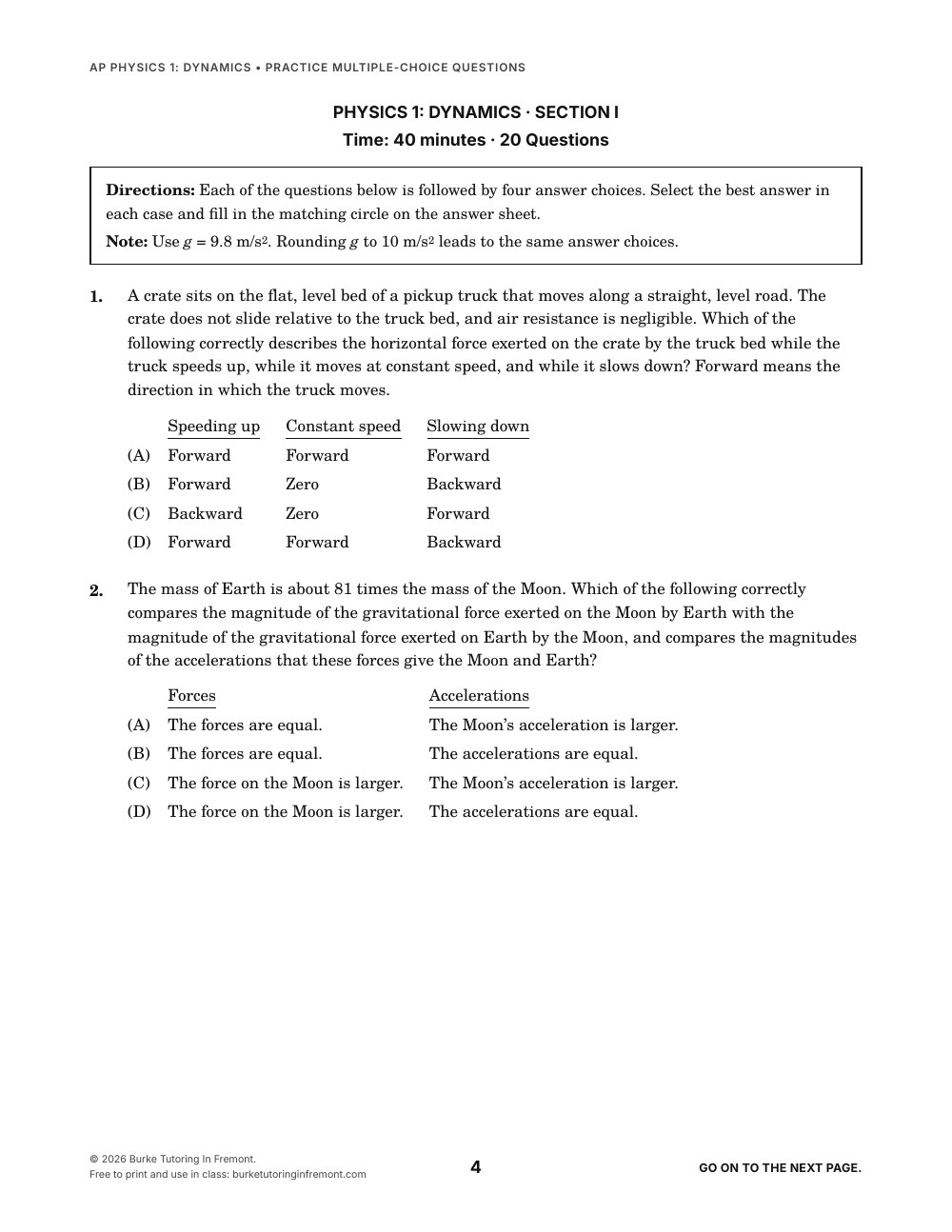
Printable PDF
All 20 questions laid out like the exam booklet, with an answer sheet and the answer key with explanations at the back. 22 pages, US Letter.
Download the PDF01 / Before you start
How the AP Physics 1 multiple-choice section works
Starting with the May 2027 exam, Section I of the AP Physics 1 exam has 42 multiple-choice questions in 85 minutes and counts for half of the exam score, as listed on College Board’s AP Physics 1 exam page. Some questions stand alone, and others come in sets that share a figure or a data table. The section is taken in the Bluebook testing app.
Since the exam was redesigned in May 2025, every multiple-choice question has four answer choices and one correct answer. This practice set follows that format at a smaller size: 20 questions in 40 minutes, about 2 minutes per question, close to the exam’s pace. Questions 14 and 15 share one figure.
| AP Physics 1 exam, starting May 2027 | This practice set | |
|---|---|---|
| Questions | 42 | 20 |
| Time | 85 minutes | 40 minutes |
| Answer choices | 4 per question | 4 per question |
| Correct answers per question | 1 | 1 |
| Questions that share a figure | Yes, in sets | Questions 14 and 15 |
| Format | Digital, in the Bluebook app | Web page and printable PDF |
What the 20 questions cover
The questions cover eight of the nine topics in Unit 2 of AP Physics 1. Topic 2.8, spring forces, is not part of this set. The last column links to the page on this site that teaches each topic.
| Unit 2 topic | Questions | Review on this site |
|---|---|---|
| 2.1 Systems and center of mass | 13 | The system method in the pulley problems guide |
| 2.2 Forces and free-body diagrams | 3, 17 | Forces and free-body diagrams in the dynamics study guide |
| 2.3 Newton’s third law | 2 | Third law: forces come in pairs in the dynamics study guide |
| 2.4 Newton’s first law | 1 | First law: no net force, no change in velocity in the dynamics study guide |
| 2.5 Newton’s second law | 4, 5, 11, 12 | The elevator worked example in the dynamics study guide and the Atwood machine in the pulley problems guide |
| 2.6 Gravitational force | 19, 20 | Gravity and satellite orbits in the circular motion guide |
| 2.7 Kinetic and static friction | 6, 7, 8, 9, 10 | Static and kinetic friction in the dynamics study guide |
| 2.9 Circular motion | 14, 15, 16, 18 | The rule behind every circular motion problem in the circular motion guide |
How to use this set. Work all 20 questions in one sitting, with a calculator and the AP Physics 1 equation sheet open. Write down each answer before you open its explanation. Each explanation gives the reasoning for the correct choice, shows why the most tempting wrong choices fail, and links to the page on this site that covers the idea.
02 / Questions 1 to 10
AP Physics 1 dynamics multiple-choice questions 1 to 10
Questions 1 to 10 cover Newton’s three laws, free-body diagrams, the normal force, and static and kinetic friction on level surfaces and inclines. Use g = 9.8 m/s2 and treat air resistance as negligible.
Directions: Each question below is followed by four answer choices. Select the best answer in each case.
Question 1 Friction on a crate riding in a truck Topic 2.4
1.A crate sits on the flat, level bed of a pickup truck that moves along a straight, level road. The crate does not slide relative to the truck bed, and air resistance is negligible. Which of the following correctly describes the horizontal force exerted on the crate by the truck bed while the truck speeds up, while it moves at constant speed, and while it slows down? Forward means the direction in which the truck moves.
| Speeding up | Constant speed | Slowing down | |
|---|---|---|---|
| (A) | Forward | Forward | Forward |
| (B) | Forward | Zero | Backward |
| (C) | Backward | Zero | Forward |
| (D) | Forward | Forward | Backward |
Answer and explanation for Question 1
Answer: (B)
The crate moves with the truck, so it has the same acceleration as the truck. The only horizontal force on the crate is static friction from the truck bed, so that force alone gives the crate its horizontal acceleration.
While the truck speeds up, the acceleration points forward, so the friction force points forward. At constant speed on a straight road the acceleration is zero, so by Newton’s first law the net force is zero, and the friction force is zero. While the truck slows down, the acceleration points backward, and so does the friction force.
Why not (D)? A forward force at constant speed would give the crate a forward acceleration. An object moving at constant velocity needs no net force to keep moving.
Why not (C)? Static friction opposes the sliding that would happen without it. Without friction, the crate would slide toward the back of the bed while the truck speeds up, so friction points forward.
Review: Newton’s first law in the AP Physics 1 dynamics study guide. Its friction section also explains which way static friction points.
Question 2 Gravitational forces between Earth and the Moon Topic 2.3
2.The mass of Earth is about 81 times the mass of the Moon. Which of the following correctly compares the magnitude of the gravitational force exerted on the Moon by Earth with the magnitude of the gravitational force exerted on Earth by the Moon, and compares the magnitudes of the accelerations that these forces give the Moon and Earth?
| Forces | Accelerations | |
|---|---|---|
| (A) | The forces are equal. | The Moon’s acceleration is larger. |
| (B) | The forces are equal. | The accelerations are equal. |
| (C) | The force on the Moon is larger. | The Moon’s acceleration is larger. |
| (D) | The force on the Moon is larger. | The accelerations are equal. |
Answer and explanation for Question 2
Answer: (A)
The force exerted on the Moon by Earth and the force exerted on Earth by the Moon form a Newton’s third law pair. They have the same magnitude and point in opposite directions. Each force gives an acceleration equal to the force divided by the mass it acts on. The Moon has about 1/81 of Earth’s mass, so the same force gives the Moon about 81 times the acceleration it gives Earth.
Why not (B)? Equal forces give equal accelerations only when the masses are equal.
Why not (C)? Earth’s larger mass does not make it pull harder. The gravitational force depends on the product of the two masses, and that product is the same for both forces.
Review: Third law: forces come in pairs in the AP Physics 1 dynamics study guide.
Question 3 Free-body diagram for a box sliding up a ramp Topic 2.2
3.A box is given a brief push up a rough ramp. After the push ends, the box continues up the ramp and slows down, as shown.
Which of the following free-body diagrams best represents the forces exerted on the box while it slides up the ramp after the push ends? In each diagram, the dashed line is parallel to the ramp.
Answer and explanation for Question 3
Answer: (C)
After the push ends, two objects exert forces on the box. Earth exerts the gravitational force, straight down. The ramp exerts a normal force perpendicular to its surface and a kinetic friction force along its surface. The box slides up the ramp, so kinetic friction points down the ramp, opposite the sliding. The box slows down because friction and the component of gravity along the ramp both point down the ramp.
Why not (B)? Choice (B) adds a force up the ramp. The hand stopped touching the box when the push ended, so no object exerts that force. The box keeps moving up the ramp because of the velocity it already has.
Why not (A)? Friction opposes the direction the box slides relative to the ramp. The box slides up the ramp, so friction points down the ramp.
Why not (D)? A normal force is perpendicular to the surface that exerts it, so on a ramp it tilts away from vertical.
Review: How to draw a free-body diagram in five steps in the AP Physics 1 dynamics study guide.
Question 4 Net force from a velocity-time graph Topic 2.5
4.A 2.0 kg cart moves along a straight, level track. The graph shows the cart’s velocity v as a function of time t.
Which of the following graphs best represents the net force F on the cart as a function of time?
Answer and explanation for Question 4
Answer: (A)
By Newton’s second law, the net force equals mass times acceleration, and the acceleration is the slope of the velocity-time graph. From 0 to 3.0 s the slope is (6.0 m/s)/(3.0 s) = 2.0 m/s2, so F = (2.0 kg)(2.0 m/s2) = 4.0 N. From 3.0 s to 5.0 s the velocity is constant, so the net force is zero. From 5.0 s to 7.0 s the slope is (0 − 6.0 m/s)/(2.0 s) = −3.0 m/s2, so F = −6.0 N.
Why not (C)? Choice (C) keeps a 4.0 N force on the cart while it moves at constant velocity. Constant velocity means zero net force.
Why not (D)? Choice (D) copies the shape of the velocity graph. The net force follows the slope of that graph, not its height.
Why not (B)? The cart slows down in 2.0 s, faster than it sped up, so the negative force is larger in magnitude than the positive force.
Review: Second law: the net force sets the acceleration in the AP Physics 1 dynamics study guide, and motion graphs: slope and area in the kinematics study guide.
Question 5 Scale reading in an elevator Topic 2.5
5.A student of mass 50 kg stands on a bathroom scale in an elevator. While the elevator moves downward, the scale reads 550 N. Which of the following correctly describes the direction of the elevator’s acceleration and how its speed is changing at that time?
| Direction of acceleration | Speed of the elevator | |
|---|---|---|
| (A) | Upward | Increasing |
| (B) | Upward | Decreasing |
| (C) | Downward | Increasing |
| (D) | Downward | Decreasing |
Answer and explanation for Question 5
Answer: (B)
The scale pushes up on the student with a normal force of 550 N, and Earth pulls down with mg = (50 kg)(9.8 m/s2) = 490 N. Taking up as positive, FN − mg = ma gives a = (550 N − 490 N)/(50 kg) = +1.2 m/s2, so the acceleration points up. The elevator moves downward, and an acceleration opposite the velocity means the elevator is slowing down.
Why not (C)? If the elevator were speeding up on its way down, its acceleration would point down, and the scale would read less than 490 N.
Why not (A)? An upward acceleration makes an object speed up only when the object is moving upward. This elevator is moving downward.
Review: A scale in a slowing elevator, worked example 1 in the AP Physics 1 dynamics study guide.
Question 6 Friction on a sled pulled at an angle Topic 2.7
6.A student pulls a sled of mass m across level snow at constant velocity with a rope that makes an angle θ above the horizontal, as shown. The tension in the rope is FT, and the coefficient of kinetic friction between the sled and the snow is μk.
Which of the following expressions gives the magnitude of the friction force exerted on the sled by the snow?
- (A)FT sin θ
- (B)μkmg
- (C)μk(mg + FT sin θ)
- (D)μk(mg − FT sin θ)
Answer and explanation for Question 6
Answer: (D)
The rope pulls up and forward on the sled. Its vertical component, FT sin θ, supports part of the sled’s weight, so the snow pushes up with less than mg. The sled has no vertical acceleration, so FN + FT sin θ − mg = 0, which gives FN = mg − FT sin θ. The sled slides, so the friction is kinetic: Ff = μkFN = μk(mg − FT sin θ).
Why not (B)? μkmg uses mg as the normal force, which is true only when no other force on the sled has a vertical component.
Why not (C)? Adding FT sin θ fits a push directed downward at an angle, which presses the sled into the snow.
Why not (A)? FT sin θ is the vertical component of the tension. At constant velocity, friction balances the horizontal component, FT cos θ.
Review: Pulling a box with a rope at an angle, worked example 2 in the AP Physics 1 dynamics study guide. For splitting a force into components, see vectors, components, and directions in the vectors and relative velocity guide.
Question 7 Adding a second block on a rough incline Topic 2.7
7.A block slides down a rough incline at constant velocity. A second block, identical to the first, is fastened on top of it, and the two-block stack is started down the same incline with the same initial speed. Which of the following describes the motion of the stack, and why?
- (A)It speeds up, because the component of gravity along the incline doubles.
- (B)It slows down, because the friction force doubles.
- (C)It slides at constant velocity, because the friction force and the component of gravity along the incline both double.
- (D)It slides at constant velocity, because the normal force exerted by the incline does not change.
Answer and explanation for Question 7
Answer: (C)
For the single block, constant velocity means the forces along the incline balance: mg sin θ = μkmg cos θ. The mass cancels, leaving tan θ = μk. For the stack, the mass is 2m. The component of gravity along the incline doubles to 2mg sin θ, the normal force doubles to 2mg cos θ, and kinetic friction doubles to μk(2mg cos θ). The forces still balance, so the stack slides at constant velocity.
Why not (D)? Choice (D) gives the right motion for the wrong reason. The stack presses on the incline with twice the weight, so the normal force doubles.
Why not (A)? The component of gravity along the incline does double, but so does the friction force.
Review: Friction on an incline in the AP Physics 1 dynamics study guide. The incline animation in the same guide has a mass control, so you can change the mass and compare the motion.
Question 8 Friction force as a pull increases Topic 2.7
8.A block rests on a level table. The coefficient of kinetic friction between the block and the table is less than the coefficient of static friction. A student pulls horizontally on the block with a force sensor, starting from zero and slowly increasing the pull, and keeps increasing it after the block starts to slide. Which of the following graphs best represents the magnitude of the friction force Ff exerted on the block by the table as a function of the magnitude of the pull FP?
Answer and explanation for Question 8
Answer: (B)
While the block stays at rest, its acceleration is zero, so static friction is exactly as large as the pull. The graph starts as a straight line through the origin with a slope of 1. Static friction can grow only to its maximum value, μsFN. Once the pull exceeds that value, the block slides, and the friction becomes kinetic, μkFN. That value is smaller, because μk < μs, and it does not depend on the pull, so the graph drops and then stays level.
Why not (A)? μkFN is the friction force only while the block slides. Before the block moves, friction matches the pull.
Why not (D)? After the block starts to slide, the friction is kinetic, and μkFN is less than the maximum static friction.
Why not (C)? Static friction has a maximum value, so friction cannot keep growing with the pull.
Review: Static friction matches the push, up to a limit, in the friction section of the AP Physics 1 dynamics study guide.
Question 9 Velocity graph for a block launched up a rough ramp Topic 2.7
9.A block is launched up a rough ramp. It slides up the ramp, stops for an instant, and then slides back down to its starting point. Take up the ramp as the positive direction. Which of the following graphs best represents the block’s velocity v as a function of time t, from the launch until the block returns to its starting point?
Answer and explanation for Question 9
Answer: (D)
On the way up, kinetic friction points down the ramp, the same direction as the component of gravity along the ramp. The two forces add, so the velocity decreases quickly and the first part of the graph is steep. On the way down, friction points up the ramp and partly cancels the component of gravity, so the block speeds up more slowly and the second part of the graph is less steep.
The area between a velocity-time graph and the time axis gives the distance traveled, and the block slides the same distance down as it did up. With the smaller acceleration on the way down, the two areas match only if the trip down takes longer and ends at a speed smaller than v0.
Key
- Block’s velocity
- Area while sliding up: the distance up the ramp
- Area while sliding down: the same distance back
Why not (A)? A single straight line means the same acceleration in both directions, which happens only when there is no friction.
Why not (C)? In choice (C), the area for the trip down is larger than the area for the trip up, so the block would end up below its starting point.
Why not (B)? Choice (B) uses one slope for the whole trip. Friction changes direction when the block starts to slide down, so the acceleration changes at the top.
Review: Challenge problem 26 in the AP Physics 1 dynamics study guide, which works through the same motion with numbers.
Question 10 Measuring a coefficient of kinetic friction Topic 2.7
10.A student uses the setup shown to measure the coefficient of kinetic friction μk between a block of mass M and a level table. A light string attached to the block passes over an ideal pulley at the edge of the table to a hanging block of mass m. The student adjusts m until the blocks, once given a small push, move at constant speed.
Which of the following expressions gives μk?
- (A)m over M
- (B)M over m
- (C)m over the quantity M plus m
- (D)m g over M
Answer and explanation for Question 10
Answer: (A)
At constant speed, the net force on each block is zero. For the hanging block, the tension balances the block’s weight, so FT = mg. For the block on the table, the tension balances kinetic friction, so FT = μkFN = μkMg. Setting the two expressions equal gives μkMg = mg, so μk = m/M.
Why not (C)? Only the block on the table presses on the table, so the normal force on it is Mg, not (M + m)g.
Why not (D)? A coefficient of friction has no units, but mg/M has the units of acceleration.
Review: Block on a table in the AP Physics 1 pulley problems guide.
03 / Questions 11 to 20
AP Physics 1 dynamics multiple-choice questions 11 to 20
Questions 11 to 20 cover connected objects, the center of mass of a system, circular motion, and gravitation. Strings and pulleys are ideal, and Questions 14 and 15 share one figure.
Directions: Each question below is followed by four answer choices. Select the best answer in each case.
Question 11 Which way the blocks accelerate Topic 2.5
11.Block A of mass 4.0 kg rests on a frictionless ramp inclined at 30° above the horizontal. A light string attached to block A runs parallel to the ramp, over an ideal pulley at the top of the ramp, to block B of mass 1.5 kg, which hangs freely, as shown.
The blocks are released from rest. Which of the following correctly describes the direction in which block A moves and the magnitude of its acceleration?
| Block A moves | Magnitude of acceleration | |
|---|---|---|
| (A) | Up the ramp | 0.89 m/s2 |
| (B) | Up the ramp | 2.7 m/s2 |
| (C) | Down the ramp | 0.89 m/s2 |
| (D) | Down the ramp | 1.2 m/s2 |
Answer and explanation for Question 11
Answer: (C)
Compare the two forces that pull along the string. The component of block A’s weight along the ramp is (4.0 kg)(9.8 m/s2)(sin 30°) = 19.6 N, toward the bottom of the ramp. Block B’s weight is (1.5 kg)(9.8 m/s2) = 14.7 N. The ramp side is larger, so block A slides down the ramp and block B rises. Treating both blocks as one system, a = (19.6 N − 14.7 N)/(4.0 kg + 1.5 kg) = 0.89 m/s2.
Why not (A)? Block A would move up the ramp only if block B’s weight were larger than 19.6 N.
Why not (B)? 2.7 m/s2 treats block B’s weight as the only force along the string and leaves out the component of block A’s weight along the ramp.
Why not (D)? 1.2 m/s2 divides the net force by the mass of block A alone. The net force accelerates both blocks.
Review: Block on an incline in the AP Physics 1 pulley problems guide.
Question 12 Doubling both masses in an Atwood machine Topic 2.5
12.Two blocks of masses m1 and m2, where m2 > m1, hang from opposite ends of a light string that passes over an ideal pulley, as shown. The blocks are released from rest.
Both masses are then doubled, and the blocks are again released from rest. How do the magnitude of the blocks’ acceleration and the tension in the string compare with their original values?
| Acceleration | Tension | |
|---|---|---|
| (A) | Doubled | Doubled |
| (B) | Unchanged | Unchanged |
| (C) | Halved | Doubled |
| (D) | Unchanged | Doubled |
Answer and explanation for Question 12
Answer: (D)
For the two blocks as one system, the difference in weights drives the motion and the total mass resists it: a = (m2 − m1)g/(m1 + m2). Doubling both masses doubles the numerator and the denominator, so the acceleration does not change. For the lighter block, FT − m1g = m1a, so FT = m1(g + a). With a unchanged and m1 doubled, the tension doubles.
Why not (B)? The acceleration stays the same, but each block now has twice the mass, so the string must pull twice as hard to give it that acceleration.
Why not (A)? Doubling the masses doubles the difference in weights, but it also doubles the total mass to be accelerated, and the two changes cancel.
Review: The Atwood machine in the AP Physics 1 pulley problems guide.
Question 13 Where two students on ice meet Topic 2.1
13.Students A and B stand at rest on frictionless ice, 10.0 m apart, each holding one end of a light rope. Student A has a mass of 50 kg, and student B has a mass of 75 kg. Student A pulls the rope in hand over hand until the two students meet. How far from student A’s starting position do they meet?
- (A)4.0 m
- (B)5.0 m
- (C)6.0 m
- (D)10.0 m
Answer and explanation for Question 13
Answer: (C)
Treat the two students and the rope as one system. The ice exerts no horizontal force, and the vertical forces on each student balance, so the net external force on the system is zero. The center of mass starts at rest and stays at rest, and the students meet there. Measured from student A’s starting position, xcm = [(50 kg)(0) + (75 kg)(10.0 m)]/(125 kg) = 6.0 m.
As a check, the rope pulls on each student with a force of the same size. Student A has 2/3 of student B’s mass, so student A’s acceleration is 1.5 times as large, and student A covers 1.5 times the distance: 6.0 m for student A and 4.0 m for student B.
Why not (A)? 4.0 m is the distance student B moves.
Why not (B)? The students would meet at the midpoint only if their masses were equal.
Why not (D)? The rope pulls on both students, so student B moves toward student A even though only student A pulls hand over hand.
Review: The system method in two ways to set up the equations in the AP Physics 1 pulley problems guide. Problem 5 in the dynamics study guide, where two skaters push off each other, uses the same pair of forces.
Questions 14 and 15 refer to the following material.
A car moves at constant speed along a road that has a dip, a level section, and a hill, as shown in the side view. Point X is at the bottom of the dip, point Y is on the level section, and point Z is at the top of the hill. Near points X and Z, the road follows circular arcs, each with a radius of 40 m.
Question 14 Ranking normal forces on a dip and a hill Topic 2.9
14.Which of the following correctly ranks the magnitudes of the normal force exerted on the car by the road at points X, Y, and Z?
- (A)FX > FY > FZ
- (B)FX = FY = FZ
- (C)FZ > FY > FX
- (D)FX = FZ > FY
Answer and explanation for Question 14
Answer: (A)
Vertically, two forces act on the car: the normal force from the road, up, and gravity, down. At X the car moves along a circle whose center is above it, so its acceleration points up, and FN − mg = m v squared over r. The normal force is larger than mg. At Y the road is level and straight, so the vertical acceleration is zero and FN = mg. At Z the center of the circle is below the car, so the acceleration points down, and mg − FN = m v squared over r. The normal force is smaller than mg.
Key
- Normal force from the road
- Gravitational force from Earth
Why not (B)? FN = mg holds only where the car has no vertical acceleration, which is true at Y but not at X or Z.
Why not (C)? Choice (C) reverses the dip and the hill. At the top of a hill the acceleration points down, so the normal force is less than mg.
Why not (D)? At X and Z the accelerations point in opposite directions, so the normal forces there cannot be equal.
Review: Ferris wheel problems in the AP Physics 1 circular motion guide, which compares the forces at the top and bottom of a vertical circle.
Question 15 Speed at the top of the hill Topic 2.9
15.At what constant speed would the magnitude of the normal force exerted on the car at point Z be half the magnitude of the car’s weight?
- (A)9.9 m/s
- (B)14 m/s
- (C)20 m/s
- (D)28 m/s
Answer and explanation for Question 15
Answer: (B)
At Z the acceleration points down, toward the center of the circle. Newton’s second law toward the center gives mg − FN = m v squared over r. Setting FN = mg/2 leaves mg/2 = m v squared over r, so v2 = gr/2 = (9.8 m/s2)(40 m)/2 = 196 m2/s2 and v = 14 m/s. The car’s mass cancels, which is why the question does not give it.
Why not (C)? 20 m/s is √(gr), the speed at which the normal force at Z would drop to zero.
Why not (A)? At 9.9 m/s, m v squared over r equals mg/4, so the normal force would be three fourths of the car’s weight.
Why not (D)? At 28 m/s the road would have to pull down on the car to keep it on the circle. A road can only push, so the car would lose contact with the road on the hill.
Review: Ferris wheel problems in the AP Physics 1 circular motion guide, which sets up the same equation at the top of a circle.
Question 16 Normal force on a banked curve Topic 2.9
16.A car rounds a curve on a road banked at angle θ above the horizontal. The figure shows a cross section, with the center of the curve to the left. The car moves at constant speed in a horizontal circle, at exactly the speed for which the road exerts no friction force on it.
Which of the following correctly compares the magnitude of the normal force exerted on the car by the road with the magnitude of the car’s weight mg, and explains why?
- (A)It is less than mg, because only the component mg cos θ of the weight presses the car into the road.
- (B)It is equal to mg, because the car has no vertical acceleration.
- (C)It is greater than mg, because only the vertical component of the normal force balances the car’s weight.
- (D)It is less than mg, because the car’s motion around the curve tends to lift it off the road.
Answer and explanation for Question 16
Answer: (C)
At this speed, two forces act on the car: gravity, straight down, and the normal force, perpendicular to the road. The car moves in a horizontal circle, so its vertical acceleration is zero. The normal force is tilted toward the center of the curve, so only its vertical component, FN cos θ, balances the weight: FN cos θ = mg, which gives FN = mg/cos θ. Since cos θ is less than 1, the normal force is greater than mg. Its horizontal component, FN sin θ, is the net force toward the center.
Why not (A)? FN = mg cos θ is the result for a block on an incline, where any acceleration is along the slope. On a banked curve the acceleration is horizontal.
Why not (B)? The car does have zero vertical acceleration, but the normal force is tilted, so only part of it acts vertically.
Review: Banked road problems in the AP Physics 1 circular motion guide. Its list of common errors includes treating a banked curve like an incline.
Question 17 Free-body diagram for a swing ride Topic 2.2
17.On a swing ride, a chair hangs from a light chain attached to the end of a rotating arm. The chair and its rider move at constant speed in a horizontal circle around the central pole, and the chain makes a constant angle θ with the vertical, as shown.
Which of the following free-body diagrams best represents the forces exerted on the chair and rider, treated as one system? In each diagram, the center of the circle is to the left and the dashed line shows the direction of the chain. Air resistance is negligible.
Answer and explanation for Question 17
Answer: (D)
Only two objects exert forces on the chair and rider: the chain and Earth. The chain pulls along its length, up and toward the center of the circle, and Earth pulls straight down. The vertical component of the tension balances gravity, and the horizontal component is the net force toward the center that keeps the chair moving in a circle. Because the chain is tilted, the tension is larger than the gravitational force.
Key
- Tension from the chain
- Gravitational force from Earth
- Vertical component of the tension, the same size as the gravitational force
- Horizontal component of the tension, the net force toward the center
Why not (A)? The force toward the center is the horizontal component of the tension, which is already on the diagram. Drawing a separate arrow for it counts the same force twice.
Why not (B)? No object pushes the chair outward. The rider feels pressed outward because the chair is pulled toward the center while the rider’s body tends to keep moving in a straight line.
Why not (C)? Two equal vertical forces give zero net force, and an object with zero net force moves in a straight line at constant speed, not in a circle.
Review: Centripetal force is a net force in the AP Physics 1 circular motion guide.
Question 18 Path of a puck after its string breaks Topic 2.9
18.A puck on a horizontal air table, where friction is negligible, is tied by a string to a fixed peg. The puck moves counterclockwise in a circle at constant speed, as shown in the top view. When the puck reaches point P, the string breaks.
Which of the following best represents the path of the puck after the string breaks? In each choice, the dashed circle shows the puck’s path before the string breaks.
Answer and explanation for Question 18
Answer: (A)
While the string is intact, its pull toward the peg is the net force that keeps the puck on the circle. When the string breaks, no horizontal force acts on the puck. By Newton’s first law, the puck keeps the velocity it had at point P, so it moves in a straight line, tangent to the circle, at constant speed. Because the puck moves counterclockwise, its velocity at P points straight up the page in the top view.
Why not (B)? No force pushes the puck away from the peg, so it does not move outward along a radius.
Why not (C)? A curved path needs a net force toward the inside of the curve. After the string breaks, no such force acts.
Why not (D)? Choice (D) adds an outward part to the motion, and no force acts on the puck to produce it.
Review: When the string is cut in the AP Physics 1 circular motion guide.
Question 19 Gravitational force one Earth radius above the surface Topic 2.6
19.A satellite has a weight of 4,000 N on Earth’s surface. The satellite is then placed in a circular orbit at an altitude above Earth’s surface equal to Earth’s radius. What is the magnitude of the gravitational force exerted on the satellite by Earth while it is in orbit?
- (A)0 N
- (B)1,000 N
- (C)2,000 N
- (D)4,000 N
Answer and explanation for Question 19
Answer: (B)
The gravitational force is inversely proportional to the square of the distance from Earth’s center. On the surface, that distance is Earth’s radius R. At an altitude of R, the distance is R + R = 2R. Doubling the distance divides the force by 22 = 4, so the force is (4,000 N)/4 = 1,000 N.
Why not (C)? 2,000 N divides the force by 2, which treats the force as inversely proportional to the distance instead of its square.
Why not (A)? Gravity does not switch off in orbit. It is the force that keeps the satellite moving in a circle. Objects inside an orbiting spacecraft seem weightless because they fall around Earth along with the spacecraft, which is the same idea as free fall.
Why not (D)? 4,000 N is the weight at the surface. In orbit, the distance from Earth’s center is twice as large.
Review: Gravity and satellite orbits in the AP Physics 1 circular motion guide, which measures every orbit radius from the planet’s center.
Question 20 Two satellites in the same orbit Topic 2.6
20.Satellites X and Y move in circular orbits of the same radius around the same planet. The mass of satellite X is twice the mass of satellite Y. Which of the following correctly compares the speeds of the two satellites and the magnitudes of the gravitational forces exerted on them by the planet?
| Speeds | Gravitational forces | |
|---|---|---|
| (A) | The speeds are equal. | The forces are equal. |
| (B) | Satellite X is slower. | The force on X is twice as large. |
| (C) | Satellite X is faster. | The forces are equal. |
| (D) | The speeds are equal. | The force on X is twice as large. |
Answer and explanation for Question 20
Answer: (D)
For a satellite in a circular orbit, gravity is the net force toward the center: G M m over r squared = m v squared over r. The satellite’s mass m cancels, so v = √(GM/r) is the same for both satellites. The gravitational force itself, GMm/r2, is proportional to the satellite’s mass, so it is twice as large on X. X needs the larger force because it has twice the mass to give the same acceleration, v squared over r.
Why not (A)? The satellites are at the same distance from the planet, but X has twice the mass, so the gravitational force on X is twice as large.
Why not (B)? A satellite with more mass does not move more slowly. The extra force on X is exactly what its extra mass needs to follow the same orbit at the same speed.
Review: Why a satellite stays in orbit, in the gravity and satellite orbits section of the AP Physics 1 circular motion guide.
04 / Check your work
Answer key for all 20 questions
Use this table to score a timed attempt. Each question’s explanation is in the answer block under that question.
Show the answer key
| Question | Answer | Topic |
|---|---|---|
| Question 1 | (B) | 2.4 Newton’s first law |
| Question 2 | (A) | 2.3 Newton’s third law |
| Question 3 | (C) | 2.2 Forces and free-body diagrams |
| Question 4 | (A) | 2.5 Newton’s second law |
| Question 5 | (B) | 2.5 Newton’s second law |
| Question 6 | (D) | 2.7 Kinetic and static friction |
| Question 7 | (C) | 2.7 Kinetic and static friction |
| Question 8 | (B) | 2.7 Kinetic and static friction |
| Question 9 | (D) | 2.7 Kinetic and static friction |
| Question 10 | (A) | 2.7 Kinetic and static friction |
| Question 11 | (C) | 2.5 Newton’s second law |
| Question 12 | (D) | 2.5 Newton’s second law |
| Question 13 | (C) | 2.1 Systems and center of mass |
| Question 14 | (A) | 2.9 Circular motion |
| Question 15 | (B) | 2.9 Circular motion |
| Question 16 | (C) | 2.9 Circular motion |
| Question 17 | (D) | 2.2 Forces and free-body diagrams |
| Question 18 | (A) | 2.9 Circular motion |
| Question 19 | (B) | 2.6 Gravitational force |
| Question 20 | (D) | 2.6 Gravitational force |
Free printable · No signup
AP Physics 1 dynamics MCQ practice PDF
The PDF is laid out like the exam booklet: a cover, an instructions page, an answer sheet, and the 20 questions on pages 4 to 12. The answer key is on page 13, and explanations for all 20 questions follow it. It is sized for US Letter. Teachers and study groups are welcome to print and distribute it in class. A link back to this page is appreciated but not required.
Keep going with Unit 2
For written answers in the exam format, work through the AP Physics 1 dynamics FRQ practice set, which has eight free-response questions with scoring guides. For more problems on the same topics, the dynamics study guide has 27 practice problems with answers, the pulley problems guide has 12 AP-style questions on Atwood machines and blocks on tables and inclines, and the circular motion guide has 12 AP-style questions on Ferris wheels, banked curves, pendulums, and orbits. To review Unit 1 first, try the AP Physics 1 kinematics MCQ practice set or the kinematics worksheets and study guides.
Working through AP Physics 1 multiple-choice questions with a tutor
I tutor AP Physics 1 in person across Fremont, Newark, and Union City. A session on Unit 2 multiple-choice questions can focus on drawing the free-body diagram before reading the answer choices, finding the normal force instead of assuming it equals mg, and checking a choice against a limiting case. Bring a recent unit test so we can start from the questions that cost you points.
Call or text to talk about your student’s class.
(510) 453-0350Serving Fremont, Newark, and Union City. AP coursework is priced separately from standard in-home subjects. See class rates.
About these questions
These are original practice questions written for this page, not released exam questions. They cover AP Physics 1 Unit 2, topics 2.1 to 2.7 and 2.9, and follow the multiple-choice format of the current exam. This page is an independent study resource. AP is a trademark registered by the College Board, which is not affiliated with and does not endorse this resource.