AP Physics 1 · Unit 1 · Kinematics worksheets
AP Physics 1 Kinematics MCQ Practice: 20 Multiple-Choice Questions
Written in the format of the 2015 to 2024 exams, with explanations and a printable PDF
This AP Physics 1 kinematics MCQ practice set has 20 multiple-choice questions on Unit 1: motion graphs, constant acceleration, free fall, reference frames, and projectile motion. The questions follow the layout of the multiple-choice section on the 2015 to 2024 exams, including two questions that share one graph and two questions with two correct answers. Each question has an answer and explanation you can open after you choose. For the concepts behind them, use the AP Physics 1 kinematics study guide and the free fall problems guide.

Written by Berke Sahbazoglu · Owner and tutor, Burke Tutoring In Fremont · BA Biochemistry, Washington University in St. Louis · 10+ years tutoring math and science, including AP Physics 1 · Full bio
Published October 16, 2026 · Last updated October 16, 2026 · Free to print and use in class
| Course | AP Physics 1, Unit 1 (kinematics), topics 1.1 to 1.5 |
|---|---|
| Questions | 20 multiple-choice questions: 18 with one correct answer and 2 with two correct answers |
| Format | Four answer choices per question, as on the 2015 to 2024 exams |
| Time | 36 minutes, the pace of the 2015 to 2024 exam |
| Answers | Explanation under each question, plus an answer key for the whole set |
| Printable | PDF in the exam booklet layout, with an answer sheet and answer key |
| Assumptions | g = 9.8 m/s2, air resistance negligible |
Printable PDF
All 20 questions laid out like the exam booklet, with an answer sheet and the answer key with explanations at the back. 19 pages, US Letter.
Download the PDF01 / Before you start
How the AP Physics 1 multiple-choice section works
From 2015 to 2024, Section I of the AP Physics 1 exam had 50 multiple-choice questions in 90 minutes and counted for half of the exam score. Each question had four answer choices. Some questions shared a figure or a data table, and five questions had two correct answers, both of which had to be selected for credit.
This practice set follows that format at a smaller size: 20 questions in 36 minutes, the same pace of 1.8 minutes per question. Questions 9 and 10 share one graph, and Questions 19 and 20 have two correct answers each.
| AP Physics 1 exam, 2015 to 2024 | This practice set | |
|---|---|---|
| Questions | 50 | 20 |
| Time | 90 minutes | 36 minutes |
| Answer choices | 4 per question | 4 per question |
| Questions with two correct answers | 5 | 2 (Questions 19 and 20) |
| Questions that share a figure | Yes, in sets | Questions 9 and 10 |
The redesigned exam that began in May 2025 dropped the two-answer questions, so every question now has one correct answer. Starting with the May 2027 exam, Section I has 42 questions in 85 minutes, as listed on College Board’s AP Physics 1 exam page. The two-answer questions here still work as practice if you treat each choice as its own true-or-false statement.
What the 20 questions cover
The questions cover all five topics in Unit 1 of AP Physics 1. The last column links to the page on this site that teaches each topic.
| Unit 1 topic | Questions | Review on this site |
|---|---|---|
| 1.1 Scalars and vectors in one dimension | 2 | Position, velocity, and acceleration in the kinematics study guide |
| 1.2 Displacement, velocity, and acceleration | 6, 7, 17, 18, 20 | The constant-acceleration equations in the kinematics study guide and the free fall equations in the free fall guide |
| 1.3 Representing motion | 1, 3, 4, 5, 8, 9, 10 | Motion graphs: slope and area in the kinematics study guide |
| 1.4 Reference frames and relative motion | 11, 12 | Question 6 of the kinematics FRQ practice set, two travelers on a moving walkway |
| 1.5 Vectors and motion in two dimensions | 13, 14, 15, 16, 19 | Free fall and projectile motion in the kinematics study guide |
How to use this set. Work all 20 questions in one sitting, with a calculator and the AP Physics 1 reference information open. Write down each answer before you open its explanation. Each explanation gives the reasoning for the correct choice, shows why the most tempting wrong choices fail, and links to the page on this site that covers the idea.
Need more practice before a timed attempt? Browse our AP Physics 1 kinematics worksheets and answer keys for practice with motion graphs, constant acceleration, free fall, relative velocity, and projectile motion.
02 / Questions 1 to 10
AP Physics 1 kinematics multiple-choice questions 1 to 10
Questions 1 to 10 use motion graphs, a motion diagram, and the constant-acceleration equations for motion along a straight line. Use g = 9.8 m/s2 and treat air resistance as negligible.
Directions: Each question below is followed by four answer choices. Select the best answer in each case.
Question 1 Velocity from a position-time graph Topic 1.3
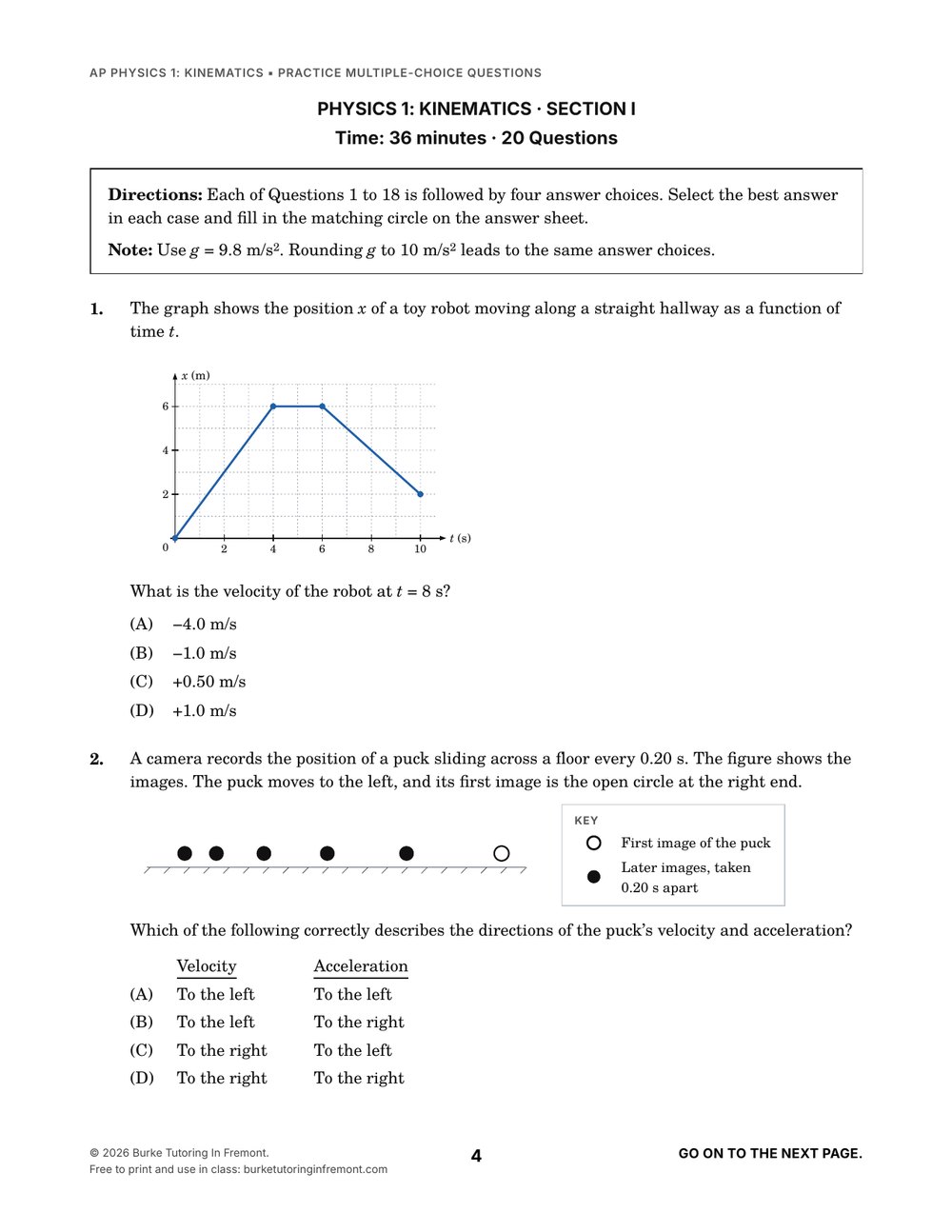
1.The graph shows the position x of a toy robot moving along a straight hallway as a function of time t.
What is the velocity of the robot at t = 8 s?
- (A)−4.0 m/s
- (B)−1.0 m/s
- (C)+0.50 m/s
- (D)+1.0 m/s
Answer and explanation for Question 1
Answer: (B)
Velocity is the slope of a position-time graph. From t = 6 s to t = 10 s the graph is a straight line from 6 m down to 2 m, so the slope is (2 m − 6 m)/(10 s − 6 s) = −1.0 m/s. A straight segment has the same slope at every point, so the velocity at t = 8 s is −1.0 m/s.
Why not (C)? +0.50 m/s is the position at 8 s divided by 8 s. That is the average velocity for the first 8 s, not the velocity at the instant t = 8 s.
Why not (A)? −4.0 m/s is the change in position during the last segment. It still has to be divided by the 4 s the change took.
Review: Motion graphs: slope and area in the AP Physics 1 kinematics study guide.
Question 2 Directions of velocity and acceleration Topic 1.1
2.A camera records the position of a puck sliding across a floor every 0.20 s. The figure shows the images. The puck moves to the left, and its first image is the open circle at the right end.
Key
- First image of the puck
- Later images, taken 0.20 s apart
Which of the following correctly describes the directions of the puck’s velocity and acceleration?
| Velocity | Acceleration | |
|---|---|---|
| (A) | To the left | To the left |
| (B) | To the left | To the right |
| (C) | To the right | To the left |
| (D) | To the right | To the right |
Answer and explanation for Question 2
Answer: (B)
The puck moves to the left, so its velocity points left. The gaps between images get smaller in the direction of motion, so the puck covers less distance in each 0.20 s interval and is slowing down. An object slows down when its acceleration points opposite its velocity, so the acceleration points right.
Why not (A)? If the velocity and the acceleration both pointed left, the puck would be speeding up, and the gaps would grow from right to left.
Review: Motion diagrams and measured data in the motion graphs section of the AP Physics 1 kinematics study guide.
Question 3 Slowing down on a position-time graph Topic 1.3
3.The graph shows the position x of a cart on a straight track as a function of time t. Four times, t1, t2, t3, and t4, are marked.
At which of the marked times is the cart moving in the negative direction and slowing down?
- (A)t1
- (B)t2
- (C)t3
- (D)t4
Answer and explanation for Question 3
Answer: (C)
The slope of a position-time graph gives the velocity. The slope is negative at t2 and at t3, so the cart is moving in the negative direction at both times. At t3 the graph is getting less steep as time goes on, so the speed is decreasing. The graph also curves upward there, which means the acceleration is positive, opposite to the negative velocity.
Why not (B)? At t2 the slope is negative and getting steeper, so the cart is speeding up in the negative direction.
Why not (A)? At t1 the cart is slowing down, but the slope is positive, so it is moving in the positive direction.
Review: Motion graphs: slope and area in the AP Physics 1 kinematics study guide.
Question 4 Distance from a curved velocity-time graph Topic 1.3
4.A sprinter starts from rest. The graph shows her velocity v as a function of time t for the first 4.0 s of a race.
Which of the following correctly compares the distance she runs in the first 4.0 s with 16 m?
- (A)It is greater than 16 m, because the area under her velocity graph is greater than the area under a straight line from 0 to 8.0 m/s.
- (B)It is equal to 16 m, because her average velocity is (0 + 8.0 m/s)/2.
- (C)It is less than 16 m, because her acceleration decreases during the 4.0 s.
- (D)It cannot be determined without knowing her acceleration at each instant.
Answer and explanation for Question 4
Answer: (A)
Distance is the area under the velocity-time graph. The value 16 m is the area of the triangle under a straight line from 0 to 8.0 m/s, which is the graph a constant acceleration would give. Her curve lies above that line at every time between 0 and 4.0 s, so the area under it is larger. For this curve the area is about 21 m.
Key
- Sprinter’s velocity
- Constant acceleration from 0 to 8.0 m/s
- Triangle under the dashed line: 16 m
- Extra area under the curve: about 5.3 m
Why not (B)? Averaging the starting and final velocities gives the average velocity only when the acceleration is constant. Her graph is curved, so her acceleration changes.
Why not (C)? Her acceleration does decrease, but it is largest at the start, so she reaches high speeds early and covers more ground than a steady acceleration to 8.0 m/s would.
Why not (D)? The graph already gives her velocity at every instant, which is all the area calculation needs.
Review: The constant-acceleration equations in the AP Physics 1 kinematics study guide, which lists when they apply.
Question 5 From acceleration to velocity Topic 1.3
5.A cart starts from rest at t = 0 and moves along a straight track. The graph shows its acceleration a as a function of time t.
Which of the following graphs best represents the cart’s velocity v as a function of time?
Answer and explanation for Question 5
Answer: (D)
The area under an acceleration-time graph gives the change in velocity. From 0 to 2 s the area is (2 m/s2)(2 s) = +4 m/s, so the velocity rises steadily from 0 to 4 m/s. From 2 s to 4 s the acceleration is zero, so the velocity stays at 4 m/s. From 4 s to 6 s the area is −4 m/s, so the velocity falls steadily back to 0.
Why not (A)? Choice (A) copies the shape of the acceleration graph. A constant, nonzero acceleration gives a sloped straight line on a velocity graph, not a flat one.
Why not (B)? In choice (B) the velocity changes by −8 m/s in the last 2 s, which would need an acceleration of −4 m/s2.
Review: the slope and area table in the motion graphs section of the AP Physics 1 kinematics study guide.
Question 6 Constant acceleration from rest Topic 1.2
6.A cart starts from rest and moves along a straight track with constant acceleration. It takes time T to travel the first 1.0 m. How much additional time does it take to travel the next 1.0 m?
- (A)(√2 − 1)T
- (B)T/2
- (C)T
- (D)√2T
Answer and explanation for Question 6
Answer: (A)
From rest with constant acceleration, Δx = ½at2, so the time to cover a distance is proportional to the square root of the distance. Reaching 2.0 m takes √2T, about 1.41T. The second meter takes the difference, √2T − T = (√2 − 1)T, about 0.41T. The cart is moving faster during the second meter, so that meter takes less time.
Why not (D)? √2T is the total time to travel 2.0 m from the start, not the time for the second meter alone.
Why not (C)? T would be correct only if the cart moved at constant speed.
Review: The constant-acceleration equations in the AP Physics 1 kinematics study guide.
Question 7 Stopping distance and stopping time Topic 1.2
7.A puck slides across a long horizontal table and slows down at a constant rate. When it starts with speed v, it slides a distance L and takes a time T to stop. On the same table, the puck starts with speed 2v and slows down at the same rate. Which of the following gives the distance it slides and the time it takes to stop?
| Distance | Time | |
|---|---|---|
| (A) | 2L | 2T |
| (B) | 2L | 4T |
| (C) | 4L | 2T |
| (D) | 4L | 4T |
Answer and explanation for Question 7
Answer: (C)
Let a be the magnitude of the acceleration, so the puck’s acceleration is −a. The stopping time comes from v = v0 − at with a final velocity of zero, which gives t = v0/a. Doubling the starting speed doubles the time, to 2T. The stopping distance comes from v2 = v02 − 2aΔx, which gives Δx = v02/(2a). Doubling the starting speed multiplies the distance by 4, to 4L. As a check, the average speed doubles and the time doubles, so the distance grows by 2 × 2 = 4.
Why not (A)? Choice (A) treats the distance as proportional to the starting speed. That would hold only if the stopping time stayed the same.
Review: The constant-acceleration equations in the AP Physics 1 kinematics study guide, including the one that leaves out time.
Question 8 Velocity of a ball thrown up from a cliff Topic 1.3
8.A ball is thrown straight up from the edge of a cliff with speed v0. It rises, falls past the edge, and lands at the base of the cliff. Air resistance is negligible, and upward is the positive direction. Which of the following graphs best represents the ball’s velocity v as a function of time t from release until just before it lands?
Answer and explanation for Question 8
Answer: (D)
In free fall the acceleration is −g the whole time, including at the top, so the velocity graph is one straight line with a constant negative slope. The line crosses zero at the highest point. The ball passes the edge of the cliff moving downward at v0 and keeps speeding up as it falls the extra height, so it lands with a speed greater than v0. Choice (D) is the only single straight line that ends below −v0.
Why not (A)? Choice (A) ends at −v0, which describes a ball that lands at the height it was thrown from.
Why not (B)? Choice (B) shows speed, not velocity. With upward positive, the velocity is negative on the way down.
Why not (C)? Choice (C) changes slope at the top. The acceleration does not change there.
Review: Type 3: an object thrown straight up in the AP Physics 1 free fall problems guide.
Questions 9 and 10 refer to the following material.
Two carts, X and Y, move in the same direction on parallel straight tracks. At t = 0, the carts are side by side. The graph shows the velocity v of each cart as a function of time t.
Key
- Cart X
- Cart Y
Question 9 Equal velocities at one instant Topic 1.3
9.Which of the following is true at t = 4.0 s?
- (A)The carts are side by side.
- (B)Cart Y is 16 m ahead of Cart X.
- (C)Cart X is 8.0 m ahead of Cart Y.
- (D)Cart X is 16 m ahead of Cart Y.
Answer and explanation for Question 9
Answer: (D)
At t = 4.0 s the two lines cross, so the carts have the same velocity, 4.0 m/s. Their positions come from the areas under their graphs. Cart X has moved ½(8.0 m/s + 4.0 m/s)(4.0 s) = 24 m, the area of a trapezoid. Cart Y has moved ½(4.0 s)(4.0 m/s) = 8.0 m, the area of a triangle. Cart X is 24 m − 8.0 m = 16 m ahead.
Key
- Cart X
- Cart Y
- From 0 to 4.0 s, Cart X gains ½(4.0 s)(8.0 m/s) = 16 m on Cart Y
- From 4.0 s to 8.0 s, Cart Y gains ½(4.0 s)(8.0 m/s) = 16 m back
Why not (A)? Where two velocity graphs cross, the carts have equal velocities. Their positions are equal only when the areas under the two graphs are equal.
Why not (C)? An 8.0 m lead comes from taking Cart X’s distance as (4.0 m/s)(4.0 s) = 16 m. Cart X was moving faster than 4.0 m/s the whole time before 4.0 s.
Review: Motion graphs: slope and area in the AP Physics 1 kinematics study guide.
Question 10 When the carts meet again Topic 1.3
10.At what time are the carts side by side again?
- (A)4.0 s
- (B)6.9 s
- (C)8.0 s
- (D)10 s
Answer and explanation for Question 10
Answer: (C)
The carts are side by side when the areas under their graphs are equal. From 0 to 4.0 s, Cart X gains 16 m on Cart Y. After 4.0 s, Cart Y is faster, and the region between the lines from 4.0 s to 8.0 s is a triangle with area ½(4.0 s)(8.0 m/s) = 16 m. Cart Y makes up the whole 16 m at t = 8.0 s. As a check, each cart has moved 32 m at that time.
Why not (A)? 4.0 s is when the carts have equal velocities, not equal positions.
Why not (B)? At 6.9 s Cart Y reaches 24 m, where Cart X was at 4.0 s. By then Cart X has moved on to about 31 m, so Cart Y is still behind.
Review: the catch-up problem (problem 23) in the study guide’s practice set, which solves the same kind of question with equations.
03 / Questions 11 to 20
AP Physics 1 kinematics multiple-choice questions 11 to 20
Questions 11 to 20 cover reference frames, projectile motion, displacement in two dimensions, and two lab methods. Questions 19 and 20 have two correct answers each.
Directions: Each question below is followed by four answer choices. Select the best answer in each case.
Question 11 Relative velocity on a train Topic 1.4
11.A train moves east at 12 m/s relative to the ground. A passenger walks toward the back of the train at 1.5 m/s relative to the train. A cyclist on a road beside the tracks rides east at 6.0 m/s relative to the ground. What is the velocity of the passenger relative to the cyclist?
- (A)4.5 m/s east
- (B)4.5 m/s west
- (C)7.5 m/s east
- (D)10.5 m/s east
Answer and explanation for Question 11
Answer: (A)
Take east as positive. Walking toward the back of an eastbound train means moving west relative to the train, so the passenger’s velocity relative to the ground is +12 m/s + (−1.5 m/s) = +10.5 m/s. To find the velocity relative to the cyclist, subtract the cyclist’s velocity: +10.5 m/s − (+6.0 m/s) = +4.5 m/s, or 4.5 m/s east.
Why not (C)? 7.5 m/s east comes from adding the walking speed to the train’s speed before subtracting the cyclist’s velocity. The passenger walks against the train’s motion, so the walking speed is subtracted.
Why not (D)? 10.5 m/s east is the passenger’s velocity relative to the ground, not relative to the cyclist.
Review: Question 6 of the AP Physics 1 kinematics FRQ practice set which works through relative velocity with two travelers on a moving walkway.
Question 12 Reference frames on a rising balloon Topic 1.4
12.A hot-air balloon rises straight up at a constant speed of 4.0 m/s. A passenger in the basket lets go of a small sandbag without throwing it. Air resistance on the sandbag is negligible. Which of the following correctly compares the motion of the sandbag as observed by the passenger and as observed by a person standing on the ground?
- (A)Both observers see the sandbag start from rest, but they measure different accelerations.
- (B)Both observers see the sandbag move upward at first, and both measure the same acceleration.
- (C)The person on the ground sees the sandbag start from rest, and the passenger sees it move downward at 4.0 m/s at first.
- (D)Both observers measure the same acceleration, but only the passenger sees the sandbag start from rest.
Answer and explanation for Question 12
Answer: (D)
At the instant it is released, the sandbag has the same velocity as the basket: 4.0 m/s upward relative to the ground. The passenger moves with the basket, so in the passenger’s frame the sandbag starts from rest. The two frames differ by a constant velocity, so the velocities the two observers measure differ by 4.0 m/s at every instant. A constant difference does not change how quickly the velocity changes, so both observers measure an acceleration of 9.8 m/s2 downward.
Why not (B)? In the passenger’s frame the sandbag’s starting velocity is zero, because the passenger is rising with it.
Why not (C)? Choice (C) swaps the two frames. The person on the ground sees the sandbag moving upward at 4.0 m/s at first.
Review: Type 3: an object thrown straight up in the AP Physics 1 free fall problems guide, which is the motion the person on the ground sees.
Question 13 Horizontal launches from two heights Topic 1.5
13.Ball X rolls off the edge of a horizontal table of height h with speed v. Ball Y rolls off the edge of a horizontal table of height 4h with speed v/2. Air resistance is negligible. How does the horizontal distance dY that ball Y travels before it hits the floor compare with the horizontal distance dX traveled by ball X?
- (A)dY = dX/2
- (B)dY = dX
- (C)dY = 2dX
- (D)dY = 4dX
Answer and explanation for Question 13
Answer: (B)
Each ball leaves its table with zero vertical velocity, so its time in the air depends only on the height: h = ½gt2 gives a time proportional to the square root of the height. Four times the height gives twice the time, so ball Y is in the air for 2t if ball X is in the air for t. The horizontal velocity stays constant, so dX = vt and dY = (v/2)(2t) = vt. The distances are equal.
Why not (A)? dX/2 ignores the height difference and assumes the two balls fall for the same time.
Why not (C)? 2dX comes from making the time four times as long. The time grows with the square root of the height, not in proportion to it.
Review: Free fall and projectile motion in the AP Physics 1 kinematics study guide, under two directions, one clock.
Question 14 The top of a projectile’s path Topic 1.5
14.A ball is launched from level ground with a speed of 16 m/s at an angle of 60° above the horizontal. Air resistance is negligible. Which of the following gives the ball’s speed and acceleration at the highest point of its path?
| Speed | Acceleration | |
|---|---|---|
| (A) | 0 | 9.8 m/s2, downward |
| (B) | 8.0 m/s | 0 |
| (C) | 8.0 m/s | 9.8 m/s2, downward |
| (D) | 14 m/s | 9.8 m/s2, downward |
Answer and explanation for Question 14
Answer: (C)
At the highest point the vertical component of the velocity is zero, but the horizontal component is the same as at launch: (16 m/s)(cos 60°) = 8.0 m/s. So the speed at the top is 8.0 m/s. Gravity still acts on the ball, so the acceleration is 9.8 m/s2 downward at every point of the flight, including the top.
Why not (B)? If the acceleration were zero at the top, the velocity would stop changing there. The vertical velocity changes from upward to downward as the ball passes the top.
Why not (D)? 14 m/s is (16 m/s)(sin 60°), the vertical component at launch. That component is zero at the top.
Review: Where students lose points in the AP Physics 1 kinematics study guide, starting with setting the acceleration to zero at the top.
Question 15 Two launches with the same vertical velocity Topic 1.5
15.Projectiles P and Q are launched from level ground. Projectile P is launched with speed 2v at 30° above the horizontal. Projectile Q is launched with speed √2v at 45° above the horizontal. Air resistance is negligible. Which of the following correctly compares the times the projectiles spend in the air and their horizontal ranges?
| Time in the Air | Horizontal Range | |
|---|---|---|
| (A) | Same for both | Same for both |
| (B) | Same for both | Greater for P |
| (C) | Greater for P | Greater for P |
| (D) | Same for both | Greater for Q |
Answer and explanation for Question 15
Answer: (B)
The time in the air depends only on the vertical component of the launch velocity. For P it is (2v)(sin 30°) = v, and for Q it is (√2v)(sin 45°) = v. The vertical components are equal, so the times are equal. The ranges then depend on the horizontal components: (2v)(cos 30°) ≈ 1.7v for P and (√2v)(cos 45°) = v for Q. P covers more ground in the same time.
Why not (D)? A 45° launch gives the greatest range only when the launch speeds are the same. Here they are different.
Why not (C)? A faster launch does not always mean a longer flight. The vertical component sets the flight time, and it is the same for both.
Review: the projectile simulator in the AP Physics 1 kinematics study guide, which reports time in the air and range for any launch speed and angle.
Question 16 Average velocity in two dimensions Topic 1.5
16.A delivery drone flies 160 m due north in 50 s, hovers in place for 15 s, and then flies 120 m due west in 35 s. What is the magnitude of the drone’s average velocity for the entire 100 s?
- (A)2.0 m/s
- (B)2.4 m/s
- (C)2.8 m/s
- (D)3.3 m/s
Answer and explanation for Question 16
Answer: (A)
Average velocity is displacement divided by the total elapsed time. The two legs are perpendicular, so the displacement has magnitude √((160 m)2 + (120 m)2) = 200 m. The elapsed time includes the hovering: 50 s + 15 s + 35 s = 100 s. The average velocity is 200 m / 100 s = 2.0 m/s, directed about 37° west of north.
Why not (C)? 2.8 m/s is the average speed: the 280 m path length divided by 100 s.
Why not (B)? 2.4 m/s leaves out the 15 s of hovering. The elapsed time includes time spent at rest.
Review: Position, velocity, and acceleration in the AP Physics 1 kinematics study guide, including the table that separates average velocity from average speed.
Question 17 Finding g from lab data Topic 1.2
17.A student drops a small steel ball from rest from several different heights h and uses an electronic timer to measure the time t the ball takes to fall to the floor. Air resistance is negligible. The student wants to graph the data so that the points fall on a straight line and then use the line to determine g. Which of the following should the student do?
- (A)Graph h as a function of t. The value of g is equal to the slope.
- (B)Graph h as a function of t2. The value of g is equal to the slope.
- (C)Graph √h as a function of t. The value of g is equal to the square of the slope.
- (D)Graph h as a function of t2. The value of g is equal to twice the slope.
Answer and explanation for Question 17
Answer: (D)
For a ball dropped from rest, h = ½gt2. Compare this with the equation of a straight line through the origin, y = mx. With h on the vertical axis and t2 on the horizontal axis, the slope m equals ½g, so g is twice the slope.
Why not (B)? The slope of h against t2 is ½g, not g.
Why not (C)? A graph of √h against t is also a straight line, but its slope is √(g/2), so g is twice the square of the slope.
Review: practice problem 8 in the AP Physics 1 kinematics study guide, which graphs displacement against time squared for a cart.
Question 18 Half the launch speed Topic 1.2
18.A ball is launched straight up from the ground with speed v0 and rises to a maximum height H. Air resistance is negligible. At what height is the ball’s speed equal to v0/2?
- (A)H/4
- (B)H/2
- (C)3H/4
- (D)It depends on the value of v0.
Answer and explanation for Question 18
Answer: (C)
Use v2 = v02 − 2gy, which does not involve time. At the top, v = 0, so H = v02/(2g). When the speed is v0/2, (v0/2)2 = v02 − 2gy, which gives y = 3v02/(8g) = ¾H. Losing each half of the speed takes the same amount of time, and the ball is moving faster during the first half, so it climbs more of the height then.
Why not (B)? Half the speed at half the height would hold only if the speed decreased in proportion to height. The equation v2 = v02 − 2gy shows that the square of the speed decreases in proportion to height.
Why not (D)? The ratio is ¾ for any launch speed, because v0 cancels.
Review: One set of free fall equations for all three problem types in the AP Physics 1 free fall problems guide.
Directions: For Questions 19 and 20, two of the answer choices are correct. Select both correct answers. A question earns credit only when both are selected.
Question 19 Symmetry of a projectile’s flight Topic 1.5
19.A ball is launched from level ground at an angle above the horizontal and lands at the same height. Air resistance is negligible. Which of the following quantities have the same value just after launch and just before landing? Select two answers.
- (A)The speed of the ball
- (B)The vertical component of the ball’s velocity
- (C)The horizontal component of the ball’s velocity
- (D)The direction of the ball’s velocity
Answer and explanation for Question 19
Answer: (A) and (C)
There is no horizontal acceleration, so the horizontal component of the velocity never changes. The vertical component has the same size at launch and at landing, but it points up at launch and down at landing. The speed, √(vx2 + vy2), does not depend on the sign of vy, so it is the same at both moments.
Why not (B) and (D)? The vertical component changes from upward to downward, so the vertical component and the direction of the velocity both differ.
Review: Free fall and projectile motion in the AP Physics 1 kinematics study guide.
Question 20 Measurements that give acceleration Topic 1.2
20.A student wants to determine the acceleration of a cart that is released from rest and rolls down a ramp with constant acceleration. Which of the following sets of measurements, each used by itself, would allow the student to determine the acceleration? Select two answers.
- (A)The cart’s speed as it passes each of two marks on the ramp
- (B)The distance from the release point to a mark, and the time the cart takes to reach that mark
- (C)The mass of the cart, and the time the cart takes to reach a mark
- (D)The distance from the release point to a mark, and the cart’s speed as it passes that mark
Answer and explanation for Question 20
Answer: (B) and (D)
For a cart that starts from rest with constant acceleration, a distance d and a time t are related by d = ½at2, which gives a = 2d/t2, choice (B). A distance and a speed are related by v2 = 2ad, which gives a = v2/(2d), choice (D).
Why not (A)? Two speeds are not enough without the distance or the time between the marks. The same pair of speeds fits a large acceleration with marks close together or a small one with marks far apart.
Why not (C)? Mass does not appear in any kinematics equation, and a time alone does not fix the acceleration.
Review: Question 3 of the AP Physics 1 kinematics FRQ practice set which asks you to design this kind of ramp measurement and analyze the data.
04 / Check your work
Answer key for all 20 questions
Use this table to score a timed attempt. Each question’s explanation is in the answer block under that question.
Show the answer key
| Question | Answer | Topic |
|---|---|---|
| Question 1 | (B) | 1.3 Representing motion |
| Question 2 | (B) | 1.1 Scalars and vectors in one dimension |
| Question 3 | (C) | 1.3 Representing motion |
| Question 4 | (A) | 1.3 Representing motion |
| Question 5 | (D) | 1.3 Representing motion |
| Question 6 | (A) | 1.2 Displacement, velocity, and acceleration |
| Question 7 | (C) | 1.2 Displacement, velocity, and acceleration |
| Question 8 | (D) | 1.3 Representing motion |
| Question 9 | (D) | 1.3 Representing motion |
| Question 10 | (C) | 1.3 Representing motion |
| Question 11 | (A) | 1.4 Reference frames and relative motion |
| Question 12 | (D) | 1.4 Reference frames and relative motion |
| Question 13 | (B) | 1.5 Vectors and motion in two dimensions |
| Question 14 | (C) | 1.5 Vectors and motion in two dimensions |
| Question 15 | (B) | 1.5 Vectors and motion in two dimensions |
| Question 16 | (A) | 1.5 Vectors and motion in two dimensions |
| Question 17 | (D) | 1.2 Displacement, velocity, and acceleration |
| Question 18 | (C) | 1.2 Displacement, velocity, and acceleration |
| Question 19 | (A) and (C) | 1.5 Vectors and motion in two dimensions |
| Question 20 | (B) and (D) | 1.2 Displacement, velocity, and acceleration |
Free printable · No signup
AP Physics 1 kinematics MCQ practice PDF
The PDF is laid out like the exam booklet: a cover, an instructions page, an answer sheet, and the 20 questions on pages 4 to 11. The answer key is on page 12, and explanations for all 20 questions follow it. It is sized for US Letter. Teachers and study groups are welcome to print and distribute it in class. A link back to this page is appreciated but not required.
Keep going with Unit 1
For written answers in the exam format, work through the AP Physics 1 kinematics FRQ practice set, which has eight free-response questions with scoring guides. For more problems on the same topics, the kinematics study guide has 24 practice problems with answers and a one-page kinematics cheat sheet, and the free fall guide adds 27 free fall practice problems and a free fall reference sheet. Turkish-language versions of the kinematics material are also available: AP Physics 1 Kinematik: Konu Anlatımı and Hareket Grafikleri.
Working through AP Physics 1 multiple-choice questions with a tutor
I tutor AP Physics 1 in person across Fremont, Newark, and Union City. A session on multiple-choice questions can focus on reading slopes and areas from motion graphs, choosing the kinematics equation that fits the question, and ruling out answer choices with a quick units or limiting-case check. Bring a recent unit test so we can start from the questions that cost you points.
Call or text to talk about your student’s class.
(510) 453-0350Serving Fremont, Newark, and Union City. AP coursework is priced separately from standard in-home subjects. See class rates.
About these questions
These are original practice questions written for this page, not released exam questions. They cover AP Physics 1 Unit 1, topics 1.1 to 1.5, and follow the multiple-choice format of the 2015 to 2024 exams. This page is an independent study resource. AP is a trademark registered by the College Board, which is not affiliated with and does not endorse this resource.