AP Physics 1 Kinetic and Potential Energy Problems
Kinetic energy is the energy an object has because it moves. Potential energy is energy stored in the arrangement of a system, such as a ball and Earth or a block and a compressed spring. This guide covers kinetic and potential energy problems for AP Physics 1: K = ½mv2, gravitational potential energy near Earth and far from it, spring potential energy, and energy bar charts. An incline animation and four animated worked examples show the energy changing form as objects move, and the page ends with 27 practice problems and a printable worksheet with an answer key.
Browse all AP Physics 1 Unit 3 worksheets, study guides, and practice tests.

Written by Berke Sahbazoglu · Owner and tutor, Burke Tutoring In Fremont · BA Biochemistry, Washington University in St. Louis · 10+ years tutoring math and science, including AP Physics 1 · Full bio
Published November 2, 2026 · Last updated November 3, 2026 · Free to print and use in class
| Course | AP Physics 1, Unit 3, topics 3.1 (translational kinetic energy) and 3.3 (potential energy). See the topic list. |
|---|---|
| Equations | K = ½mv2, ΔUg = mgΔy, Us = ½k(Δx)2, UG = −Gm1m2/r |
| Animations | Incline plane energy animation with four scenarios, plus animated worked examples: a skateboard ramp, a spring launcher, a pendulum, and three throws from a cliff |
| Practice | 24 problems in four parts and 3 challenge problems, with answers on the page |
| Printables | Worksheet with answer key, one-page cheat sheet, and the cheat sheet as an image |
| Assumptions | g = 9.8 m/s2, air resistance neglected, ideal springs, and surfaces frictionless unless a friction coefficient is given |
01 / Energy of motion
Kinetic energy: K = ½mv2
Kinetic energy is the energy an object has because it is moving. For an object of mass m moving at speed v, the translational kinetic energy is:
K = ½mv2
Kinetic energy in joules, with m in kilograms and v in meters per second.
v = √(2K/m)
The speed that goes with a given kinetic energy.
1 J = 1 kg·m2/s2
The joule, the SI unit of energy.
Three properties follow from the equation.
- Kinetic energy is a scalar. It has a size but no direction, so a ball moving left at 6.0 m/s has the same kinetic energy as one moving right at 6.0 m/s.
- Kinetic energy is never negative. Mass is positive and v2 is positive or zero, so K ≥ 0. A negative K in your work means a sign error, or a height the object cannot reach.
- Kinetic energy depends on the square of the speed. Doubling the speed multiplies K by 4, and tripling it multiplies K by 9. Doubling the mass only doubles K.
| K = ½mv2 for m = 2.0 kg | |
| K = ½mv2 for m = 4.0 kg | |
| v = 2.0 m/s, K = 4.0 J | |
| v = 4.0 m/s, K = 16 J |
Kinetic energy against speed for a 2.0 kg object and a 4.0 kg object. On the 2.0 kg curve, the speed doubles from 2.0 m/s to 4.0 m/s and K rises from 4.0 J to 16 J.
A graph of K against v is half of a parabola, so kinetic energy is a quadratic function of speed. Gravitational potential energy near Earth, in section 2, is a linear function of height. If the difference between linear and quadratic growth is new to you, the comparing linear, quadratic, and exponential functions worksheet covers it with tables and graphs.
Ratio check. A 1,500 kg car at 10.0 m/s has K = ½(1,500)(10.0)2 = 75,000 J. A 3,000 kg truck at 5.0 m/s has K = ½(3,000)(5.0)2 = 37,500 J. The truck has twice the mass and half the speed, so it has half the kinetic energy: 2 × (½)2 = ½.
Kinetic energy depends on the reference frame
Speed is measured relative to an observer, so kinetic energy is too. A 60.0 kg passenger sitting on a train that moves at 20.0 m/s has zero kinetic energy measured by the person in the next seat, and ½(60.0)(20.0)2 = 12,000 J measured by someone standing on the platform. Both values are correct in their own frames. In a problem, measure every speed in the same frame. Velocities measured by moving observers are covered in the relative velocity guide.
02 / Energy of height
Gravitational potential energy: ΔUg = mgΔy
Potential energy is energy stored in the arrangement of a system of objects that exert forces on each other. Gravitational potential energy belongs to an object and Earth together, the object-Earth system, and it changes when the distance between them changes. A single object on its own has no potential energy.
Near Earth's surface the gravitational field is close to constant, so the change in gravitational potential energy is:
ΔUg = mgΔy
Δy is the change in vertical position. With up as positive, rising gives a positive ΔUg.
Ug = mgy
With y measured from a zero level that you choose.
g = 9.8 m/s2
Near Earth's surface. Use the value a problem gives if it differs.
Only the vertical change matters. Carrying a box up a staircase and pushing it up a long ramp to the same landing give the same ΔUg, because the path does not appear in mgΔy.
Choosing the zero level
The value of Ug depends on where you put y = 0, and that choice is yours. The change ΔUg does not depend on it. The figure shows a 0.500 kg ball on a shelf 2.00 m above the floor with three possible zero levels, and the table gives Ug for each.
| Ball, 0.500 kg, on a shelf 2.00 m above the floor | |
| Zero level at the floor | |
| Zero level at the table top, 0.80 m above the floor | |
| Zero level at the shelf | |
| Ball after it falls to the floor |
A ball on a shelf with three choices of zero level. The table below lists the potential energy for each choice.
| Zero level at | Ug with the ball on the shelf | Ug with the ball on the floor | ΔUg for the fall |
|---|---|---|---|
| The floor | (0.500)(9.8)(2.00) = 9.80 J | 0 | −9.80 J |
| The table top | (0.500)(9.8)(1.20) = 5.88 J | (0.500)(9.8)(−0.80) = −3.92 J | −9.80 J |
| The shelf | 0 | (0.500)(9.8)(−2.00) = −9.80 J | −9.80 J |
Ug is negative whenever the object is below the zero level. That is allowed, because only differences in potential energy have physical meaning. Putting the zero at the lowest point in a problem keeps every Ug positive.
Gravitational potential energy as stored energy
Pumped storage hydropower plants store energy this way. When electricity is plentiful, they pump water from a lower reservoir to a higher one, and later they let it flow back down through turbines. The U.S. Department of Energy's pumped storage hydropower page describes how these plants work. Lifting 1.0 m3 of water, which has a mass of 1,000 kg, through 250 m raises the gravitational potential energy of the water-Earth system by (1,000)(9.8)(250) = 2.45 × 10⁶ J. Problem 10 asks how much water it takes to store one megawatt-hour.
03 / Energy of a stretched spring
Spring potential energy: Us = ½k(Δx)2
A stretched or compressed spring stores elastic potential energy in the system made of the spring and the objects attached to it. For an ideal spring with spring constant k:
Us = ½k(Δx)2
Δx is the stretch or compression, measured from the spring's natural length.
Fs = −kΔx
Hooke's law. The spring pushes or pulls back toward its natural length.
k in N/m
A stiffer spring has a larger k and stores more energy for the same Δx.
| Block position at the natural length, where Δx = 0 | |
| Stretch Δx (middle spring) | |
| Compression Δx (bottom spring), the same size |
The same spring at its natural length, stretched, and compressed. Δx is measured from the dashed line in both directions.
Because Δx is squared, stretching a spring 0.10 m and compressing it 0.10 m store the same energy, and doubling Δx stores four times the energy. A graph of Us against Δx is a parabola with its vertex at Δx = 0, the same shape you plot in the graphing quadratic functions worksheet.
Spring energy is the area under the force graph
The force needed to hold a spring at stretch Δx is kΔx, so a graph of that force against Δx is a straight line through the origin with slope k. The area under the line from 0 to Δx is a triangle with base Δx and height kΔx, and ½(Δx)(kΔx) = ½k(Δx)2, the energy stored in the spring.
For more practice using the area under a force–position graph, see how to find work from a force graph.
| F = kΔx with k = 200 N/m | |
| Δx = 0.150 m, F = 30.0 N | |
| Area = ½(0.150 m)(30.0 N) = 2.25 J = Us |
Force needed to hold a spring with k = 200 N/m. The shaded area up to 0.150 m equals the 2.25 J stored at that stretch, the spring used in worked example 2.
04 / Planets and satellites
Gravitational potential energy far from Earth: UG = −Gm1m2/r
The form mgΔy assumes g stays the same over the whole change in height. For satellites, planets, and any change in height that is not small compared with a planet's radius, use the general form for two roughly spherical objects whose centers are a distance r apart:
UG = −Gm1m2/r
r is measured between centers. G = 6.67 × 10⁻¹¹ N·m2/kg2.
Zero at infinite r
So UG is negative at every finite distance and rises toward 0 as r grows.
Moving the objects farther apart makes UG less negative, which is an increase, just as lifting a book increases Ug. For a system of more than two objects, add the potential energy of every pair.
| UG = −Gm1m2/r for a 100 kg object and Earth | |
| UG = 0, approached as r grows without limit | |
| At Earth’s surface, r = 6.37 × 10⁶ m | |
| At r = 2 Earth radii | |
| ΔUG = 3.13 × 10⁹ J | |
| mgΔy with g = 9.8 m/s2, which gives 6.24 × 10⁹ J |
Gravitational potential energy of a 100 kg object and Earth. Raising the object from the surface to two Earth radii increases UG by about half of what mgΔy predicts.
Take a 100 kg object raised from Earth's surface (r = 6.37 × 10⁶ m) to a height equal to Earth's radius, so r doubles. With Earth's mass 5.97 × 1024 kg, ΔUG = Gm1m2(1/r1 − 1/r2) = 3.13 × 10⁹ J. Using mgΔy with g = 9.8 m/s2 gives 6.24 × 10⁹ J, about twice as much, because the pull of gravity weakens as the object rises. For changes in height of a few hundred meters, the two methods agree to well under 1%.
05 / Representing energy
Energy bar charts and choosing the system
An energy bar chart shows how much of each type of energy a system has at one moment. AP Physics 1 questions ask you to draw and read them, so use the same three steps each time.
- Name the system. Potential energy needs at least two interacting objects inside the system, so a ball-Earth system can have Ug but a ball on its own cannot.
- Choose the zero level for Ug and state where it is.
- Draw one bar for each energy type at each moment, on the same scale. If no energy enters or leaves the system, every chart has the same total.
| Kinetic energy, K | |
| Gravitational potential energy, Ug, with zero at the ground | |
| Ball’s height in each panel: at release, halfway down, just before landing | |
| One unit of energy per grid line |
Bar charts for a ball-Earth system as the ball falls from rest. Four units of Ug become four units of K, and the total stays at four units.
Two systems, one falling ball
Choose the ball alone as the system, and gravity is a force from outside the system that does work on the ball. The bar chart then has only K, and it grows as the ball falls. Choose the ball and Earth together, and gravity acts inside the system: Ug falls as K rises and the total stays the same. Both choices give the same speed. Count gravity once, either as work done on the ball or as a change in Ug.
Speed from height
With no friction and no outside work, the ball-Earth system keeps K + Ug constant. For an object that starts at speed v0 and drops through a height h:
½mv2 = ½mv02 + mgh
Kinetic energy gained equals potential energy lost.
v = √(v02 + 2gh)
Mass cancels, and only the size of v0 appears.
Dropped from rest, v = √(2gh), the same result the free fall guide gets from the kinematics equations. When the object rises through h instead, the sign changes: v = √(v02 − 2gh). If v02 − 2gh comes out negative, the object does not reach that height. The square root has no real value there, which is the restriction covered in domain restrictions from even roots.
Energy also explains where a ball launched straight up has half its launch speed. Its kinetic energy has dropped to ¼ of the starting value, so ¾ of it has become Ug, and the ball is at ¾ of its maximum height. Question 18 in the kinematics multiple-choice set reaches the same answer from v2 = v02 − 2gy.
06 / Animation
Incline plane energy animation
A block sliding down a ramp turns gravitational potential energy into kinetic energy, and into thermal energy as well if the ramp has friction. Pick a scenario and press Play. The bar chart is for the block-ramp-Earth system with the zero level at the bottom of the ramp, so the thermal energy produced by friction stays inside the system and the total bar does not change.
- Block, 2.0 kg
- Ramp
- Rough surface, μk = 0.20 (scenarios 3 and 4)
- Height y above the zero level
- Zero level for Ug, at the bottom of the ramp
- Velocity, drawn to scale
- Position every 0.20 s
In scenarios 1 to 3 a 2.0 kg block starts from rest 2.0 m above the bottom of the ramp. In scenario 4 it starts at the bottom of the 30° ramp moving up the slope at 5.00 m/s, and static friction is too weak to hold it at the top. Notes for every animation on this page: Slow motion plays at one third speed, Step moves forward a short time on each press, and if your device is set to reduce motion, Play jumps to the next key moment.
| Scenario | Time on the ramp | Speed at the bottom | Thermal energy |
|---|---|---|---|
| 1. Frictionless, 30° | 1.28 s | 6.26 m/s | 0 |
| 2. Frictionless, 60° | 0.738 s | 6.26 m/s | 0 |
| 3. μk = 0.20, 30° | 1.58 s | 5.06 m/s | 13.6 J |
| 4. Launched up at 5.00 m/s, μk = 0.20, 30° | 0.758 s up, 1.09 s down | 3.48 m/s on return | 12.9 J |
Why the angle does not change the speed at the bottom
On a frictionless ramp of height h, the system loses mgh of gravitational potential energy and gains the same amount of kinetic energy. So ½mv2 = mgh and v = √(2gh) at the bottom, for any angle. A steeper ramp gives a larger acceleration, g sin θ, over a shorter distance, h/sin θ, and the two effects cancel in the speed. They do not cancel in the time: in scenarios 1 and 2 the block reaches the same 6.26 m/s, but the 60° ramp takes 0.738 s and the 30° ramp takes 1.28 s.
What friction changes
Kinetic friction converts some of the energy into thermal energy in the block and the ramp. The amount is the friction force times the distance slid: ΔEth = μkFNd = μkmg cos θ · d. In scenario 3 that is (0.20)(2.0)(9.8)(cos 30°)(4.0) = 13.6 J of the 39.2 J, which leaves 25.6 J of kinetic energy and a speed of 5.06 m/s. On a rough ramp the angle does matter. Since d = h/sin θ, ΔEth = μkmgh/tan θ, so a shallower ramp produces more thermal energy: it is longer, and the normal force on it is larger.
In scenario 4 the block starts with 25.0 J of kinetic energy. Friction acts on the way up and on the way down, so it returns to the bottom with 12.1 J and a speed of 3.48 m/s. Without friction it would return at 5.00 m/s.
07 / Worked examples
Kinetic and potential energy worked examples with animations
Each example has an animation with an energy bar chart. Work the problem first, then press Play to check the energy at each stage. The readouts beside each animation are computed from the same model as the bars.
Worked example 1 · Ramp to ledge
A skateboarder rolls down a ramp and up onto a ledge
A 55.0 kg skateboarder starts from rest at the top of a ramp 3.20 m above the bottom. She rolls down and then up onto a ledge 1.40 m above the bottom. Treat the ramp as frictionless and ignore air resistance. Find her speed (a) at the bottom and (b) on the ledge.
- Skateboarder, 55.0 kg
- Frictionless ramp and ledge
- Starting height, 3.20 m
- Zero level, at the bottom of the ramp
- Height above the bottom
- Velocity, drawn to scale
- Position every 0.25 s
- System and zero level. Take the skateboarder and Earth as the system, with Ug = 0 at the bottom of the ramp. The ramp is frictionless, and the normal force is perpendicular to her motion and does no work, so K + Ug stays constant.
- At the bottom. All of the starting Ug becomes K: mgh = ½mv2, so v = √(2gh) = √(2 × 9.8 × 3.20) = 7.92 m/s.
- On the ledge. She is 3.20 − 1.40 = 1.80 m below her start: v = √(2 × 9.8 × 1.80) = 5.94 m/s.
- Check with energy amounts. At the start, Ug = (55.0)(9.8)(3.20) = 1,725 J. On the ledge, Ug = (55.0)(9.8)(1.40) = 755 J and K = 1,725 − 755 = 970 J, and ½(55.0)(5.94)2 gives the same 970 J.
Answer: (a) 7.92 m/s, (b) 5.94 m/s. Her mass cancels in both speeds. It sets the size of the bars: 1,725 J in total.
Worked example 2 · Spring launcher
A spring launches a block up a ramp
A 0.500 kg block is pushed against a spring with k = 200 N/m, compressing it 0.150 m. When released, the block slides across a frictionless floor and up a frictionless ramp. Find (a) the energy stored in the spring, (b) the block's speed after it leaves the spring, (c) the greatest height it reaches, and (d) the compression needed for the block to rise 0.800 m.
- Block, 0.500 kg
- Spring, k = 200 N/m
- End of the spring at its natural length
- Compression Δx
- Height above the floor
- Zero level, at the floor
- Velocity, drawn to scale
- Spring energy. Us = ½k(Δx)2 = ½(200)(0.150)2 = 2.25 J.
- Speed after the spring. Once the spring is back at its natural length, all 2.25 J is kinetic energy: ½(0.500)v2 = 2.25, so v = 3.00 m/s.
- Greatest height. At the top of its slide the block stops for an instant, and all 2.25 J is Ug: (0.500)(9.8)h = 2.25, so h = 0.459 m.
- Compression for 0.800 m. The spring must store mgh = (0.500)(9.8)(0.800) = 3.92 J, so ½(200)(Δx)2 = 3.92 and Δx = 0.198 m. Raising the target height by a factor of 1.74 takes only √1.74 = 1.32 times the compression, because Us grows with (Δx)2.
Answer: (a) 2.25 J, (b) 3.00 m/s, (c) 0.459 m above the floor, (d) 0.198 m. The push from the spring lasts only 0.079 s, so use Step 0.02 s to watch Us turn into K.
Worked example 3 · Pendulum
A pendulum released from 40.0°
A 0.300 kg pendulum bob hangs on a 1.20 m string. It is pulled aside until the string makes 40.0° with the vertical and is released from rest. Find (a) how far the bob is above its lowest point at release, (b) its speed at the lowest point, and (c) its speed when the string makes 20.0° with the vertical.
- Bob, 0.300 kg, on a 1.20 m string
- Path of the bob
- Zero level, at the lowest point
- Height above the lowest point
- Velocity, drawn to scale
- Height from the angle. The bob's height above the lowest point is h = L − L cos θ = L(1 − cos θ). At 40.0°, h = 1.20(1 − cos 40.0°) = 0.281 m.
- At the lowest point. The string pulls perpendicular to the bob's path, so it does no work, and the bob-Earth system keeps K + Ug constant: v = √(2gh) = √(2 × 9.8 × 0.281) = 2.35 m/s.
- At 20.0°. The height there is 1.20(1 − cos 20.0°) = 0.0724 m, so the bob has dropped 0.281 − 0.0724 = 0.208 m: v = √(2 × 9.8 × 0.208) = 2.02 m/s.
Answer: (a) 0.281 m, (b) 2.35 m/s, (c) 2.02 m/s. The mass cancels in the speeds. It sets the total energy in the bar chart, (0.300)(9.8)(0.281) = 0.825 J.
Worked example 4 · Three throws
Three balls thrown from a cliff at the same speed
Three identical 0.200 kg balls are thrown from the top of a cliff 20.0 m high, each at 10.0 m/s. Ball A is thrown 45.0° above the horizontal, ball B horizontally, and ball C 45.0° below the horizontal. Ignoring air resistance, find the speed of each ball just before it hits the ground below the cliff.
| Ball | Landing time (s) | Speed (m/s) |
|---|---|---|
| A | in flight | 10.00 |
| B | in flight | 10.00 |
| C | in flight | 10.00 |
- Ball A, thrown 45.0° above the horizontal
- Ball B, thrown horizontally
- Ball C, thrown 45.0° below the horizontal
- Ball after it lands
- Launch height, 20.0 m above the ground
- Zero level, at the ground
- System. For each ball-Earth system, K + Ug stays constant from release to landing. Put Ug = 0 at the ground.
- Same starting energy. Each ball starts with K = ½(0.200)(10.0)2 = 10.0 J and Ug = (0.200)(9.8)(20.0) = 39.2 J, a total of 49.2 J. The direction of the throw changes neither amount.
- Landing speed. At the ground all 49.2 J is kinetic energy: ½(0.200)v2 = 49.2, so v = 22.2 m/s for all three balls. The shortcut v = √(v02 + 2gh) = √(10.02 + 2 × 9.8 × 20.0) gives the same 22.2 m/s.
- What does differ. The landing times and directions differ: C lands after 1.42 s, B after 2.02 s, and A after 2.87 s. Finding those times takes kinematics, as in the platform launch section of the projectile motion guide.
Answer: All three balls land at 22.2 m/s. In the animation, ball A's kinetic energy falls to 5.0 J at the top of its arc before it rises, and all three bars end at the same 49.2 J.
08 / Learn from the errors
Where students lose points on kinetic and potential energy
These six errors give wrong answers even when the algebra is right. Each one ends with a check you can run on your own work.
1. Forgetting to square the speed
Writing K = ½(2.0)(3.0) = 3.0 J for a 2.0 kg cart at 3.0 m/s leaves out the square. The kinetic energy is ½(2.0)(3.0)2 = 9.0 J.
Check: Look at the units. kg·m/s is a unit of momentum. Energy needs kg·m2/s2.
2. Using the length of a ramp as the height
On a 4.0 m ramp tilted at 30°, the block drops 4.0 sin 30° = 2.0 m. Using 4.0 m in mgh doubles the potential energy.
Check: Ug depends on vertical position only. Find h before you write mgh.
3. Measuring Δx from the wrong place
A spring with a natural length of 20.0 cm stretched to 30.0 cm has Δx = 0.100 m. Using the full 0.300 m in ½k(Δx)2 gives a stored energy 9 times too large.
Check: Δx is zero when the spring is at its natural length.
4. Counting gravity twice
If the system includes Earth, gravity is accounted for by Ug. Adding the work done by gravity as well counts the same energy twice and doubles the change in v2.
Check: Name the system first. With Earth inside, use Ug. With Earth outside, use the work done by gravity and leave out Ug.
5. Changing the sign of a negative potential energy
With the zero level at the top of a cliff, a stone at the bottom has a negative Ug. Rewriting it as positive reverses the sign of ΔUg and gives a wrong speed.
Check: Below the zero level, y is negative and so is Ug. Only ΔUg enters the answer.
6. Taking the square root of a negative number
For a ball thrown up at 5.0 m/s toward a shelf 2.0 m higher, v2 = v02 − 2gh = 25 − 39.2 = −14.2. The calculation is right. The ball cannot reach the shelf, because it rises only 1.28 m.
Check: Before you solve for a speed, check that the starting kinetic energy is at least mgh.
09 / Practice
27 kinetic and potential energy practice problems with answers
The problems are adapted from problem types I use in AP Physics 1 tutoring sessions. Use g = 9.8 m/s2, neglect air resistance, and treat surfaces as frictionless unless a friction coefficient is given. Keep unrounded values between steps and round final answers to three significant figures. Problems 19 and 20 can also be solved with the constant-acceleration equations in the kinematics study guide, and the answers agree. Answers are in the collapsible key under each part, and the printable worksheet has the same problems with work space and a full answer key.
Part A: Kinetic energy
K = ½mv2, ratios, direction, and reference frames.
- A 1,200 kg car travels at 15.0 m/s. Find its kinetic energy.
- A 0.145 kg baseball has 120 J of kinetic energy. How fast is it moving?
- A cyclist and her bike have a combined mass of 75.0 kg. Find their kinetic energy at 4.00 m/s and at 8.00 m/s. By what factor did the kinetic energy increase?
- A truck has three times the mass of a car, and the car moves twice as fast as the truck. Which has more kinetic energy, and by what factor?
- A 0.500 kg ball moving east at 6.00 m/s bounces off a wall and moves west at 6.00 m/s. Find (a) the change in its kinetic energy and (b) the change in its velocity.
- A 60.0 kg passenger walks toward the front of a train at 1.50 m/s relative to the train. The train moves forward at 20.0 m/s relative to the ground. Find the passenger's kinetic energy measured by (a) a seated passenger on the train and (b) a person standing on the platform.
Show answers for Part A
- K = ½mv2 = ½(1,200)(15.0)2 = 1.35 × 10⁵ J.
- v = √(2K/m) = √(2(120)/0.145) = 40.7 m/s.
- At 4.00 m/s: ½(75.0)(4.00)2 = 600 J. At 8.00 m/s: ½(75.0)(8.00)2 = 2,400 J. Doubling the speed multiplied the kinetic energy by 4.
- Give the truck mass 3m and speed v, so the car has mass m and speed 2v. Then Kcar = ½m(2v)2 = 2mv2 and Ktruck = ½(3m)v2 = 1.5mv2. The car has more, by a factor of 2/1.5 = 1.33, which is 4/3.
- (a) K = ½(0.500)(6.00)2 = 9.00 J before and after, so ΔK = 0. (b) With east as positive, Δv = −6.00 − 6.00 = −12.0 m/s, so the change is 12.0 m/s west. Kinetic energy is a scalar, so reversing the direction does not change it.
- (a) Relative to the train, v = 1.50 m/s: K = ½(60.0)(1.50)2 = 67.5 J. (b) Relative to the ground, v = 20.0 + 1.50 = 21.5 m/s: K = ½(60.0)(21.5)2 = 13,868 J, or 1.39 × 10⁴ J. Both values are correct, each in its own reference frame.
Part B: Gravitational potential energy
ΔUg = mgΔy, the zero level, and path independence.
- A 2.50 kg book is lifted from the floor to a shelf 1.80 m above it. Find the change in gravitational potential energy of the book-Earth system.
- A 1.20 kg flowerpot sits on a balcony railing 6.00 m above the sidewalk. A window ledge is 2.50 m above the sidewalk. Find Ug of the pot-Earth system with the zero level at (a) the sidewalk, (b) the window ledge, and (c) the railing. (d) The pot falls to the sidewalk. Find ΔUg for each choice of zero level.
- A 65.0 kg hiker climbs from a trailhead at an elevation of 1,240 m to a summit at 2,010 m. (a) Find the change in gravitational potential energy of the hiker-Earth system. (b) She returns to the trailhead by a longer trail. What is ΔUg for the whole round trip?
- A pumped storage hydropower plant moves water from a lower reservoir to an upper reservoir 250 m higher. (a) By how much does the gravitational potential energy of the water-Earth system increase for each cubic meter of water lifted? A cubic meter of water has a mass of 1,000 kg. (b) Ignoring losses, how many cubic meters must be lifted to store 1.00 MWh, which is 3.60 × 10⁹ J?
- Two students move identical 12.0 kg boxes from the ground floor to a landing 7.20 m higher. One carries her box up a staircase. The other carries his up a ramp 30.0 m long. Compare the changes in gravitational potential energy of the two box-Earth systems.
- A 0.250 kg stone falls from a bridge deck to a river 15.0 m below. Take the zero level at the deck. (a) Find Ug of the stone-Earth system when the stone reaches the water surface. (b) Explain why the negative sign is not an error.
Show answers for Part B
- ΔUg = mgΔy = (2.50)(9.8)(1.80) = 44.1 J.
- (a) y = 6.00 m: Ug = (1.20)(9.8)(6.00) = 70.6 J. (b) y = 6.00 − 2.50 = 3.50 m: Ug = (1.20)(9.8)(3.50) = 41.2 J. (c) 0. (d) At the sidewalk, Ug is 0, −29.4 J, and −70.6 J for the three choices, so ΔUg = −70.6 J in every case.
- (a) Δy = 2,010 − 1,240 = 770 m: ΔUg = (65.0)(9.8)(770) = 490,490 J, or 4.90 × 10⁵ J. (b) 0. She ends at the height where she started, and the route does not matter.
- (a) ΔUg = (1,000)(9.8)(250) = 2.45 × 10⁶ J per cubic meter. (b) (3.60 × 10⁹)/(2.45 × 106) = 1,469, or 1.47 × 10³ m3 of water, about the volume of a cube 11.4 m on a side.
- Both boxes rise 7.20 m, so ΔUg = (12.0)(9.8)(7.20) = 847 J for each. The changes are equal, because ΔUg depends only on the change in height and not on the path.
- (a) y = −15.0 m: Ug = (0.250)(9.8)(−15.0) = −36.8 J. (b) The water is below the zero level, so y and Ug are negative there. Only changes in Ug have physical meaning, and ΔUg = −36.8 J for the fall no matter where the zero level is placed.
Part C: Spring potential energy
Us = ½k(Δx)2, stretch from the natural length, and force graphs.
- A spring with k = 300 N/m is stretched 0.120 m from its natural length. Find the elastic potential energy stored in the spring.
- A spring stores 5.00 J when it is compressed 4.00 cm. How much energy does it store when compressed (a) 8.00 cm and (b) 2.00 cm?
- A spring stores 0.900 J when it is stretched 0.150 m. Find (a) its spring constant and (b) the force needed to hold it at that stretch.
- A spring has a natural length of 25.0 cm and k = 120 N/m. It is stretched to a total length of 36.0 cm. (a) Find the energy stored. (b) A student uses Δx = 0.360 m. What energy does the student get, and what is the mistake?
- The graph shows the force needed to hold a spring stretched by Δx. Find (a) the spring constant and (b) the energy stored at Δx = 0.300 m, using the area under the graph.
Key Force needed to hold the spring at stretch Δx Δx = 0.300 m, F = 18.0 N - A spring with k = 500 N/m is stretched from 0.100 m to 0.200 m. (a) Find the increase in the energy stored. (b) Is the increase equal to the energy stored at 0.100 m? Explain.
Show answers for Part C
- Us = ½k(Δx)2 = ½(300)(0.120)2 = 2.16 J.
- Us depends on (Δx)2. (a) Twice the compression stores 22 = 4 times as much: 20.0 J. (b) Half the compression stores ¼ as much: 1.25 J.
- (a) k = 2Us/(Δx)2 = 2(0.900)/(0.150)2 = 80.0 N/m. (b) F = kΔx = (80.0)(0.150) = 12.0 N.
- (a) Δx = 36.0 − 25.0 = 11.0 cm = 0.110 m: Us = ½(120)(0.110)2 = 0.726 J. (b) ½(120)(0.360)2 = 7.78 J, more than ten times too large. The student used the total length of the spring. Δx is measured from the natural length.
- (a) k is the slope: 18.0 N ÷ 0.300 m = 60.0 N/m. (b) The area of the triangle is ½(0.300 m)(18.0 N) = 2.70 J, which matches ½(60.0)(0.300)2.
- (a) Us = ½(500)(0.100)2 = 2.50 J at 0.100 m and ½(500)(0.200)2 = 10.0 J at 0.200 m, so the increase is 7.50 J. (b) No. The increase is three times the energy at 0.100 m, because Us grows with (Δx)2: 0.2002 − 0.1002 = 3(0.100)2.
Part D: Kinetic and potential energy together
No friction and no outside work, so K + U stays constant for the system named.
- A 0.200 kg ball is dropped from rest 5.00 m above the ground. Use energy to find its speed just before it lands.
- A ball is thrown straight up at 12.0 m/s. Use energy to find (a) its maximum height above the launch point and (b) its speed when it is 5.00 m above the launch point.
- A cart starts from rest at point A on the frictionless track shown. (a) Rank its speeds at points A to E from greatest to least. (b) Find its speed at C. (c) Could the track include a hill 31.0 m high after E? Explain.
Key Point A: 30.0 m above the ground (start, at rest) Point B: 0.0 m above the ground Point C: 18.0 m above the ground Point D: 8.0 m above the ground Point E: 24.0 m above the ground Starting height, 30.0 m - A toy launcher holds a spring with k = 450 N/m. The spring is compressed 0.0400 m and launches a 0.0200 kg ball straight up. How high does the ball rise above the point where it was released? Treat the spring as massless.
- A 0.800 kg pendulum bob on a 2.00 m string is pulled aside until it is 0.300 m above its lowest point and released from rest. Find (a) its speed at the lowest point and (b) its height above the lowest point when its speed is half that value.
- A block is pushed against a horizontal spring, compressing it by Δx, and released on a frictionless floor. For the block-spring system, draw energy bar charts (a) at release, (b) when the compression has fallen to Δx/2, and (c) after the block has left the spring. Use 4 units of energy at release.
Show answers for Part D
- mgh = ½mv2, so v = √(2gh) = √(2(9.8)(5.00)) = 9.90 m/s. The mass cancels.
- (a) ½mv02 = mgh, so h = v02/(2g) = 12.02/19.6 = 7.35 m. (b) v = √(v02 − 2gh) = √(144 − 98.0) = √46.0 = 6.78 m/s, on the way up or on the way down.
- (a) Lower points have more kinetic energy: B, D, C, E, A, from fastest to slowest. (b) The cart has dropped 30.0 − 18.0 = 12.0 m: v = √(2(9.8)(12.0)) = 15.3 m/s. (c) No. At 31.0 m the system would need more gravitational potential energy than the total it started with, which would make K negative. A cart that starts from rest at 30.0 m on a frictionless track cannot rise above 30.0 m.
- Us = ½(450)(0.0400)2 = 0.360 J. At the highest point all of it is gravitational potential energy: (0.0200)(9.8)h = 0.360, so h = 1.84 m above the release point.
- (a) v = √(2(9.8)(0.300)) = 2.42 m/s. (b) Half the speed means ¼ of the maximum kinetic energy, so ¾ of the energy is still gravitational potential energy: h = ¾(0.300) = 0.225 m.
- (a) Us = 4 units and K = 0. (b) Us depends on (Δx)2, so half the compression leaves ¼ of 4 = 1 unit of Us and 3 units of K. (c) Us = 0 and K = 4 units. The total is 4 units in every chart, because no energy enters or leaves the block-spring system.
Key Spring potential energy, Us Kinetic energy, K One unit per grid line
Challenge set: problems 25 to 27
Friction on a ramp, energy far from Earth, and a spring that stops a block.
- A 3.00 kg box is released from rest at the top of a ramp 4.00 m long, tilted at 25.0° above the horizontal, and slides down. The coefficient of kinetic friction is 0.150. Find (a) the thermal energy produced by friction during the slide and (b) the speed of the box at the bottom.
- A 500 kg satellite is moved from a circular orbit of radius 7.00 × 10⁶ m to one of radius 8.00 × 10⁶ m around Earth, which has a mass of 5.97 × 1024 kg. (a) Find the change in gravitational potential energy of the satellite-Earth system. Use G = 6.67 × 10⁻¹¹ N·m2/kg2. (b) A student uses mgΔy with g = 9.8 m/s2. Find that value and explain why it is too large.
- A 2.00 kg block slides at 4.00 m/s across a frictionless floor into a horizontal spring with k = 800 N/m. Find (a) the maximum compression of the spring and (b) the speed of the block when the compression is half the maximum.
Show answers for Challenge set
- h = 4.00 sin 25.0° = 1.69 m, so the system starts with Ug = (3.00)(9.8)(1.69) = 49.7 J. (a) On the ramp FN = mg cos 25.0°, so ΔEth = μkmg cos 25.0° × d = (0.150)(3.00)(9.8)(0.906)(4.00) = 16.0 J. (b) K = 49.7 − 16.0 = 33.7 J at the bottom, so v = √(2(33.7)/3.00) = 4.74 m/s.
- (a) ΔUG = (−GMm/r2) − (−GMm/r1) = GMm(1/r1 − 1/r2) = (6.67 × 10⁻¹¹)(5.97 × 1024)(500)[1/(7.00 × 106) − 1/(8.00 × 106)] = 3.56 × 10⁹ J. (b) mgΔy = (500)(9.8)(1.00 × 10⁶) = 4.90 × 10⁹ J. It is too large because g is smaller than 9.8 m/s2 that far from Earth: GM/r2 is 8.13 m/s2 at 7.00 × 10⁶ m and 6.22 m/s2 at 8.00 × 10⁶ m.
- (a) At maximum compression the block is at rest, so ½kx2 = ½mv2: x = v√(m/k) = 4.00√(2.00/800) = 0.200 m. (b) At x = 0.100 m, Us = ½(800)(0.100)2 = 4.00 J, so K = 16.0 − 4.00 = 12.0 J and v = √(2(12.0)/2.00) = 3.46 m/s. Half the compression stores only ¼ of the energy.
Free printables · No signup
Kinetic and potential energy worksheet and cheat sheet (PDF)
Both files are sized for US Letter. Teachers and study groups are welcome to print and distribute them in class. A link back to this page is appreciated but not required.
- Kinetic and potential energy worksheet12 pages. All 27 problems with work space, in the same order as this page, and a worked answer key on pages 11 to 12.
- Kinetic and potential energy cheat sheetOne page. K, Ug, Us, UG, energy bar charts, inclines, a drop-height table, and five checks.
- Cheat sheet as an imageThe same page as a 1700 × 2200 pixel JPG for slides, class websites, and note apps.
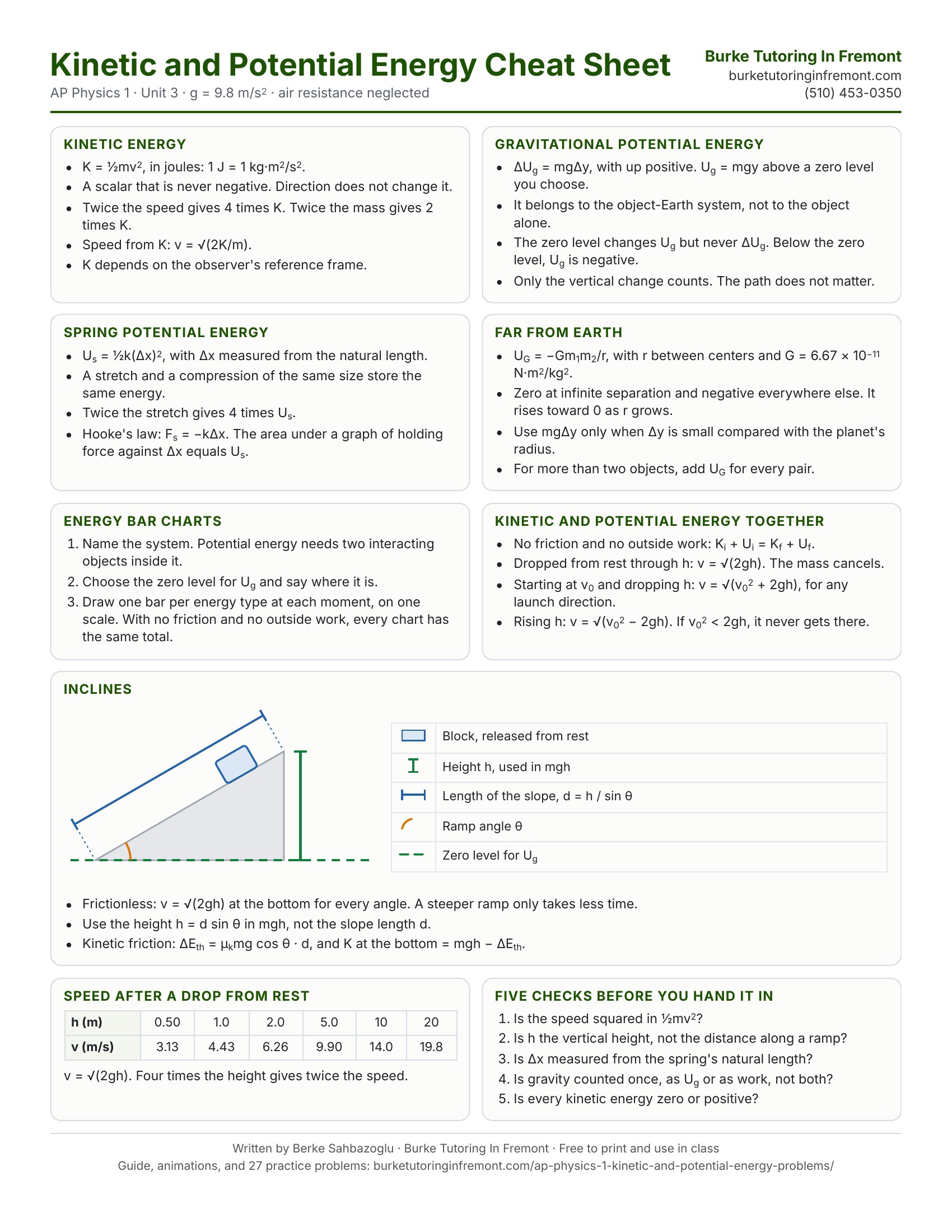
Kinetic and Potential Energy Cheat Sheet
AP Physics 1 · Unit 3 · g = 9.8 m/s2 · air resistance neglected
Kinetic energy
- K = ½mv2, in joules: 1 J = 1 kg·m2/s2.
- A scalar that is never negative. Direction does not change it.
- Twice the speed gives 4 times K. Twice the mass gives 2 times K.
- Speed from K: v = √(2K/m).
- K depends on the observer's reference frame.
Gravitational potential energy
- ΔUg = mgΔy, with up positive. Ug = mgy above a zero level you choose.
- It belongs to the object-Earth system, not to the object alone.
- The zero level changes Ug but never ΔUg. Below the zero level, Ug is negative.
- Only the vertical change counts. The path does not matter.
Spring potential energy
- Us = ½k(Δx)2, with Δx measured from the natural length.
- A stretch and a compression of the same size store the same energy.
- Twice the stretch gives 4 times Us.
- Hooke's law: Fs = −kΔx. The area under a graph of holding force against Δx equals Us.
Far from Earth
- UG = −Gm1m2/r, with r between centers and G = 6.67 × 10⁻¹¹ N·m2/kg2.
- Zero at infinite separation and negative everywhere else. It rises toward 0 as r grows.
- Use mgΔy only when Δy is small compared with the planet's radius.
- For more than two objects, add UG for every pair.
Energy bar charts
- Name the system. Potential energy needs two interacting objects inside it.
- Choose the zero level for Ug and say where it is.
- Draw one bar per energy type at each moment, on one scale. With no friction and no outside work, every chart has the same total.
Kinetic and potential energy together
- No friction and no outside work: Ki + Ui = Kf + Uf.
- Dropped from rest through h: v = √(2gh). The mass cancels.
- Starting at v0 and dropping h: v = √(v02 + 2gh), for any launch direction.
- Rising h: v = √(v02 − 2gh). If v02 < 2gh, it never gets there.
Inclines
| Block, released from rest | |
| Height h, used in mgh | |
| Length of the slope, d = h / sin θ | |
| Ramp angle θ | |
| Zero level for Ug |
- Frictionless: v = √(2gh) at the bottom for every angle. A steeper ramp only takes less time.
- Use the height h = d sin θ in mgh, not the slope length d.
- Kinetic friction: ΔEth = μkmg cos θ · d, and K at the bottom = mgh − ΔEth.
Speed after a drop from rest
| h (m) | 0.50 | 1.0 | 2.0 | 5.0 | 10 | 20 |
|---|---|---|---|---|---|---|
| v (m/s) | 3.13 | 4.43 | 6.26 | 9.90 | 14.0 | 19.8 |
v = √(2gh). Four times the height gives twice the speed.
Five checks before you hand it in
- Is the speed squared in ½mv2?
- Is h the vertical height, not the distance along a ramp?
- Is Δx measured from the spring's natural length?
- Is gravity counted once, as Ug or as work, not both?
- Is every kinetic energy zero or positive?
Print it, or keep this page open while you work. Download the cheat sheet PDF or the image version.
Keep going
Energy methods connect back to Unit 1. In the kinematics free-response set, Question 5 accepts an energy solution for the model rocket's height and Question 8 accepts the work-energy theorem for stopping distance. For the rest of motion in one and two dimensions, start from the AP Physics 1 kinematics worksheets and study guides.
Working through energy problems with a tutor
I tutor AP Physics 1 in person across Fremont, Newark, and Union City. A session on this unit can focus on naming the system before writing an energy equation, choosing a zero level, and checking whether an object can reach a height before solving for its speed. Bring a recent assignment or test so we can start from the problems that cost you points.
Call or text to talk about your student's class.
(510) 453-0350Serving Fremont, Newark, and Union City. AP coursework is priced separately from standard in-home subjects. See class rates. If algebra or trigonometry is what slows the physics down, see math tutoring in Fremont.
Curriculum reference
Scope checked against the College Board's AP Physics 1 Course and Exam Description. This guide covers topics 3.1 (translational kinetic energy) and 3.3 (potential energy) from Unit 3, Work, Energy, and Power, which is weighted at 18% to 23% of the multiple-choice section. The energy bar charts, the incline animation, and the worked examples also use ideas from topic 3.4 (conservation of energy). Topics 3.2 (work) and 3.5 (power) are not covered here. This guide is an independent study resource. AP is a trademark registered by the College Board, which is not affiliated with and does not endorse this resource.