AP Physics 1 · Unit 3 · Work, energy, and power
AP Physics 1 Work, Energy, and Power Problems
Guide, incline animation, animated worked examples, cheat sheet, worksheet, and answer key
Work is energy transferred to or from a system by a force, power is the rate of that transfer, and conservation of energy accounts for where the energy goes. This guide covers work, energy, and power problems for AP Physics 1: work done by constant and changing forces, the work-energy theorem, conservation of energy when friction acts, and average and instantaneous power. An incline animation tracks the work done by each force on a crate, four animated worked examples show the ideas in motion, and the page ends with 27 practice problems and a printable worksheet with an answer key.
Browse all AP Physics 1 Unit 3 worksheets, study guides, and practice tests.

Written by Berke Sahbazoglu · Owner and tutor, Burke Tutoring In Fremont · BA Biochemistry, Washington University in St. Louis · 10+ years tutoring math and science, including AP Physics 1 · Full bio
Published November 03, 2026 · Last updated November 03, 2026 · Free to print and use in class
| Course | AP Physics 1, Unit 3, topics 3.2 (work), 3.4 (conservation of energy), and 3.5 (power). See the topic list. |
|---|---|
| Problem types | Work by a force at an angle, work from a force graph, the work-energy theorem and stopping distance, energy with friction and thermal energy, and average and instantaneous power |
| Animations | Incline animation with four scenarios, plus animated worked examples for a changing force, two braking cars, a roller coaster, and two motors |
| Practice | 24 problems in four parts and 3 challenge problems, with answers on the page |
| Printables | Worksheet with answer key, one-page cheat sheet, and the cheat sheet as an image |
| Assumptions | g = 9.8 m/s2, air resistance neglected unless a problem gives it, and friction coefficients that do not depend on speed |
01 / Energy transfer
Work done by a constant force
Work is the energy a force transfers into or out of a system while the object it acts on moves. Only the part of the force along the displacement does work. That component is written F∥, and for a constant force:
W = F∥d = Fd cos θ
θ is the angle between the force and the displacement.
1 J = 1 N·m
Work and energy are both measured in joules.
Wnet = W1 + W2 + …
Net work is the sum of the work done by each force.
F and d are magnitudes, so the sign of the work comes from cos θ. Work is a scalar: it can be positive, negative, or zero, but it has no direction.
| Applied force, F | |
| Horizontal component, F cos θ = F∥ | |
| Vertical component, F sin θ | |
| Angle θ between F and d | |
| Displacement, d |
A force F pulls a box at angle θ above the floor while the box moves along the floor. Only the component along the displacement, F cos θ, does work on the box.
Positive, negative, and zero work
| Angle θ between F and d | cos θ | Work | Example |
|---|---|---|---|
| 0° | 1 | Positive, W = Fd | A horizontal push on a box sliding in the direction of the push |
| Between 0° and 90° | Positive | Positive | A rope pulling a sled at an angle above the snow |
| 90° | 0 | Zero | The normal force on a box sliding across a level floor |
| Between 90° and 180° | Negative | Negative | Gravity on a ball rising at an angle after it is thrown |
| 180° | −1 | Negative, W = −Fd | Kinetic friction on a sliding box |
Positive work transfers energy into the object, and negative work takes energy out. A force does zero work when the object does not move or when the force is perpendicular to the motion. Holding a heavy box still tires your arms, but it does no work on the box, because d = 0.
Friction work depends on the normal force, and FN is not always mg. Find it from the forces perpendicular to the surface before you calculate friction, as worked example 1 does.
Work done by gravity
Near Earth's surface, gravity pulls on an object with a force mg straight down. The work it does depends only on the change in height:
Wg = −mgΔy
Negative when the object rises, positive when it drops.
The path does not matter. A crate pulled up a ramp and a crate lifted straight up to the same height have the same work done on them by gravity. Section 6 shows this in the incline animation.
Worked example 1 · Work by each force
A sled pulled by a rope at an angle
A child pulls a 25.0 kg sled 12.0 m across level snow with a rope held at 30.0° above the horizontal. The tension in the rope is 80.0 N, and the coefficient of kinetic friction between the sled and the snow is 0.150. The sled starts from rest. Find (a) the work done on the sled by each force, (b) the net work, and (c) the sled's speed after 12.0 m.
| Tension T = 80.0 N, 30.0° above the horizontal | |
| Normal force FN = 205 N | |
| Gravity mg = 245 N | |
| Kinetic friction, 30.75 N | |
| Displacement d = 12.0 m |
Forces on the sled, drawn to scale from its center.
- List the forces. Tension at 30.0° above the horizontal, gravity mg = 25.0(9.8) = 245 N down, the normal force up, and kinetic friction backward. The displacement is 12.0 m forward.
- Tension. The angle between the tension and the displacement is 30.0°. The component along the motion is 80.0 cos 30.0° = 69.28 N, so WT = 69.28(12.0) = 831 J.
- Normal force and friction. Vertically, FN + 80.0 sin 30.0° = 245, so FN = 245 − 40.0 = 205 N. Friction is μkFN = 0.150(205) = 30.75 N, opposite the motion, so Wf = −30.75(12.0) = −369 J.
- Gravity and the normal force. Both are perpendicular to the displacement, so each does 0 J.
- Net work. Wnet = 831.4 − 369 = 462 J.
- Speed. By the work-energy theorem, the net work equals the gain in kinetic energy: 462.4 = ½(25.0)v2, so v = 6.08 m/s.
Answer: (a) WT = 831 J, Wf = −369 J, and Wg = WN = 0. (b) Wnet = 462 J. (c) v = 6.08 m/s.
With a horizontal rope the normal force would be the full 245 N, and friction would do −441 J over the same 12.0 m instead of −369 J.
02 / Changing forces
Work from a force versus position graph
W = F∥d applies only to a constant force. When the force changes with position, graph F∥ against position x. The work done between two positions is the area between the graph and the x-axis over that interval.
- Area above the x-axis is positive work. Area below it is negative work.
- Split the region into rectangles, triangles, and trapezoids, find each area, and add them with their signs.
- The area has units of newtons times meters, which is joules.
A spring is the standard example. The force needed to stretch a spring is proportional to the stretch, so its graph is a straight line through the origin, and the area under it, the triangle ½kx2, is the work done to stretch the spring by x. When the graph shows the net force on an object, the area also equals the change in the object's kinetic energy, which is how worked example 2 finds speeds without the acceleration at each moment.
Worked example 2 · Animated
A cart pushed by a changing force
A 2.00 kg cart starts from rest at x = 0 on a level, frictionless track. A horizontal force acts on it: 4.00 N at x = 0, rising steadily to 8.00 N at x = 2.00 m, constant at 8.00 N until x = 4.00 m, then decreasing steadily to 0 at x = 6.00 m and to −4.00 N at x = 7.00 m. The graph in the animation shows this force. Find (a) the work done on the cart from 0 to 4.00 m and its speed at 4.00 m, (b) the work done from 0 to 7.00 m and its speed at 7.00 m, and (c) where the cart is fastest and how fast it goes there.
| Cart, 2.00 kg, on a frictionless track | |
| Force on the cart, to scale | |
| Force against position | |
| Work done so far, force forward | |
| Work done so far, force backward | |
| Start at x = 0 and finish at x = 7.00 m |
- Split the graph into pieces. From 0 to 2.00 m, a trapezoid: ½(4.00 + 8.00)(2.00) = 12.0 J. From 2.00 to 4.00 m, a rectangle: 8.00(2.00) = 16.0 J. From 4.00 to 6.00 m, a triangle: ½(2.00)(8.00) = 8.00 J. From 6.00 to 7.00 m, a triangle below the axis: ½(1.00)(−4.00) = −2.00 J.
- (a) W = 12.0 + 16.0 = 28.0 J. Gravity and the normal force are perpendicular to the motion, so this is the net work: ½(2.00)v2 = 28.0 and v = 5.29 m/s.
- (b) W = 28.0 + 8.00 − 2.00 = 34.0 J, so ½(2.00)v2 = 34.0 and v = 5.83 m/s.
- (c) The cart speeds up while the force points forward and slows down once it points backward, so it is fastest at x = 6.00 m, where the force changes sign. There W = 36.0 J and v = 6.00 m/s.
Answer: (a) 28.0 J and 5.29 m/s. (b) 34.0 J and 5.83 m/s. (c) 6.00 m/s at x = 6.00 m.
03 / Work and speed
The work-energy theorem
The work-energy theorem says that the net work done on an object equals the change in its kinetic energy:
Wnet = ΔK
The sum of the work done by every force on the object.
ΔK = ½mvf2 − ½mvi2
Find each kinetic energy, then subtract.
Positive net work speeds an object up, negative net work slows it down, and zero net work leaves its speed unchanged even when individual forces do work. A box pushed across a floor at constant speed has positive work from the push and an equal amount of negative work from friction.
The theorem treats the object as a single particle, so it fits problems about one object, such as a ball, a block, or a car. Use it when a problem gives forces and distances and asks for a speed, or gives speeds and asks for a force or a distance. Time does not appear in it.
Stopping distance
When a car skids to a stop on a level road, kinetic friction is the only force that does work on it, and that work removes all of its kinetic energy: −μkmg·d = 0 − ½mv2. Solving for the distance:
d = v2 / (2μkg)
Mass cancels. Twice the speed gives four times the distance.
The same result comes from v2 = v02 + 2aΔx with a = −μkg, one of the constant-acceleration equations in the kinematics study guide. Because d depends on v2, a graph of stopping distance against speed is half of a parabola, the shape practiced in the graphing quadratic functions worksheet.
Worked example 3 · Animated
Stopping distance at two speeds
Two identical 1,500 kg cars lock their brakes and skid to a stop on dry, level pavement, where μk = 0.700. Car A starts at 15.0 m/s and car B at 30.0 m/s. Find (a) the work done by friction on each car, (b) each stopping distance, and (c) the ratio of the stopping distances.
Time t = 0.00 s
| Quantity | Car A | Car B |
|---|---|---|
| Speed (m/s) | 15.0 | 30.0 |
| Distance (m) | 0.0 | 0.0 |
| Work by friction (kJ) | 0.0 | 0.0 |
| Kinetic energy (kJ) | 168.8 | 675.0 |
| Car A, starts at 15.0 m/s | |
| Car B, starts at 30.0 m/s | |
| Start line, where both cars lock their brakes | |
| Skid marks | |
| Distance marks every 10 m | |
| Stopping point, shown once a car stops |
- (a) Each car ends at rest, so friction does work equal to minus its starting kinetic energy. Car A: W = −½(1,500)(15.0)2 = −1.69 × 10⁵ J. Car B: W = −½(1,500)(30.0)2 = −6.75 × 10⁵ J.
- (b) The friction force on each car is μkmg = 0.700(1,500)(9.8) = 10,290 N. Car A: d = 168,750 / 10,290 = 16.4 m. Car B: d = 675,000 / 10,290 = 65.6 m. Both match d = v2 / (2μkg) with μkg = 6.86 m/s2.
- (c) 65.6 / 16.4 = 4.00. Doubling the speed multiplies the kinetic energy by four, and the same friction force needs four times the distance to remove it.
Answer: (a) −1.69 × 10⁵ J for car A and −6.75 × 10⁵ J for car B. (b) 16.4 m and 65.6 m. (c) Car B skids 4.00 times as far.
A full stopping distance also includes the distance covered during the driver's reaction time, which grows in proportion to v rather than v2. Question 8 of the kinematics FRQ set combines the two parts.
04 / Energy accounting
Conservation of energy, with and without friction
Energy is conserved in every interaction. What changes from one problem to the next is the system you choose and whether energy crosses its boundary. For the mechanical models used here, where energy crosses the system boundary only through work:
ΔK + ΔU + ΔEth = Wext
Wext is the work done by forces from outside the system.
Ki + Ui = Kf + Uf
When Wext = 0 and no friction or drag acts inside the system.
ΔEth = Ffd
Thermal energy from kinetic friction over a sliding distance d.
Mechanical energy is K + U. It stays constant when nothing outside the system does work on it and no friction or drag acts inside it. Kinetic friction converts mechanical energy into thermal energy in both sliding surfaces, so include both surfaces in the system and count that energy as ΔEth.
Choosing the system
| System | Gravity appears as | Kinetic friction appears as |
|---|---|---|
| The object alone | Work: Wg = −mgΔy | Work: −Ffd |
| The object and Earth | A change in Ug: mgΔy | Work: −Ffd |
| The object, Earth, and the surface | A change in Ug: mgΔy | Thermal energy: ΔEth = Ffd |
All three choices give the same speed. Count gravity once, either as work in the first row or as a change in Ug in the other two. The kinetic and potential energy guide shows the same choice with energy bar charts for a falling ball.
Energy added by an outside force
When a person, a motor, or a rope outside the system pushes or pulls on it, that force's work Wext adds energy to the system, or removes it when the work is negative. A winch that pulls a crate up a ramp at constant speed does work equal to the crate's gain in Ug plus the thermal energy from friction. The incline animation shows that split for a 20.0 kg crate.
Energy gives speeds without directions or times. A ball thrown from a height h at speed v0 lands at √(v02 + 2gh) for any launch angle, which matches the impact speed found from components in the platform case of the projectile motion guide.
Worked example 4 · Animated
A roller coaster with friction and a brake run
A 500 kg roller coaster car starts from rest at point A, 30.0 m above the ground, and rolls down to ground level at B. It climbs to point C at the top of a 22.0 m hill, descends to ground level at D, and enters a level brake run. Between A and C, friction and air resistance convert 1.80 × 10⁴ J of mechanical energy into thermal energy, and they convert another 4.00 × 10³ J between C and D. Find (a) the speed at C, (b) the greatest height hill C could have for the car to reach its top with the same energy loss, and (c) the braking distance if the brakes exert a constant 5.00 × 10³ N force on the car.
| A: start, 30.0 m above the ground | |
| B: ground level | |
| C: top of the 22.0 m hill | |
| D: ground level, start of the brake run | |
| Brake run, 25.0 m to the stopping point | |
| Car, 500 kg |
- Choose the system: the car, the track, the air, and Earth. No outside force does work on it, so its total energy stays at the starting value, UA = mghA = 500(9.8)(30.0) = 147,000 J. Heights are measured from the ground.
- (a) KC = UA − UC − ΔEth = 147,000 − 500(9.8)(22.0) − 18,000 = 147,000 − 107,800 − 18,000 = 21,200 J. Then ½(500)vC2 = 21,200, so vC = 9.21 m/s.
- (b) The car just reaches the top when KC = 0, so mgh = 147,000 − 18,000 = 129,000 J. With mg = 4,900 N, h = 129,000 / 4,900 = 26.3 m. A taller hill would need a negative kinetic energy at the top, so the car would roll back before reaching it.
- (c) At D the car is at ground level with KD = 147,000 − 18,000 − 4,000 = 125,000 J, a speed of 22.4 m/s. On the level brake run, the brakes do −Fbd of work on the car and stop it, so 5,000d = 125,000 and d = 25.0 m.
Answer: (a) 9.21 m/s. (b) 26.3 m. (c) 25.0 m.
05 / Rate of transfer
Power: how fast energy is transferred
Power is the rate at which energy is transferred into or out of a system, or converted from one form to another inside it. Its unit is the watt: 1 W = 1 J/s.
Pavg = W / Δt = ΔE / Δt
Average power over a time interval.
P = F∥v = Fv cos θ
Power from a constant force on an object moving at speed v.
P = mgv
Lifting at constant speed v.
Two motors that lift the same crate to the same height do the same work, and the one that finishes sooner has the greater power. When a constant force moves an object at constant speed, the average and instantaneous power are equal. When the speed changes, P = Fv gives the power at the moment the speed is v, and W / Δt gives the average over the interval.
Watts and kilowatt-hours
A kilowatt (kW) is 1,000 W. A kilowatt-hour (kWh) is a unit of energy: the energy transferred in one hour at a rate of 1 kW, which is 1,000 J/s × 3,600 s = 3.6 × 10⁶ J. Electric bills charge for energy in kilowatt-hours. The U.S. Energy Information Administration's page on measuring electricity works through the same conversion with a light bulb. Horsepower is another power unit: 1 hp is about 746 W.
Worked example 5 · Animated
Two motors, the same work, different power
Motor A and motor B each lift a 120 kg crate 9.00 m straight up at constant speed. Motor A takes 12.0 s and motor B takes 4.00 s. Find (a) the work each motor does, (b) each motor's average power, and (c) the force motor B exerts and its power while the crate is moving.
Time t = 0.00 s
| Quantity | Motor A | Motor B |
|---|---|---|
| Height (m) | 0.00 | 0.00 |
| Work done (J) | 0 | 0 |
| Power (W) | 882 | 2,646 |
| Crate lifted by motor A, 12.0 s | |
| Crate lifted by motor B, 4.00 s | |
| Height marks every 1 m | |
| Target height, 9.00 m | |
| Work by motor A against time | |
| Work by motor B against time |
- (a) At constant speed ΔK = 0, so each motor's work equals the crate's gain in Ug: W = mgh = 120(9.8)(9.00) = 10,584 J, or 1.06 × 10⁴ J for each motor.
- (b) PA = 10,584 / 12.0 = 882 W. PB = 10,584 / 4.00 = 2,646 W, or 2.65 kW, which is 3.00 times as much.
- (c) At constant velocity the cable force balances the weight: F = mg = 120(9.8) = 1,176 N, or 1.18 × 10³ N. Motor B lifts at v = 9.00 / 4.00 = 2.25 m/s, so P = Fv = 1,176(2.25) = 2,646 W. That equals its average power because the speed is constant. Motor A lifts at 0.750 m/s with the same force.
Answer: (a) 1.06 × 10⁴ J each. (b) 882 W and 2.65 kW. (c) 1.18 × 10³ N and 2.65 kW.
On the graph in the animation, the slope of each work line is that motor's power. Both lines end at the same height, 10,584 J.
06 / Animation
Work on an incline: ramp versus lift
A ramp lets you raise a load with a smaller force, but the force has to act over a longer distance. Without friction the work comes out the same as lifting straight up: pulling a crate up a ramp at angle θ at constant speed takes a force mg sin θ over a distance h / sin θ, and the product is mgh.
| Crate of mass m, part way up | |
| Path of the crate | |
| Height gained, h (the same on both sides) | |
| Pull at constant speed: mg straight up, mg sin θ along a frictionless ramp (half as much at 30°) |
The crate gains the same height h on both paths. On a 30° ramp the pull is half the weight, and the path is twice as long.
F = mg sin θ
Pull needed at constant speed on a frictionless ramp.
F = mg(sin θ + μk cos θ)
Pull needed at constant speed with kinetic friction.
Wpull = mgh + μkmg cos θ · L
Work by the pull over a ramp of length L.
Friction adds work without adding height, and that extra work ends up as thermal energy in the crate and the ramp. The normal force is perpendicular to the ramp, so it does no work in any of these cases.
Incline animation
Choose a scenario and press Play. In the first three, a winch pulls a 20.0 kg crate up a ramp 1.50 m high at a constant 0.500 m/s, and the bars show the work done on the crate by each force so far. In the last one, the winch is off and the crate slides down from rest.
| Crate, 20.0 kg | |
| Winch pull along the ramp | |
| Gravity, mg = 196 N | |
| Normal force, mg cos θ | |
| Kinetic friction, opposite the sliding | |
| Ramp height, 1.50 m in every scenario | |
| Pulley at the top of the ramp, and the winch drum below it |
Every animation on this page replays a fixed scenario from this page. If your device is set to reduce motion, Play jumps to the next pause point or the end, and Step moves forward in small time steps.
| Scenario | Winch force | Distance | Work by the winch | Thermal energy | Winch power at 0.500 m/s |
|---|---|---|---|---|---|
| 30°, no friction | 98.0 N | 3.00 m | 294 J | 0 | 49.0 W |
| 60°, no friction | 170 N | 1.73 m | 294 J | 0 | 84.9 W |
| 30°, μk = 0.300 | 149 N | 3.00 m | 447 J | 153 J | 74.5 W |
| 30°, μk = 0.300, sliding down | Off | 3.00 m | None | 153 J | None |
In the first three rows the crate gains (20.0)(9.8)(1.50) = 294 J of Ug. The steeper ramp needs a larger pull and more power at the same speed, but it is shorter, so the job takes less time and the work is unchanged. In the last row gravity does +294 J and friction does −153 J, so the net work is 141.2 J and the crate reaches the bottom at √(2(141.2) / 20.0) = 3.76 m/s.
07 / Learn from errors
Where students lose points on work and energy problems
Each case below describes an error in a work, energy, or power problem and a check you can run on your own work.
1. The wrong angle in W = Fd cos θ
θ is the angle between the force and the displacement, which is not always the angle given in the problem. For a crate pulled up a 30° ramp, gravity points straight down while the crate moves up the slope, so the angle between them is 90° + 30° = 120°.
Check: Draw the force and the displacement tail to tail and measure the angle between them. Then check the sign: cos 120° is negative, and gravity does negative work on a rising crate.
2. Counting gravity twice
Writing both the work done by gravity and the change in Ug in one equation counts the same energy transfer twice, and the kinetic energy comes out doubled.
Check: Name the system before you write the equation. If Earth is inside the system, use ΔUg and leave Wg out.
3. Assuming FN = mg
The normal force equals mg only on a level surface with no other vertical forces. A rope pulling up at an angle reduces it, a push down at an angle increases it, and on an incline it is mg cos θ. Friction is μkFN, so a wrong normal force gives a wrong friction work.
Check: Write the force balance perpendicular to the surface, solve for FN, and only then find friction.
4. Work from a force that nothing moves along
A force can take effort to exert and still do no work. Holding a box still, or carrying it across a room at constant height and speed, takes effort, but the upward force from your hands has no displacement along it.
Check: Ask whether the object has a displacement component along the force. If it does not, W = 0.
5. Squaring the change in speed
ΔK = ½mvf2 − ½mvi2. Squaring the change in speed first, ½m(vf − vi)2, gives a different number. For a 1,000 kg car that speeds up from 10.0 m/s to 20.0 m/s, ΔK = 150,000 J, while ½m(Δv)2 gives 50,000 J.
Check: Find the kinetic energy at each moment, then subtract.
6. Mixing up power and energy
Watts measure a rate. Joules and kilowatt-hours measure an amount. A related error is using average speed in P = Fv to calculate instantaneous power. For a car that speeds up from rest under a constant force, the power at the end is twice the average power (problem 24).
Check: Check the units the question needs: J or kWh for an amount of energy, W for a rate. Use P = Fv with the speed at that instant for instantaneous power, and W / Δt for an interval.
08 / Practice
27 work, energy, and power problems with answers
The problems are adapted from problem types I use in AP Physics 1 tutoring sessions. Use g = 9.8 m/s2, neglect air resistance unless a problem gives it, and treat surfaces as frictionless unless a friction coefficient or force is given. Keep unrounded values between steps and round final answers to three significant figures. Answers are in the collapsible key under each part, and the printable worksheet has the same problems with work space and a full answer key.
Part A: Work
W = F∥d = Fd cos θ for a constant force, and the area under a force graph for a changing one.
- A student pushes a 15.0 kg box 4.00 m across a level floor with a horizontal force of 60.0 N. The friction force on the box is 40.0 N. Find the work done on the box by (a) the push, (b) friction, (c) gravity, and (d) the normal force. (e) Find the net work.
- A rope pulls a cart 20.0 m along level ground. The tension is 50.0 N and the rope makes an angle of 35.0° with the ground. (a) How much work does the tension do? (b) How much work would the same tension do if the rope were horizontal?
- A person lifts a 2.00 kg book at constant velocity from the floor to a shelf 1.80 m high, then carries it 3.00 m horizontally at constant velocity and constant height. Find the work done on the book by the person (a) during the lift and (b) during the walk. (c) Find the work done by gravity over the whole trip.
- A 60.0 kg skier slides 120 m down a straight slope inclined at 25.0° below the horizontal. (a) How far does the skier drop vertically? (b) How much work does gravity do on the skier?
- The graph shows the horizontal force on a 4.00 kg crate on a level, frictionless floor as it moves from x = 0 to x = 8.00 m. The force is 12.0 N from 0 to 3.00 m, then decreases steadily to 0 at 5.00 m and to −6.00 N at 8.00 m. Find the work done by the force (a) from 0 to 5.00 m, (b) from 5.00 m to 8.00 m, and (c) from 0 to 8.00 m. (d) If the crate starts from rest at x = 0, at what position is its speed greatest?
Key Force on the crate, F F = 0 - A 0.250 kg puck on a frictionless, level table is tied to a peg by a string and moves in a circle of radius 0.800 m at constant speed. The tension in the string is 5.00 N. How much work does the tension do on the puck during (a) a quarter of a revolution and (b) one full revolution? Explain.
Show answers for Part A
- (a) 60.0(4.00) = 240 J. (b) −40.0(4.00) = −160 J. (c) 0, because gravity is perpendicular to the displacement. (d) 0, for the same reason. (e) 240 − 160 = 80.0 J.
- (a) W = 50.0(20.0) cos 35.0° = 819 J. (b) W = 50.0(20.0) = 1.00 × 10³ J. Only the component along the ground does work, so the angled rope does less.
- (a) At constant velocity the hand pushes up with mg = 19.6 N through 1.80 m: W = 19.6(1.80) = 35.3 J. (b) 0. The hand’s force is vertical and the displacement is horizontal. (c) Wg = −mgΔy = −35.3 J. The walk adds nothing because the height does not change.
- (a) Drop = 120 sin 25.0° = 50.7 m. (b) Wg = mg × drop = 60.0(9.8)(50.71) = 2.98 × 10⁴ J. The angle between gravity and the motion is 65.0°, and mg(120) cos 65.0° gives the same result.
- (a) Rectangle 12.0(3.00) = 36.0 J plus triangle ½(2.00)(12.0) = 12.0 J, total 48.0 J. (b) Triangle below the axis: ½(3.00)(−6.00) = −9.00 J. (c) 48.0 − 9.00 = 39.0 J. (d) At x = 5.00 m. The force points forward up to that position and backward after it, so the crate speeds up until 5.00 m and then slows down.
- (a) 0 and (b) 0. The tension points toward the peg, perpendicular to the puck’s velocity at every point of the circle, so no part of the path has a displacement component along the force. The speed stays constant, which agrees with zero net work.
Part B: The work-energy theorem
Wnet = ΔK = ½mvf2 − ½mvi2.
- A pitcher throws a 0.145 kg baseball. The ball starts from rest and leaves the hand at 40.0 m/s after the hand pushes it along a 1.80 m path. Ignoring other forces, find (a) the work done on the ball by the pitcher and (b) the average force the hand exerts along the path.
- A 1,200 kg car traveling at 25.0 m/s brakes to a stop in 50.0 m on a level road. Find (a) the work done on the car by the braking force and (b) the size of the average braking force.
- A cyclist skids to a stop from 6.00 m/s in 4.50 m. On the same road, with the same friction, how far would she skid from 9.00 m/s?
- The graph shows the net horizontal force on a 0.500 kg cart that starts from rest at x = 0. The force is 2.00 N at x = 0, rises steadily to 6.00 N at x = 0.200 m, stays at 6.00 N until x = 0.400 m, then decreases steadily to 0 at x = 0.600 m. Find the cart’s speed at (a) x = 0.400 m and (b) x = 0.600 m.
Key Net force on the cart, F - A 3.00 kg block is pushed so that it starts sliding up a 20.0° incline at 6.00 m/s. The coefficient of kinetic friction is 0.250. How far up the incline does the block slide before it stops?
- Carts P and Q start from rest on a level, frictionless track. Q has twice the mass of P. The same constant force F pushes each cart through the same distance d. Compare (a) their final kinetic energies and (b) their final speeds.
Show answers for Part B
- (a) W = ΔK = ½(0.145)(40.0)2 = 116 J. (b) F = W / d = 116 / 1.80 = 64.4 N.
- (a) W = ΔK = 0 − ½(1,200)(25.0)2 = −3.75 × 10⁵ J. (b) F = 375,000 / 50.0 = 7.50 × 10³ N.
- Friction removes all the kinetic energy, so μkmg·d = ½mv2 and d is proportional to v2. (9.00 / 6.00)2 = 2.25, so d = 2.25(4.50) = 10.1 m.
- Areas: trapezoid ½(2.00 + 6.00)(0.200) = 0.800 J, rectangle 6.00(0.200) = 1.20 J, triangle ½(0.200)(6.00) = 0.600 J. (a) W = 0.800 + 1.20 = 2.00 J = ½(0.500)v2, so v = 2.83 m/s. (b) W = 2.00 + 0.600 = 2.60 J, so v = 3.22 m/s.
- Both forces along the incline oppose the motion: the component of gravity, mg sin 20.0° = 10.1 N, and friction, μkmg cos 20.0° = 6.91 N. Work-energy theorem: −(10.06 + 6.907)d = 0 − ½(3.00)(6.00)2, so 16.96d = 54.0 and d = 3.18 m.
- (a) Equal. Each cart receives work Fd, so each ends with K = Fd. (b) ½mvP2 = ½(2m)vQ2, so vP = √2 vQ, about 1.41 times as fast. The lighter cart is faster.
Part C: Conservation of energy
Name the system first. Include thermal energy, ΔEth, when friction or air resistance acts.
- A 450 kg roller coaster car passes over the top of a 40.0 m hill at 4.00 m/s. Ignoring friction, find its speed (a) at ground level and (b) at the top of the next hill, which is 25.0 m high.
- A 25.0 kg child slides from rest down a playground slide whose top is 2.50 m above its bottom. Her speed at the bottom is 4.20 m/s. (a) How much mechanical energy became thermal energy? (b) What fraction of the starting gravitational potential energy is that?
- A 0.800 kg block is pushed against a horizontal spring (k = 500 N/m), compressing it 0.200 m, and released from rest. The block is not attached to the spring, and μk = 0.300 between the block and the floor. Find (a) the block’s speed when it leaves the spring at the spring’s relaxed length and (b) the total distance it slides from the release point before stopping.
- A 0.600 kg ball is thrown straight up at 15.0 m/s and reaches a maximum height of 10.5 m above the release point. (a) How much mechanical energy did air resistance remove on the way up? (b) What was the average force of air resistance? (c) Will the ball return to the release point faster or slower than 15.0 m/s? Explain.
- A 2.00 kg ball falls 5.00 m from rest. Student 1 writes that gravity does +98.0 J of work on the ball. Student 2 writes that the gravitational potential energy decreases by 98.0 J. (a) Who is right? (b) What goes wrong if one energy equation includes both terms? (c) Find the ball’s speed after it has fallen 5.00 m.
- A 4.00 kg block slides from rest down a frictionless curved ramp from a height of 1.20 m, then moves onto a level floor where μk = 0.400. Find (a) its speed at the bottom of the ramp and (b) how far it slides on the floor before stopping.
Show answers for Part C
- With no friction, ½v2 = ½v02 + g × (height dropped), and the mass cancels. (a) v = √(4.002 + 2(9.8)(40.0)) = √800 = 28.3 m/s. (b) The car is 15.0 m below its starting height: v = √(4.002 + 2(9.8)(15.0)) = √310 = 17.6 m/s.
- Ug = 25.0(9.8)(2.50) = 612.5 J and K = ½(25.0)(4.20)2 = 220.5 J. (a) ΔEth = 612.5 − 220.5 = 392 J. (b) 392 / 612.5 = 0.640, or 64.0%.
- Us = ½(500)(0.200)2 = 10.0 J, and the friction force is μkmg = 0.300(0.800)(9.8) = 2.352 N. (a) While the spring pushes, friction converts 2.352(0.200) = 0.470 J: ½(0.800)v2 = 10.0 − 0.470, so v = 4.88 m/s. (b) All 10.0 J ends up as thermal energy: 2.352d = 10.0, so d = 4.25 m.
- K0 = ½(0.600)(15.0)2 = 67.5 J, and at the top Ug = 0.600(9.8)(10.5) = 61.7 J. (a) 67.5 − 61.74 = 5.76 J. (b) F = 5.76 / 10.5 = 0.549 N. (c) Slower. Air resistance removes more energy on the way down, so the ball returns with less than 67.5 J of kinetic energy. Without air resistance it would rise v02/2g = 11.5 m, as in the thrown-up case of the free fall guide.
- (a) Both. Student 1 chose the ball alone as the system, so gravity is an outside force that does work on it. Student 2 chose the ball and Earth, so the same transfer appears as a change in Ug. (b) The equation counts the transfer twice and gives K = 196 J, twice the correct value. (c) ½(2.00)v2 = 98.0, so v = 9.90 m/s.
- (a) v = √(2(9.8)(1.20)) = 4.85 m/s. (b) Friction on the floor turns all of mgh into thermal energy: mgh = μkmg·d, so d = h / μk = 1.20 / 0.400 = 3.00 m. The mass cancels.
Part D: Power
Pavg = W / Δt = ΔE / Δt, and P = F∥v for a constant force on an object moving at speed v.
- A 55.0 kg student climbs a flight of stairs 4.20 m high in 6.00 s. What is her average power output against gravity?
- A motor lifts a 300 kg freight elevator at a constant 1.50 m/s. Ignoring friction, what power does the motor deliver?
- A car’s engine delivers 30.0 kW to the wheels while the car moves at a constant 25.0 m/s on a level road. What is the total force of air resistance and rolling friction on the car?
- A 1,500 W hair dryer runs for 12.0 minutes. Find the energy it uses (a) in joules and (b) in kilowatt-hours.
- A winch pulls a 90.0 kg crate up a 15.0° ramp at a constant 0.800 m/s. The coefficient of kinetic friction between the crate and the ramp is 0.200. What power does the winch deliver?
- A 1,000 kg car speeds up from rest to 20.0 m/s in 8.00 s on a level road. Ignore friction and assume the net force is constant. Find (a) the average power delivered to the car and (b) the instantaneous power at t = 8.00 s.
Show answers for Part D
- W = mgh = 55.0(9.8)(4.20) = 2,264 J. P = 2,264 / 6.00 = 377 W.
- At constant speed the motor’s force equals mg, so P = mgv = 300(9.8)(1.50) = 4,410 W = 4.41 kW.
- At constant speed the driving force equals the resistive force. F = P / v = 30,000 / 25.0 = 1.20 × 10³ N.
- (a) E = Pt = 1,500(720) = 1.08 × 10⁶ J. (b) E = 1.50 kW × 0.200 h = 0.300 kWh.
- At constant speed the pull is mg(sin 15.0° + μk cos 15.0°) = 882(0.2588 + 0.1932) = 399 N. P = Fv = 398.7(0.800) = 319 W.
- (a) ΔK = ½(1,000)(20.0)2 = 2.00 × 10⁵ J, so Pavg = 200,000 / 8.00 = 25.0 kW. (b) a = 20.0 / 8.00 = 2.50 m/s2, so F = ma = 2.50 × 10³ N and P = Fv = 2,500(20.0) = 50.0 kW. The speed grows steadily from 0 to 20.0 m/s, so the average power is half the final power.
Challenge problems
Each one combines two ideas from this page.
- A 2.00 kg block is dropped from rest 0.500 m above the top of a vertical spring with k = 800 N/m. Find the maximum compression of the spring.
- A 200 kg roller coaster car starts from rest and goes around a vertical loop of radius 8.00 m, as in the figure. (a) Without friction, what is the smallest starting height above the bottom of the loop that keeps the car on the track at the top of the loop? (b) If friction converts 4,900 J to thermal energy between the start and the top of the loop, what starting height is needed?
Key Car at the start, at rest Starting height h above the bottom of the loop Loop radius R = 8.00 m Top of the loop - An 800 kg elevator car is connected by a cable over a pulley to a 650 kg counterweight. The car rises at a constant 2.00 m/s. Ignoring friction and the mass of the cable, what power must the motor supply? What power would it need without the counterweight?
Show answers for the challenge problems
- At maximum compression x the block is momentarily at rest, and it has fallen 0.500 + x. Energy: mg(0.500 + x) = ½kx2, so 400x2 − 19.6x − 9.8 = 0. The quadratic formula gives x = [19.6 + √(19.62 + 4(400)(9.8))] / 800 = 0.183 m. The other root is negative.
- At the smallest possible speed at the top, the normal force is zero and gravity alone provides the centripetal force: mg = mv2/R, so v2 = gR = 78.4 m2/s2. (a) mgh = mg(2R) + ½m(gR), so h = 2.5R = 20.0 m. (b) 200(9.8)h = 200(9.8)(16.0) + ½(200)(78.4) + 4,900 = 44,100, so h = 22.5 m.
- Take the car, the counterweight, and Earth as the system. Each second the car gains 800(9.8)(2.00) = 15,680 J of Ug and the counterweight loses 650(9.8)(2.00) = 12,740 J. The kinetic energy stays constant, so the motor supplies the difference: 2,940 J/s = 2.94 kW. Without the counterweight it would supply 15.7 kW.
Free printables · No signup
Work, energy, and power worksheet and cheat sheet (PDF)
Both files are sized for US Letter. Teachers and study groups are welcome to print and distribute them in class. A link back to this page is appreciated but not required.
- Work, energy, and power worksheet11 pages. All 27 problems with work space, in the same order as this page, and a worked answer key on pages 10 to 11.
- Work, energy, and power cheat sheetOne page. Work and its sign, work from force graphs, the work-energy theorem, energy with friction, inclines, power units, and five checks.
- Cheat sheet as an imageThe same page as a 1700 × 2200 pixel JPG for slides, class websites, and note apps.
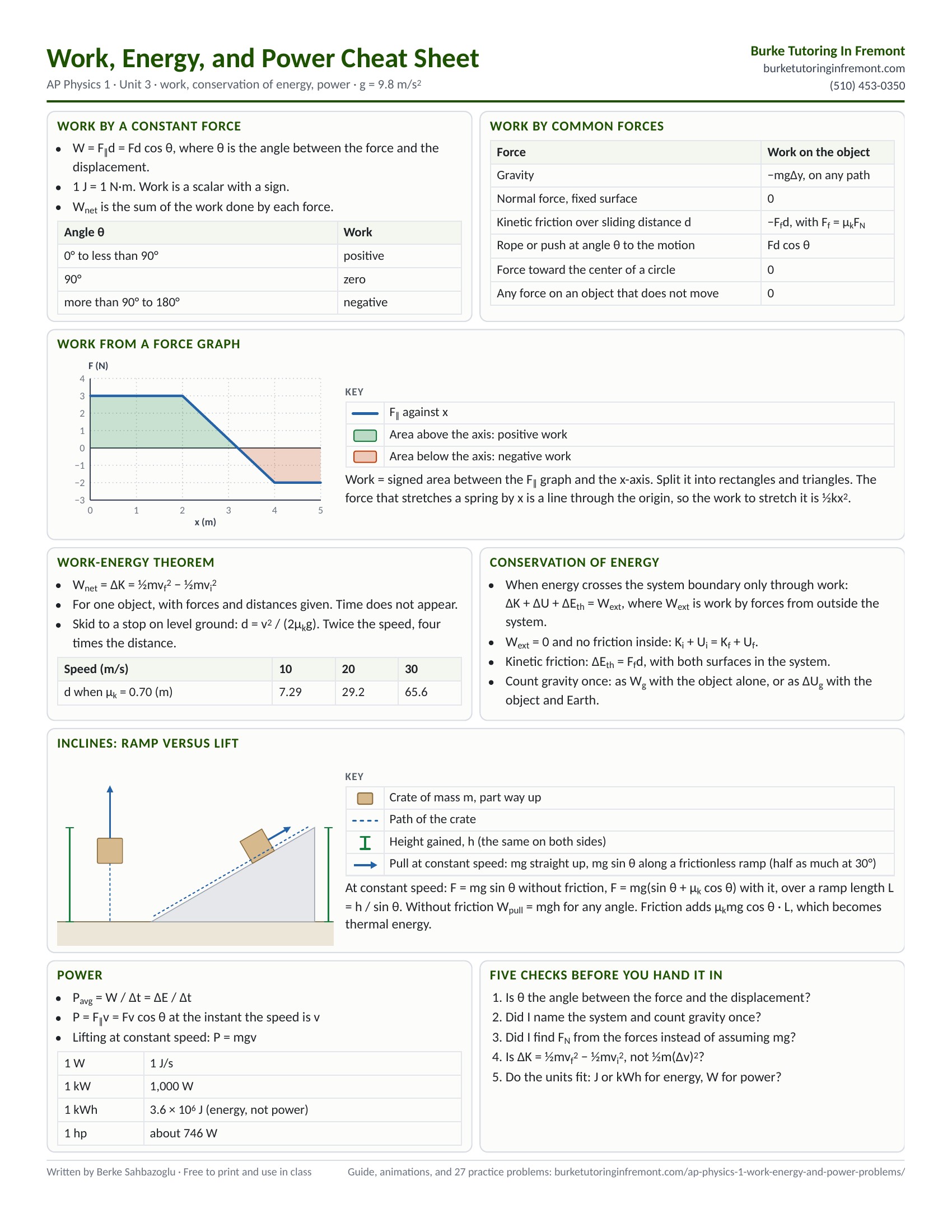
Work, Energy, and Power Cheat Sheet
AP Physics 1 · Unit 3 · work, conservation of energy, power · g = 9.8 m/s2
Work by a constant force
- W = F∥d = Fd cos θ, where θ is the angle between the force and the displacement.
- 1 J = 1 N·m. Work is a scalar with a sign.
- Wnet is the sum of the work done by each force.
| Angle θ | Work |
|---|---|
| 0° to less than 90° | positive |
| 90° | zero |
| more than 90° to 180° | negative |
Work by common forces
| Force | Work on the object |
|---|---|
| Gravity | −mgΔy, on any path |
| Normal force, fixed surface | 0 |
| Kinetic friction over sliding distance d | −Ffd, with Ff = μkFN |
| Rope or push at angle θ to the motion | Fd cos θ |
| Force toward the center of a circle | 0 |
| Any force on an object that does not move | 0 |
Work from a force graph
| F∥ against x | |
| Area above the axis: positive work | |
| Area below the axis: negative work |
Work = signed area between the F∥ graph and the x-axis. Split it into rectangles and triangles. The force that stretches a spring by x is a line through the origin, so the work to stretch it is ½kx2.
Work-energy theorem
- Wnet = ΔK = ½mvf2 − ½mvi2
- For one object, with forces and distances given. Time does not appear.
- Skid to a stop on level ground: d = v2 / (2μkg). Twice the speed, four times the distance.
| Speed (m/s) | 10 | 20 | 30 |
|---|---|---|---|
| d when μk = 0.70 (m) | 7.29 | 29.2 | 65.6 |
Conservation of energy
- When energy crosses the system boundary only through work: ΔK + ΔU + ΔEth = Wext, where Wext is work by forces from outside the system.
- Wext = 0 and no friction inside: Ki + Ui = Kf + Uf.
- Kinetic friction: ΔEth = Ffd, with both surfaces in the system.
- Count gravity once: as Wg with the object alone, or as ΔUg with the object and Earth.
Inclines: ramp versus lift
| Crate of mass m, part way up | |
| Path of the crate | |
| Height gained, h (the same on both sides) | |
| Pull at constant speed: mg straight up, mg sin θ along a frictionless ramp (half as much at 30°) |
At constant speed: F = mg sin θ without friction, F = mg(sin θ + μk cos θ) with it, over a ramp length L = h / sin θ. Without friction Wpull = mgh for any angle. Friction adds μkmg cos θ · L, which becomes thermal energy.
Power
- Pavg = W / Δt = ΔE / Δt
- P = F∥v = Fv cos θ at the instant the speed is v
- Lifting at constant speed: P = mgv
| 1 W | 1 J/s |
| 1 kW | 1,000 W |
| 1 kWh | 3.6 × 10⁶ J (energy, not power) |
| 1 hp | about 746 W |
Five checks before you hand it in
- Is θ the angle between the force and the displacement?
- Did I name the system and count gravity once?
- Did I find FN from the forces instead of assuming mg?
- Is ΔK = ½mvf2 − ½mvi2, not ½m(Δv)2?
- Do the units fit: J or kWh for energy, W for power?
Print it, or keep this page open while you work. Download the cheat sheet PDF or the image version.
Keep going
Ready for exam-style practice? Try the 20 Unit 3 multiple-choice questions or work through the 8 Unit 3 free-response questions with scoring guides.
The kinetic and potential energy guide covers the other half of Unit 3: K = ½mv2, gravitational and spring potential energy, and energy bar charts. For the motion side, the AP Physics 1 kinematics worksheets and study guides collect the Unit 1 pages, and the vector components section of the relative velocity guide practices the F cos θ and F sin θ split used for every angled force on this page.
Working through energy problems with a tutor
I tutor AP Physics 1 in person across Fremont, Newark, and Union City. A session on this unit can focus on naming the system before writing an energy equation, finding the angle for each force's work, and deciding when energy is quicker than the kinematics equations. Bring a recent assignment or test so we can start from the problems that cost you points.
Call or text to talk about your student's class.
(510) 453-0350Serving Fremont, Newark, and Union City. AP coursework is priced separately from standard in-home subjects. See class rates. If algebra or trigonometry is what slows the physics down, see math tutoring in Fremont.
Curriculum reference
Scope checked against the College Board's AP Physics 1 Course and Exam Description. This guide covers topics 3.2 (work), 3.4 (conservation of energy), and 3.5 (power) from Unit 3, Work, Energy, and Power, which is weighted at 18% to 23% of the multiple-choice section. Topics 3.1 (translational kinetic energy) and 3.3 (potential energy) are in the kinetic and potential energy guide. The equations use the College Board's notation, with F∥ for the component of a force parallel to the displacement. This guide is an independent study resource. AP is a trademark registered by the College Board, which is not affiliated with and does not endorse this resource.