Graphing Polynomial Functions Worksheet: End Behavior, Zeros, and Multiplicity
Browse our collection of free polynomial worksheets and answer keys for operations, factoring, division, graphing, and zeros.
This worksheet walks through graphing polynomial functions from their equations: reading end behavior from the leading term, locating the zeros, and using the multiplicity of each zero to decide whether the graph crosses or touches the x-axis. It contains twenty-four practice problems in four parts, a complete answer key, and a short step-by-step method you can follow for any polynomial written in factored form.
Download the printable worksheets (free PDFs)
Grab the practice sets and the complete worked answer key below, or read the full guide underneath. All files are free to print for classroom and home use.
You can also print straight from this page: use your browser's print command and choose "Save as PDF" or send it to a printer. The answer key can be printed separately or withheld from students.
What the graph of a polynomial function looks like
A polynomial function is a sum of terms of the form axn, where each exponent is a whole number. Its graph is a single smooth, unbroken curve with no sharp corners, no vertical asymptotes, and no gaps. Two features set the shape: the degree (the highest exponent) together with the leading coefficient (the number multiplying that highest-degree term) fix the end behavior, and the zeros (the x-values where the function equals zero) fix where the curve meets the x-axis.
If you can read the degree and leading coefficient, and you can factor the polynomial to find its zeros and their multiplicities, you can produce a correct sketch without plotting a large table of points.
When I work this topic with students, the most common mistake I see is treating every zero as a crossing. Before anyone sketches the graph, I have them write ‘cross’ or ‘touch’ next to each zero. That usually catches the multiplicity mistake before it shows up in the graph.
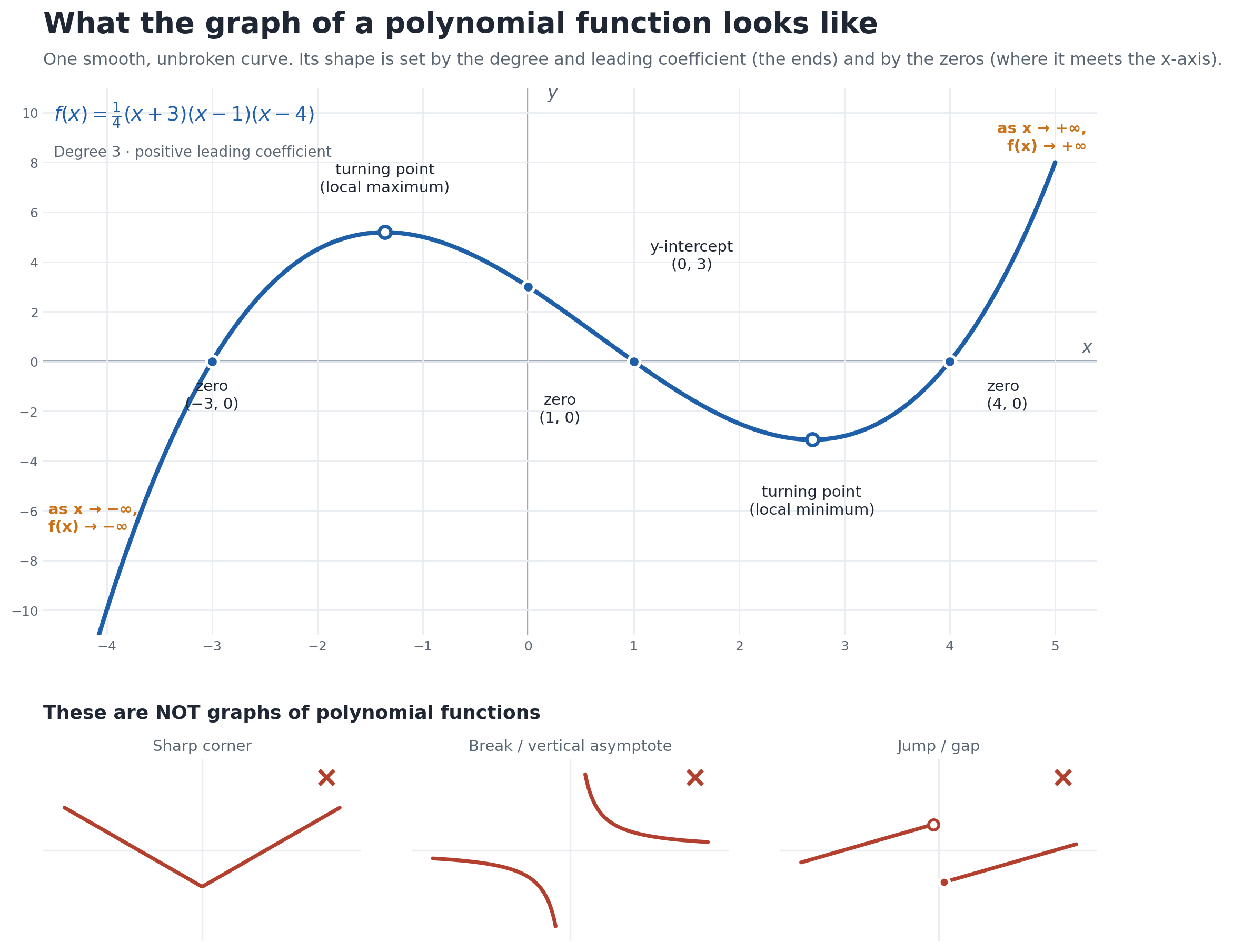
End behavior and the leading term
End behavior describes what the graph does as x moves far to the left and far to the right. For large values of |x|, the highest-degree term grows faster than every other term, so it alone decides the direction of each end. This is often called the leading term test or leading coefficient test.
| Degree | Leading coefficient | Left end (x → −∞) | Right end (x → +∞) |
|---|---|---|---|
| Even | Positive | Up (→ +∞) | Up (→ +∞) |
| Even | Negative | Down (→ −∞) | Down (→ −∞) |
| Odd | Positive | Down (→ −∞) | Up (→ +∞) |
| Odd | Negative | Up (→ +∞) | Down (→ −∞) |
A short way to remember the pattern: an even degree makes both ends point the same direction, and an odd degree makes them point in opposite directions. A negative leading coefficient reflects the even and odd pictures vertically.
I have students mark the two end arrows before plotting any intercepts. Otherwise, they often get the zeros right and then connect them with a curve whose end behavior contradicts the leading term.
Zeros and the x-intercepts
A zero of a polynomial is a value of x that makes the function equal zero. Each real zero is an x-intercept of the graph. When a polynomial is factored, the zeros are read directly from the factors: the factor (x − c) gives the zero x = c, and the factor (x + c) gives the zero x = −c. A factor of x by itself gives the zero x = 0.
A polynomial of degree n has at most n real zeros, so a degree-4 polynomial can cross or touch the x-axis at no more than four points. To find the y-intercept, evaluate the function at x = 0.
Multiplicity: crossing versus touching
The multiplicity of a zero is the number of times its factor appears. In (x − 2)2(x + 3), the zero x = 2 has multiplicity 2 and the zero x = −3 has multiplicity 1. Multiplicity controls how the graph behaves at the x-axis:
| Multiplicity | Behavior at the zero |
|---|---|
| Odd (1, 3, 5, …) | The graph crosses the x-axis. Multiplicity 1 passes straight through; multiplicity 3 or higher flattens as it crosses. |
| Even (2, 4, …) | The graph touches the x-axis and turns back without crossing (it is tangent to the axis there). |
Turning points and the degree
A turning point is a place where the graph changes from rising to falling or from falling to rising. A polynomial of degree n has at most n − 1 turning points. A cubic, for instance, has at most two turning points, and a quartic has at most three. This upper bound is a useful check: if a proposed sketch shows more turns than the degree allows, something is wrong.
A step-by-step method for graphing polynomial functions
The following order works for any polynomial written in, or factorable into, factored form.
- Read the degree and the sign of the leading coefficient, and use them to set both ends of the graph.
- Find the zeros from the factors, and write the multiplicity of each.
- At every zero, mark whether the curve crosses (odd multiplicity) or touches (even multiplicity).
- Find the y-intercept by evaluating the function at x = 0.
- Note that the number of turning points is at most one less than the degree.
- Draw a smooth curve through the intercepts that matches the end behavior and the crossing-or-touching behavior at each zero.
For a first sketch, I do not have students make a full table of values. I usually ask for the end behavior, labeled zeros with multiplicities, the y-intercept, and then the smooth curve.
Standards covered
The problems below align with the following Common Core high school standards for interpreting and building functions.
| Standard | Description |
|---|---|
| HSF.IF.C.7c | Graph polynomial functions, identifying zeros when suitable factorizations are available, and showing end behavior. |
| HSA.APR.B.3 | Identify zeros of polynomials when suitable factorizations are available, and use the zeros to construct a rough graph. |
Practice problems
Work each part on paper. Twenty-four problems in total; a full answer key follows the last part.
Part A · End behavior (6 problems)
State the end behavior of each function by describing the direction of the left and right ends.
- f(x) = 2x3 − 5x + 1
- f(x) = −x4 + 3x2 − 2
- f(x) = −4x5 + x2
- f(x) = 3x6 − 7x3 + 2
- f(x) = −2x4 + 6x3 − x + 9
- f(x) = −(x − 1)(x + 2)(x − 3)
Part B · Zeros and multiplicity (6 problems)
List every real zero, state its multiplicity, and say whether the graph crosses or touches the x-axis there.
- f(x) = (x − 4)(x + 1)
- f(x) = (x − 2)2(x + 3)
- f(x) = x(x − 5)3
- f(x) = (x + 1)2(x − 2)2
- f(x) = −2(x − 3)(x + 2)2(x − 1)
- f(x) = (x2 − 9)(x + 4)
Part C · Sketching from factored form (6 problems)
For each function, state the degree, the end behavior, the zeros with their multiplicities, and the y-intercept. Then make a rough sketch.
- f(x) = (x + 2)(x − 1)(x − 3)
- f(x) = −(x − 1)2(x + 2)
- f(x) = x2(x − 3)
- f(x) = (x + 1)(x − 2)2
- f(x) = −(x + 2)(x + 1)(x − 1)(x − 2)
- f(x) = (x − 1)2(x + 2)2
Part D · Interpreting graphs and writing equations (6 problems)
- A polynomial has degree 5 and a negative leading coefficient. State its end behavior, the maximum number of x-intercepts, and the maximum number of turning points.
- Write a possible equation for a degree-3 polynomial with a positive leading coefficient whose zeros are x = −2 (multiplicity 1) and x = 1 (multiplicity 2).
- A graph crosses the x-axis at x = −2 and x = 3, touches the x-axis at x = 1, and both ends point up. Find the least possible degree and write one possible equation.
- Match each function to its end behavior (both up, both down, down then up, or up then down): (a) 4x4 − x2; (b) −3x3 + x; (c) 2x5 − 7; (d) −x6 + 5x2.
- A cubic polynomial has zeros at x = −3, x = 0, and x = 2, and its graph passes through the point (1, −6). Find its equation.
- Can a degree-4 polynomial have exactly three distinct real zeros? Explain, and give an example in factored form if it is possible.
Answer key
Part A · End behavior
- Degree 3, positive: left end down, right end up. As x → −∞, f(x) → −∞; as x → +∞, f(x) → +∞.
- Degree 4, negative: both ends down. As x → ±∞, f(x) → −∞.
- Degree 5, negative: left end up, right end down. As x → −∞, f(x) → +∞; as x → +∞, f(x) → −∞.
- Degree 6, positive: both ends up. As x → ±∞, f(x) → +∞.
- Degree 4, negative: both ends down.
- Leading term −x3: degree 3, negative. Left end up, right end down.
Part B · Zeros and multiplicity
- x = 4 (multiplicity 1, crosses); x = −1 (multiplicity 1, crosses).
- x = 2 (multiplicity 2, touches); x = −3 (multiplicity 1, crosses).
- x = 0 (multiplicity 1, crosses); x = 5 (multiplicity 3, crosses with a flattening).
- x = −1 (multiplicity 2, touches); x = 2 (multiplicity 2, touches).
- x = 3 (multiplicity 1, crosses); x = −2 (multiplicity 2, touches); x = 1 (multiplicity 1, crosses).
- Factor to (x − 3)(x + 3)(x + 4): x = 3, x = −3, x = −4, each multiplicity 1, all crossing.
Part C · Sketching from factored form
- Degree 3, positive; ends left down / right up. Zeros: −2, 1, 3, all crossing. y-intercept (0, 6).
- Degree 3, leading term −x3 (negative); ends left up / right down. Zeros: x = 1 (touches), x = −2 (crosses). y-intercept (0, −2).
- Degree 3, positive; ends left down / right up. Zeros: x = 0 (touches), x = 3 (crosses). y-intercept (0, 0).
- Degree 3, positive; ends left down / right up. Zeros: x = −1 (crosses), x = 2 (touches). y-intercept (0, 4).
- Degree 4, negative; both ends down. Zeros: −2, −1, 1, 2, all crossing. y-intercept (0, −4).
- Degree 4, positive; both ends up. Zeros: x = 1 (touches), x = −2 (touches). y-intercept (0, 4).
Part D · Interpreting graphs and writing equations
- Odd degree with a negative leading coefficient: left end up, right end down. At most 5 x-intercepts and at most 4 turning points.
- f(x) = (x + 2)(x − 1)2. Any positive constant multiple is also correct.
- Two crossings (odd multiplicity) and one touch (even multiplicity) give a minimum degree of 1 + 1 + 2 = 4; a degree of 4 with a positive leading coefficient makes both ends point up. One equation: f(x) = (x + 2)(x − 3)(x − 1)2.
- (a) both up; (b) up then down (as x → −∞, up; as x → +∞, down); (c) down then up; (d) both down.
- f(x) = a·x(x + 3)(x − 2). Using (1, −6): a(1)(4)(−1) = −4a = −6, so a = 3/2. Therefore f(x) = 3/2·x(x + 3)(x − 2).
- Yes. If one zero has multiplicity 2 and the other two have multiplicity 1, the degrees add to 4 while giving three distinct real zeros. Example: f(x) = (x − 1)2(x + 2)(x − 3).
More polynomial practice
Outside references
- Common Core State Standards, Interpreting Functions (HSF.IF) — the standards this worksheet aligns to.
- GeoGebra Graphing Calculator — a free tool for checking a sketch against the actual graph.
- Khan Academy: Graphs of polynomials — free lessons and practice on end behavior, zeros, and multiplicity.