Finding the Focus and Directrix of a Parabola Worksheet
A focus and directrix worksheet for Algebra II and Precalculus: one point, one line, and the small number that connects them — with 20 practice problems and a full answer key.
Published July 29, 2026 · Last updated
- Level
- Algebra II and Precalculus, grades 9–12
- Standards
- CCSS.MATH.CONTENT.HSG.GPE.A.2 and HSF.IF.C.8
- Includes
- 20 problems in two parts, three color-coded figures, and a full answer key with steps
- Time
- About 40–50 minutes for both parts
- Format
- Read on this page or print the PDF — no sign-up
Want the printable focus and directrix worksheet?
Graphs, 20 practice problems, and a full answer key. No sign-up, no email required.
Download the PDF worksheetPDF · problems and answer key · prints on letter paper
A parabola can be defined using a focus and a directrix. Every point on the parabola is the same distance from the focus as it is from the directrix, and the vertex lies halfway between them.
Focus (h, k + p)
Directrix y = k − p
x is squared → vertical parabola.
Focus (h + p, k)
Directrix x = h − p
y is squared → horizontal parabola.
From y = ax², divide.
Sign of p = which way it opens.
|p| = vertex to focus.
- Read the three rule cards above, then cover them.
- Work Part A without notes. Ten problems, about 15 minutes.
- Check Part A against the key before you start Part B.
- For anything you missed, sketch the vertex, focus, and directrix on a quick grid. The picture catches sign errors faster than the algebra does.
What the Focus and Directrix Actually Are
Pick any point on the parabola. Its distance to the focus equals its perpendicular distance to the directrix.
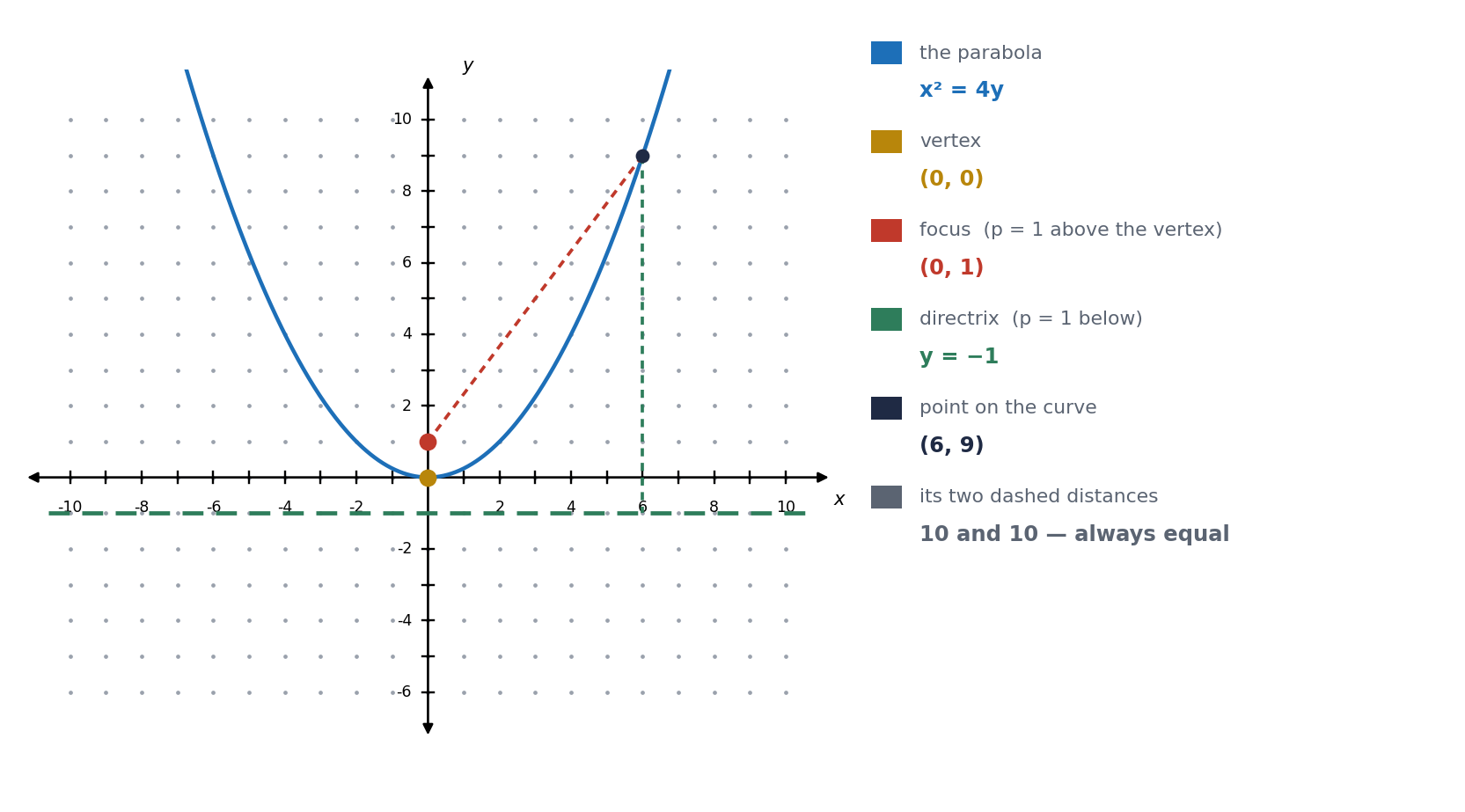
| Color | Piece | Where it came from |
|---|---|---|
| Blue | x² = 4y | 4p = 4, so p = 1 |
| Gold | Vertex (0, 0) | h and k in the equation |
| Red | Focus (0, 1) | p = 1 unit above the vertex |
| Green | Directrix y = −1 | p = 1 unit below the vertex |
Notice the focus is inside the bowl and the directrix is outside it. The directrix never touches the curve. The directrix does not intersect the parabola. Together with the focus, it determines the shape of the curve. Wolfram MathWorld has the formal version if you want the definition written the way a textbook would say it.
Sideways Parabolas: Where the Focus and Directrix Move
If x is squared, the parabola opens up or down and the directrix is horizontal. If y is squared, the focus and directrix both tip ninety degrees with it.
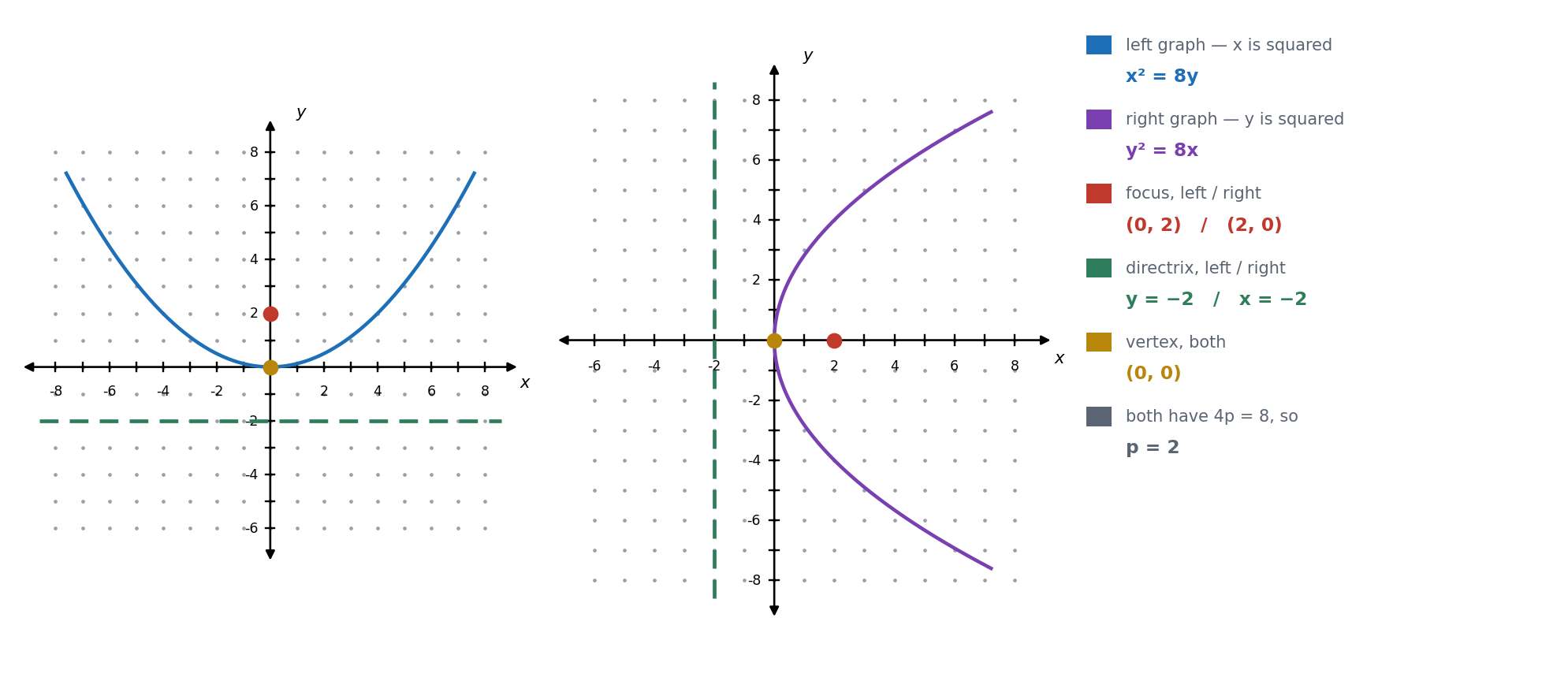
| Color | Equation | Focus and directrix |
|---|---|---|
| Blue | x² = 8y | Focus (0, 2), directrix y = −2 |
| Purple | y² = 8x | Focus (2, 0), directrix x = −2 |
The p vs 4p Trap When Finding the Focus and Directrix
Given (x − 2)² = 8(y + 1), the 8 is 4p, not p. So p = 2, the focus is 2 above the vertex, and the directrix is 2 below. Calling p = 8 puts your focus four times too far away. This is a common error I see with my students.
In y = ax² you have to flip and divide, since p = 1/(4a). A steep curve like y = 2x² has a focus of 1/8 of a unit above the vertex. Then, just recheck for any potential calculation errors which I see quite a bit with my students.
Why the Focus and Directrix Also Set the Width
Move the focus and directrix farther apart and the curve has to open wider to stay equally far from both. As ∣p∣ increases, the focus and directrix move farther from the vertex and the parabola becomes wider. Smaller ∣p∣ produces a narrower parabola.
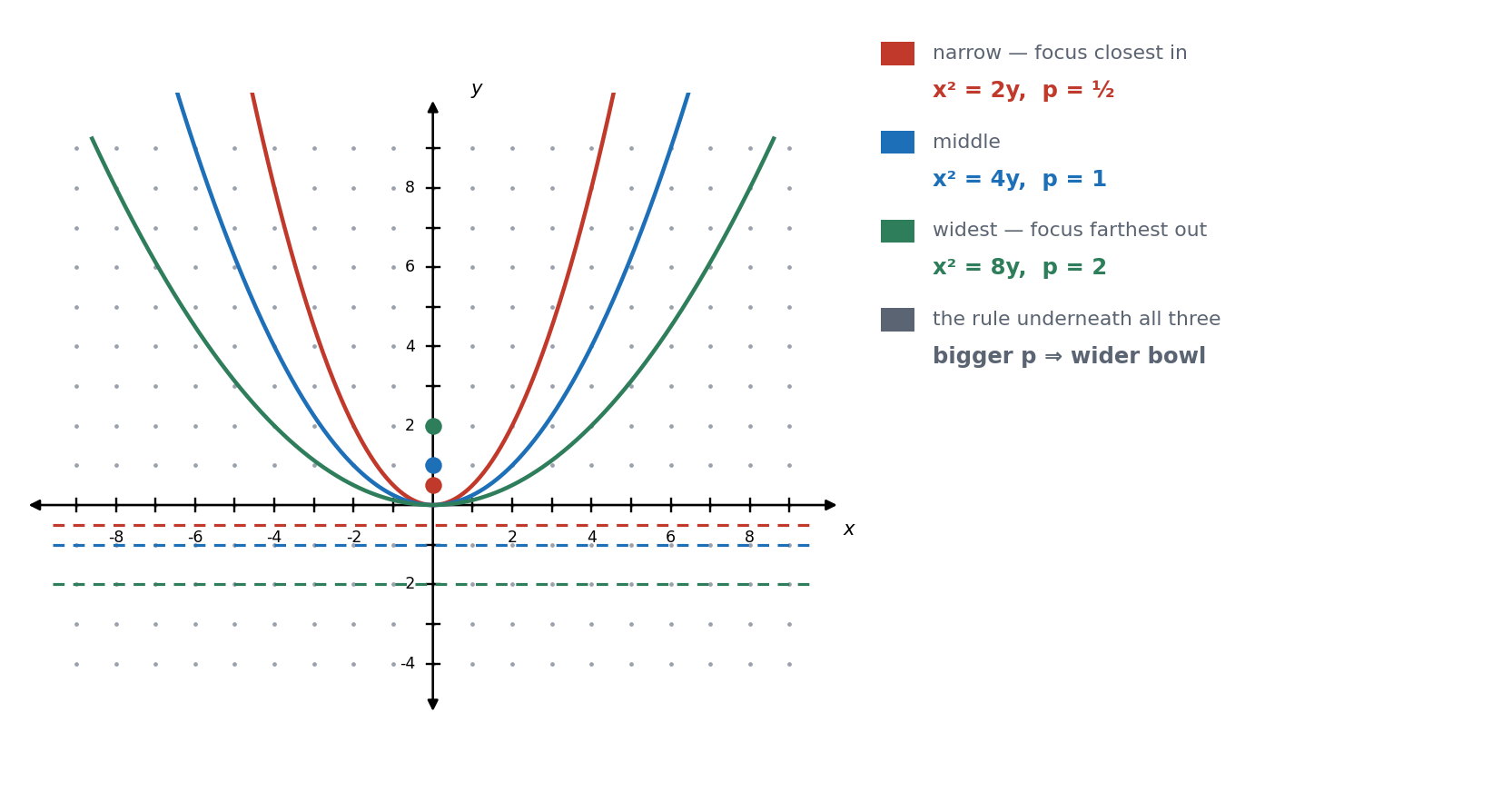
| Color | Equation | p and shape |
|---|---|---|
| Red | x² = 2y | p = ½ — narrowest |
| Blue | x² = 4y | p = 1 — middle |
| Green | x² = 8y | p = 2 — widest |
This is also why satellite dishes and headlight reflectors care: everything arriving parallel to the axis bounces to the focus, so the receiver goes exactly p units from the vertex. Purplemath's real-world parabola problems are a good secondary resource, and if you want an interactive module, then Math Warehouse and Interactive Mathematics are worth checking out.
If the equation shows up messy instead of tidy, get it into vertex form first and completing the square or the vertex form worksheet both land you where this page starts. Not sure the equation is even a parabola? Compare it against the other function families first.
Practice Problems: Finding the Focus and Directrix
Part A is straight identification: vertex, focus, directrix. Part B works backwards from the focus and directrix, or into a word problem. Show your work in the space provided.
Part A — state the vertex, the focus, and the directrix
- x² = 8y
- y² = 12x
- x² = −16y
- y = ¼x²
- y² = −4x
- (x − 3)² = 8(y + 1)
- (y + 2)² = 12(x − 1)
- (x + 4)² = −4(y − 2)
- y = 2x²
- y = −(1/12)x² + 3
Part B — work backwards, then answer the question
- Focus (0, 5), directrix y = −5. Write the equation.
- Focus (−2, 0), directrix x = 2. Write the equation.
- Vertex (2, −3), focus (2, −1). Write the equation and give the directrix.
- Vertex (−1, 4), directrix x = 3. Write the equation and give the focus.
-
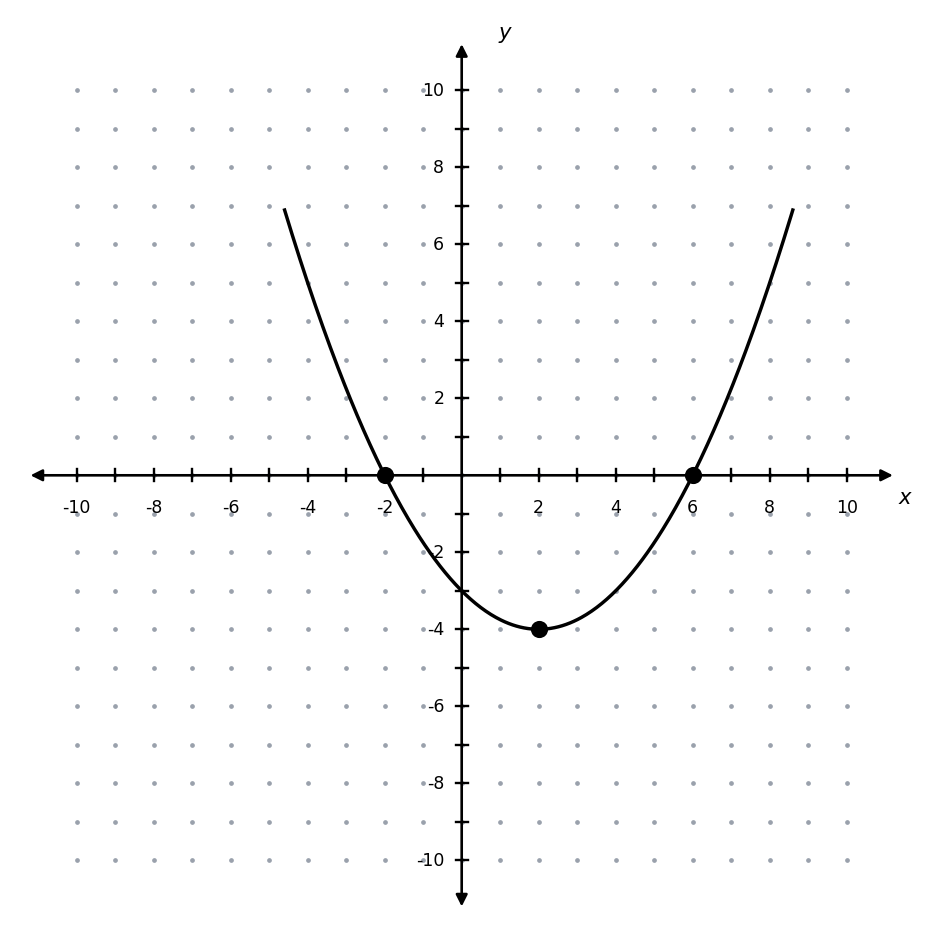
Use the graph below. Write the equation in the form (x − h)² = 4p(y − k), then state the focus and directrix.
- y = x² − 6x + 5. Rewrite it, then find the focus and directrix.
- A satellite dish is 8 ft across and 2 ft deep at the center. How far from the vertex does the receiver go?
- A flashlight reflector is 6 in across and 3 in deep. How far from the vertex is the bulb?
- On x² = 12y, a point sits 9 units from the focus. How far is it from the directrix, and what is its y-coordinate?
- Which has its focus farther from the vertex, y = ½x² or y = ⅛x²? Give both foci.
Focus and Directrix Worksheet: Answer Key
Part A
1. x² = 8y
4p = 8, so p = 2. x is squared, so it opens up from (0, 0).
Vertex (0, 0) · Focus (0, 2) · Directrix y = −2
2. y² = 12x
y is squared, so it opens sideways. 4p = 12 gives p = 3, positive, so it opens right.
Vertex (0, 0) · Focus (3, 0) · Directrix x = −3
3. x² = −16y
4p = −16, so p = −4. Negative p means the focus drops below the vertex and the directrix goes above.
Vertex (0, 0) · Focus (0, −4) · Directrix y = 4
4. y = ¼x²
Multiply both sides by 4 to get x² = 4y, so 4p = 4 and p = 1.
Vertex (0, 0) · Focus (0, 1) · Directrix y = −1
5. y² = −4x
Sideways again, and 4p = −4 gives p = −1, so it opens left.
Vertex (0, 0) · Focus (−1, 0) · Directrix x = 1
6. (x − 3)² = 8(y + 1)
Vertex (3, −1). The 8 is 4p, so p = 2 — up 2 for the focus, down 2 for the directrix.
Vertex (3, −1) · Focus (3, 1) · Directrix y = −3
7. (y + 2)² = 12(x − 1)
Vertex (1, −2), p = 3, and y is squared, so move right 3 for the focus and left 3 for the directrix.
Vertex (1, −2) · Focus (4, −2) · Directrix x = −2
8. (x + 4)² = −4(y − 2)
Vertex (−4, 2), 4p = −4, so p = −1 and it opens down.
Vertex (−4, 2) · Focus (−4, 1) · Directrix y = 3
9. y = 2x²
Rewrite as x² = ½y, so 4p = ½ and p = 1/8. Steep curve, tiny p.
Vertex (0, 0) · Focus (0, 1/8) · Directrix y = −1/8
10. y = −(1/12)x² + 3
Move the 3 and multiply by −12: x² = −12(y − 3). So p = −3 from the vertex (0, 3).
Vertex (0, 3) · Focus (0, 0) · Directrix y = 6
Part B
11. Focus (0, 5), directrix y = −5
The vertex is halfway between, at (0, 0), and p = 5. Then 4p = 20.
x² = 20y
12. Focus (−2, 0), directrix x = 2
Vertical directrix means y gets squared. Vertex (0, 0), focus to the left, so p = −2 and 4p = −8.
y² = −8x
13. Vertex (2, −3), focus (2, −1)
Same x-coordinate, so it opens up. Focus is 2 above, so p = 2 and 4p = 8. Directrix goes 2 below the vertex.
(x − 2)² = 8(y + 3) · Directrix y = −5
14. Vertex (−1, 4), directrix x = 3
Vertical directrix, so y is squared. It sits 4 units right of the vertex, so p = −4 and the curve opens left. 4p = −16.
(y − 4)² = −16(x + 1) · Focus (−5, 4)
15. From the graph
Vertex (2, −4) and it passes through (6, 0). Substituting: 16 = 4p(4), so 4p = 4 and p = 1.
(x − 2)² = 4(y + 4) · Focus (2, −3) · Directrix y = −5
16. y = x² − 6x + 5
Complete the square: y = (x − 3)² − 4, so (x − 3)² = 1(y + 4). Then 4p = 1 and p = ¼.
Vertex (3, −4) · Focus (3, −3.75) · Directrix y = −4.25
17. Dish 8 ft across, 2 ft deep
Put the vertex at the origin. The rim is at (4, 2), so 16 = 4p(2) and 4p = 8.
p = 2 — the receiver goes 2 ft above the vertex
18. Reflector 6 in across, 3 in deep
Rim at (3, 3), so 9 = 4p(3) and 4p = 3.
p = ¾ — the bulb sits 0.75 in from the vertex
19. x² = 12y, point 9 units from the focus
The two distances are always equal, so it is 9 from the directrix too. Here 4p = 12, p = 3, directrix y = −3, so y + 3 = 9.
9 units from the directrix · y = 6
20. y = ½x² against y = ⅛x²
They become x² = 2y and x² = 8y, so p = ½ and p = 2. The wider curve wins.
y = ⅛x², focus (0, 2), against focus (0, ½)
Every answer above was checked for accuracy against the original equation or graph before publishing, most recently on July 29, 2026. If you spot an error, email burketutoringinfremont@outlook.com or text (510) 453-0350 and it will be corrected.
Common Questions
How do you find the focus and directrix from an equation?
Get it into (x − h)² = 4p(y − k) or (y − k)² = 4p(x − h), read the vertex, then divide the number in front by 4 to get p. The focus sits p units from the vertex along the axis; the directrix is the line p units the other way.
What does p mean in the focus and directrix formulas?
It is the distance from the vertex to the focus, and also from the vertex to the directrix. Its sign tells you the direction: positive opens up or right, negative opens down or left.
Is p the same as a in y = ax²?
No, and mixing them up is the classic slip. They are related by p = 1/(4a). A large a gives a narrow curve and a very small p.
Can the directrix touch the parabola?
Never. Every point on the curve is the same distance from the focus as from the directrix, and the focus is not on the line, so that distance can't be zero.
How wide is the parabola at the focus?
Exactly |4p| across. That segment through the focus is the latus rectum, and it is the fastest way to sketch the curve once you have the focus and directrix: go |2p| left and right of the focus, mark both points, and draw through the vertex.
What grade level is this worksheet for?
Algebra II most often, and again in Precalculus during the conic sections unit, where the focus and directrix show up as part of the wider conics topic. Part A works as a warm-up; Part B is closer to test level.
Keep Practicing
The focus and directrix are the last stop on the parabola tour, so the rest of the unit helps: vertex and axis of symmetry, graphing quadratic functions, reading the equation of a parabola from a graph, and quadratic transformations. When you need the roots instead of the focus, try factoring, the quadratic formula, or the discriminant.
About the Author

Berke has taught K–12 math and science for more than 10 years, logging over 6,000 tutoring hours with 200+ students. He holds a BS in Biochemistry from Washington University in St. Louis and an MS in Bioinformatics from UMGC.
He writes every worksheet on this site from problems he actually uses in sessions, which is why the p vs 4p box above exists — it is the one he corrects most often.
How these are made: problems are prepared from previous class notes and assigned homework, and every answer is checked for accuracy before publishing. Corrections come in by email or text and get fixed the same week.
More: tutor profile · LinkedIn · burketutoringinfremont@outlook.com
Page Updates
- July 29, 2026 — all 20 answers re-checked against the source equations and graph; latus rectum question added to the FAQ; measurement wording standardized to US usage.
- July 29, 2026 — page published with 20 problems, three figures, and the printable PDF.
- — added quadratics hub page link.
- — Edited text for grammatical clarity.
If you want someone sitting next to you while you work through this focus and directrix worksheet, Burke Tutoring offers in-home algebra and precalculus tutoring in Fremont, Newark, and Union City. Call (510) 453-0350.
Burke Tutoring · Fremont, CA 94538 · (510) 453-0350 · Serving Fremont · Newark · Union City