Domain Restrictions and Excluded Values
Guide, worksheet, and answer key
Find the domain restrictions and excluded values of a function, then write the domain in interval notation. This guide covers denominators, even roots, logarithms, graphs, and composite functions. The worksheet has 24 practice problems and three challenge problems, all with answers.
Part of a nine guide unit. See all the rational expressions and rational functions worksheets, listed in a recommended order.
On this page
- Domain, restrictions, and excluded values
- Where restrictions come from
- Excluded values of rational expressions
- Restrictions from even roots
- Combining restrictions
- Writing the domain in three notations
- Reading the domain from a graph or a situation
- Combined and composite functions
- Four worked examples
- Where students lose points
- Domain Finder with restriction map
- Domain Notation Drill
- One page cheat sheet
- 24 practice problems and answers
- Challenge problems
- Where this fits in the unit
Download the worksheet and cheat sheet (PDF)
Domain, restrictions, and excluded values
The domain of a function is the set of inputs that produce a real output. When a function is given only as a formula, such as f(x) = √x − 4x − 7, its domain is every real number the formula can accept. Textbooks call this the natural domain or implied domain.
A domain restriction is a condition that removes numbers from that set. An excluded value is one specific number that is removed. In a rational expression, it is a number that makes the denominator equal to zero. In the function above, 7 is an excluded value, and the square root adds the restriction x ≥ 4.
| Term | Meaning | Example |
|---|---|---|
| Domain | All x-values that give a real output | For 1/(x − 3): every real number except 3 |
| Excluded value | One number removed from the domain | 3, for 1/(x − 3) |
| Domain restriction | Any condition that removes numbers, one point or a whole interval | x − 4 ≥ 0, for √x − 4 |
| Restricted domain | A domain stated on purpose, narrower than the natural one | A(w) = w(20 − w) for 0 < w < 20 |
An excluded value removes a single point. A square root or a logarithm can remove an entire interval, such as every number below 4. Both answer the same question: for which inputs is the formula undefined?
Where restrictions come from
In Algebra II, restrictions come from a short list of operations. Check the function for each one, write the condition it creates, and solve that condition.
| Operation in the function | Condition | Example | What gets removed |
|---|---|---|---|
| Division by an expression that contains x | denominator ≠ 0 | 5/(x − 2): x ≠ 2 | Single points |
| Negative exponent | base ≠ 0 | (x + 1)−2: x ≠ −1 | Single points |
| Square root or any even root | radicand ≥ 0 | √x − 4: x ≥ 4 | One or more intervals |
| Even root inside a denominator | radicand ≥ 0, and the complete denominator ≠ 0 | 1/√x − 4: x > 4; 1/(√x − 3): x ≥ 0, x ≠ 9 | Intervals, plus each point where the denominator is zero |
| Fraction exponent m/n in lowest terms, with n even | base ≥ 0, or base > 0 when the exponent is negative | x3/4: x ≥ 0; x−1/2: x > 0 | One or more intervals |
| Logarithm, ln or log | argument > 0 | ln(x + 3): x > −3 | Intervals, with the endpoint removed too |
| Polynomials, odd roots, absolute value, exponentials such as 2x | none of their own | 3√x − 8: every real x | Nothing, though the expression inside may carry restrictions |
| A real situation | the input has to make sense | a length has to be positive | Depends on the context |
When a function contains more than one of these, every condition has to hold at the same time. The domain is the set of numbers that pass all of them, which is the intersection of the individual solution sets.
Odd roots accept negative numbers. The cube root of −8 is −2, because (−2)3 = −8. Only even roots (square roots, fourth roots, and so on) need a nonnegative radicand. This page reads xm/n as (n√x)m. Some graphing tools treat x2/3 differently for negative x, so check which convention your class uses.
Excluded values of rational expressions
For a rational expression, the excluded values are the real zeros of the denominator. The routine has three steps.
- Factor the denominator completely. The factoring polynomials flowchart reviews the factoring patterns used on this page.
- Set each factor equal to zero and solve. A repeated factor such as (x − 5)2 gives one excluded value, 5.
- Write the list down before you cancel anything.
Step 3 matters because simplifying changes the formula. The expression x2 − 9x2 + x − 6 simplifies to x − 3x − 2, and the simplified form only shows x ≠ 2. The original also excludes −3. The two expressions are equal only when x ≠ −3 and x ≠ 2, so both restrictions stay attached to the simplified answer.
Holes and vertical asymptotes
On a graph, an excluded value shows up in one of two ways. If its factor cancels out of the denominator completely, the graph has a hole at that x-value. If a copy of the factor is still in the denominator after canceling, the graph has a vertical asymptote there. Either way the number is excluded from the domain.
Three cases to watch
- Numerator zeros are allowed. In x2 − 4x3 − 9x, the values ±2 make the numerator zero, so the expression equals 0 there, which is a real number. The excluded values come from the denominator: 0, 3, and −3.
- Some denominators have no real zeros. The equation x2 + 9 = 0 has no real solution, so x + 2x2 + 9 is defined for every real x.
- Some excluded values are irrational. If the denominator does not factor over the integers, use the quadratic formula. For 1x2 − 2x − 1, the excluded values are 1 ± √2.
Dividing by a rational expression adds one more source. In x + 1x − 3 ÷ x − 4x + 2, the numbers 3 and −2 are excluded because they zero out a denominator, and 4 is excluded because at x = 4 you would be dividing by zero.
Restrictions from even roots
The square root of a negative number is not a real number, so the radicand of an even root has to be greater than or equal to zero. That makes the restriction an inequality instead of an equation, so its solution can contain whole intervals of numbers.
Linear radicands
For √10 − 2x, solve 10 − 2x ≥ 0. Subtract 10 to get −2x ≥ −10, then divide by −2. Dividing by a negative number reverses the inequality, so x ≤ 5. The domain is (−∞, 5]. A quick check: x = 0 gives √10, which is real, so 0 belongs in the answer.
Quadratic and higher radicands
For √x2 − 16, the radicand is zero at x = −4 and x = 4. Those two numbers split the number line into three intervals. Test one number from each: x = −5 gives 9, x = 0 gives −16, and x = 5 gives 9. The radicand is nonnegative outside the zeros and at the zeros themselves, so the domain is (−∞, −4] ∪ [4, ∞). This method is called a sign chart.
Roots in a denominator
Keep two separate conditions when a root sits in a denominator. Every even-root radicand has to be nonnegative, and the complete denominator has to be nonzero.
In 5√3 − x, the root is the whole denominator. The radicand needs 3 − x ≥ 0, and the denominator √3 − x equals zero when x = 3. Together these give 3 − x > 0, so x < 3 and the domain is (−∞, 3). The same shortcut, radicand greater than zero, applies whenever the root is the entire denominator or one of its factors.
In 1√x − 3, the root is only one term of the denominator, so the shortcut does not apply. The radicand needs x ≥ 0, and the denominator √x − 3 equals zero when x = 9. Zero is allowed, because the denominator there is −3. The domain is [0, 9) ∪ (9, ∞).
Fractions under a root
If the radicand is itself a fraction, write two conditions: the inner denominator is not zero, and the whole fraction is at least zero. The sign chart then needs cut points at the zeros of the inner numerator and the inner denominator. Challenge problem 25 below is this case.
Combining restrictions
When a function has two or more sources, write one condition per source, solve each one, and keep only the numbers that pass all of them. A stacked number line makes the overlap easy to see. This page calls it a restriction map: one row per condition, plus a last row that is shaded only where every row above it is shaded.
Sometimes one restriction makes another one redundant. In ln(x) + √x + 2, the logarithm needs x > 0 and the root needs x ≥ −2. Every number greater than 0 is already greater than −2, so the domain is (0, ∞). The root condition still belongs on your paper. In this function it does not remove anything new.
Writing the domain in three notations
Teachers and textbooks ask for the domain in interval notation, set-builder notation, or inequalities. All three describe the same set.
| Inequality | Interval notation | Set-builder notation |
|---|---|---|
| x ≠ 2 | (−∞, 2) ∪ (2, ∞) | {x ∈ ℝ | x ≠ 2} |
| x ≥ 4 | [4, ∞) | {x ∈ ℝ | x ≥ 4} |
| x < 3 | (−∞, 3) | {x ∈ ℝ | x < 3} |
| −3 ≤ x ≤ 4 | [−3, 4] | {x ∈ ℝ | −3 ≤ x ≤ 4} |
| x ≤ −4 or x ≥ 4 | (−∞, −4] ∪ [4, ∞) | {x ∈ ℝ | x ≤ −4 or x ≥ 4} |
| x ≥ −5, x ≠ −2, x ≠ 2 | [−5, −2) ∪ (−2, 2) ∪ (2, ∞) | {x ∈ ℝ | x ≥ −5, x ≠ ±2} |
| no restriction | (−∞, ∞) | ℝ |
- A bracket, [ or ], means the endpoint is included. A parenthesis means it is not.
- Infinity is not a number the set can contain, so −∞ and ∞ take parentheses.
- The union symbol ∪ joins pieces. List the pieces from left to right.
- A single excluded value splits an interval into two pieces, with a parenthesis on each side of the gap.
Reading the domain from a graph or a situation
On a graph, the domain is the set of x-values the graph covers. Read it from left to right along the x-axis, and look closely at the ends and at any gaps.
| Graph of the function | |
| Closed dot: the point is on the graph | |
| Open circle: the point is not on the graph | |
| Dashed line: vertical asymptote | |
| Arrowhead: the graph continues | |
| Domain | [−6, 0) ∪ (0, 3) ∪ (3, ∞) |
- Include every x-coordinate that has an included point on the graph. Points along a drawn curve and closed dots are included points.
- An open circle removes one point. Its x-value is out of the domain only if no other included point has the same x-coordinate. On a piecewise graph, a closed dot can sit directly above or below an open circle, and then that x-value stays in the domain.
- A branch has no point at a vertical asymptote. That x-value is excluded unless the graph shows a separate included point there.
- Use −∞ or ∞ only where a branch extends arbitrarily far to the left or right. An arrowhead shows that a branch continues, but a branch that climbs or falls along a vertical asymptote continues with bounded x-values.
- Where a piece of the domain ends at a closed dot, use a bracket. Where it ends at an open circle or an asymptote, use a parenthesis.
In a word problem, the situation can restrict the domain further than the formula does. A rectangle with a perimeter of 40 cm and a width of w cm has area A(w) = w(20 − w). The formula accepts every real w, but the width has to be positive and so does the other side, 20 − w. The domain in context is 0 < w < 20. Common Core standard HSF.IF.B.5 asks students to relate the domain of a function to its graph and to the situation it describes.
Combined and composite functions
When two functions are added, subtracted, or multiplied, the result is defined only where both functions are defined, so the domain is the intersection of the two domains. Dividing adds one more condition: (f/g)(x) also needs g(x) ≠ 0.
A composite function f(g(x)) needs two things. First, x has to be in the domain of g. Second, the output g(x) has to be in the domain of f. Work from the inside out. Worked example 4 below does this for f(x) = 1/(x − 3) and g(x) = √x.
Find the domain before you simplify a composite. With f(x) = x2 and g(x) = √x − 1, the composite f(g(x)) = (√x − 1)2 simplifies to x − 1. The simplified formula accepts every real number, but g is only defined for x ≥ 1, so the domain of f(g(x)) is [1, ∞).
Four worked examples
Find the excluded values of x2 − 9x2 + x − 6, then simplify it.
- Factor both parts(x − 3)(x + 3)(x + 3)(x − 2)
- Set each denominator factor equal to zerox + 3 = 0 gives x = −3, and x − 2 = 0 gives x = 2.
- Cancel the common factor and keep both restrictionsx − 3x − 2, x ≠ −3, x ≠ 2
- Connect to the graphThe factor x + 3 canceled completely, so the graph has a hole at x = −3. The factor x − 2 remains, so the graph has a vertical asymptote at x = 2.
| Graph of the function | |
| Open circle: the point is not on the graph | |
| Dashed line: vertical asymptote | |
| Arrowhead: the graph continues | |
| x = −3 | Hole at (−3, 6/5), because the factor x + 3 cancels |
| x = 2 | Vertical asymptote, because the factor x − 2 remains |
Find the domain of g(x) = √12 + x − x2.
- Write the condition12 + x − x2 ≥ 0
- Multiply by −1 and reverse the inequalityx2 − x − 12 ≤ 0
- Factor and find the zeros(x − 4)(x + 3) ≤ 0, with zeros at −3 and 4.
- Test one value in each intervalx = −4: (−8)(−1) = 8, which is positive, so that interval fails. x = 0: (−4)(3) = −12, which works. x = 5: (1)(8) = 8, which fails.
- Include the zerosThe condition allows the product to equal 0, so −3 and 4 are included.
Find the domain of h(x) = √x + 5x2 − 4.
- Even rootx + 5 ≥ 0, so x ≥ −5.
- Denominatorx2 − 4 ≠ 0, so (x − 2)(x + 2) ≠ 0, which gives x ≠ 2 and x ≠ −2.
- IntersectStart from [−5, ∞). Both −2 and 2 lie inside it, so remove both.
Let f(x) = 1x − 3 and g(x) = √x. Find the domain of f(g(x)).
- Inside functiong(x) = √x needs x ≥ 0.
- Outside functionf accepts every input except 3, so g(x) ≠ 3.
- Solve the second condition√x ≠ 3 means x ≠ 9.
- CombineKeep x ≥ 0 and remove 9. The composite is f(g(x)) = 1√x − 3, and at x = 9 its denominator is 3 − 3 = 0.
Where students lose points
These are six mistakes I correct in tutoring sessions on domain. Each one shows the wrong step, the fix, and the reason.
1. Taking excluded values from the simplified form
Build the list from the original denominator, before canceling. The canceled factor still made the original expression undefined at −3.
2. Setting the numerator equal to zero
At x = 1 the expression equals 0/(−24) = 0, a real number. For a rational expression, only a zero in the denominator makes it undefined.
3. Writing x ≥ 0 for every square root
The whole radicand has to be nonnegative, not x by itself. Testing x = 1 gives √−3, which is not real.
4. Keeping the endpoint when the root is the whole denominator
At x = 2 the denominator is √0 = 0. The radicand has to be nonnegative and the complete denominator has to be nonzero. With the root as the whole denominator, those two conditions combine to x − 2 > 0.
5. Forgetting to reverse the inequality
Dividing both sides by −2 reverses the inequality. A test value catches it: x = 0 gives √6, which is real, so 0 has to be in the domain.
6. Brackets on infinity or on an excluded value
An excluded value gets a parenthesis on both sides of the gap. Infinity takes a parenthesis because no number in the set equals it.
Domain Finder with restriction map
Type a function of x. The finder lists every restriction it finds and names its source. It solves each one, draws the restriction map, and writes the domain in interval, set-builder, and inequality notation. You can also test a single value of x to see which rows pass. Work a problem by hand first, then use the finder to check each row of your work.
Use sqrt( ), cbrt( ), root(4, …), abs( ), ln( ), log( ), ^ for powers, and / for division. 2x and (x+1)(x-2) work without a multiplication sign. Put the whole denominator in parentheses: 1/(2x).
The finder handles polynomials and fractions of polynomials, square roots and other roots, absolute value, ln and log, and powers with whole-number or fraction exponents. Inside a single denominator, radicand, or logarithm it can solve one root or one logarithm at a time, such as √x − 3. If a condition goes beyond that, the finder reports that it cannot solve it. Boundaries are kept exact where a short exact form exists, such as √3 or e. Any other boundary is shown as a rounded decimal marked ≈.
Domain Notation Drill
The drill gives you a function or a graph and scores your domain in interval notation. Type inf for ∞ and U for ∪, as in (-inf, 2) U (2, inf). Fractions such as 3/2 are fine. If the notation itself has a problem, such as a bracket on infinity or intervals listed out of order, the drill tells you what to fix and does not score that entry.
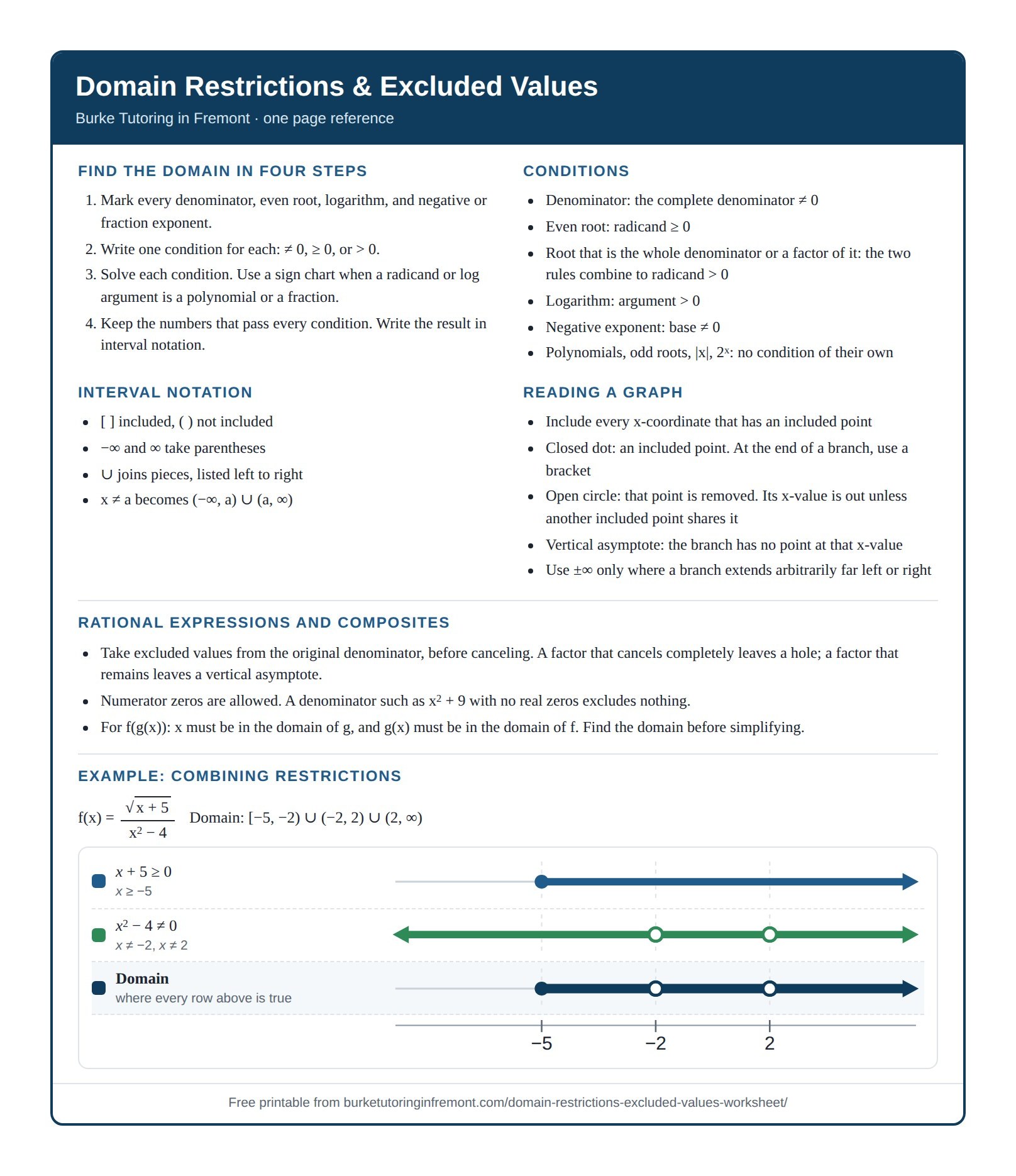
One page cheat sheet
This is the same content as the printable reference card. It is written out here so you can read it on a phone.
Find the domain in four steps
- Mark every denominator, even root, logarithm, and negative or fraction exponent.
- Write one condition for each: ≠ 0, ≥ 0, or > 0.
- Solve each condition. Use a sign chart when a radicand or log argument is a polynomial or a fraction.
- Keep the numbers that pass every condition. Write the result in interval notation.
Conditions
- Denominator: the complete denominator ≠ 0
- Even root: radicand ≥ 0
- Root that is the whole denominator or a factor of it: the two rules combine to radicand > 0
- Logarithm: argument > 0
- Negative exponent: base ≠ 0
- Polynomials, odd roots, |x|, 2x: no condition of their own
Interval notation
- [ ] included, ( ) not included
- −∞ and ∞ take parentheses
- ∪ joins pieces, listed left to right
- x ≠ a becomes (−∞, a) ∪ (a, ∞)
Reading a graph
- Include every x-coordinate that has an included point
- Closed dot: an included point. At the end of a branch, use a bracket
- Open circle: that point is removed. Its x-value is out unless another included point shares it
- Vertical asymptote: the branch has no point at that x-value
- Use ±∞ only where a branch extends arbitrarily far left or right
Rational expressions and composites
- Take excluded values from the original denominator, before canceling. A factor that cancels completely leaves a hole; a factor that remains leaves a vertical asymptote.
- Numerator zeros are allowed. A denominator such as x2 + 9 with no real zeros excludes nothing.
- For f(g(x)): x must be in the domain of g, and g(x) must be in the domain of f. Find the domain before simplifying.
Printable worksheet and reference card
The worksheet PDF has all 24 practice problems and the three challenge problems with work space and number lines, followed by a full answer key with every domain shaded. The cheat sheet is one page.
24 practice problems and answers
Answers are in the collapsible box under each part. Write every domain in interval notation unless the directions say otherwise.
- 8x + 6
- x − 1x2 − 25
- x2 − 1x2 − 10x + 25
- x + 4x2 + 2x − 8
- 3x2x2 − 7x + 3
- x2 − 4x3 − 9x
Answers, Part A
- x ≠ −6
- x ≠ −5, 5
- x ≠ 5 (the factor (x − 5)2 gives one value)
- x ≠ −4, 2; simplifies to 1x − 2, x ≠ −4, 2
- x ≠ 12, 3, from (2x − 1)(x − 3)
- x ≠ −3, 0, 3, from x(x − 3)(x + 3); ±2 are allowed
- f(x) = √x − 4
- f(x) = 4√10 − 2x
- f(x) = 3√x − 8
- f(x) = √x2 − 16
- f(x) = 5√3 − x
- f(x) = √x3 − 4x
Answers, Part B
- [4, ∞)
- (−∞, 5]
- (−∞, ∞), since a cube root accepts negatives
- (−∞, −4] ∪ [4, ∞)
- (−∞, 3)
- [−2, 0] ∪ [2, ∞), from the sign chart of x(x − 2)(x + 2)
- f(x) = √x + 3x − 2
- f(x) = (x + 2)(x2 + 9)−1
- f(x) = √6 − xx2 − 9
- f(x) = ln x + √5 − x
- f(x) = (x − 1)−2 + √x
- f(x) = log(x2 − 4x)
Answers, Part C
- [−3, 2) ∪ (2, ∞)
- (−∞, ∞); the base x2 + 9 has no real zeros
- (−∞, −3) ∪ (−3, 3) ∪ (3, 6]
- (0, 5]
- [0, 1) ∪ (1, ∞)
- (−∞, 0) ∪ (4, ∞), from x(x − 4) > 0
- State the domain of the function graphed below.
Graph of the function Closed dot: the point is on the graph Open circle: the point is not on the graph Arrowhead: the graph continues - State the domain of the function graphed below.
Graph of the function Closed dot: the point is on the graph Dashed line: vertical asymptote Arrowhead: the graph continues - Let f(x) = x − 5 and g(x) = √x. Find the domain of (f/g)(x).
- Let f(x) = 1x − 2 and g(x) = √x + 1. Find the domain of f(g(x)).
- Let f(x) = x2 and g(x) = √x − 1. Simplify f(g(x)) and state its domain.
- A rectangle has a perimeter of 40 cm and a width of w cm. Its area is A(w) = w(20 − w). State the domain of A in this context.
Answers, Part D
- [−4, 1) ∪ (1, ∞)
- (−∞, −2) ∪ (−2, 3]
- (0, ∞); g needs x ≥ 0 and g(x) ≠ 0 removes 0
- [−1, 3) ∪ (3, ∞); √x + 1 ≠ 2 removes 3
- f(g(x)) = x − 1, domain [1, ∞)
- (0, 20); both w and 20 − w are side lengths, so both are positive
Challenge problems
- Find the domain of f(x) = √x + 3x − 1. Explain why −3 is included and 1 is not.
- Write a function whose domain is [−2, 5) ∪ (5, ∞). Then explain which part of your function creates each piece of the domain.
- Let f(x) = 1x − 2 and g(x) = √x + 1. Find the domain of g(f(x)). Compare it with your answer to problem 22.
Answers, challenge problems
25. (−∞, −3] ∪ (1, ∞). The inner denominator needs x ≠ 1, and the radicand needs x + 3x − 1 ≥ 0. A sign chart with cuts at −3 and 1 shows the fraction is positive for x < −3 and x > 1. At x = −3 the fraction equals 0, and √0 = 0 is real, so −3 is included. At x = 1 the fraction is undefined, so 1 is excluded.
26. One answer is f(x) = √x + 2x − 5. The square root requires x ≥ −2, which starts the domain at −2 with a bracket, and the denominator removes 5. Grade other answers on whether their domain matches [−2, 5) ∪ (5, ∞); for example 1x − 5 + 4√x + 2 also works.
27. (−∞, 1] ∪ (2, ∞). The inside function f needs x ≠ 2. The outside function g needs f(x) + 1 ≥ 0, which is 1x − 2 + 1 = x − 1x − 2 ≥ 0. A sign chart with cuts at 1 and 2 gives x ≤ 1 or x > 2. Problem 22 had domain [−1, 3) ∪ (3, ∞), so reversing the order of a composition can change the domain completely.
Where this fits in the unit
Excluded values come back when you solve rational equations: a solution that matches an excluded value is extraneous and has to be rejected. The rational equations and extraneous solutions worksheet builds on the lists you make here.
Related worksheets and guides
All free to print, each with a full answer key.
- Simplifying rational expressions worksheet
- Multiplying and dividing rational expressions worksheet
- Adding and subtracting rational expressions worksheet
- Complex rational expressions worksheet
- Rational equation word problems worksheet
- Graphing rational functions worksheet
- Asymptotes, holes, and intercepts worksheet
- Polynomial inequalities worksheet, for sign charts
- Graphing quadratic inequalities worksheet
- All polynomials worksheets and guides
- All quadratics worksheets and guides

About the author
Berke Sahbazoglu · Founder and tutor, Burke Tutoring in Fremont, CA
I have more than ten years of tutoring experience and teach Algebra I, Algebra II, and Precalculus in homes across Fremont, Newark, and Union City. I hold a BA in Biochemistry from Washington University in St. Louis and an MS in Bioinformatics from the University of Maryland Global Campus. The worksheets I publish here are built from the notes and homework sets I use in sessions.
Working through functions and domain with a tutor
Burke Tutoring provides in-home tutoring in Algebra I, Algebra II, and Precalculus across Fremont, Newark, and Union City. Sessions happen at your kitchen table, on your schedule, with the same tutor each week.
(510) 453-0350Serving Fremont, Newark, and Union City · Rates and formats
Standards and further reading
- Common Core standard HSF.IF.B.5, relating the domain of a function to its graph and to the situation it describes. This page also supports HSF.IF.A.1 (domain and range as sets) and HSF.BF.A.1c (composing functions).
- University of Sydney Mathematics Learning Centre, Functions: The domain and range, an eight page booklet with exercises and solutions on natural and restricted domains.
- Penn State Math 110 companion site, The Domain of a Function, with worked examples for denominators, square roots, and logarithms.
- Trinity College Dublin, Domain and range of functions, lecture notes that find natural domains by intersecting the conditions from roots and denominators.
- Portland Community College Math 95, Notes on functions, a short handout on writing domain and range in interval notation from a graph.