Solving Quadratics by Factoring Worksheet
Factor each equation, use the zero-product property, and check the solutions.
Sixteen printable quadratics worksheets with answer keys, covering graphing, vertex and intercept form, factoring, completing the square, the quadratic formula and word problems. Start at the beginning or jump to the topic you need today.
By Berke Sahbazoglu · 6,000+ hours and 200+ students tutored · 10+ years teaching Algebra I & II · BS Biochemistry (Washington University in St. Louis), MS Bioinformatics (UMGC) • Published · Updated • How these are written and checked
Three common starting points for homework help, class review and test preparation.
Factor each equation, use the zero-product property, and check the solutions.
Find the turning point and the vertical line that splits a parabola into matching halves.
Identify key features, plot useful points, and sketch each parabola with confidence.
Every worksheet below is a printable PDF with a full answer key. The complete compressed pack also includes the new one-page quadratics cheat sheet. Download everything in one click, or choose individual worksheet PDFs. No sign-up and no email required.
The ZIP button is the simplest way to save the full collection, including the one-page cheat sheet. The selector below still works for a custom group, although your browser may ask permission before saving several files at once.
Free to use in your classroom. Print, copy and hand these worksheets out at no cost, in school or at home. Please link back to this page rather than re-hosting the PDF files, so students always land on the current version.
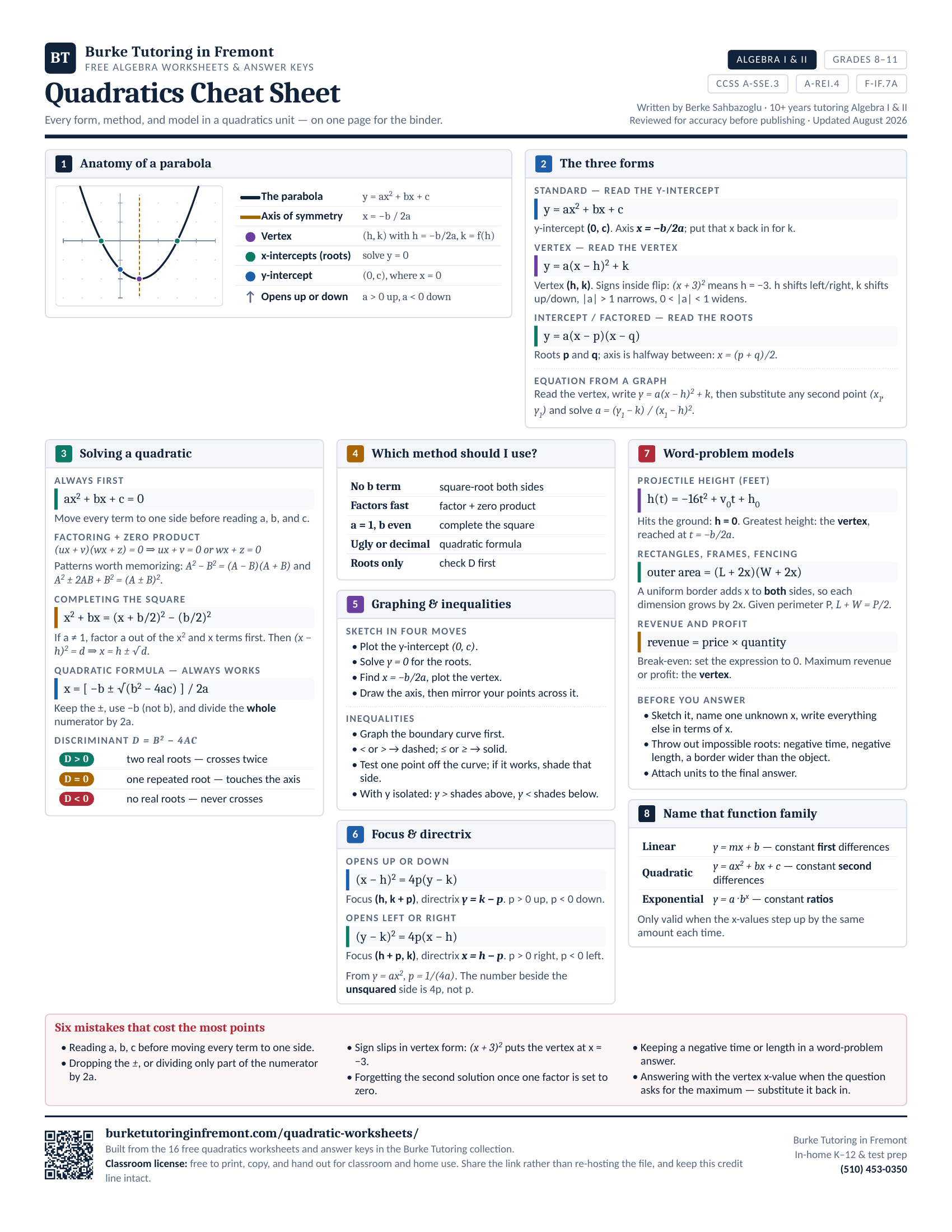
A compact reference built from the equations and methods used across all 16 worksheets: standard, vertex and intercept forms; graph features; factoring; completing the square; the quadratic formula; inequalities; focus and directrix; and common word-problem models.
Printing: One portrait letter-size page. The PDF is best for printing; the PNG works well in a class website, slide deck or learning-management system.
Create a table, identify useful points, and sketch an accurate parabola.
Find the turning point and the vertical line that divides a parabola into matching halves.
Explore shifts, reflections, stretches, and compressions from the parent function.
Shade the correct region and test points to graph a quadratic inequality.
Tell the three function families apart from a table, a graph, or an equation.
Recognize what each form reveals about the vertex, zeros, and overall graph.
Use visible features such as the vertex, intercepts, or a known point to build the equation.
Factor the quadratic, set each factor equal to zero, and solve for the roots.
Rewrite a quadratic into a perfect-square form and solve step by step.
Use a reliable method that works even when a quadratic does not factor neatly.
Decide whether a quadratic has two real roots, one repeated root, or no real roots.
Translate real situations into quadratic equations and interpret the solutions in context.
Use area and side-length relationships to create and solve quadratic equations.
Spot incorrect reasoning and repair common mistakes in graphing and solving.
Mix graphing, equation forms, solving methods, and applications in one review.
Extend your understanding of parabolas by connecting the graph to its geometric definition.
Choose the statement that sounds closest to what you need.
Learn what a parabola looks like and how its key features fit together.
Start graphing →It is usually the most approachable method when the quadratic factors cleanly.
Practice factoring →Check several skills at once and notice which topics still need another pass.
Open the review →What I actually assign, in what order, and where students get stuck.
Students who learn to solve before they learn to graph tend to treat quadratics as a formula to memorize. Start with graphing, then vertex and axis of symmetry, then transformations. Three sessions is usually enough. By the end a student should be able to sketch a parabola from an equation and say, out loud, where the vertex is and which way it opens.
Vertex form and intercept form come next, and they land much more easily once the graph is familiar. The one to slow down on is writing an equation from a graph: it is the first time students have to work backwards, and it is worth a full session on its own.
Three mistakes account for most lost points. Forgetting to set the equation equal to zero before factoring. Dropping the negative on −b in the quadratic formula. And halving b before squaring it, rather than after, when completing the square. The error analysis worksheet is built around exactly these.
Take the three solving methods in order — factoring, completing the square, then the quadratic formula — and give each its own session rather than teaching them side by side. Students need to see that the formula always works before they will trust it, and they need to have struggled with factoring first to appreciate why.
The discriminant fits naturally after the formula, since it is the part under the radical they have already been computing. Finish with word problems and the rectangle problems, where the hard part is not the algebra but deciding which root to keep. A negative width is not an answer.
Skip straight to the spiral review. It runs five short daily sets across the whole unit, so a week of ten-minute sessions will surface whichever topic is still shaky. Then go back to the single worksheet for that topic.
Each worksheet below is written against a specific high school algebra standard, so you can drop it straight into a unit plan.
| Standard | What students do | Worksheet |
|---|---|---|
HSF.IF.C.7a |
Graph quadratic functions and show intercepts, maxima, and minima. | Graphing Quadratic Functions |
HSF.IF.B.4 |
Interpret key features of a graph, including the vertex and axis of symmetry. | Vertex and Axis of Symmetry |
HSF.BF.B.3 |
Identify the effect of replacing f(x) with f(x)+k, k·f(x), f(kx), and f(x+k). | Quadratic Transformations |
HSA.REI.D.12 |
Graph the solution set of a quadratic inequality by shading and testing points. | Graphing Quadratic Inequalities |
HSF.LE.A.3 |
Compare growth rates of linear, quadratic, and exponential functions. | Comparing Function Families |
HSF.IF.C.8a |
Use factored and completed-square forms to reveal zeros, extreme values, and symmetry. | Vertex Form and Intercept Form |
HSA.SSE.B.3a |
Factor a quadratic expression to reveal the zeros of the function. | Solving Quadratics by Factoring |
HSA.SSE.B.3b |
Complete the square to reveal the maximum or minimum value. | Completing the Square |
HSA.REI.B.4b |
Solve quadratic equations by inspection, factoring, completing the square, and the quadratic formula. | The Quadratic Formula |
HSA.REI.B.4b |
Recognize when the quadratic formula gives complex solutions. | Discriminant and Number of Roots |
HSA.CED.A.1 |
Create equations in one variable and use them to solve problems. | Quadratic Word Problems |
HSA.CED.A.1 |
Model area and side-length relationships with quadratic equations. | Quadratic Rectangle Problems |
HSA.REI.D.11 |
Build an equation from the visible features of a graph. | Equation of a Parabola from a Graph |
HSA.REI.B.4b |
Critique worked solutions and correct errors in factoring and formula work. | Quadratics Error Analysis |
HSA.REI.B.4 |
Mixed retrieval practice across graphing, solving, forms, and applications. | Quadratics Spiral Review |
HSG.GPE.A.2 |
Derive the equation of a parabola from a focus and directrix. | Finding the Focus and Directrix |
The order these skills are usually taught in, on one page. Free to post on a class site or blog with attribution.
Reuse permission: You may post the image on a school, classroom, tutoring or education website when the image links back to this quadratics worksheet hub. Please do not remove the attribution line.
Short answers to the questions students and parents ask most before they print anything.
Yes. Every worksheet on this page is a free printable PDF with a full answer key. There is no sign-up, no email required and no paywall.
Start with graphing quadratic functions, then move to the vertex and axis of symmetry. Those two topics make the later equation forms much easier to understand.
Try factoring when the expression factors cleanly. Completing the square helps connect an equation to vertex form, and the quadratic formula works for every quadratic equation, including ones with no real roots.
Most of the set fits Algebra I, usually grades 8 to 10. The focus and directrix worksheet and parts of the spiral review reach into Algebra II.
Yes. Every PDF ends with a full answer key, and the solving worksheets show the steps rather than the final answer alone.
The quadratics spiral review is the best final check because it combines graphing, solving, equation forms and applications across five short daily sets.
Every problem set is prepared from previous class notes and assigned homework, then sequenced so each skill builds on the one before it. Difficulty inside a worksheet is graded deliberately, from a warm-up that mirrors a worked example to a final set that mixes methods.
Answer keys are checked for accuracy before publishing: roots are substituted back into the original equations, and vertices and discriminants are cross-checked in a graphing calculator. Corrections reported by email are fixed the same week, and the update date on this page changes when they are.
These worksheets are written by Berke Sahbazoglu, who has logged over 6,000 tutoring hours with 200+ students across Fremont, Newark and Union City, and has taught Algebra I and Algebra II for more than 10 years. He holds a BS in Biochemistry from Washington University in St. Louis and an MS in Bioinformatics from UMGC.
They began as printed handouts for in-home sessions and were rewritten for the web so any student can use them. More: tutor profile · LinkedIn · email a correction.
Burke Tutoring offers in-home algebra tutoring in Fremont, Newark and Union City, California. Call (510) 453-0350.