Quadratic Transformations Worksheet: Translation, Reflection, Rotation, and Stretching
This quadratic transformations worksheet covers every move a parabola can make — translation, reflection, rotation, and stretching — read off one equation, with 20 practice problems and a full answer key.
Published July 28, 2026 · Last updated
- Level
- Algebra I and Algebra II (grades 8–11)
- Standards
- CCSS.MATH.CONTENT.HSF.BF.B.3, HSF.IF.C.7.A, and 8.G.A.1
- Includes
- 20 problems in two parts, four colour-coded graphs, full answer key with steps
- Time
- About 30–40 minutes for both parts
- Format
- Read on this page or print the PDF — no sign-up
On this page: translation · reflection · stretch & shrink · rotation · the order trap · practice problems · answer key · common questions
Want the printable quadratic transformations worksheet?
Four graphs, 20 practice problems, and a full answer key. No sign-up, no email required.
Download the PDF worksheetPDF · problems and answer key · prints on letter paper
Most quadratic transformations can be read directly from vertex form. The values of a, h, and k tell you how the parent graph y=x^2 changes.
y = a(x − h)² + k
a = width and flip · h = left and right · k = up and down
Slides only.
Same shape, new address.
Flips it upside down.
Smile becomes frown.
Narrow or wide.
Vertex stays put.
Spin it half a turn.
Yes, it is a flip in disguise.
Translation: Sliding the Parabola Around
The shape never changes. Only the vertex moves to (h, k).
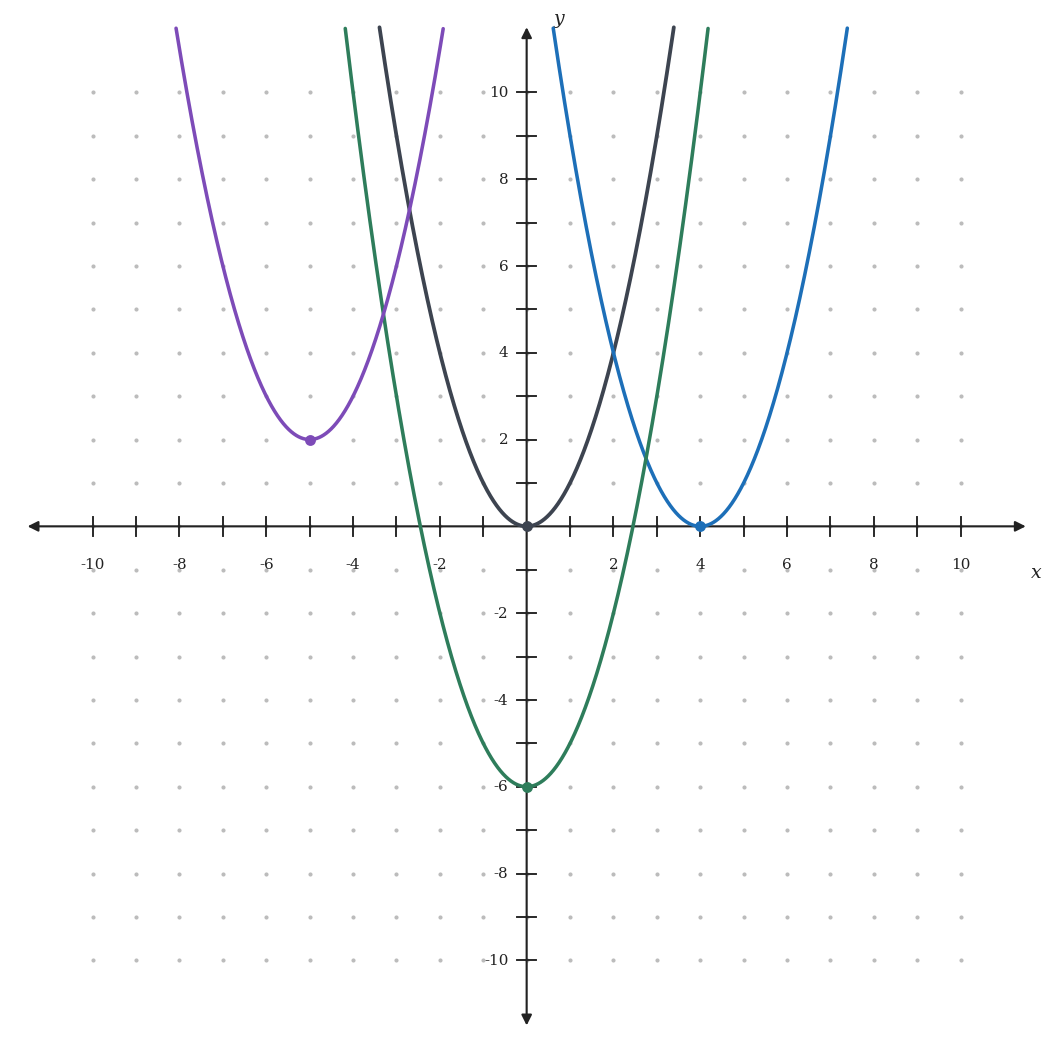
| Equation | Vertex | |
|---|---|---|
| y = x²the parent — nothing done to it | (0, 0) | |
| y = (x − 4)²right 4 | (4, 0) | |
| y = x² − 6down 6 | (0, −6) | |
| y = (x + 5)² + 2left 5, up 2 | (−5, 2) | |
Minus four inside the bracket moves the graph right four. Every student has argued with me about this. The bracket is (x − h), so (x − 4)² means h = +4. Outside the bracket, k behaves itself: −6 really does mean down.
Reflection: Flipping It Over
Negative in front of a flips the parabola over the x-axis. Flipping over the y-axis is the transformation nobody notices, because on a parabola sitting at x = 0 it does absolutely nothing.
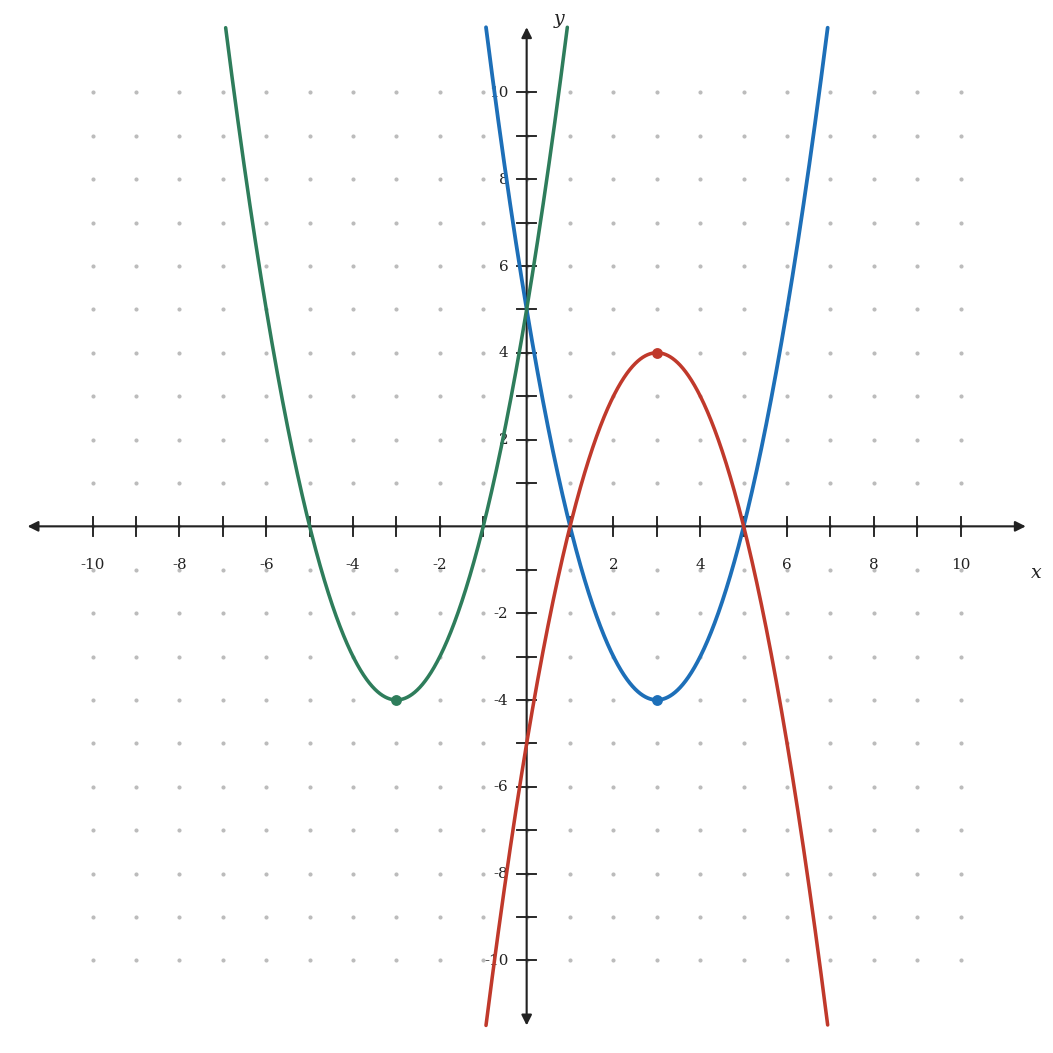
| Equation | Vertex | |
|---|---|---|
| y = (x − 3)² − 4the starting curve | (3, −4) | |
| y = −(x − 3)² + 4flipped over the x-axis | (3, 4) | |
| y = (x + 3)² − 4mirrored over the y-axis | (−3, −4) | |
Flipping over the x-axis negates the whole right side — the k has to change sign too. That is the step people forget. And notice the y-axis mirror only moved the vertex sideways; the parabola still opens up.
Stretching and Shrinking: The Width Dial
Bigger a, skinnier parabola. Smaller a, wider parabola. The vertex does not move an inch, which is the giveaway.
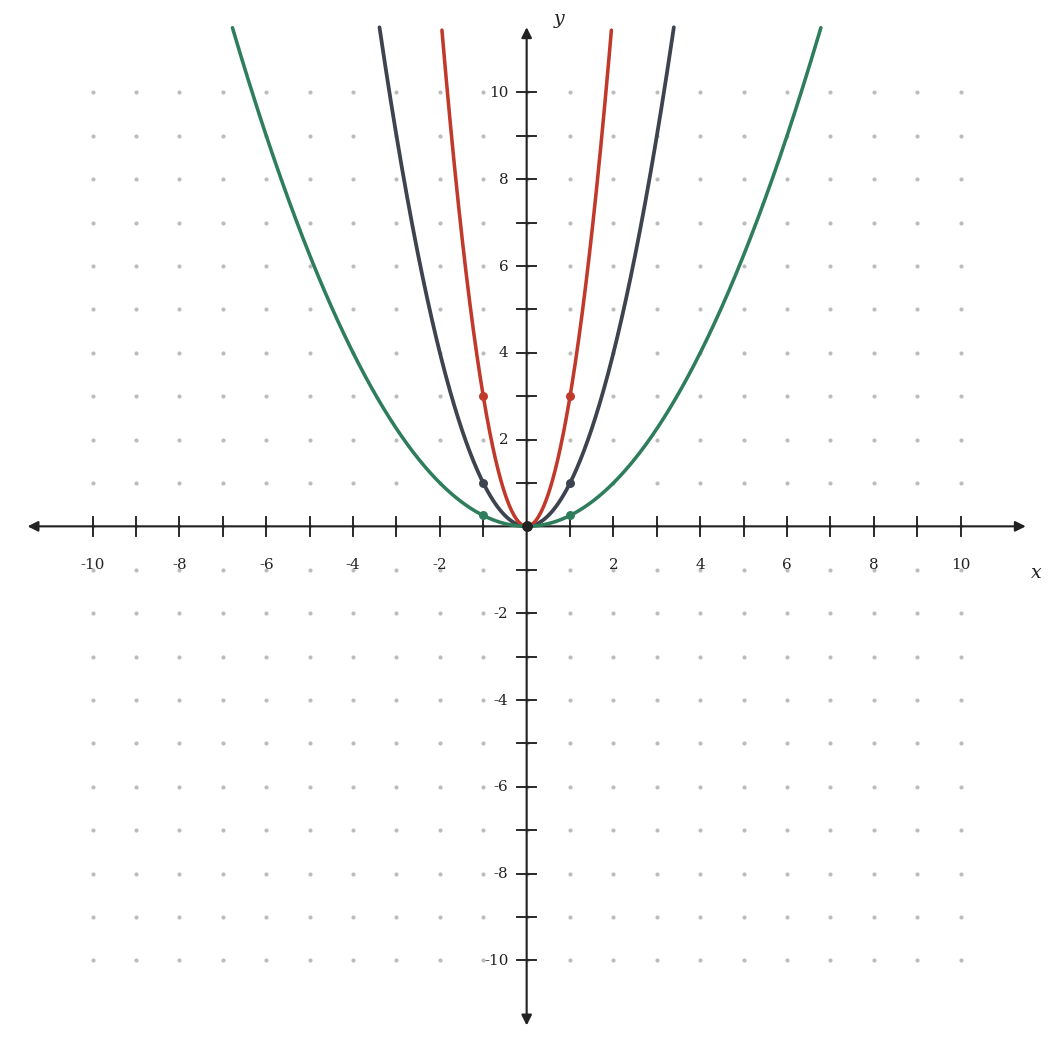
| Equation | At x = 1 | |
|---|---|---|
| y = x²parent | y = 1 | |
| y = 3x²stretch ×3 — narrower | y = 3 | |
| y = ¼x²shrink ×¼ — wider | y = 0.25 | |
When ∣a∣>1, the parabola is narrower than the parent graph. When 0<∣a∣<1, it is wider. Changing a does not move the vertex.
I usually have students move the a, h, and k sliders themselves after this example. GeoGebra works especially well for seeing the width change. Use GeoGebra applet with a, h, and k sliders is the fastest way to feel it, and Desmos works too if you type the equations yourself.
Rotations
A 180° rotation about the vertex produces the same graph as reflecting the parabola across the horizontal line through its vertex.
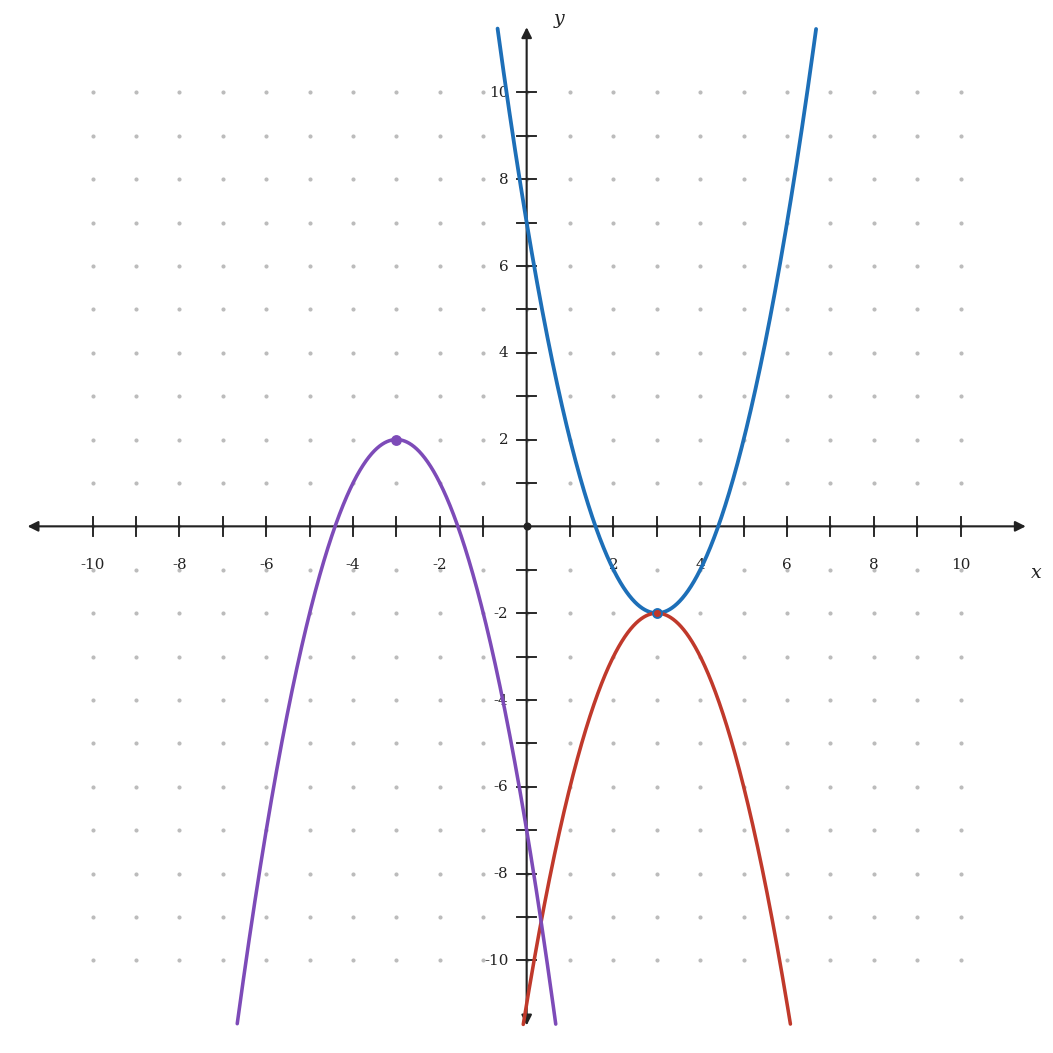
| Equation | Vertex | |
|---|---|---|
| y = (x − 3)² − 2original | (3, −2) | |
| y = −(x − 3)² − 2180° about its own vertex | (3, −2) | |
| y = −(x + 3)² + 2180° about the origin | (−3, 2) | |
Rotation is different from the usual a, h, and k transformations. A 180° rotation about the vertex reverses the parabola's opening direction while leaving the vertex fixed. A 180° rotation about the origin sends every point (x,y) to (−x,−y), so the vertex moves as well.
A 90° rotation produces a sideways parabola, which generally fails the vertical line test and therefore cannot be written as y=f(x).
The Order Trap
Stretch first, then slide. Do it backwards and you'll stretch the shift too.
Take y = x², stretch by 2, then move up 3: you get y = 2x² + 3. Move up 3 first and then stretch: y = 2(x² + 3) = 2x² + 6. Different graph, same words in a different order. Purplemath walks through more of these in point-by-point detail, and the standard behind all of it is CCSS HSF.BF.B.3 if you need the official wording for a lesson plan.
Once you can read a, h, and k off a graph, the related skills are finding the vertex and axis of symmetry, converting between vertex form and intercept form, and completing the square to get standard form into y = a(x − h)² + k in the first place.
Quadratic Transformations Worksheet: Practice Problems
Part A is reading transformations off an equation. Part B asks you to build the equation. Show your work in the space provided.
Part A — describe the transformation from y = x², then give the vertex
- y = x² + 7
- y = (x − 6)²
- y = −x²
- y = 5x²
- y = (x + 2)² − 9
- y = ⅓x²
- y = −(x − 1)² + 4
- y = 2(x + 3)²
- y = (−x)²
- y = −½(x − 4)² − 1
Part B — write the equation, or read it off the graph
- Shift y = x² left 3 and down 5. Write the equation in vertex form.
- Take y = x², flip it over the x-axis, stretch it by 4, then move it up 2. Write the equation.
- Rotate y = (x − 2)² + 3 by 180° about its own vertex. Write the new equation.
- Rotate y = (x − 2)² + 3 by 180° about the origin. Write the new equation.
- The point (3, 9) sits on y = x². Where does it land on y = −2(x − 1)² + 5?
- Which is narrower, y = 0.8x² or y = −3x²? Which one opens downward?
-
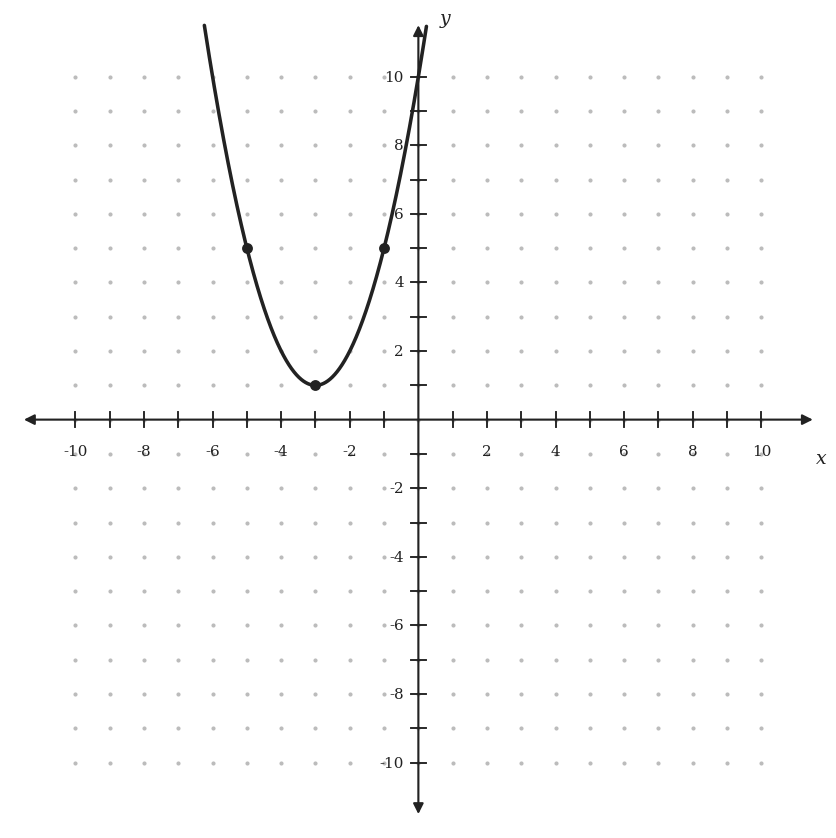
Write the equation of this parabola in vertex form.
-
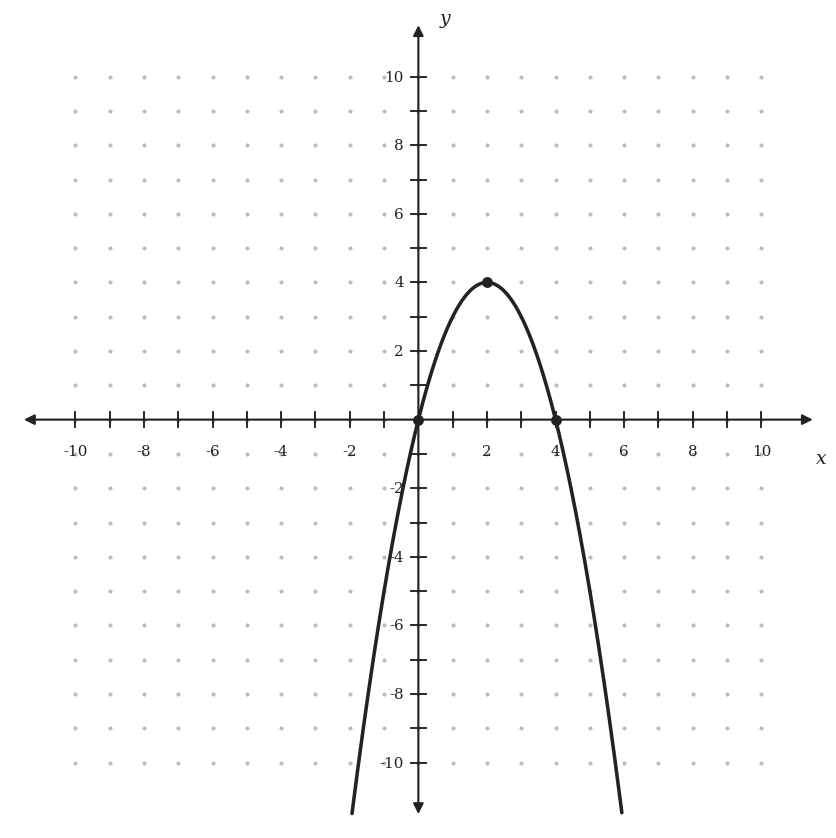
Write the equation of this parabola in vertex form.
-
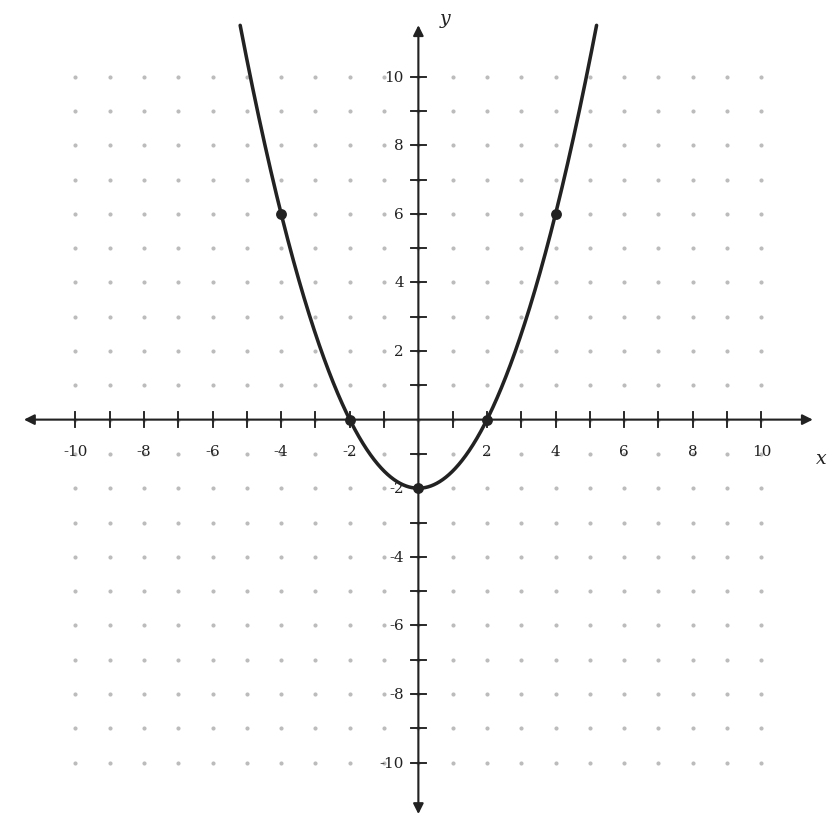
Write the equation of this parabola in vertex form.
- A drone's height is h = −4(t − 3)² + 40. The pilot runs the same flight 2 seconds later and 10 feet higher. Write the new equation and give the new maximum height.
Quadratic Transformations Worksheet: Answer Key
Part A
1. y = x² + 7
The 7 is outside the square, so it moves the whole graph.
Up 7 · vertex (0, 7)
2. y = (x − 6)²
Inside the bracket, and (x − h) means h = 6.
Right 6 · vertex (6, 0)
3. y = −x²
a = −1. Same width, opposite direction.
Reflected over the x-axis (same as a 180° turn about the vertex) · vertex (0, 0)
4. y = 5x²
a = 5, so every y-value is five times bigger.
Vertical stretch by 5, narrower · vertex (0, 0)
5. y = (x + 2)² − 9
(x + 2) is (x − (−2)), so h = −2. The −9 drops it.
Left 2, down 9 · vertex (−2, −9)
6. y = ⅓x²
a is between 0 and 1.
Vertical shrink by ⅓, wider · vertex (0, 0)
7. y = −(x − 1)² + 4
Three things at once: negative a, h = 1, k = 4.
Flipped over the x-axis, right 1, up 4 · vertex (1, 4)
8. y = 2(x + 3)²
a = 2 and h = −3.
Stretch by 2, left 3 · vertex (−3, 0)
9. y = (−x)²
(−x)² = x². A y-axis reflection lands the parabola right back on itself.
No visible change · vertex (0, 0)
10. y = −½(x − 4)² − 1
Negative flips it, ½ widens it, then h = 4 and k = −1 move it.
Flipped, shrink by ½, right 4, down 1 · vertex (4, −1)
Part B
11. Left 3, down 5
Left 3 puts h = −3, so the bracket is (x + 3). Down 5 puts k = −5.
y = (x + 3)² − 5
12. Flip, stretch by 4, up 2
Flip and stretch both live in a, giving a = −4. The move up comes last, so it is not multiplied by 4.
y = −4x² + 2
13. Half turn about the vertex
The vertex is the pivot, so it stays at (2, 3). Only a changes sign.
y = −(x − 2)² + 3
14. Half turn about the origin
Every point (x, y) goes to (−x, −y), so the vertex (2, 3) lands at (−2, −3) and the curve opens down.
y = −(x + 2)² − 3
15. Where (3, 9) lands
The shift right 1 sends x = 3 to x = 4. The y-value gets multiplied by −2 and then raised by 5: −2(9) + 5. Check it: −2(4 − 1)² + 5 = −18 + 5.
(4, −13)
16. Narrower and opening down
Compare the size of a, ignoring the sign: 3 beats 0.8.
y = −3x² is narrower, and it is also the one opening downward
17. Vertex (−3, 1), through (−1, 5)
Two right of the vertex the curve is 4 up, and 4 = a(2)², so a = 1.
y = (x + 3)² + 1
18. Vertex (2, 4), roots at 0 and 4
It opens down, so a is negative. Two left of the vertex the curve drops 4: −4 = a(2)², so a = −1.
y = −(x − 2)² + 4
19. Vertex (0, −2), roots at ±2
At x = 2 the curve has climbed 2 units: 2 = a(2)², so a = ½. Wider than the parent, which matches the picture.
y = ½x² − 2
20. Drone flight, 2 seconds later and 10 feet higher
Later means right, so h goes from 3 to 5. Higher means up, so k goes from 40 to 50. The −4 is untouched.
h = −4(t − 5)² + 50 · maximum 50 feet, now at t = 5 seconds
Every answer above was checked against the original equation or graph before publishing, most recently on July 28, 2026. Please reach out by email at burketutoringinfremont@outlook.com or text (510) 453-0350 if any mistakes are spotted.
Common Questions
What are the four transformations of a quadratic function?
Translation (sliding, from h and k), reflection (flipping, from a negative a), stretching or shrinking (width, from the size of a), and rotation — which for a parabola means a 180° turn.
Why does (x − 4)² move the graph right instead of left?
Because vertex form is written (x − h). Matching (x − 4) to (x − h) gives h = 4, and the vertex sits at x = h. If it helps, ask what x makes the bracket zero: x = 4, which is where the vertex has to be.
Is rotating a parabola 180° the same as reflecting it?
About its own vertex, yes — identical curve. About any other point, no: the vertex moves as well, so you get a flipped parabola somewhere else entirely.
Does a change the vertex?
No. Only h and k move the vertex. Changing a squeezes or flips the curve around a vertex that stays exactly where it was.
What grade level is this quadratic transformations worksheet for?
Algebra I, usually grades 8 to 10, and again in Algebra II when function families come back around. Part A of this quadratic transformations worksheet works as a warm-up; Part B is closer to test level. For extra reps, the Function Flyer lets you drag coefficients and watch the graph react.
Keep Practicing
Transformations are the shortcut; the long way still has to work too. Try graphing quadratic functions from scratch, writing a parabola's equation from a graph, and using the discriminant to count roots. When it comes time to solve, there is factoring and the quadratic formula — and if you want to see how quadratics stack up against the other function families, try comparing linear, quadratic, and exponential functions.
About the Author

Berke has taught K–12 math and science for more than 10 years, logging over 6,000 tutoring hours with 200+ students. He holds a BS in Biochemistry from Washington University in St. Louis and an MS in Bioinformatics from UMGC.
He writes every worksheet on this site from problems he actually uses in sessions. This quadratic transformations worksheet started as a one-page handout for an Algebra I student who kept shifting parabolas the wrong way — the "h lies to your face" box exists because that argument happens at least once a month.
How these are made: problems are prepared from previous class notes and assigned homework, and every answer is checked before publishing. Corrections come in by email or text and get fixed the same week.
If you want someone sitting next to you while you work through this quadratic transformations worksheet, Burke Tutoring offers in-home algebra tutoring in Fremont, Newark, and Union City. Call (510) 453-0350.
Burke Tutoring · Fremont, CA 94538 · (510) 453-0350 · Serving Fremont · Newark · Union City