Completing the Square Worksheet with Answer Key
Solving quadratics by completing the square: two worked examples, the slip that costs the most marks, and 20 practice problems with a full answer key.
Published July 27, 2026 · Last updated
Want the printable completing the square worksheet?
Worked examples, 20 practice problems, and a full answer key. No sign-up, no email required.
↓ Download PDFFactoring is usually fastest when a quadratic factors cleanly. When it doesn't, completing the square still gives you a practical way to solve the equation and it also rewrites the quadratic in vertex form. The key step is simple: add the number needed to make a perfect square, while keeping the expression or equation balanced.
When rewriting an expression, whatever you add to create the perfect square has to be subtracted again so the value does not change.
- Keep the x² and x terms together. If a number sits in front of x², factor it out of those two terms only.
- Halve the x coefficient, then square it.
- Add that number and subtract it again in the same line.
- Fold the first three terms into a square and tidy up what is left.
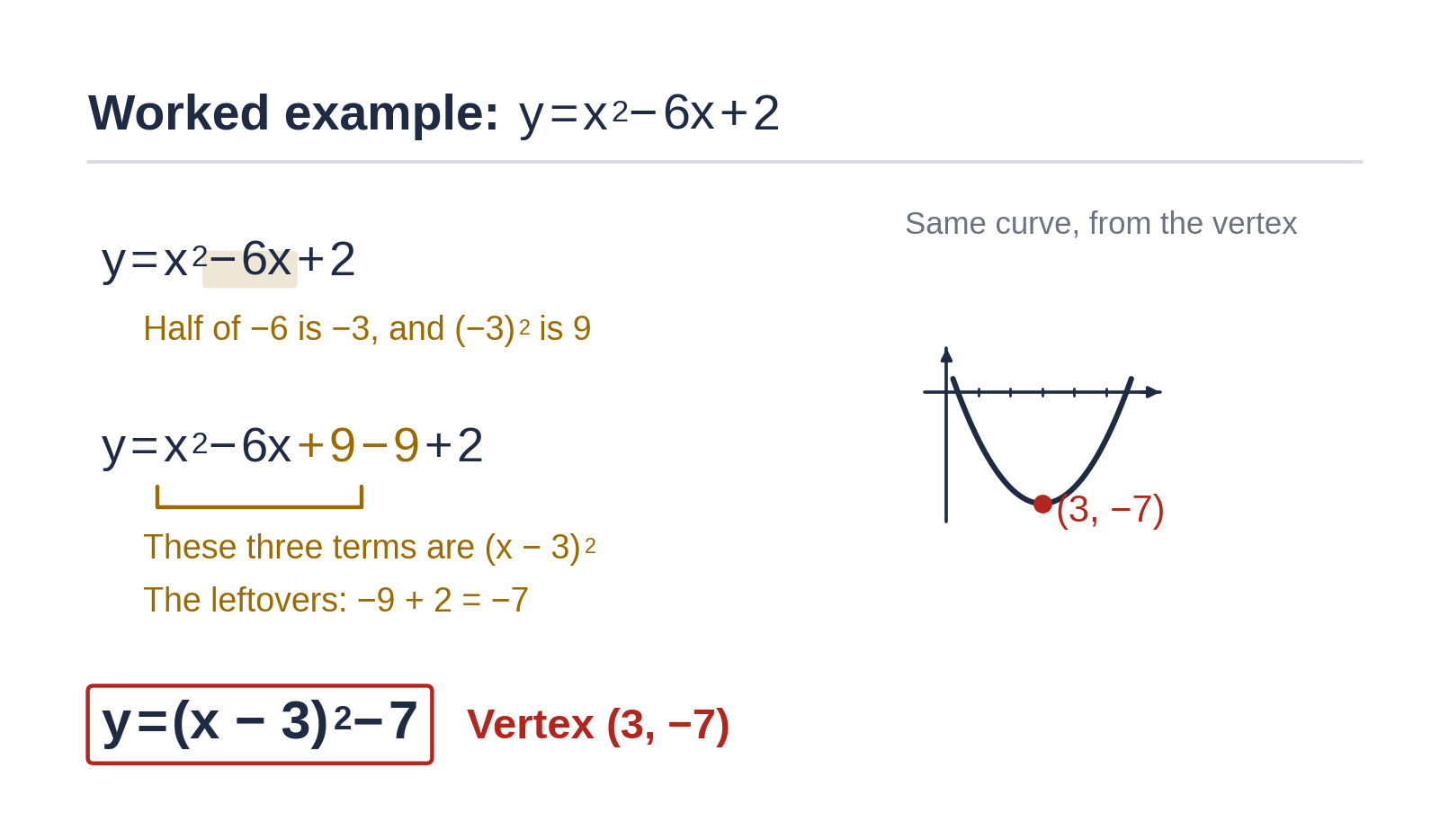
Worked Example: y = x² − 6x + 2
Half of −6 is −3, and (−3)² is 9. Add 9, subtract 9, and the first three terms collapse into (x − 3)². The two loose constants, −9 and +2, combine to −7.
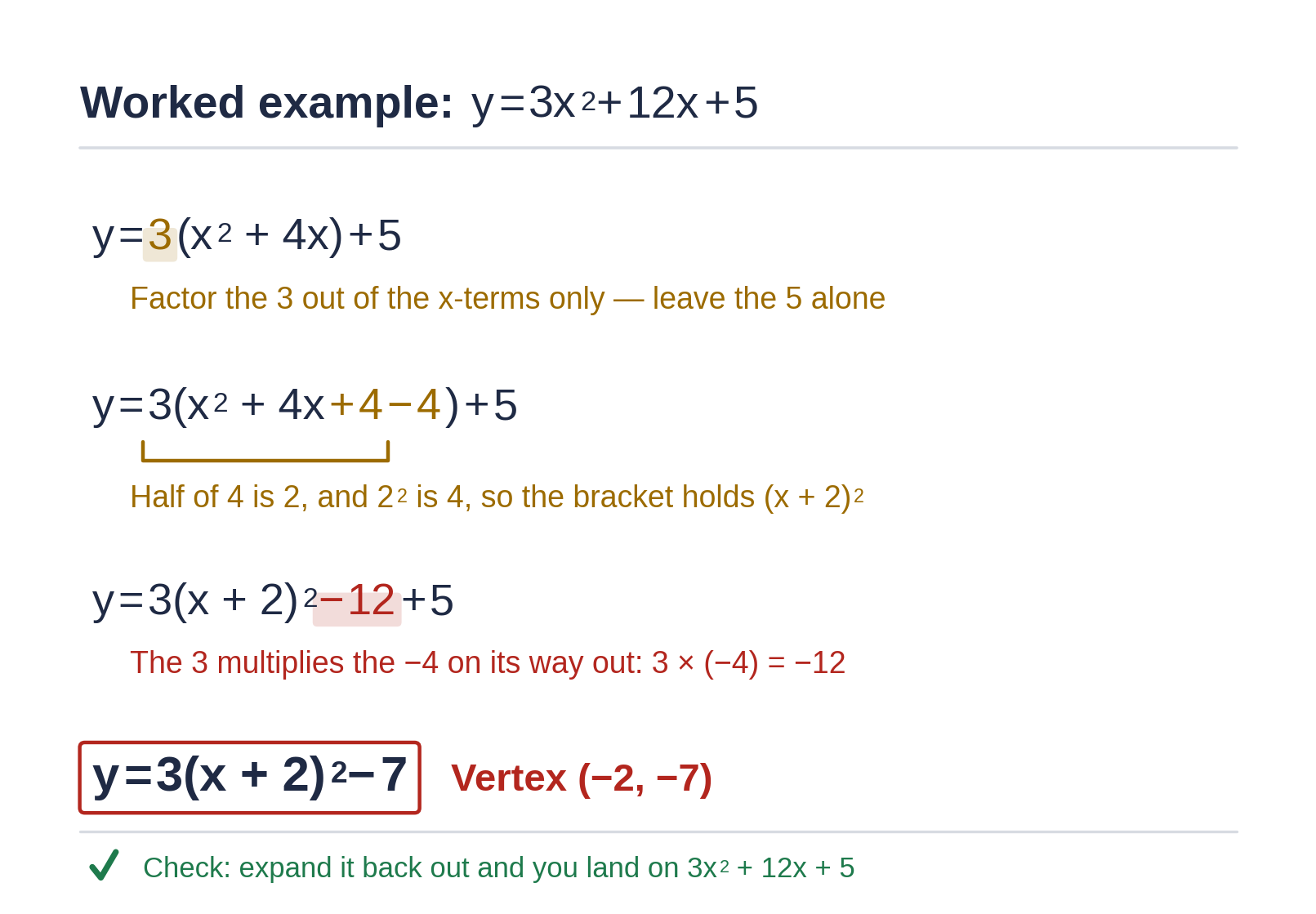
When a Number Sits in Front of x²
Factor it out of the x terms first, then complete the square inside the bracket. The one thing students forget: whatever you subtract inside gets multiplied by that number on the way out.
The Slip Worth Knowing About
One of the most common errors I see is adding the number needed to make the square and forgetting to subtract it again. The 25 gets added, the square gets written, and the 25 never comes back off. That changes the value of the expression, so you no longer have the original quadratic. In ten years of marking this topic, it is far and away the most common mistake I see.
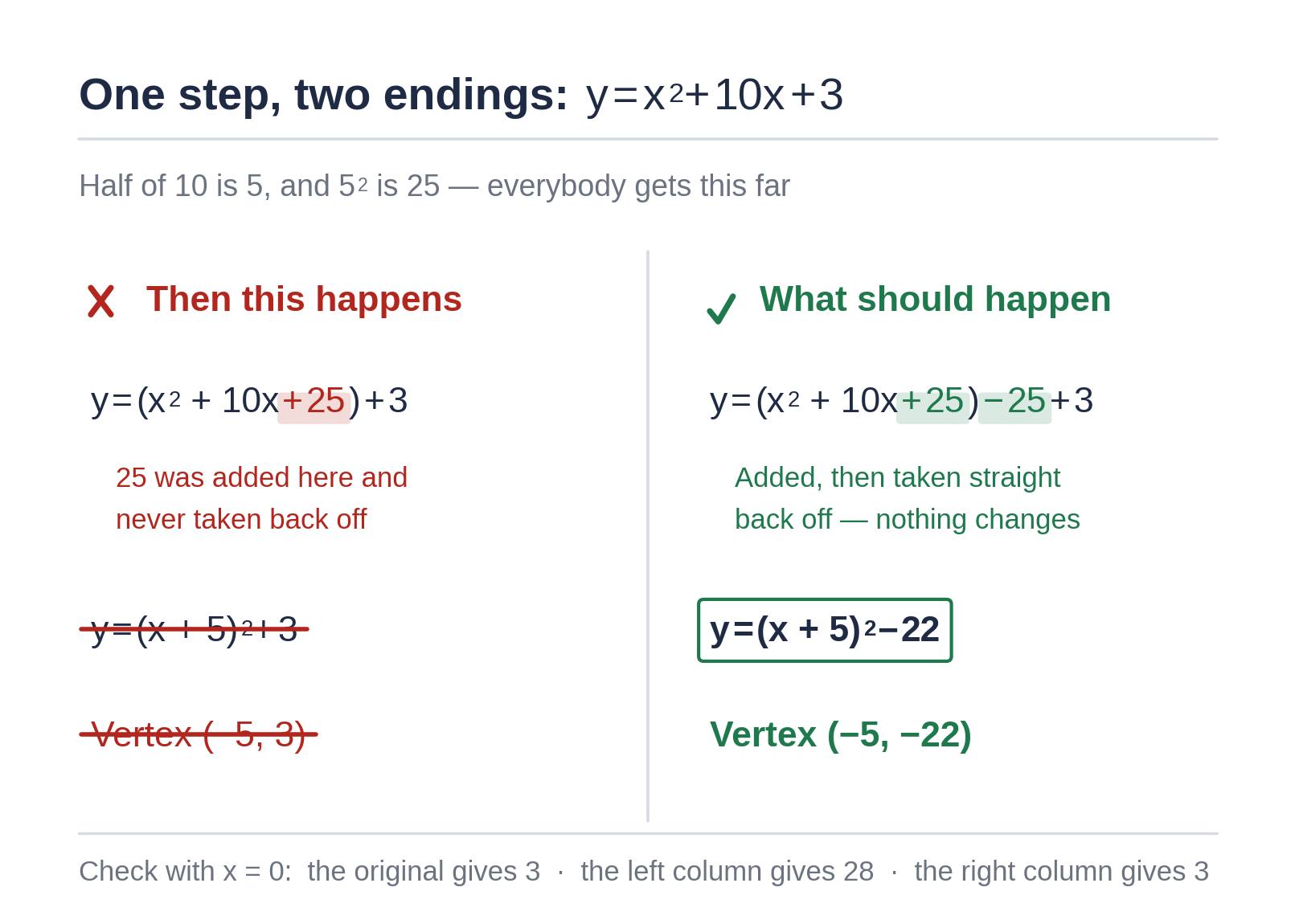
If you add a number to one side of an equation and nothing else changes, the equation is no longer true. Either subtract it again in the same line, or add it to both sides. Pick one habit and keep it.
Solving vs. Rewriting
Completing the square is used both to solve quadratic equations and to rewrite quadratics in vertex form.
Solving. Move the constant across, complete the square, then take the square root of both sides. The ± is not optional. x − 3 = ±2 gives two answers, and dropping the negative one loses half the marks.
Rewriting in vertex form. Keep everything on one side and stop at y = a(x − h)² + k. The vertex is (h, k), sign flipped. There is more on that in the vertex form and intercept form worksheet, and in the vertex and axis of symmetry worksheet if you'd rather get there straight from standard form. If the quadratic happens to factor cleanly, solving by factoring is faster, and the quadratic formula is really just this method run once on the general case — the discriminant tells you how many roots to expect before you start. Khan Academy's completing the square article and the OpenStax Algebra and Trigonometry chapter both cover the same ground if you want a second explanation.
Practice Problems: Completing the Square Worksheet
The practice set has 20 problems. Part A keeps the leading coefficient at 1; Part B introduces coefficients other than 1. Show your work in the space provided — there's room under each question.
Part A — solve by completing the square
- x² + 6x + 5 = 0
- x² − 4x − 12 = 0
- x² + 2x − 8 = 0
- x² − 8x + 7 = 0
- x² + 10x + 9 = 0
- x² − 6x + 4 = 0
- x² + 4x − 6 = 0
- x² − 2x − 5 = 0
- x² + 5x + 6 = 0
- x² − 3x − 10 = 0
Part B — problems 11–15: solve. Problems 16–20: write in vertex form and give the vertex.
- 2x² + 8x + 6 = 0
- 3x² − 12x + 9 = 0
- 2x² − 4x − 3 = 0
- 4x² + 8x − 5 = 0
- 2x² + 6x + 1 = 0
- y = 2x² + 8x + 3
- y = 3x² − 6x + 1
- y = x² + 7x + 10
- y = −x² + 4x − 1
- y = 5x² − 20x + 13
Completing the Square Worksheet: Answer Key
Part A
1. x² + 6x + 5 = 0
Half of 6 is 3, squared is 9. (x + 3)² − 9 + 5 = 0, so (x + 3)² = 4 and x + 3 = ±2.
x = −1 and x = −5
2. x² − 4x − 12 = 0
(x − 2)² − 4 − 12 = 0, so (x − 2)² = 16 and x − 2 = ±4.
x = 6 and x = −2
3. x² + 2x − 8 = 0
(x + 1)² − 1 − 8 = 0, so (x + 1)² = 9 and x + 1 = ±3.
x = 2 and x = −4
4. x² − 8x + 7 = 0
(x − 4)² − 16 + 7 = 0, so (x − 4)² = 9 and x − 4 = ±3.
x = 7 and x = 1
5. x² + 10x + 9 = 0
(x + 5)² − 25 + 9 = 0, so (x + 5)² = 16 and x + 5 = ±4.
x = −1 and x = −9
6. x² − 6x + 4 = 0
(x − 3)² − 9 + 4 = 0, so (x − 3)² = 5. This one does not factor, which is the point.
x = 3 ± √5
7. x² + 4x − 6 = 0
(x + 2)² − 4 − 6 = 0, so (x + 2)² = 10.
x = −2 ± √10
8. x² − 2x − 5 = 0
(x − 1)² − 1 − 5 = 0, so (x − 1)² = 6.
x = 1 ± √6
9. x² + 5x + 6 = 0
Half of 5 is 5/2, squared is 25/4. (x + 5/2)² − 25/4 + 6 = 0, so (x + 5/2)² = 1/4 and x + 5/2 = ±1/2.
x = −2 and x = −3
10. x² − 3x − 10 = 0
(x − 3/2)² − 9/4 − 10 = 0, so (x − 3/2)² = 49/4 and x − 3/2 = ±7/2.
x = 5 and x = −2
Part B
11. 2x² + 8x + 6 = 0
Divide through by 2 first: x² + 4x + 3 = 0. Then (x + 2)² = 1.
x = −1 and x = −3
12. 3x² − 12x + 9 = 0
Divide by 3: x² − 4x + 3 = 0. Then (x − 2)² = 1.
x = 1 and x = 3
13. 2x² − 4x − 3 = 0
Divide by 2: x² − 2x = 3/2. Then (x − 1)² = 5/2.
x = 1 ± (√10)/2
14. 4x² + 8x − 5 = 0
Divide by 4: x² + 2x = 5/4. Then (x + 1)² = 9/4 and x + 1 = ±3/2.
x = 1/2 and x = −5/2
15. 2x² + 6x + 1 = 0
Divide by 2: x² + 3x = −1/2. Then (x + 3/2)² = 7/4.
x = (−3 ± √7) / 2
16. y = 2x² + 8x + 3
2(x² + 4x) + 3 = 2(x² + 4x + 4 − 4) + 3 = 2(x + 2)² − 8 + 3.
y = 2(x + 2)² − 5 · Vertex (−2, −5)
17. y = 3x² − 6x + 1
3(x² − 2x) + 1 = 3(x² − 2x + 1 − 1) + 1 = 3(x − 1)² − 3 + 1.
y = 3(x − 1)² − 2 · Vertex (1, −2)
18. y = x² + 7x + 10
Half of 7 is 7/2, squared is 49/4. (x + 7/2)² − 49/4 + 10.
y = (x + 7/2)² − 9/4 · Vertex (−7/2, −9/4)
19. y = −x² + 4x − 1
Factor out −1: −(x² − 4x) − 1 = −(x² − 4x + 4 − 4) − 1 = −(x − 2)² + 4 − 1.
y = −(x − 2)² + 3 · Vertex (2, 3)
20. y = 5x² − 20x + 13
5(x² − 4x) + 13 = 5(x² − 4x + 4 − 4) + 13 = 5(x − 2)² − 20 + 13.
y = 5(x − 2)² − 7 · Vertex (2, −7)
Every answer above was worked by hand and checked by substituting the roots back into the original equation. If you spot an error, let us know and it will be corrected.
Keep Practicing
Once the vertex is second nature, graphing quadratic functions is the natural next step, and working backward with the parabola equation from a graph worksheet checks whether it actually stuck.
About the Author

Berke has taught K–12 math and science for more than 10 years, logging over 6,000 tutoring hours with 200+ students. He holds a BS in Biochemistry from Washington University in St. Louis and an MS in Bioinformatics from UMGC.
He writes every worksheet on this site from problems he actually uses in sessions, which is why the common-mistake section above exists — it is the error he corrects most often.
If you want someone sitting next to you while you work through this completing the square worksheet with answer key, Burke Tutoring offers in-home algebra tutoring in Fremont, Newark, and Union City.
Burke Tutoring — Fremont · Newark · Union City