Vertex and Axis of Symmetry Worksheet: How to Find the Vertex of a Parabola
Guide and free worksheet for finding the vertex and axis of symmetry of a quadratic equation — using the midpoint of the roots or the vertex formula x = −b ⁄ 2a
- Algebra I & II
- 20 problems
- ~25 minutes
- Answer key included
- No sign-up
Want the printable vertex and axis of symmetry worksheet?
Full worksheet with worked examples, 20 practice problems, and a complete answer key. No sign-up, no email required.
Every parabola is symmetric. Fold it down the middle and the two halves land on top of each other. That fold line is the axis of symmetry, and the point where it crosses the curve is the vertex — the lowest point if the parabola opens up, the highest if it opens down. Both come from a single x-value, and there are two ways to find it. This guide walks through both methods, and the vertex and axis of symmetry worksheet below lets you practice them with a full answer key.
You will get the most out of this if you can already read coefficients off a quadratic in standard form and factor a simple trinomial. If factoring is still shaky, start with solving quadratics by factoring and come back.
x = −b ⁄ 2a
or, when you already know the roots: x = (r₁ + r₂) ⁄ 2
Why Both Vertex Formula Methods Give the Same Line
Look at the quadratic formula: x = ( −b ± √(b² − 4ac) ) ⁄ 2a. The two roots sit at −b ⁄ 2a plus a bit, and −b ⁄ 2a minus that same bit. They are equally far from −b ⁄ 2a in opposite directions.
- That makes −b ⁄ 2a the exact middle of the two roots, which is why averaging the roots gives the identical answer.
- It also means you can skip the roots entirely. The ± part cancels when you average, so it never mattered.
- When there is only one root, that root is the axis so the vertex is sitting on the x-axis.
- When there are no real roots, averaging is not available at all. Use −b ⁄ 2a; the parabola still has a vertex, it just never crosses the axis.
If you want a second explanation of where this formula comes from, Purplemath covers the vertex, the leading coefficient, and the axis of symmetry from the graphing side.
How to Find the Vertex of a Quadratic: The Steps
- Write the quadratic in standard form: y = ax² + bx + c. If it is not in this form yet, rearrange first. Reading coefficients off an unarranged equation is where most wrong answers start.
- Read off a and b with their signs. The minus sign in front of a term belongs to the coefficient. In y = x² − 8x + 12, b is −8, not 8.
- Compute x = −b ⁄ 2a. Write the negative of b first, on its own, before dividing. When b is already negative, −b becomes positive — this is the single most common place to lose a sign.
- Substitute that x back into the original equation to get y. The axis of symmetry is a line, x = something. The vertex is a point, (x, y). You are not finished until you have both.
If the quadratic is already factored, or factors quickly, averaging the roots is faster and easier to do in your head. If it does not factor, has no real roots, or you are handed the equation in standard form, go straight to −b ⁄ 2a. Both are correct — pick based on what the problem already gives you. Paul's Online Math Notes on parabolas walks through the same vertex and axis-of-symmetry ideas if you want a second worked treatment.
Worked Examples: Finding the Vertex and Axis of Symmetry
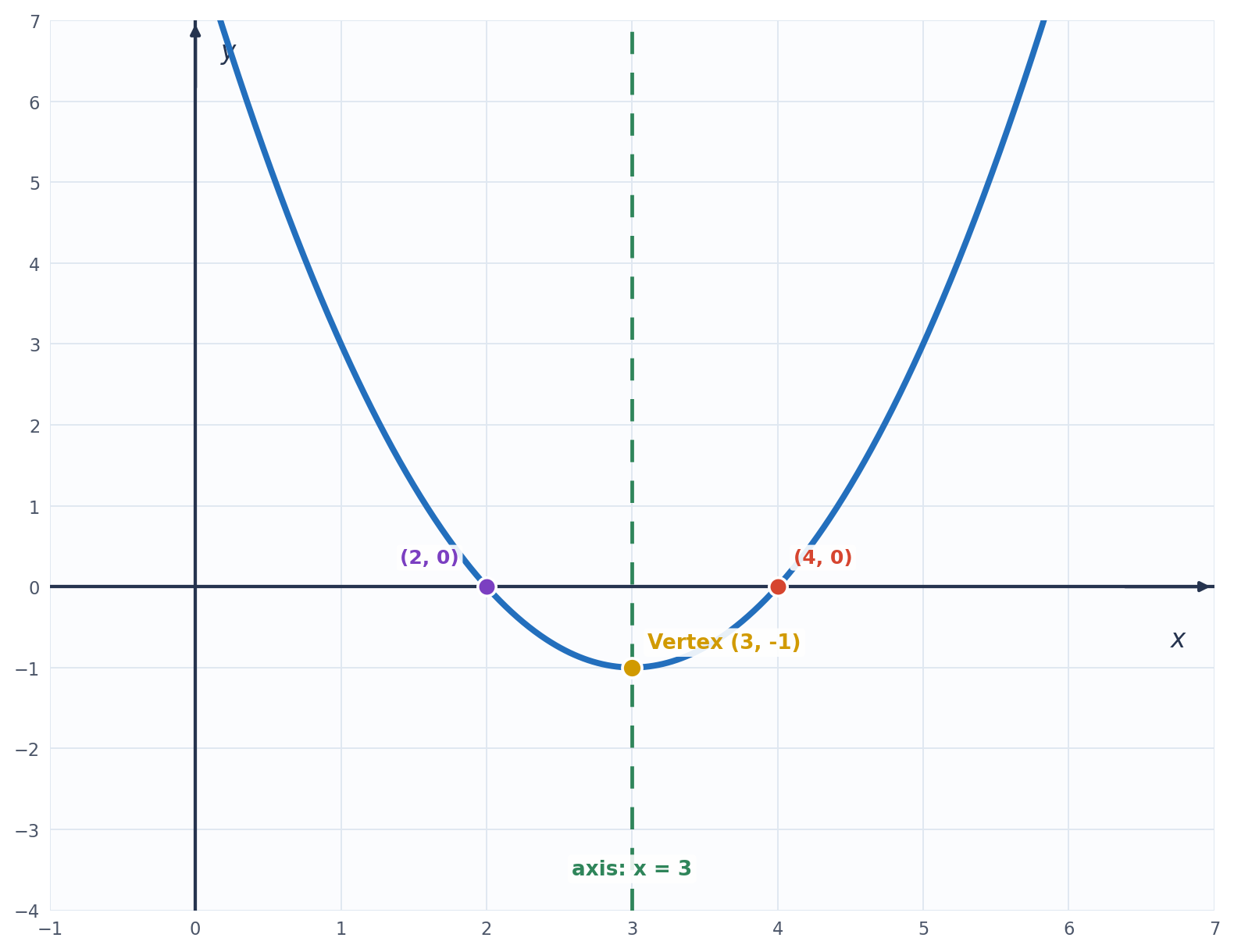
Example 1 — averaging the roots
y = x² − 6x + 8
This factors: y = (x − 2)(x − 4), so the roots are x = 2 and x = 4. The axis of symmetry is the midpoint: (2 + 4) ⁄ 2 = 3. Substituting back: y = 3² − 6(3) + 8 = 9 − 18 + 8 = −1.
Axis of symmetry: x = 3. Vertex: (3, −1). Check it with the other method: −b ⁄ 2a = −(−6) ⁄ 2(1) = 6 ⁄ 2 = 3. Same line.
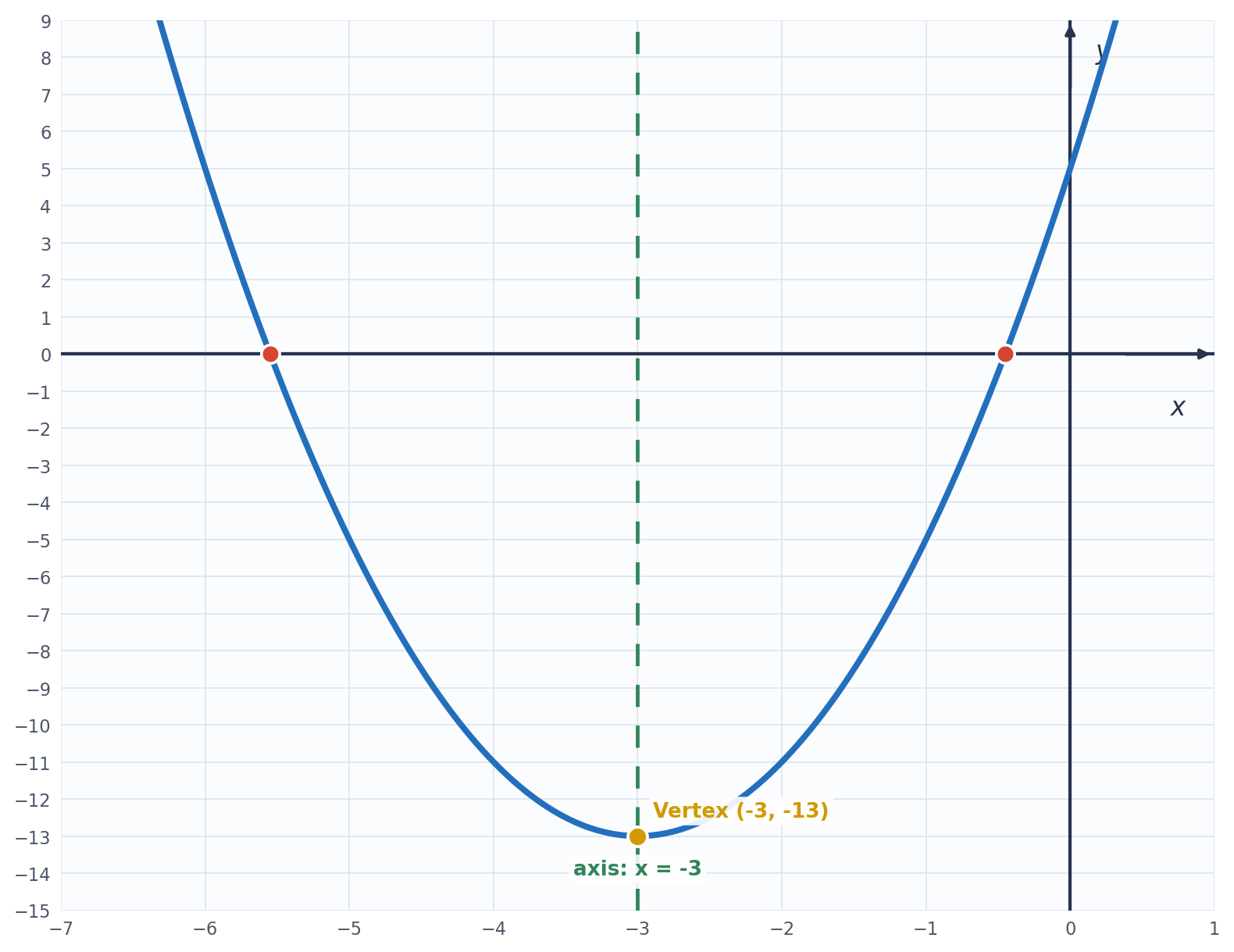
Example 2 — using the vertex formula −b ⁄ 2a
y = 2x² + 12x + 5
a = 2, b = 12. This one does not factor cleanly, so averaging roots is not the fast route. −b = −12, and 2a = 4, so x = −12 ⁄ 4 = −3. Substituting: y = 2(−3)² + 12(−3) + 5 = 18 − 36 + 5 = −13.
Axis of symmetry: x = −3. Vertex: (−3, −13). Since a is positive the parabola opens upward, so this vertex is the minimum point.
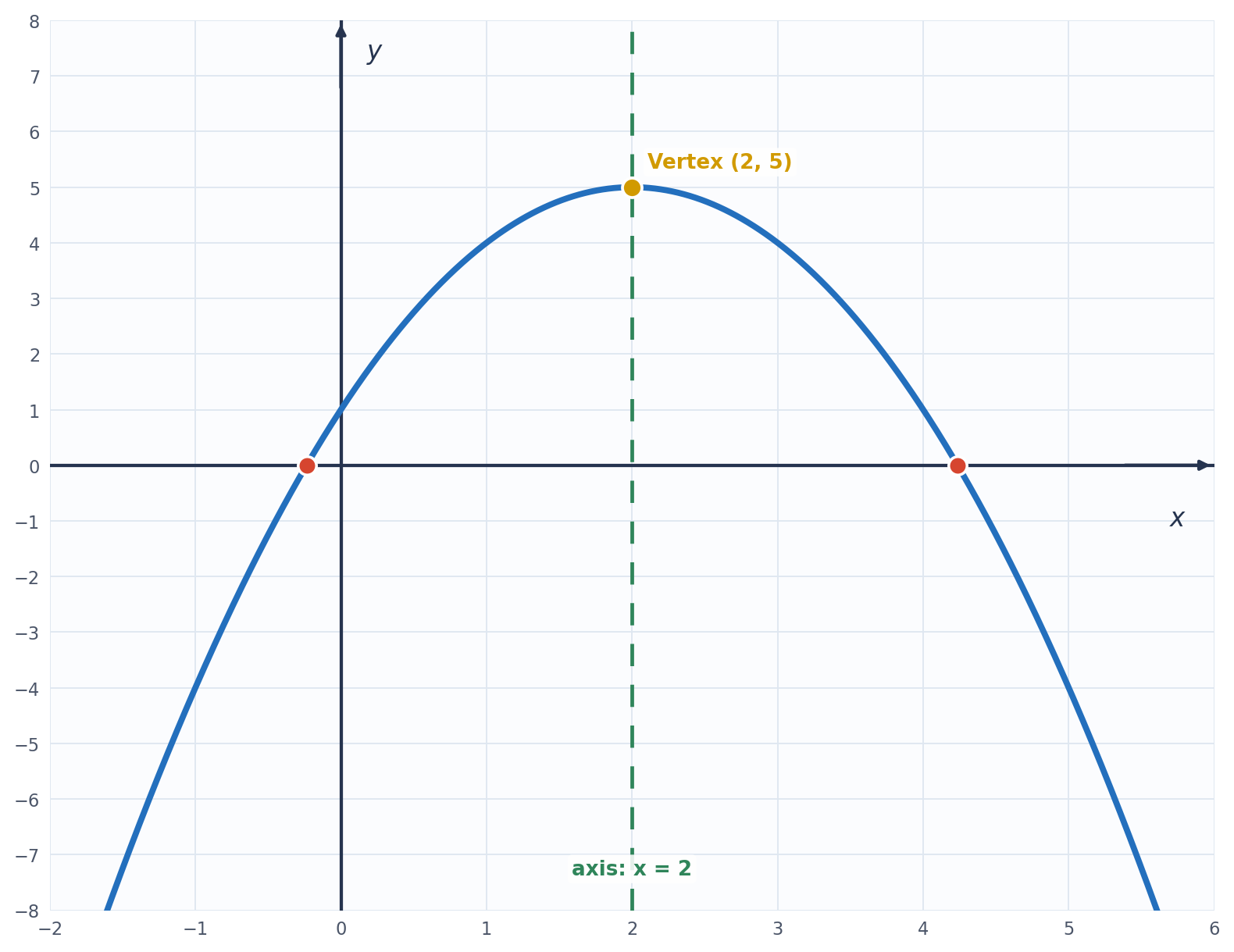
Example 3 — a negative leading coefficient
y = −x² + 4x + 1
a = −1, b = 4. Here 2a = −2, so x = −4 ⁄ −2 = 2. A negative divided by a negative is positive — slow down on that line. Substituting: y = −(2)² + 4(2) + 1 = −4 + 8 + 1 = 5.
Axis of symmetry: x = 2. Vertex: (2, 5). a is negative, so this parabola opens downward and the vertex is the maximum. Do not report it as a minimum out of habit.
Three Mistakes I See Most Often
Across ten years of Algebra I and II sessions, almost every lost point on this topic comes from one of three places. None of them is about not knowing the formula.
- Dropping the negative on b. With y = x² − 10x + 3, students write x = −10 ⁄ 2 instead of x = 10 ⁄ 2. Writing "−b = 10" on its own line first fixes this almost every time.
- Stopping at the axis. The x-value is only half the answer. If the question asks for the vertex and you hand in x = 4, that is a point you did not need to lose — substitute back.
- Calling a maximum a minimum. Check the sign of a before you label anything. Positive a opens up and gives a minimum; negative a opens down and gives a maximum.
How to Check Your Own Answer Before You Turn It In
You do not need the answer key to know whether you are right. The symmetry that defines the vertex also gives you a free check, and it takes about fifteen seconds.
- Pick any number, say 1, and step that far to each side of your axis. If your axis is x = 3, test x = 2 and x = 4.
- Plug both into the original equation. If the two y-values come out equal, your axis is genuinely the fold line. If they differ, the axis is wrong — go back to the sign on b.
- Sanity-check the y-value against the sign of a. If a is positive, no point on the parabola should be lower than your vertex. Test one nearby x. If you find something lower, your y is wrong.
Using Example 1 (y = x² − 6x + 8, axis x = 3): at x = 2, y = 4 − 12 + 8 = 0. At x = 4, y = 16 − 24 + 8 = 0. Equal, so x = 3 is confirmed. This check catches the dropped-negative mistake every single time, which is why it is worth building the habit.
Practice Problems: Vertex and Axis of Symmetry
These vertex and axis of symmetry worksheet problems mix both methods on purpose. For each quadratic, find the axis of symmetry and the vertex, using whichever method fits the problem in front of you.
The set builds deliberately: problems 1–5 factor cleanly so you can average roots, 6–7 and 11–12 introduce leading coefficients other than 1 and negative values of a, and 8, 10, 14 and 16 cover the edge cases — b = 0, no real roots, and a double root sitting on the x-axis.
- y = x² − 4x + 3Axis: ____________ Vertex: ____________
- y = x² + 6x + 5Axis: ____________ Vertex: ____________
- y = x² − 2x − 8Axis: ____________ Vertex: ____________
- y = 2x² + 8x + 3Axis: ____________ Vertex: ____________
- y = x² + 10x + 21Axis: ____________ Vertex: ____________
- y = −x² + 6x − 5Axis: ____________ Vertex: ____________
- y = 3x² − 12x + 7Axis: ____________ Vertex: ____________
- y = x² − 9Axis: ____________ Vertex: ____________
- y = x² + 5x + 6Axis: ____________ Vertex: ____________
- y = x² − 8x + 20Axis: ____________ Vertex: ____________
- y = 4x² + 4x − 3Axis: ____________ Vertex: ____________
- y = −2x² + 8x − 3Axis: ____________ Vertex: ____________
- y = x² + 3x − 10Axis: ____________ Vertex: ____________
- y = x² + 2x + 7Axis: ____________ Vertex: ____________
- y = 2x² − 10x + 8Axis: ____________ Vertex: ____________
- y = x² − 12x + 36Axis: ____________ Vertex: ____________
- y = −3x² + 6x + 2Axis: ____________ Vertex: ____________
- y = x² − 7x + 12Axis: ____________ Vertex: ____________
- y = 5x² + 20x + 11Axis: ____________ Vertex: ____________
- y = x² + x − 6Axis: ____________ Vertex: ____________
Vertex and Axis of Symmetry: Answer Key
Every problem from the vertex and axis of symmetry worksheet is worked out below. Click a question to reveal the full solution.
1. y = x² − 4x + 3
a = 1, b = −4 → x = −(−4) ⁄ 2(1) = 2
y = 2² − 4(2) + 3 = 4 − 8 + 3 = −1Answer: Axis x = 2, Vertex (2, −1)
2. y = x² + 6x + 5
Factors to (x + 1)(x + 5), roots −1 and −5 → midpoint (−1 + −5) ⁄ 2 = −3
y = (−3)² + 6(−3) + 5 = 9 − 18 + 5 = −4Answer: Axis x = −3, Vertex (−3, −4)
3. y = x² − 2x − 8
Factors to (x − 4)(x + 2), roots 4 and −2 → midpoint (4 + −2) ⁄ 2 = 1
y = 1² − 2(1) − 8 = 1 − 2 − 8 = −9Answer: Axis x = 1, Vertex (1, −9)
4. y = 2x² + 8x + 3
a = 2, b = 8 → x = −8 ⁄ 4 = −2
y = 2(−2)² + 8(−2) + 3 = 8 − 16 + 3 = −5Answer: Axis x = −2, Vertex (−2, −5)
5. y = x² + 10x + 21
Factors to (x + 3)(x + 7), roots −3 and −7 → midpoint −5
y = (−5)² + 10(−5) + 21 = 25 − 50 + 21 = −4Answer: Axis x = −5, Vertex (−5, −4)
6. y = −x² + 6x − 5
a = −1, b = 6 → x = −6 ⁄ −2 = 3
y = −(3)² + 6(3) − 5 = −9 + 18 − 5 = 4Answer: Axis x = 3, Vertex (3, 4) — a maximum, since a < 0
7. y = 3x² − 12x + 7
a = 3, b = −12 → x = 12 ⁄ 6 = 2
y = 3(2)² − 12(2) + 7 = 12 − 24 + 7 = −5Answer: Axis x = 2, Vertex (2, −5)
8. y = x² − 9
a = 1, b = 0 → x = −0 ⁄ 2 = 0. Both methods agree here: the roots are 3 and −3, and their midpoint is also 0.
y = 0² − 9 = −9Answer: Axis x = 0, Vertex (0, −9)
9. y = x² + 5x + 6
Factors to (x + 2)(x + 3), roots −2 and −3 → midpoint −5/2
y = (−5/2)² + 5(−5/2) + 6 = 25/4 − 25/2 + 6 = −1/4Answer: Axis x = −5/2, Vertex (−5/2, −1/4)
10. y = x² − 8x + 20
a = 1, b = −8 → x = 8 ⁄ 2 = 4. (No real roots here — the discriminant is 64 − 80 = −16 — so averaging is unavailable.)
y = 4² − 8(4) + 20 = 16 − 32 + 20 = 4Answer: Axis x = 4, Vertex (4, 4)
11. y = 4x² + 4x − 3
a = 4, b = 4 → x = −4 ⁄ 8 = −1/2
y = 4(1/4) + 4(−1/2) − 3 = 1 − 2 − 3 = −4Answer: Axis x = −1/2, Vertex (−1/2, −4)
12. y = −2x² + 8x − 3
a = −2, b = 8 → x = −8 ⁄ −4 = 2
y = −2(4) + 8(2) − 3 = −8 + 16 − 3 = 5Answer: Axis x = 2, Vertex (2, 5) — a maximum
13. y = x² + 3x − 10
Factors to (x + 5)(x − 2), roots −5 and 2 → midpoint −3/2
y = 9/4 − 9/2 − 10 = −49/4Answer: Axis x = −3/2, Vertex (−3/2, −49/4)
14. y = x² + 2x + 7
a = 1, b = 2 → x = −2 ⁄ 2 = −1. (No real roots — the whole parabola sits above the x-axis.)
y = 1 − 2 + 7 = 6Answer: Axis x = −1, Vertex (−1, 6)
15. y = 2x² − 10x + 8
a = 2, b = −10 → x = 10 ⁄ 4 = 5/2
y = 2(25/4) − 10(5/2) + 8 = 25/2 − 25 + 8 = −9/2Answer: Axis x = 5/2, Vertex (5/2, −9/2)
16. y = x² − 12x + 36
Perfect square: (x − 6)², one root at x = 6, so the root is the axis.
y = 36 − 72 + 36 = 0Answer: Axis x = 6, Vertex (6, 0) — sitting on the x-axis
17. y = −3x² + 6x + 2
a = −3, b = 6 → x = −6 ⁄ −6 = 1
y = −3(1) + 6(1) + 2 = −3 + 6 + 2 = 5Answer: Axis x = 1, Vertex (1, 5) — a maximum
18. y = x² − 7x + 12
Factors to (x − 3)(x − 4), roots 3 and 4 → midpoint 7/2
y = 49/4 − 49/2 + 12 = −1/4Answer: Axis x = 7/2, Vertex (7/2, −1/4)
19. y = 5x² + 20x + 11
a = 5, b = 20 → x = −20 ⁄ 10 = −2
y = 5(4) + 20(−2) + 11 = 20 − 40 + 11 = −9Answer: Axis x = −2, Vertex (−2, −9)
20. y = x² + x − 6
Factors to (x + 3)(x − 2), roots −3 and 2 → midpoint −1/2
y = 1/4 − 1/2 − 6 = −25/4Answer: Axis x = −1/2, Vertex (−1/2, −25/4)
Vertex and Axis of Symmetry: Common Questions
What is the axis of symmetry of a parabola?
It is the vertical line that splits the parabola into two mirror halves. For y = ax² + bx + c it is the line x = −b ⁄ 2a, and it always passes through the vertex.
How do you find the vertex of a quadratic in standard form?
Compute x = −b ⁄ 2a, then substitute that x back into the equation to get y. The vertex is the point (x, y); the axis of symmetry is the line x = that same value.
Is the vertex always the minimum?
No. If a is positive the parabola opens upward and the vertex is the minimum. If a is negative it opens downward and the vertex is the maximum.
Can you find the axis of symmetry without the roots?
Yes, and often you have to. The formula −b ⁄ 2a only uses a and b, so it works even when the quadratic does not factor or has no real roots at all.
What is the axis of symmetry when b = 0?
It is x = 0, the y-axis. With no linear term the parabola is centered on the y-axis, so the vertex sits at (0, c).
What is the difference between the vertex and the axis of symmetry?
The axis of symmetry is a line, written x = 3. The vertex is a point on that line, written (3, −1). They share the same x-value, which is why one question often asks for both. Reporting only the x-value is the most common way to lose credit on this topic.
How do you find the vertex from a graph instead of an equation?
Find the turning point — the single highest or lowest point on the curve — and read off its coordinates. The axis of symmetry is the vertical line through it. If the parabola crosses the x-axis at two visible points, the vertex sits exactly halfway between them horizontally.
These problems were prepared from previous class notes and assigned homework — the quadratics that actually came up with Algebra I and II students, not randomly generated ones. The set is ordered so the factorable cases come first and the edge cases (no real roots, double root, b = 0) come after, because that is the order confusion tends to arrive in.
Every question and answer was checked for accuracy before publishing, using both routes where both apply: averaging the roots and the −b ⁄ 2a formula have to agree. Where a problem has no real roots, only the formula method applies, and the answer key says so. If you spot an error, tell us and it gets fixed the same week.

Berke Sahbazoglu has taught K-12 math and science for more than ten years, logging 6,000+ tutoring hours with over 200 students. He holds a BS in Biochemistry from Washington University in St. Louis and an MS in Bioinformatics from UMGC, and writes every worksheet on this site from problems his own students get stuck on.
He tutors Algebra I and II, Geometry, Precalculus, Calculus, Chemistry and Biology, plus SAT and ACT math, for students across Fremont, Newark and Union City.
↓ Download the printable vertex and axis of symmetry worksheet
Guide + worked examples + answer key · Free to print for classroom and home use
Still losing points on quadratics? We do in-home tutoring in Fremont, Newark and Union City — one tutor, at your kitchen table, working through the exact problems your student is stuck on.