AP Physics 1 · Unit 2 · Dynamics FRQ practice
AP Physics 1 Dynamics FRQ Practice: 8 Free-Response Questions
Two exam-style sets with scoring guides and a printable PDF
These eight free-response questions cover Unit 2 of AP Physics 1: free-body diagrams and Newton’s three laws, apparent weight, forces at an angle, inclines, static and kinetic friction, pulleys, circular motion, and gravitation. Each question is written in one of the four formats used on the exam’s free-response section, and Questions 1 to 4 and Questions 5 to 8 each make a complete practice set. A point-by-point scoring guide sits under every question. For the concepts behind them, use the AP Physics 1 dynamics study guide, the pulley problems guide, and the circular motion guide.
Browse all AP Physics 1 dynamics worksheets and study guides, including topic guides, practice tests, and free printable PDFs.

Written by Berke Sahbazoglu · Owner and tutor, Burke Tutoring In Fremont · BA Biochemistry, Washington University in St. Louis · 10+ years tutoring math and science, including AP Physics 1 · Full bio
Published October 31, 2026 · Last updated October 31, 2026 · Free to print and use in class
| Course | AP Physics 1, Unit 2 (force and translational dynamics) |
|---|---|
| Questions | 8 free-response questions in two sets of four |
| Question types | Mathematical routines, translation between representations, experimental design and analysis, and qualitative/quantitative translation, once in each set |
| Topics | Free-body diagrams, Newton’s laws, apparent weight, inclines, friction, pulleys, circular motion, and orbits |
| Scoring | Point-by-point guide under each question, 40 points per set |
| Time | 95 minutes per set, the length of the free-response section starting with the May 2027 exam |
| Printable | PDF in the exam booklet layout, with scoring guidelines |
| Assumptions | g = 9.8 m/s2, air resistance negligible, ideal strings and pulleys |
Printable PDF
All 8 questions laid out like the exam booklet, with dots for free-body diagrams, blank graph grids, and the scoring guidelines at the back. 32 pages, US Letter.
Download the PDF01 / Before you start
How the eight questions cover Unit 2
Starting with the May 2027 exam, the free-response section of the AP Physics 1 exam has four questions, one of each type below, in 95 minutes. Each set on this page follows that pattern at the 2026 point values, so one set works as a full timed section. The kinematics FRQ page explains what each question type asks for and how the task verbs, such as derive, justify, and sketch, are scored.
| Question | Type | Points | What it tests | Review page |
|---|---|---|---|---|
| Question 1 | Mathematical routines | 10 | Free-body diagram, normal force with an angled rope or push, kinetic friction, constant velocity | Dynamics study guide |
| Question 2 | Translation between representations | 12 | Apparent weight in an elevator, Newton’s second and third laws, velocity and force graphs | Dynamics study guide |
| Question 3 | Experimental design and analysis | 10 | Static and kinetic friction on a tilted board, linearizing a graph | Dynamics study guide |
| Question 4 | Qualitative/quantitative translation | 8 | Static friction on a ramp, a block held by a hanging block | Pulley problems guide |
| Question 5 | Mathematical routines | 10 | Atwood machine, tension, a system and its center of mass | Pulley problems guide |
| Question 6 | Translation between representations | 12 | Forces at the end and the bottom of a pendulum swing, motion after the string is cut | Circular motion guide |
| Question 7 | Experimental design and analysis | 10 | Static friction as the force toward the center on a turntable and on a level curve | Circular motion guide |
| Question 8 | Qualitative/quantitative translation | 8 | Gravitational force and circular orbits around two planets | Circular motion guide |
Free-body diagrams on the exam
Questions 1, 2, 5, and 6 ask for free-body diagrams. On the exam, the object is drawn as a dot, and the diagram follows these rules.
- Draw only forces, each as one arrow that starts on the dot and points away from it. Arrows for velocity, acceleration, or net force do not belong on the diagram.
- Draw each force once, in its real direction. Split a force into components in your equations, not on the diagram.
- Label each arrow with the type of force, such as FN for the normal force, and name the object that exerts it when that helps.
- When a question asks for relative lengths, decide which forces must balance or exceed one another before you draw, and make the arrows match.
How the scoring guides work. Each scoring guide lists every point with what earns it, and the example responses show one correct way to earn them. Equivalent physics reasoning earns the same points. When a criterion names one method, the matching step in another correct method earns that point, such as a single system equation in place of two single-block equations in Question 5. In the experimental design questions, any pair of quantities that makes the graph linear earns credit when the slope or intercept is then related to the friction coefficient correctly for that pair.
How to use the two sets. Work each set in one sitting with the AP Physics 1 reference information open, and write your answers on paper before you open a scoring guide. Set A focuses on forces, friction, and inclines, and Set B on pulleys, circular motion, and gravitation, so the two sets also work as separate review sessions.
02 / Practice set A
Set A: Questions 1 to 4
Set A starts with a crate that is pulled and then pushed across a floor and an elevator ride on a scale, then asks you to design a friction experiment on a tilted board, and ends with a block held on a rough ramp by a hanging block. Allow 95 minutes.
Question 1Mathematical RoutinesPulling and pushing a crate
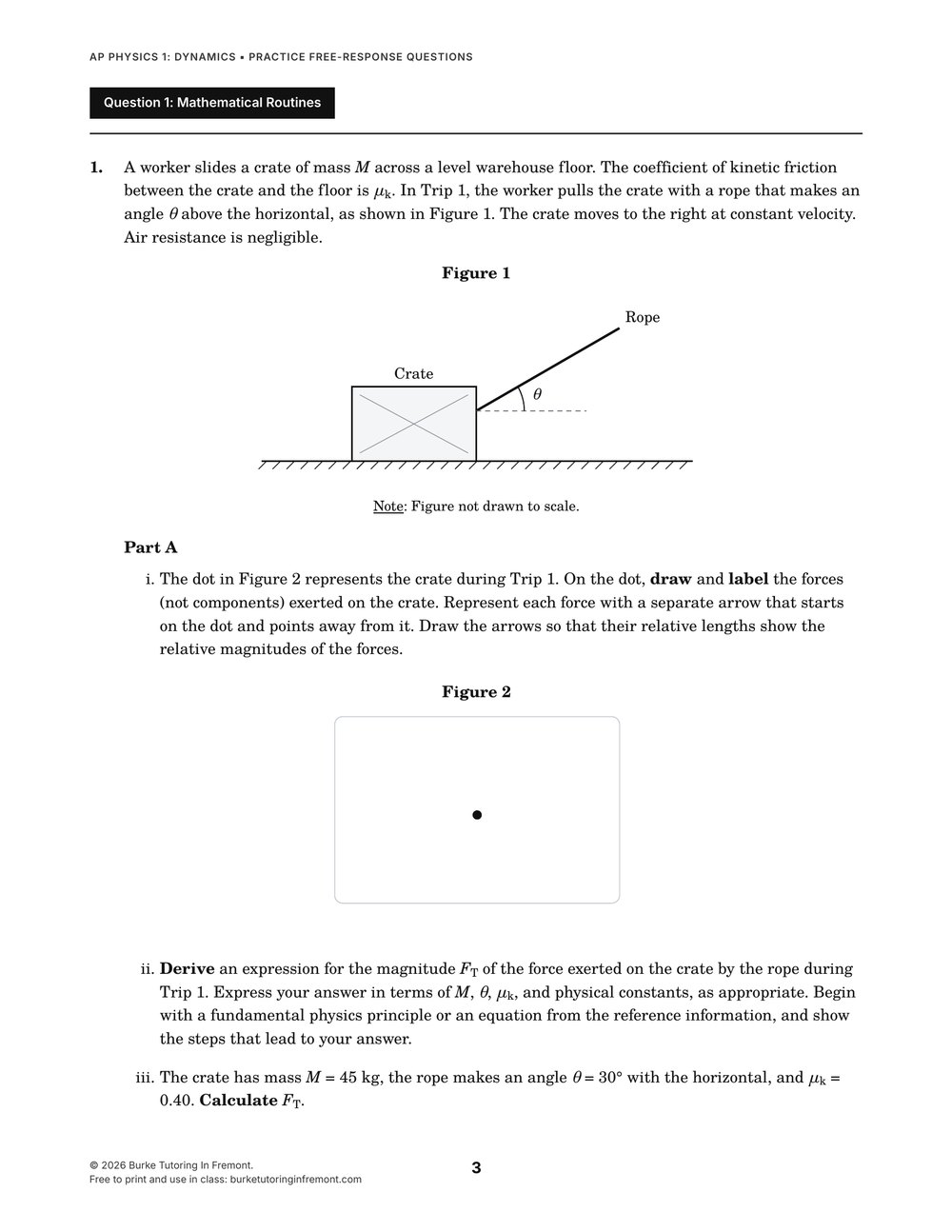
1.A worker slides a crate of mass M across a level warehouse floor. The coefficient of kinetic friction between the crate and the floor is μk. In Trip 1, the worker pulls the crate with a rope that makes an angle θ above the horizontal, as shown in Figure 1. The crate moves to the right at constant velocity. Air resistance is negligible.
Figure 1
Note: Figure not drawn to scale.
Part A
The dot in Figure 2 represents the crate during Trip 1. On the dot, draw and label the forces (not components) exerted on the crate. Represent each force with a separate arrow that starts on the dot and points away from it. Draw the arrows so that their relative lengths show the relative magnitudes of the forces.
Figure 2
Derive an expression for the magnitude FT of the force exerted on the crate by the rope during Trip 1. Express your answer in terms of M, θ, μk, and physical constants, as appropriate. Begin with a fundamental physics principle or an equation from the reference information, and show the steps that lead to your answer.
The crate has mass M = 45 kg, the rope makes an angle θ = 30° with the horizontal, and μk = 0.40. Calculate FT.
Part B
In Trip 2, the worker moves the same crate across the same floor at constant velocity by pushing on a handle with a force of magnitude FP. The push is directed at the same angle θ below the horizontal, as shown in Figure 3.
Figure 3
Note: Figure not drawn to scale.
Indicate whether FP is greater than, less than, or equal to FT by writing one of the following.
- FP > FT
- FP < FT
- FP = FT
Justify your answer. Your justification must include reasoning in words, not only equations or derivations.
Review: The table of normal force cases and worked example 2 in the dynamics study guide show how a rope pulled at an angle changes the normal force, and static and kinetic friction explains why friction follows the normal force. If splitting a force into components is the hard step, the vectors section of the relative velocity guide practices it with drawings.
Scoring guide for Question 1 (10 points)
Equivalent correct methods earn the same points. See how the scoring guides work.
| A1 | For four forces with correct directions, each labeled, and no extra arrows: a downward gravitational force, an upward normal force, a force from the rope directed up and to the right along the rope, and a kinetic friction force directed to the left. | 1 point |
|---|---|---|
| A2 | For a normal force arrow shorter than the gravitational force arrow, and a friction arrow shorter than the arrow for the rope’s force. | 1 point |
Example response
Scoring note: The rope pulls partly upward, so the floor supports less than the full weight and the normal force is less than Mg. The crate does not accelerate, so the friction force equals the horizontal part of the rope’s force, which is less than the whole rope force.
Scoring note: Arrows for velocity or acceleration, or the rope’s force drawn as two components, are extra arrows and do not earn point A1.
| A3 | For applying Newton’s second law with zero acceleration, or Newton’s first law, in both the horizontal and the vertical directions. | 1 point |
|---|---|---|
| A4 | For a normal force of Mg − FT sin θ, so that the friction force is μk(Mg − FT sin θ). | 1 point |
| A5 | For a correct expression for FT. | 1 point |
Example response
Vertical, with ay = 0: FN + FT sin θ − Mg = 0, so FN = Mg − FT sin θ
Horizontal, with ax = 0: FT cos θ − μkFN = 0
FT cos θ = μk(Mg − FT sin θ) → FT(cos θ + μk sin θ) = μkMg
FT = mu k M g over cosine theta plus mu k sine theta
Scoring note: A response that uses Mg for the normal force can earn point A3 but not points A4 and A5.
| A6 | For a correct value of FT, about 165 N, with units. | 1 point |
|---|
Example response
FT = 0.40 times 45 kilograms times 9.8 meters per second squared, over cosine 30 degrees plus 0.40 times sine 30 degrees = 176.4 newtons over 1.066 = 165 N
| B1 | For indicating FP > FT. | 1 point |
|---|---|---|
| B2 | For explaining that the push has a downward vertical component, so the floor pushes up with a normal force greater than Mg, while in Trip 1 the rope’s upward component makes the normal force less than Mg. | 1 point |
| B3 | For explaining that the kinetic friction force is proportional to the normal force, so the friction force is greater in Trip 2. | 1 point |
| B4 | For explaining that at constant velocity the horizontal component of the worker’s force equals the friction force in each trip, and both forces make the same angle θ with the horizontal, so the larger friction force in Trip 2 requires a larger force from the worker. | 1 point |
Example response
FP > FT. In Trip 1, the rope pulls partly upward, so the floor does not have to support the whole weight of the crate, and the normal force is less than Mg. In Trip 2, the push presses the crate into the floor, so the normal force is greater than Mg. Kinetic friction equals μk times the normal force, so the friction force is greater in Trip 2. In both trips the crate moves at constant velocity, so the net force is zero and the horizontal part of the worker’s force equals the friction force. Both forces are at the angle θ, so the same fraction of each force, cos θ, is horizontal. The push has to balance a larger friction force, so FP is greater than FT.
Scoring note: Comparing FT = μkMg ÷ (cos θ + μk sin θ) with FP = μkMg ÷ (cos θ − μk sin θ) also earns points B2 to B4 if the response explains in words why the denominators differ: the vertical component of the worker’s force lowers the normal force in Trip 1 and raises it in Trip 2. With the values in Part A(iii), FP is about 265 N.
Question 2Translation Between RepresentationsAn elevator ride on a scale
2.A student of mass m stands on a bathroom scale on the floor of an elevator. The elevator starts from rest, travels downward, and stops at a lower floor. Figure 1 shows the velocity v of the elevator as a function of time t from t = 0 to t = 5t0, with upward as the positive direction. The scale reading Fscale is the magnitude of the force that the student exerts on the scale.
Figure 1
Part A
The dots in Figure 2 represent the student at times t = 0.5t0, t = 2t0, and t = 4t0. On each dot, draw and label the forces (not components) exerted on the student. Represent each force with a separate arrow that starts on the dot and points away from it. Use the same scale for all three diagrams, so that the arrow lengths can be compared within each diagram and from one diagram to another.
Figure 2
Part B
Derive an expression for Fscale from t = 0 to t = t0. Express your answer in terms of m, v0, t0, and physical constants, as appropriate. Begin with a fundamental physics principle or an equation from the reference information, and show the steps that lead to your answer.
Part C
On the axes in Figure 3, sketch a graph of Fscale as a function of time t from t = 0 to t = 5t0. The dashed line shows the value mg.
Figure 3
Part D
Indicate whether the magnitude of the force exerted on the scale by the student at t = 4t0 is greater than, less than, or equal to the magnitude of the gravitational force exerted on the student by Earth.
- Greater than
- Less than
- Equal to
Justify your answer by referring to Figure 1 and to Newton’s third law.
Review: Worked example 1 in the dynamics study guide finds the reading of a scale in an elevator that slows down on its way up, and its section on Newton’s three laws covers third-law pairs. Reading an acceleration from the slope of a velocity graph is covered in motion graphs in the kinematics study guide.
Scoring guide for Question 2 (12 points)
Equivalent correct methods earn the same points. See how the scoring guides work.
| A1 | For each diagram showing exactly two forces, both labeled: a downward gravitational force and an upward normal force exerted by the scale. | 1 point |
|---|---|---|
| A2 | For gravitational force arrows of equal length in all three diagrams, with the normal force arrow shorter than the gravitational force arrow at t = 0.5t0 and equal to it at t = 2t0. | 1 point |
| A3 | For a normal force arrow longer than the gravitational force arrow at t = 4t0. | 1 point |
Example response
Scoring note: The direction of the velocity does not set the lengths. The acceleration does: downward from 0 to t0, zero from t0 to 3t0, and upward from 3t0 to 5t0.
| B1 | For finding the acceleration from the slope of Figure 1: a = −v0/t0, a magnitude of v0/t0 directed downward. | 1 point |
|---|---|---|
| B2 | For applying Newton’s second law to the student, with Fscale equal to the magnitude of the normal force, such as FN − mg = m(−v0/t0). | 1 point |
| B3 | For a correct expression for Fscale. | 1 point |
Example response
Slope of Figure 1 from 0 to t0: a = negative v zero minus zero, over t zero minus zero = −v zero over t zero
Newton’s second law, up positive: FN − mg = ma = −m v zero over t zero
The scale pushes up on the student with FN, and the student pushes down on the scale with a force of the same magnitude (Newton’s third law), so
Fscale = m(g − v zero over t zero)
Scoring note: A response that gives m(g + v0/t0) can earn point B2 but not points B1 and B3.
| C1 | For a graph made of horizontal segments: one value from 0 to t0, one from t0 to 3t0, and one from 3t0 to 5t0. | 1 point |
|---|---|---|
| C2 | For a graph below the dashed line from 0 to t0, on it from t0 to 3t0, and above it from 3t0 to 5t0. | 1 point |
| C3 | For a drop below mg from 0 to t0 that is twice as large as the rise above mg from 3t0 to 5t0. | 1 point |
Example response
Key
Scoring note: From 3t0 to 5t0, the velocity changes by the same amount, v0, over twice the time, so the acceleration has half the magnitude it had from 0 to t0. The jumps at t0 and 3t0 can be drawn as vertical lines or left as gaps.
| D1 | For indicating greater than. | 1 point |
|---|---|---|
| D2 | For explaining that from 3t0 to 5t0 the velocity is negative but approaching zero, so the slope of Figure 1, and the acceleration, point upward. The net force on the student is then upward, so the normal force is greater than mg. | 1 point |
| D3 | For explaining that the force exerted on the scale by the student and the force exerted on the student by the scale form a Newton’s third law pair, so they have equal magnitudes. | 1 point |
Example response
Greater than. At t = 4t0 the elevator is still moving down, but Figure 1 shows its velocity getting closer to zero, so the graph has a positive slope and the acceleration points up. For the student to accelerate upward, the upward normal force from the scale must be larger than the downward gravitational force, mg. The student pushes down on the scale and the scale pushes up on the student, and these two forces are a third-law pair with equal magnitudes. So the force the student exerts on the scale is also greater than mg.
Question 3Experimental Design and AnalysisFriction on a tilted board
The following information applies to Parts A and B.
3.Students want to determine the coefficient of kinetic friction μk between a wooden block and a long board. One end of the board can be raised so that the board makes an adjustable angle θ with the horizontal, as shown in Figure 1. The students have a protractor, a meterstick, and a stopwatch. When the angle is large enough, the block slides down the board with constant acceleration after it is released from rest.
Figure 1
Note: Figure not drawn to scale.
Part A
Describe a procedure the students could follow to collect data that would let them determine μk from a linear graph. Identify each quantity they would measure and the equipment they would use to measure it.
Briefly describe one way the students could reduce the experimental uncertainty in their results.
Part B
When the board is at small angles, the block stays at rest after it is placed on the board.
Describe how the students could use the same equipment to determine the coefficient of static friction μs between the block and the board.
Indicate how μs is related to the quantity measured in Part B(i).
The following information applies to Parts C and D.
The students release the block from rest with the board at five different angles. For each angle, they determine the magnitude a of the block’s acceleration, as shown in Table 1. The students correctly determine that a and θ are related by a = g sin θ − μkg cos θ. They make a graph with a/cos θ plotted on the horizontal axis.
Table 1
| θ (degrees) | a (m/s2) | Blank column for a calculated quantity | Blank column for a calculated quantity |
|---|---|---|---|
| 30 | 2.40 | ||
| 35 | 3.15 | ||
| 40 | 4.09 | ||
| 45 | 4.82 | ||
| 50 | 5.68 |
Part C
Label the vertical axis of Figure 2 with a measured or calculated quantity, with units if it has any. Choose a quantity that makes the graph linear and that can be used to determine μk.
On the grid in Figure 2, make a graph that can be used to determine μk.
- Add a numerical scale to the vertical axis.
- Plot the data points.
- Table 1 gives space for calculations and is not scored.
Figure 2
Draw a best-fit line through the data you plotted in Part C(ii).
Part D
Use your best-fit line from Part C(iii) to calculate an experimental value for μk.
Review: Friction on an incline in the dynamics study guide sets up the forces on a block on a tilted board, and its incline animation shows the friction force at every angle. Feynman’s lecture on the characteristics of force describes measuring a friction coefficient with a tilted plane and explains why the coefficient is only approximately constant.
Scoring guide for Question 3 (10 points)
Equivalent correct methods earn the same points. See how the scoring guides work.
| A(i) | For a procedure that measures the angle θ with the protractor, and the distance the block slides from rest and the time it takes with the meterstick and stopwatch, at several angles at which the block slides. | 1 point |
|---|---|---|
| A(ii) | For a valid way to reduce uncertainty, such as timing several trials at each angle and averaging, using a long sliding distance so the time is large compared with reaction time, or releasing the block from the same marked point each time. | 1 point |
Example response
Mark a start line near the top of the board and a finish line a measured distance d farther down. Set the board to an angle θ, measured with the protractor, release the block from rest at the start line, and time how long it takes to reach the finish line. Find the acceleration from d = one halfat2, so a = 2d/t2. Repeat for at least five angles that are large enough for the block to slide.
Scoring note: Any correct kinematic method for finding the acceleration from measured quantities earns point A(i).
| B(i) | For describing raising the board slowly, starting with the block at rest, and measuring the angle at which the block just begins to slide. | 1 point |
|---|---|---|
| B(ii) | For indicating that μs is the tangent of that angle. | 1 point |
Example response
Place the block on the board while it is level and raise one end slowly until the block just starts to slide. Measure that angle, θc, with the protractor, and repeat several times. Just before the block slips, static friction is at its maximum, μsmg cos θc, and it balances the downhill component of gravity, mg sin θc. So μs = tan θc.
| C(i) | For labeling the vertical axis with a quantity that makes the graph linear with a/cos θ on the horizontal axis, such as tan θ, which has no units. | 1 point |
|---|---|---|
| C(ii) | For a linear numerical scale on the vertical axis that uses at least half of the grid. | 1 point |
| C(iii) | For plotting the five data points correctly for the chosen quantity. | 1 point |
| C(iv) | For a straight best-fit line that follows the trend of the data, with points on both sides of the line. | 1 point |
Example response
Key
Values plotted
| θ (°) | tan θ | a/cos θ (m/s2) |
|---|---|---|
| 30 | 0.577 | 2.77 |
| 35 | 0.700 | 3.85 |
| 40 | 0.839 | 5.34 |
| 45 | 1.000 | 6.82 |
| 50 | 1.192 | 8.84 |
Scoring note: Dividing a = g sin θ − μkg cos θ by g cos θ gives tan θ = one over g(a/cos θ) + μk. Plotting g tan θ on the vertical axis also makes the graph linear and earns point C(i).
| D(i) | For relating a feature of the graph to μk correctly for the quantity plotted in Part C. For tan θ versus a/cos θ, μk is the vertical intercept. For g tan θ, the intercept is μkg. | 1 point |
|---|---|---|
| D(ii) | For a value of μk between 0.26 and 0.34. | 1 point |
Example response
tan θ = one over g(a/cos θ) + μk, so the vertical intercept of the graph is μk.
The best-fit line crosses the vertical axis at about 0.30, so μk ≈ 0.30.
Check with two points on the line, (2.0 m/s2, 0.51) and (9.0 m/s2, 1.21): slope = (1.21 − 0.51) ÷ (9.0 − 2.0) m/s2 = 0.100 s2/m, close to 1/g = 0.102 s2/m.
Scoring note: The angle at which the block would slide at constant velocity has tan θ = μk, which is where the best-fit line meets the vertical axis (a = 0).
Question 4Qualitative/Quantitative TranslationA block held on a rough ramp
4.Block 1 of mass m1 rests on a ramp inclined at an angle θ above the horizontal. A light string attached to block 1 runs parallel to the ramp, passes over an ideal pulley at the top of the ramp, and is attached to block 2, which hangs freely, as shown in Figure 1. The coefficient of static friction between block 1 and the ramp is μs. If block 2 were removed, block 1 would slide down the ramp. A student finds that both blocks remain at rest when the mass m2 of block 2 has any value from a minimum value mmin to a maximum value mmax.
Figure 1
Note: Figure not drawn to scale.
Part A
Without deriving or using equations, explain why the blocks can remain at rest for a range of values of m2 rather than for only one value. Your explanation should describe the direction of the static friction force exerted on block 1 when m2 = mmin and when m2 = mmax.
Part B
Derive expressions for mmin and mmax. Express your answers in terms of m1, θ, μs, and physical constants, as appropriate. Begin with a fundamental physics principle or an equation from the reference information, and show the steps that lead to your answer.
Part C
Explain how your expressions from Part B are consistent with your reasoning in Part A.
Review: Block on an incline in the pulley problems guide uses the same setup with the blocks moving, and its pulley animation shows a range of hanging masses that leaves the blocks at rest. Block on a table covers the level case, and static and kinetic friction in the dynamics study guide explains why static friction can point either way.
Scoring guide for Question 4 (8 points)
Equivalent correct methods earn the same points. See how the scoring guides work.
| A1 | For explaining that when m2 = mmin, block 1 is about to slide down the ramp, so static friction points up the ramp and helps the string hold block 1. | 1 point |
|---|---|---|
| A2 | For explaining that when m2 = mmax, block 1 is about to be pulled up the ramp, so static friction points down the ramp, against the pull of the string. | 1 point |
| A3 | For explaining that static friction can take any magnitude up to its maximum, in whichever direction keeps block 1 at rest, so it can make up the difference between the pull of the string and the downhill pull of gravity for every hanging mass between the two limits. | 1 point |
Example response
Static friction adjusts to whatever keeps block 1 at rest, up to a maximum value, and it can point either way along the ramp. With a light block 2, the string pulls up the ramp less than gravity pulls block 1 down the ramp, so block 1 tends to slide down and friction points up the ramp. At m2 = mmin, that friction is at its maximum. As m2 increases, the string pulls harder, so less friction is needed. The friction reaches zero when the string alone balances the downhill pull, and then it points down the ramp. At m2 = mmax, block 1 is about to be pulled up the ramp and friction is at its maximum down the ramp. Every mass in between can be balanced, so there is a range. On a frictionless ramp, only the one mass whose weight equals the downhill pull of gravity on block 1 would hold it.
| B1 | For applying Newton’s second law with zero acceleration to both blocks: FT = m2g for block 2, FN = m1g cos θ for block 1, and a force balance along the ramp that includes the friction force. | 1 point |
|---|---|---|
| B2 | For a correct expression for mmin. | 1 point |
| B3 | For a correct expression for mmax. | 1 point |
Example response
Block 2: FT − m2g = 0, so FT = m2g. Block 1, perpendicular to the ramp: FN = m1g cos θ
At mmin, friction acts up the ramp at its maximum: mming + μsm1g cos θ − m1g sin θ = 0
mmin = m1(sin θ − μs cos θ)
At mmax, friction acts down the ramp at its maximum: mmaxg − μsm1g cos θ − m1g sin θ = 0
mmax = m1(sin θ + μs cos θ)
| C1 | For explaining that the two expressions differ only in the sign of the friction term, μs cos θ: it is subtracted in mmin, where friction acts up the ramp and helps the string, and added in mmax, where friction acts down the ramp and the string must also overcome it, matching the directions in Part A. | 1 point |
|---|---|---|
| C2 | For explaining that the width of the range, mmax − mmin = 2μsm1 cos θ, comes from friction and shrinks to zero as μs approaches zero, leaving the single value m1 sin θ for a frictionless ramp. | 1 point |
Example response
Consistent. In mmin, the friction term μs cos θ is subtracted, because friction acts up the ramp along with the string, so less hanging weight is needed. In mmax, the term is added, because friction acts down the ramp and the string must overcome it too. The difference, 2μsm1 cos θ, comes entirely from friction. With μs = 0, both expressions become m1 sin θ, the single mass that a frictionless ramp would allow, which matches the reasoning in Part A.
Scoring note: Another limiting case connected to Part A also earns point C2. For example, at θ = 0, mmax becomes μsm1, the largest hanging mass a level table can hold at rest.
03 / Practice set B
Set B: Questions 5 to 8
Set B covers an Atwood machine that hangs from a spring scale, a pendulum whose string is cut, an experiment on static friction in circular motion, and satellites orbiting two different planets. Allow 95 minutes.
Question 5Mathematical RoutinesAn Atwood machine on a spring scale
5.Block A of mass m and block B of mass 3m hang from the ends of a light string that passes over an ideal pulley, as shown in Figure 1. The axle of the pulley hangs from a spring scale attached to the ceiling. The masses of the pulley and the scale are negligible. The blocks are released from rest, and block B moves downward.
Figure 1
Note: Figure not drawn to scale.
Part A
The dots in Figure 2 represent block A and block B. On each dot, draw and label the forces (not components) exerted on that block. Represent each force with a separate arrow that starts on the dot and points away from it. Use the same scale for both diagrams.
Figure 2
Derive an expression for the magnitude a of the acceleration of the blocks. Express your answer in terms of m and physical constants, as appropriate. Begin with a fundamental physics principle or an equation from the reference information, and show the steps that lead to your answer.
Derive an expression for the tension FT in the string. Express your answer in terms of m and physical constants, as appropriate.
Part B
Indicate whether the reading of the spring scale while the blocks are moving is greater than, less than, or equal to 4mg, the combined weight of the two blocks.
- Greater than 4mg
- Less than 4mg
- Equal to 4mg
Justify your answer.
Review: The Atwood machine section of the pulley problems guide derives the same acceleration and tension and shows that the support holding a massless pulley pulls up with twice the tension, the relation Part B uses. System method and object method explains when the tension drops out of the equations.
Scoring guide for Question 5 (10 points)
Equivalent correct methods earn the same points. See how the scoring guides work.
| A1 | For each diagram showing exactly two forces, both labeled: an upward tension force exerted by the string and a downward gravitational force. | 1 point |
|---|---|---|
| A2 | For tension arrows of equal length in the two diagrams, longer than the gravitational force arrow on block A and shorter than the gravitational force arrow on block B. | 1 point |
Example response
Scoring note: The gravitational force on block B is three times the one on block A. That ratio is shown in the example but is not required for point A2.
| A3 | For applying Newton’s second law to each block, or to the two blocks as one system, with the tension included in each single-block equation. | 1 point |
|---|---|---|
| A4 | For using the same magnitude of acceleration for both blocks, with block A accelerating upward and block B downward. | 1 point |
| A5 | For a = g/2. | 1 point |
Example response
Block A, up positive: FT − mg = ma
Block B, down positive: 3mg − FT = 3ma
Adding the two equations: 2mg = 4ma, so a = g over 2
Scoring note: Treating both blocks as one system moving along the string gives (3m − m)g = (4m)a in one step and earns points A3 and A4.
| A6 | For using the acceleration from Part A(ii) in Newton’s second law for one of the blocks. | 1 point |
|---|---|---|
| A7 | For FT = 3mg/2. | 1 point |
Example response
FT = m(g + a) = m(g + g over 2) = 3 m g over 2
Check with block B: FT = 3m(g − a) = 3m(g over 2) = 3 m g over 2
| B1 | For indicating less than 4mg. | 1 point |
|---|---|---|
| B2 | For relating the scale reading to the forces, such as: the scale holds up the pulley, which does not accelerate and has negligible mass, against the two sections of string pulling down on it, so the reading is 2FT; or the force from the scale and the total weight, 4mg, are the only external forces on the system of the pulley, the string, and both blocks. | 1 point |
| B3 | For completing the comparison with 4mg, such as: 2FT = 2(3mg/2) = 3mg, which is less than 4mg; or the heavier block speeds up downward while the lighter block speeds up upward, so the center of mass of the system accelerates downward, the net external force is downward, and the force from the scale is less than the total weight. | 1 point |
Example response
Less than 4mg. The pulley does not accelerate and its mass is negligible, so the upward force from the scale balances the two sections of string that pull down on it. The scale reading is 2FT = 2(3mg/2) = 3mg, which is less than 4mg.
Scoring note: A complete pulley-force argument showing that the scale reading equals twice the string tension, giving 3mg < 4mg, earns all three Part B points. A separate center-of-mass explanation is not required.
Scoring note: Alternate solution (center of mass): treat the pulley, the string, and both blocks as one system. Its external forces are the upward force from the scale and the total weight, 4mg. Block B speeds up downward while block A speeds up upward, both at g/2, so the center of mass accelerates downward at (3m · g/2 − m · g/2) ÷ 4m = g/4. Newton’s second law for the system gives 4mg − (scale reading) = 4m(g/4), so the scale reads 3mg. This argument earns points B2 and B3.
Question 6Translation Between RepresentationsA pendulum with a cut string
6.A small ball of mass m hangs from a light string of length L attached to a fixed point O. The ball is pulled to the left until the string makes an angle θ0 with the vertical and is then released from rest at point P, as shown in Figure 1. The ball swings through point Q, the lowest point of its path, where its speed is vQ. Point Q is a height H above the floor. Air resistance is negligible.
Figure 1
Note: Figure not drawn to scale.
Part A
The dots in Figure 2 represent the ball at point P, just after it is released, and at point Q. On each dot, draw and label the forces (not components) exerted on the ball. Represent each force with a separate arrow that starts on the dot and points away from it. Use the same scale for both diagrams. The dashed lines show the direction of the string.
Figure 2
Part B
Derive an expression for the tension FT in the string at the instant the ball passes through point Q. Express your answer in terms of m, vQ, L, and physical constants, as appropriate. Begin with a fundamental physics principle or an equation from the reference information, and show the steps that lead to your answer.
Part C
The string is cut at the instant the ball passes through point Q while moving to the right. The ball reaches the floor at time t = tf after the string is cut. On the axes in Figure 3, sketch graphs of the horizontal component vx and the vertical component vy of the ball’s velocity as functions of time from t = 0, the instant the string is cut, to t = tf. Take right and up as the positive directions.
Figure 3
Part D
In another trial, the ball is again released from rest at point P, and this time the string is cut at a later instant when the ball is momentarily at rest at point P. Describe the path of the ball after the string is cut. Explain why the acceleration of the ball just after the string is cut is different from its acceleration just before the string is cut. Refer to your diagram for point P from Part A.
Review: The pendulum section of the circular motion guide covers the forces at the bottom and at the ends of a swing, and when the string is cut works through what happens next. After a cut at Q, the ball moves like a projectile launched horizontally from a height, as in projectiles launched from a platform in the projectile motion guide, and a ball that starts from rest falls like an object dropped from a height.
Scoring guide for Question 6 (12 points)
Equivalent correct methods earn the same points. See how the scoring guides work.
| A1 | For each diagram showing exactly two forces, both labeled: a downward gravitational force and a tension force directed along the string toward point O. | 1 point |
|---|---|---|
| A2 | For a tension arrow at P that points up along the string, at the angle θ0 from the vertical, and is shorter than the gravitational force arrow. | 1 point |
| A3 | For a vertical tension arrow at Q that is longer than the gravitational force arrow. | 1 point |
Example response
Scoring note: At P the ball is momentarily at rest, so it has no acceleration toward O, and the tension balances only the component of the gravitational force along the string: FT = mg cos θ0, which is less than mg. At Q the ball moves on a circle around O, so the net force points up, toward O.
| B1 | For identifying that at Q the ball’s acceleration is vQ2/L, directed up toward O. | 1 point |
|---|---|---|
| B2 | For applying Newton’s second law along the vertical: FT − mg = mvQ2/L. | 1 point |
| B3 | For a correct expression for FT. | 1 point |
Example response
At Q the ball moves on a circle of radius L, so its acceleration is v Q squared over L, directed up toward O.
Newton’s second law, up positive: FT − mg = m v Q squared over L
FT = mg + m v Q squared over L
Scoring note: A response that sets the net force equal to zero at Q, giving FT = mg, earns none of the Part B points: the ball is changing direction at Q, so it is accelerating.
| C1 | For a vx graph that is a horizontal line at the positive value vQ from t = 0 to tf. | 1 point |
|---|---|---|
| C2 | For a vy graph that starts at zero at t = 0. | 1 point |
| C3 | For a vy graph that is a straight line with negative slope from t = 0 to tf. | 1 point |
Example response
Key
Scoring note: The slope of the vy graph is −g, and its value at tf is −gtf. Values are not required.
| D1 | For describing a path straight down from point P. | 1 point |
|---|---|---|
| D2 | For explaining that just before the cut, the tension cancels only the part of the gravitational force along the string, so the net force, mg sin θ0, is perpendicular to the string, along the arc, and the acceleration is g sin θ0 in that direction. | 1 point |
| D3 | For explaining that just after the cut the tension is gone, so gravity is the only force and the acceleration is g straight down. Because the velocity is zero at that instant, the ball falls straight down. | 1 point |
Example response
The ball falls straight down from P. At the instant the string is cut, the ball is momentarily at rest, and after the cut gravity is the only force on it, so it starts from rest with an acceleration of g straight down, like a dropped object. Just before the cut, the diagram for point P has two forces. The tension points along the string and cancels only the part of the gravitational force along the string, mg cos θ0. The rest of the gravitational force, mg sin θ0, is perpendicular to the string, so the acceleration just before the cut is g sin θ0, along the arc. Cutting the string removes the tension, so the acceleration becomes larger and changes direction, to g straight down.
Question 7Experimental Design and AnalysisStatic friction in a circle
The following information applies to Parts A and B.
7.Students want to determine the coefficient of static friction μs between a small rubber block and the surface of a level turntable. The turntable rotates about its center at a constant rate that the students can set with a dial. The block is placed on the turntable a distance r from the axis of rotation, as shown in Figure 1. The students have a meterstick and a stopwatch.
Figure 1
Note: Figure not drawn to scale.
Part A
Describe a procedure the students could follow to collect data that would let them determine μs from a linear graph. Identify each quantity they would measure and how they would measure it.
Briefly describe one way the students could reduce the experimental uncertainty in their measurements.
Part B
Indicate the quantities that could be plotted on the horizontal and vertical axes to produce a linear graph from which μs could be determined. State clearly which quantity goes on each axis.
Briefly describe how μs is related to a feature of the graph from Part B(i). You may include an equation that relates μs to that feature.
The following information applies to Parts C and D.
In a different experiment, the students test a small remote-controlled car on a level floor. The car drives in circles of radius r. For each radius, the students find the greatest constant speed v at which the car can complete the circle without its tires sliding sideways. The data are shown in Table 1. The students make a graph with r plotted on the horizontal axis.
Table 1
| r (m) | v (m/s) | Blank column for a calculated quantity | Blank column for a calculated quantity |
|---|---|---|---|
| 0.40 | 1.62 | ||
| 0.60 | 2.06 | ||
| 0.80 | 2.31 | ||
| 1.00 | 2.66 | ||
| 1.20 | 2.85 |
Part C
Label the vertical axis of Figure 2 with a measured or calculated quantity, with units if it has any. Choose a quantity that makes the graph linear and that can be used to determine the coefficient of static friction between the tires and the floor.
On the grid in Figure 2, make a graph that can be used to determine that coefficient.
- Add a numerical scale to the vertical axis.
- Plot the data points.
- Table 1 gives space for calculations and is not scored.
Figure 2
Draw a best-fit line through the data you plotted in Part C(ii).
Part D
Use your best-fit line from Part C(iii) to calculate an experimental value for the coefficient of static friction between the tires and the floor.
Review: The rule for circular motion explains what supplies the net force toward the center, and banked road problems in the circular motion guide show how banking a curve reduces the friction a car needs. Static and kinetic friction in the dynamics study guide explains why a surface that is not sliding uses static friction.
Scoring guide for Question 7 (10 points)
Equivalent correct methods earn the same points. See how the scoring guides work.
| A(i) | For a procedure that finds, for several radii (or several rotation rates), the condition at which the block just begins to slide, measuring the radius r with the meterstick and the period T of the turntable with the stopwatch. | 1 point |
|---|---|---|
| A(ii) | For a valid way to reduce uncertainty, such as timing 10 rotations and dividing by 10, repeating each trial and averaging, or raising the rotation rate in small steps near the slipping point. | 1 point |
Example response
Place the block at a measured distance r from the center. Start the turntable slowly and raise the rate in small steps, waiting a few seconds at each setting. At the first setting where the block slides, time 10 rotations with the stopwatch and divide by 10 to find the period T. Repeat for five different radii.
Scoring note: A procedure that fixes the rotation rate and moves the block outward until it slides, measuring the largest radius at which it stays in place, also earns point A(i).
| B(i) | For a pair of quantities that gives a linear graph, such as T2 on the vertical axis and r on the horizontal axis. | 1 point |
|---|---|---|
| B(ii) | For relating a feature of the graph to μs correctly for the quantities chosen. For T2 versus r, the slope is 4π2/(μsg), so μs = 4π2/(g × slope). | 1 point |
Example response
When the block is about to slide, maximum static friction supplies the net force toward the center: μsmg = m v squared over r, with v = 2 pi r over T
μsg = 4 pi squared r over T squared, so T2 = 4 pi squared over mu s g r
A graph of T2 versus r is a straight line through the origin with slope 4 pi squared over mu s g.
Scoring note: Other linear pairs earn credit, such as r versus T2, with slope μsg/(4π2), when the slope is related to μs correctly.
| C(i) | For labeling the vertical axis with a quantity that makes the graph linear with r on the horizontal axis, such as v2 in m2/s2. | 1 point |
|---|---|---|
| C(ii) | For a linear numerical scale on the vertical axis that uses at least half of the grid. | 1 point |
| C(iii) | For plotting the five data points correctly for the chosen quantity. | 1 point |
| C(iv) | For a straight best-fit line that follows the trend of the data, with points on both sides of the line. | 1 point |
Example response
Key
Values plotted
| r (m) | v2 (m2/s2) |
|---|---|
| 0.40 | 2.62 |
| 0.60 | 4.24 |
| 0.80 | 5.34 |
| 1.00 | 7.08 |
| 1.20 | 8.12 |
Scoring note: At the top speed, maximum static friction supplies the net force toward the center: μsmg = mv2/r, so v2 = μsgr. The graph of v2 versus r is linear and passes through the origin.
| D(i) | For relating the slope to the coefficient correctly for the quantity plotted. For v2 versus r, the slope is μsg, so μs = slope ÷ g. | 1 point |
|---|---|---|
| D(ii) | For a value of the coefficient between 0.63 and 0.77. | 1 point |
Example response
Two points on the best-fit line: (0.30 m, 2.02 m2/s2) and (1.20 m, 8.25 m2/s2)
slope = (8.25 − 2.02) m2/s2 ÷ (1.20 − 0.30) m = 6.92 m/s2
μs = slope over g = 6.92 over 9.8 = 0.71
Question 8Qualitative/Quantitative TranslationOrbits around two planets
8.Planet X has twice the mass of Earth and twice the radius of Earth. Satellite 1 moves in a circular orbit just above the surface of Earth, so the radius of its orbit equals the radius of Earth, RE. Satellite 2 moves in a circular orbit just above the surface of Planet X, as shown in Figure 1. The satellites have the same mass. Earth has mass ME. Ignore any atmosphere, and assume the only force on each satellite is the gravitational force exerted by the planet it orbits.
Figure 1
Note: Figure not drawn to scale.
Part A
Indicate whether the orbital period T2 of Satellite 2 is greater than, less than, or equal to the orbital period T1 of Satellite 1 by writing one of the following.
- T2 > T1
- T2 < T1
- T2 = T1
Without deriving or using equations, justify your answer. Your justification should address both the strength of each planet’s gravitational pull on its satellite and the size of each satellite’s orbit.
Part B
Derive an expression for T2. Express your answer in terms of ME, RE, and physical constants, as appropriate. Begin with a fundamental physics principle or an equation from the reference information, and show the steps that lead to your answer.
Part C
Explain how your expression from Part B is consistent with your reasoning in Part A.
Review: Gravity and satellite orbits in the circular motion guide derives the orbital speed and period from Newton’s second law, and Question 12 in its practice set compares two satellites around the same planet.
Scoring guide for Question 8 (8 points)
Equivalent correct methods earn the same points. See how the scoring guides work.
| A1 | For indicating T2 > T1. | 1 point |
|---|---|---|
| A2 | For explaining that the gravitational pull on each kilogram of a satellite at the surface of Planet X is half as strong as at the surface of Earth: twice the mass doubles the pull, and twice the distance from the center reduces it to one fourth. | 1 point |
| A3 | For connecting the pull to the orbit: Satellite 2 travels a path twice as long while held by a weaker pull, so it takes longer to complete an orbit. For example, at the same speed, a circle twice as large needs only half the centripetal acceleration, which matches the half-strength pull, so Satellite 2 moves at the same speed as Satellite 1 over a path twice as long. | 1 point |
Example response
T2 > T1. Satellite 2 is twice as far from the center of its planet as Satellite 1, which by itself would make the gravitational pull one fourth as strong, and Planet X has twice the mass, which doubles it. So the pull on each kilogram of Satellite 2 is half as strong. A satellite stays in a circular orbit when gravity supplies exactly the centripetal acceleration it needs. At the same speed, a circle twice as large needs only half the centripetal acceleration, which is what the half-strength pull provides. So Satellite 2 moves at the same speed as Satellite 1, but each orbit is twice as long, and it takes twice as long to complete.
Scoring note: Reasoning that both effects lengthen the period, a larger orbit to travel and a weaker pull keeping the satellite on it, also earns point A3. A response that says Satellite 2 moves faster does not earn point A3.
| B1 | For setting the gravitational force equal to the satellite’s mass times its centripetal acceleration, with a mass of 2ME and a radius of 2RE. | 1 point |
|---|---|---|
| B2 | For relating the speed to the period: v = 2π(2RE)/T2. | 1 point |
| B3 | For a correct expression for T2. | 1 point |
Example response
G times 2 M E times m, over 2 R E squared = m v squared over 2 R E → v2 = G times 2 M E over 2 R E = G M E over R E
T2 = 2 pi times 2 R E over v = 4 pi R E over the square root of G M E over R E = 4πsquare root of R E cubed over G M E
| C1 | For comparing with the same derivation for Satellite 1, T1 = 2π√(RE3/GME), to show that T2 = 2T1, greater than T1, as in Part A. | 1 point |
|---|---|---|
| C2 | For connecting the derivation to the reasoning, such as: the speed √(GME/RE) is the same for both satellites because the planet’s mass and the orbit’s radius are both doubled, and the circumference is twice as large for Satellite 2. | 1 point |
Example response
Consistent. The same steps for Satellite 1 give T1 = 2πsquare root of R E cubed over G M E, so T2 = 2T1. In the derivation, doubling the mass of the planet and doubling the radius leave the speed unchanged, because the speed depends on the planet’s mass divided by the orbit’s radius. The period is the circumference divided by the speed, and the circumference of Satellite 2’s orbit is twice as large. That matches Part A: the same speed over a path twice as long.
Free printable · No signup
AP Physics 1 dynamics FRQ practice PDF
The PDF follows the layout of the exam booklet: a directions page, Questions 1 to 8 with their figures, dots for free-body diagrams, and blank graph grids, and the scoring guidelines at the back, starting on page 18, followed by a score tracker for both sets. It is sized for US Letter. Teachers and study groups are welcome to print and distribute it in class. A link back to this page is appreciated but not required.
Keep going with Unit 2
For the multiple-choice section, the AP Physics 1 dynamics MCQ set has 20 questions on the same unit, with explanations. The dynamics study guide has 27 practice problems with answers and a one-page dynamics cheat sheet, and the pulley problems guide and the circular motion guide each add 12 questions in the AP formats, 8 multiple choice and 4 free response. For Unit 1, the kinematics FRQ set uses the same booklet layout, the kinematics study guide reviews the motion graphs and projectile motion that Questions 2 and 6 use, and the kinematics worksheets and study guides page collects the Unit 1 guides, practice tests, and PDFs.
Working through AP Physics 1 free-response questions with a tutor
I tutor AP Physics 1 in person across Fremont, Newark, and Union City. A session on dynamics free-response questions can focus on drawing free-body diagrams whose arrow lengths match the physics, writing Newton’s second law along the right axes, and deciding which way friction points before any numbers go in. Bring a recent test or a set of FRQs from class so we can start from the questions that cost you points.
Call or text to talk about your student’s class.
(510) 453-0350Serving Fremont, Newark, and Union City. AP coursework is priced separately from standard in-home subjects. See class rates.
About these questions
These are original practice questions written for this page, not released exam questions. They cover AP Physics 1 Unit 2 topics 2.1 to 2.7 and 2.9 (spring forces, topic 2.8, are not included) and follow the free-response formats and point totals of the 2026 exam. The lab data in Questions 3 and 7 were constructed for practice. This page is an independent study resource. AP is a trademark registered by the College Board, which is not affiliated with and does not endorse this resource.