Polynomial Operations Worksheet: Add, Subtract, and Multiply (With Answer Key)
Looking for more practice? Browse our free polynomial worksheets and answer keys for operations, factoring, division, graphing, and zeros.
Five free printables that take Algebra I and II students from naming the parts of a polynomial through adding, subtracting, multiplying four different ways, and recognizing special products. Fifty questions, a teacher answer key with every prompt restated, and the one checking habit that catches most of the errors before the paper gets turned in.
Published · Updated
The parts of a polynomial
A polynomial is a sum of terms, and each term is a number multiplied by a variable raised to a whole-number power. In 5x4 − 3x2 + 7x − 9 there are four terms. The coefficients are 5, −3, and 7. The constant term is −9. The degree is 4, because that is the largest exponent once the expression is simplified, and the leading coefficient is the 5 that sits in front of it.
Two vocabulary habits save students trouble later. First, the sign in front of a term belongs to that term: the second term above is −3x2, not 3x2. Second, degree is decided after simplifying, so 4x3 − 4x3 + x has degree 1, not 3.
| Terms | Name by number of terms | Example |
|---|---|---|
| 1 | Monomial | 7x3 |
| 2 | Binomial | −4x3 + 2x |
| 3 | Trinomial | x2 − 2x + 3 |
Standard form and like terms
Standard form runs from the highest power down to the lowest. Writing 7 − 2x3 + 5x − x4 as −x4 − 2x3 + 5x + 7 is not busywork: the leading coefficient, the degree, and the end behavior of the graph all read straight off the front of the expression once it is ordered.
Like terms need the same variables raised to the same powers. That is why 4x2 and −7x cannot be combined, and why 3x2 + 5x is already finished. The most common error on this topic is a student writing 3x2 + 5x = 8x3, adding both the coefficients and the exponents across terms that were never alike in the first place.
Adding and subtracting polynomials
Addition is just combining like terms. Subtraction is where the marks come off, and almost always in the same place: students flip the sign of the first term inside the parentheses and forget the rest.
Make the sign flip its own step. Before combining anything, rewrite the second parentheses with every sign reversed, on its own line. So (3x2 − 4x + 2) − (−x2 + 5x − 6) becomes 3x2 − 4x + 2 + x2 − 5x + 6 first, and only then gets combined into 4x2 − 9x + 8. One extra line prevents most of the lost points on a subtraction quiz.
When the two polynomials have different degrees, zero placeholders keep the columns honest. Adding (3x5 − 2x2 + 4) and (x4 + 6x − 9) is easier if the missing powers are written in as 0x4, 0x3, and so on. The answer, 3x5 + x4 − 2x2 + 6x − 5, then falls out column by column.
Four ways to multiply polynomials
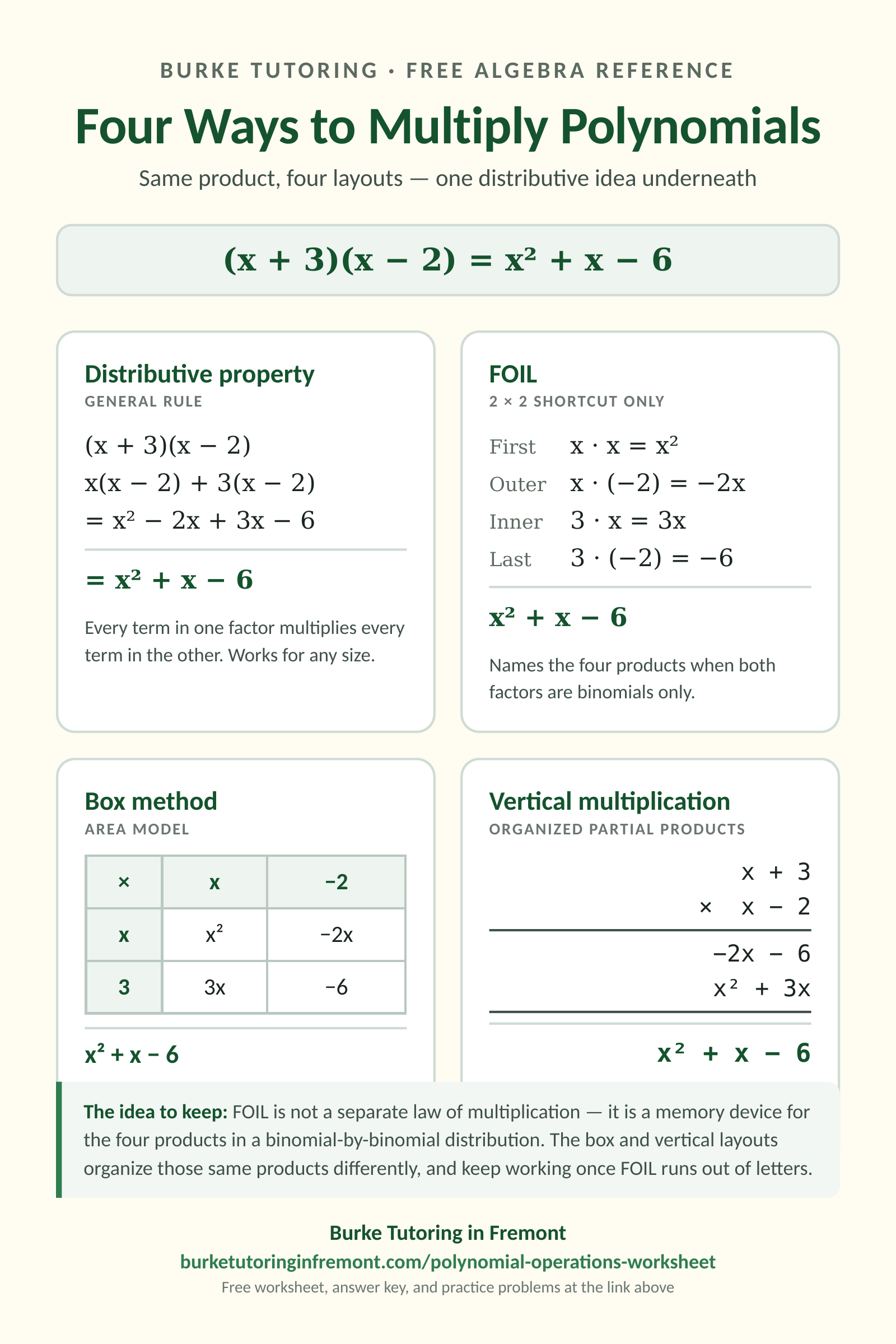
FOIL is not a separate law of multiplication. It is a memory device for the four products created in a binomial-by-binomial distribution. The box and vertical layouts organize those same products differently, and both keep working when FOIL runs out of letters. Here is (x + 3)(x − 2) worked four ways, with the same answer each time.
Distributive property
General rule
Every term in one factor multiplies every term in the other. Works for factors of any size.
FOIL
2 × 2 shortcut only
FOIL names the four products made when both factors are binomials. It is distribution in a fixed 2 × 2 case.
Box method
Area model
| × | x | −2 |
| x | x2 | −2x |
| 3 | 3x | −6 |
The grid makes a skipped product easy to spot. Combine like terms after every cell is filled.
Vertical multiplication
Organized partial products
Each row is one distribution. Line up like powers before adding the partial products.
| Method | Best used for | What goes wrong |
|---|---|---|
| Distributive property | Any two polynomials, any size | Skipping a term once there are more than four products |
| FOIL | Two binomials, nothing else | Forcing FOIL onto a trinomial, which only has a name for four of the six products |
| Box method | Visual organization; larger products | Filling the grid correctly, then forgetting to combine like terms |
| Vertical multiplication | Long polynomials; familiar arithmetic layout | Misaligning powers or omitting zero placeholders |
Count the products before you combine them. Multiply the number of terms in each factor. A binomial times a binomial gives 2 · 2 = 4 products. A binomial times a trinomial gives 2 · 3 = 6. A trinomial times a trinomial gives 3 · 3 = 9. If the list on the page is shorter than the count, a product got skipped, and no amount of careful arithmetic afterwards will recover it.
Special products worth recognizing
Three patterns show up often enough to be worth knowing on sight. None of them is a new rule. Each is ordinary distribution with the writing already done.
| Pattern | Expanded | Example |
|---|---|---|
| Square of a sum | (a + b)2 = a2 + 2ab + b2 | (x + 5)2 = x2 + 10x + 25 |
| Square of a difference | (a − b)2 = a2 − 2ab + b2 | (x − 7)2 = x2 − 14x + 49 |
| Difference of squares | (a + b)(a − b) = a2 − b2 | (x + 6)(x − 6) = x2 − 36 |
The error to watch for is (x − 4)2 = x2 + 16. Squaring a binomial always produces a middle term, because the two cross products are identical rather than opposite: −4x and −4x add to −8x. A difference of squares only appears when the cross products cancel, which happens when the two factors are conjugates.
The substitution check
The habit I teach first. Once a student has an answer, pick a test value such as x = 2 and evaluate the original expression and the answer separately. For (x + 4)(x − 6) that gives (6)(−4) = −24, and the answer x2 − 2x − 24 gives 4 − 4 − 24 = −24. Matching numbers mean the work is almost certainly right.
Two cautions. Skip x = 0 and x = 1, because they collapse too many terms and hide exactly the sign and coefficient errors you are hunting for. And a matching check confirms the answer, not the method, so on a problem that asks for a specific layout the work still has to show that layout.
Standards covered
| Worksheet | Standard | What the standard asks for |
|---|---|---|
| Foundations | A-SSE.A.1a | Interpret the parts of an expression: terms, factors, and coefficients |
| Adding and subtracting | A-APR.A.1 | Add, subtract, and multiply polynomials, and understand that they are closed under those operations |
| Multiplying polynomials | A-APR.A.1 | The same closure standard, applied to products of larger polynomials |
| Special products | A-APR.C.4, A-SSE.A.2 | Prove and use polynomial identities; use structure to rewrite an expression |
Full wording for each standard is on the Common Core algebra standards page. If you want a task-based companion for the same standards, the Illustrative Mathematics task bank pairs well with the multiplication worksheet, and Desmos is a quick way to have students confirm that a factored form and an expanded form graph as the same curve.
Practice problems
Twenty problems drawn from across the five printables. The full set of fifty is in the downloads below.
Part A · Vocabulary and standard form
- For 5x4 − 3x2 + 7x − 9, list the terms, leading coefficient, constant term, and degree.
- Classify −4x3 + 2x by number of terms and by degree.
- Write in standard form: 7 − 2x3 + 5x − x4.
- Combine like terms: 6x2 − 3x + 8 + 5x − 2x2 − 11.
- Let P(x) = 2x3 − 5x + 1. Find P(−2).
Part B · Adding and subtracting
- (3x2 + 5x − 4) + (2x2 − 7x + 9)
- (5x2 + 2x − 7) − (3x2 − 6x + 4)
- (2y3 − y2 + 4y − 9) − (−3y3 + 5y2 − 2y + 1)
- A triangle has side lengths 2x + 3, x2 − 1, and 3x2 − x + 5. Write its perimeter in standard form.
- A polynomial A(x) satisfies A(x) + (2x2 + x − 7) = 5x2 − 3x − 5. Find A(x).
Part C · Multiplying
- Distribute: −2a3(5a2 − 3a + 4)
- Multiply: (2x − 3)(x + 5)
- Use a 2 × 2 box for (3x + 2)(2x − 7). Show all four products.
- Use vertical multiplication: (x − 5)(x2 + 2x + 3)
- Challenge: (2x2 − 3x + 1)(x2 + x − 4)
- Why does FOIL not directly organize (x + 2)(x2 − 3x + 4)? Name one method that does.
Part D · Special products
- Expand: (2x + 3)2
- Expand: (5a + 2)(5a − 2)
- Factor as a special product: x2 + 18x + 81
- Jordan writes (x − 4)2 = x2 + 16. Which term is missing? Write the correct expansion.
Answer key
Part A · Vocabulary and standard form
- Terms 5x4, −3x2, 7x, −9; leading coefficient 5; constant −9; degree 4
- Binomial; cubic (degree 3)
- −x4 − 2x3 + 5x + 7
- 4x2 + 2x − 3
- 2(−2)3 − 5(−2) + 1 = −16 + 10 + 1 = −5
Part B · Adding and subtracting
- 5x2 − 2x + 5
- 2x2 + 8x − 11
- 5y3 − 6y2 + 6y − 10
- 4x2 + x + 7
- A(x) = (5x2 − 3x − 5) − (2x2 + x − 7) = 3x2 − 4x + 2
Part C · Multiplying
- −10a5 + 6a4 − 8a3
- 2x2 + 7x − 15
- Cells 6x2, −21x, 4x, −14; result 6x2 − 17x − 14
- x3 − 3x2 − 7x − 15
- 2x4 − x3 − 10x2 + 13x − 4
- FOIL names four products, which assumes two terms in each factor. Here there are 2 · 3 = 6 products. Distribution, a 2 × 3 box, or vertical multiplication all work.
Part D · Special products
- 4x2 + 12x + 9
- 25a2 − 4
- (x + 9)2
- Missing term −8x. Correct expansion x2 − 8x + 16, because the two cross products are both −4x.
Download the printables
Twelve pages in total: four student worksheets, a one-page method guide for the binder, and a two-page teacher key that restates every prompt so it can be graded without the worksheets in hand. Free to print and copy for classroom use.
Choose which files to download
Questions teachers ask
Should I still teach FOIL?
Teach it as a name, not as a method. FOIL is a useful label for the four products in a binomial times a binomial, and students who already know it should keep it. The problem starts when a student treats it as the rule for multiplying polynomials and then meets a trinomial. Introducing the box or the vertical layout alongside FOIL, on the same example, is what stops that from happening.
Which method should a struggling student use?
The box. It is the only one of the four where a skipped product leaves a visible empty cell, which means the student can find their own error instead of waiting for the paper to come back. Once the products are reliable, the vertical layout is faster for long polynomials.
What grade level is this set for?
Algebra I, typically grades 8 to 10, and as an Algebra II review before rational expressions or polynomial division. No calculator is required.
Can I use these in my classroom?
Yes. Print, photocopy, and distribute them to your own students freely. Please do not repost the PDF files on another site or resell them. A link back to this page is appreciated if you share them with colleagues.
What comes after polynomial operations?
Factoring, which is these same products run backwards, then polynomial division and graphing. The factoring polynomials flowchart guide is the direct next step.
More polynomial practice
Working through polynomials with a student in Fremont, Newark, or Union City?
Burke Tutoring runs in-home, one-to-one sessions for Algebra I and II. If a student is losing points on sign errors and skipped terms rather than on the concepts, that is usually a few sessions of work, not a semester of it.
(510) 453-0350
In-home tutoring in
Fremont, Newark, and Union City.

Berke Sahbazoglu
Owner and lead math tutor, Burke Tutoring in Fremont. BA Biochemistry (Washington University
in St. Louis), MS Bioinformatics (UMGC). 10+ years tutoring Algebra I & II.
Full bio →
Questions were prepared from previous class notes and assigned homework, and every answer was checked for accuracy before publishing. Published . Last updated .