Comparing Linear, Quadratic, and Exponential Functions Worksheet
How to tell the three families apart from an equation, a table, or a graph — with 20 practice problems and a full answer key.
Published July 28, 2026 · Last updated
- Level
- Algebra I and Algebra II (grades 8–11)
- Standards
- CCSS.MATH.CONTENT.HSF.LE.A.1, HSF.LE.A.2, HSF.LE.A.3, and 8.F.B.4
- Includes
- 20 problems in two parts, three worked figures, full answer key with steps
- Time
- About 35–45 minutes for both parts
- Format
- Read on this page or print the PDF — no sign-up
On this page: reading a table · quadratic vs exponential · which grows fastest · practice problems · answer key · common questions
Want the printable comparing functions worksheet?
Tables, graphs, 20 practice problems, and a full answer key. No sign-up, no email required.
Download the PDF worksheetPDF · problems and answer key · prints on letter paper
Three families cover most of what shows up in Algebra I and II. The difference between them is not the shape on the page but what happens to y each time x goes up by one.
x sits on its own.
Add the same amount each step.
y = 2x + 3
x is squared.
The amount you add grows evenly.
y = x² − 4x + 1
x is the exponent.
Multiply by the same amount each step.
y = 3(2)x
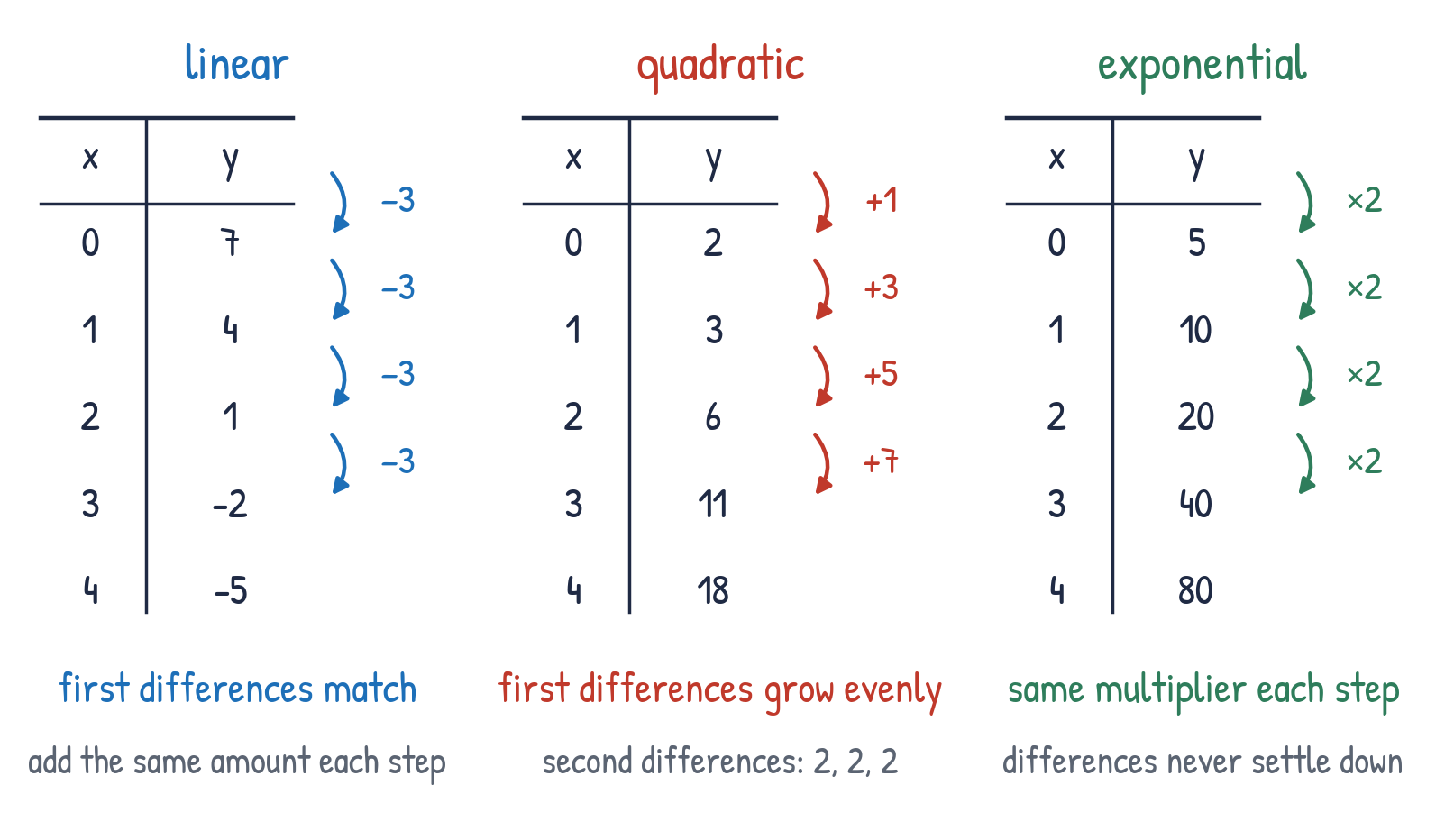
Linear functions have constant first differences. Quadratic functions have constant second differences. Exponential functions have a constant ratio.
How to Tell Linear, Quadratic, and Exponential Apart From a Table
With evenly spaced x-values, a table gives you a reliable way to distinguish the three families. Subtract each y from the one after it. If those first differences are equal, it is linear. If they are not, subtract again and equal second differences mean quadratic. If neither works, divide instead: a constant ratio means exponential.
Differences can offer insight only if you consider the spacing of the x values on the axis. If the x values jump 0, 1, 2, 5, the pattern in the y column tells you nothing until you fix the spacing.
Quadratic vs Exponential: The Mix-Up Worth Knowing About
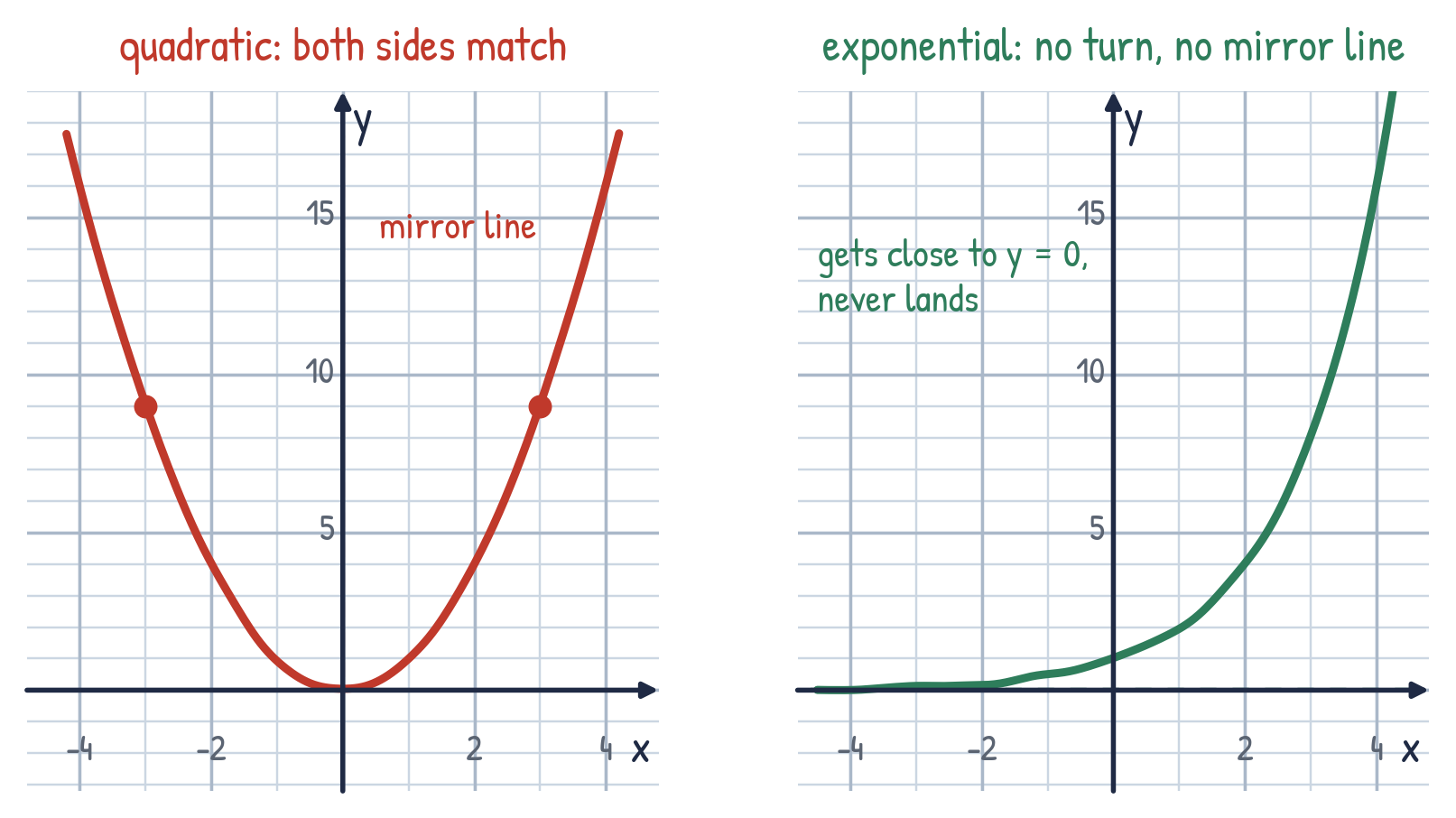
Students often label any upward-curving graph a parabola. That becomes especially easy to do when the graph only shows positive x-values. A parabola turns around and is symmetric so it folds along its axis of symmetry and the halves match. An exponential curve never turns, and on one side it flattens toward a horizontal line or limit that it never reaches but gets close to.
Which Grows Fastest in the Long Run
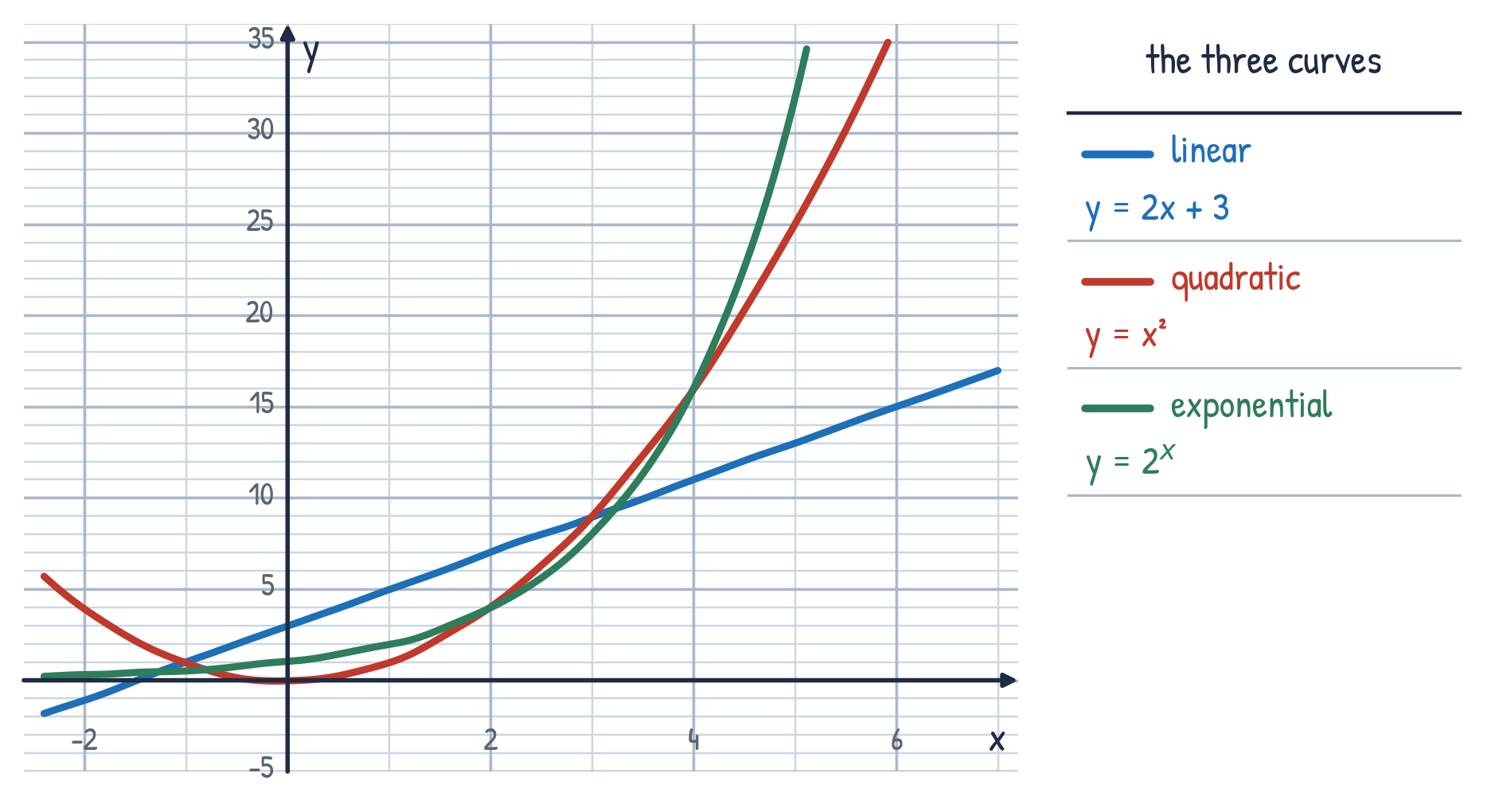
A growing exponential eventually outpaces a quadratic, although the quadratic may be larger for quite a while. Compare y = x² with y = 2x: they tie at x = 2 and again at x = 4, the quadratic is ahead at x = 3, and from x = 5 onward the exponential is gone. Illustrative Mathematics has a leaf-raking payment task that makes the point better than any graph, and Desmos is worth ten minutes here — plot all three, then zoom out and watch the order change. Paul's Online Notes covers the exponential family in more depth if you want a second explanation.If the answer comes back quadratic, the rest of the work — factoring, completing the square, or the quadratic formula — starts from there.
Practice Problems: Comparing Linear, Quadratic, and Exponential Functions
Part A is identification: name the family and say what gave it away. Part B asks for the equation and one value. Show your work in the space provided.
Part A — name the family (linear, quadratic, or exponential) and give your reason
- y = 5x − 4
- y = 3(2)x
- y = x² + 4x − 5
-
Problem 4 table of x and y values x 0 1 2 3 y 5 10 20 40 -
Problem 5 table of x and y values x 0 1 2 3 4 y 1 4 9 16 25 -
Problem 6 table of x and y values x 0 1 2 3 4 y 7 4 1 −2 −5 - y = 100(0.8)x
- y = −2x² + 7
-
Problem 9 table of x and y values x 0 1 2 3 4 y 2 3 6 11 18 -
Problem 10 table of x and y values x 0 1 2 3 4 y 1 1.5 2.25 3.375 5.0625
Part B — find the equation, then answer the question
-
Write the equation, then find y when x = 5.
Problem 11 table of x and y values x 0 1 2 3 y 6 18 54 162 -
Write the equation, then find y when x = 6.
Problem 12 table of x and y values x 0 1 2 3 4 y 3 5 11 21 35 -
Write the equation, then find x when y = −9.
Problem 13 table of x and y values x 0 1 2 3 4 y 12 9 6 3 0 - A culture starts with 200 bacteria and doubles every hour. Write the equation and find the count after 6 hours.
- A phone plan costs $30 a month plus $0.10 per GB of data. Write the equation and find the bill for a month with 45 GB.
- A car worth $24,000 loses 15% of its value each year. Write the equation and find its value after 3 years.
- A ball is thrown from a 4 ft ledge and its height is h = −16t² + 48t + 4. How high does it get, and when?
- Account A starts at $500 and gains $25 a month. Account B starts at $500 and grows 4% a month. Which is worth more after 12 months? After 24 months?
- Compare y = x² and y = 2x at x = 2, 3, 4, and 5. From which whole number is the exponential ahead for good?
- Three functions: y = 50x, y = x², y = 1.2x. Which is largest at x = 10? Which is largest at x = 100?
Comparing Functions Worksheet: Answer Key
Part A
1. y = 5x − 4
x is to the first power, no square, no exponent.
Linear
2. y = 3(2)x
x is the exponent and the base is fixed at 2.
Exponential
3. y = x² + 4x − 5
Highest power of x is 2.
Quadratic
4. 5, 10, 20, 40
First differences 5, 10, 20 are not equal. Ratios are 2, 2, 2.
Exponential, y = 5(2)x
5. 1, 4, 9, 16, 25
First differences 3, 5, 7, 9. Second differences 2, 2, 2.
Quadratic, y = (x + 1)²
6. 7, 4, 1, −2, −5
First differences are −3 every time.
Linear, y = −3x + 7
7. y = 100(0.8)x
x is the exponent. The base is under 1, so it decays instead of growing.
Exponential (decay)
8. y = −2x² + 7
x is squared. The negative in front only flips the parabola.
Quadratic
9. 2, 3, 6, 11, 18
First differences 1, 3, 5, 7. Second differences 2, 2, 2.
Quadratic, y = x² + 2
10. 1, 1.5, 2.25, 3.375, 5.0625
Differences keep changing, but every ratio is 1.5.
Exponential, y = (1.5)x
Part B
11. 6, 18, 54, 162
Ratio 3 each step, starting value 6. So y = 6(3)x, and 6 × 35 = 6 × 243.
y = 6(3)x · y = 1,458 when x = 5
12. 3, 5, 11, 21, 35
Second differences are 4, so a = 2. At x = 0, y = 3, so c = 3. At x = 1, 2 + b + 3 = 5 gives b = 0. Then 2(36) + 3.
y = 2x² + 3 · y = 75 when x = 6
13. 12, 9, 6, 3, 0
Slope −3, y-intercept 12. Set −3x + 12 = −9, so −3x = −21.
y = −3x + 12 · x = 7
14. Bacteria doubling every hour
Doubling is a ratio of 2, so it is exponential: 200(2)6 = 200 × 64.
y = 200(2)t · 12,800 bacteria after 6 hours
15. $30 a month plus $0.10 per GB
The same amount is added per GB, so it is linear: 0.10(45) + 30.
C = 0.10g + 30 · $34.50
16. Car losing 15% a year
Keeping 85% each year is a ratio of 0.85: 24,000(0.85)3 = 24,000 × 0.614125.
V = 24,000(0.85)n · $14,739
17. h = −16t² + 48t + 4
Quadratic, so the maximum is at the vertex: t = −48 / (2 × −16) = 1.5. Then h = −16(2.25) + 72 + 4.
40 ft, 1.5 seconds after the throw
18. $25 a month versus 4% a month
A is linear: 500 + 25n. B is exponential: 500(1.04)n. At 12 months, 800 against 800.52. At 24 months, 1,100 against 1,281.65.
Almost a tie at 12 months (B by 52¢), B by about $182 at 24 months
19. y = x² against y = 2x
x = 2: 4 and 4. x = 3: 9 and 8. x = 4: 16 and 16. x = 5: 25 and 32.
Tied at 2 and 4, quadratic ahead at 3, exponential ahead from x = 5 on
20. y = 50x, y = x², y = 1.2x
At x = 10: 500, 100, and about 6.2. At x = 100: 5,000, 10,000, and about 83 million. The exponential passes x² near x = 41 and passes 50x near x = 42.
Linear at x = 10, exponential at x = 100 — it is ahead of both from about x = 42 on
Every answer above was checked against the original table or equation before publishing, most recently on July 28, 2026. If you spot an error, email burketutoringinfremont@outlook.com or text (510) 453-0350 and it will be corrected.
Common Questions
How do you know if a table is linear, quadratic, or exponential?
Check that x steps up evenly, then subtract down the y column. Equal first differences means linear. If not, subtract those differences again — equal second differences means quadratic. If neither is constant, divide each y by the one before it; a constant ratio means exponential.
What is the difference between a quadratic and an exponential graph?
A parabola turns around at a vertex and is symmetric about a vertical line. An exponential curve never turns, and one end flattens toward a horizontal asymptote it never touches.
Does exponential growth always beat quadratic growth?
Eventually, yes, for any base above 1 — but not right away. With y = x² and y = 2x the quadratic is ahead at x = 3, and the exponential only pulls away for good from x = 5.
Is y = 100(0.8)x still exponential if it shrinks?
Yes. The base being between 0 and 1 makes it exponential decay rather than growth. It is still a constant multiplier each step, which is what defines the family.
What grade level is this worksheet for?
Algebra I most often, usually grades 8 to 10, and again in Algebra II when function families get reviewed. Part A works as a warm-up; Part B is closer to test level.
Keep Practicing
Once a problem turns out to be quadratic, the next questions are usually about its graph: graphing quadratic functions, rewriting into vertex form and intercept form, reading the equation of a parabola from a graph, and using the discriminant to count roots before solving.
About the Author

Berke has taught K–12 math and science for more than 10 years, logging over 6,000 tutoring hours with 200+ students. He holds a BS in Biochemistry from Washington University in St. Louis and an MS in Bioinformatics from UMGC.
He writes every worksheet on this site from problems he actually uses in sessions, which is why the mix-up section above exists — it is the one he corrects most often.
How these are made: problems are prepared from previous class notes and assigned homework, and every answer is checked before publishing. Corrections come in by email or text and get fixed the same week.
If you want someone sitting next to you while you work through this comparing functions worksheet, Burke Tutoring offers in-home algebra tutoring in Fremont, Newark, and Union City. Call (510) 453-0350.
Burke Tutoring · Fremont, CA 94538 · (510) 453-0350 · Serving Fremont · Newark · Union City