Equation of a Parabola from a Graph: A Vertex Form Worksheet
A free worksheet on finding the equation of a parabola from a graph, using vertex form and one extra point to pin down a
Published · Last updated
Most quadratic practice runs one direction: here is the equation, now graph it. This worksheet runs the other way. You get the picture and have to write the algebra that produced it.
The short version: to find the equation of a parabola from a graph,
- Read the vertex (h, k) off the graph and write y = a(x − h)² + k.
- Pick any other point the curve clearly passes through, usually the y-intercept.
- Substitute that point and solve for a.
That's it. Everything below is practice on those three steps.
Once the vertex is labeled, most of the equation is already determined. You only need one additional point to solve for a. From there you only need one more point on the curve to finish the equation. If you'd like a refresher on how vertex form relates to vertex form and intercept form generally, that worksheet is a good place to start before this one.
Want the printable parabola equation from a graph worksheet?
Worked examples, 20 practice problems, and a full answer key. No sign-up, no email required.
What to Look For on the Graph
The vertex (h, k) — the turning point. Read it straight off the graph and drop it into vertex form.
Any other point on the curve — usually the y-intercept. This is the only thing that finds a.
Start From the Vertex: Writing the Equation of a Parabola
Vertex form is y = a(x − h)² + k. Read the vertex, drop h and k into the equation, and the only thing left is a. Then substitute a second point the curve clearly passes through, and solve.
Watch the sign on h: a vertex at x = −1 goes into the equation as (x + 1)², not (x − 1)². The two examples below show the whole process side by side with the graph — one opening up, one opening down. For a video walkthrough of the same idea, Khan Academy's lesson on graphing a parabola in vertex form is a solid companion.
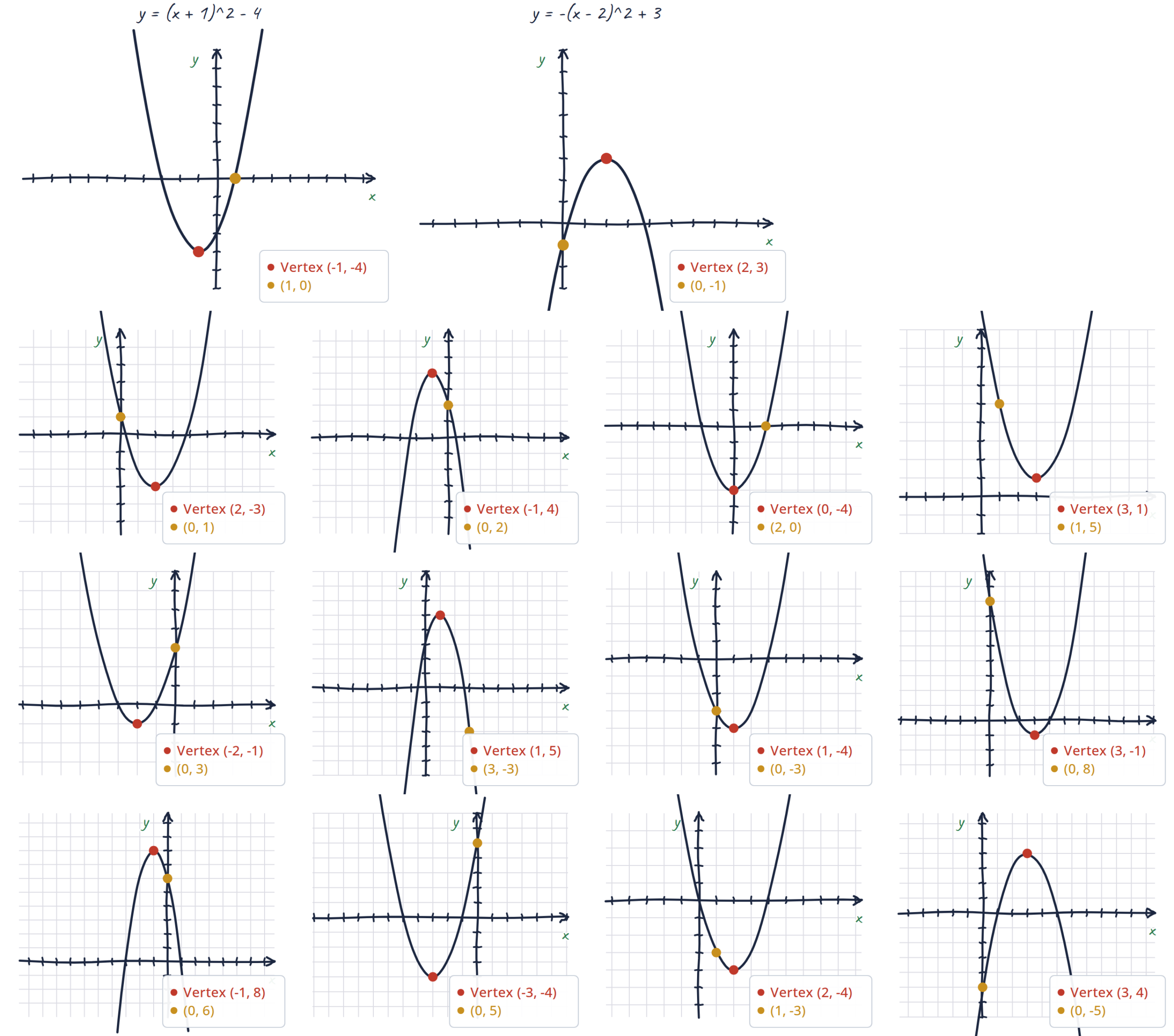
Worked Example · Opens Upward
Start with the vertex: y = a(x + 1)² − 4.
Substitute (1, 0): 0 = a(1 + 1)² − 4.
Simplify: 0 = 4a − 4, so a = 1.
y = (x + 1)² − 4
Worked Example · Opens Downward
Start with the vertex: y = a(x − 2)² + 3.
Substitute (0, −1): −1 = a(0 − 2)² + 3.
Simplify: −1 = 4a + 3, so a = −1.
y = −(x − 2)² + 3
Watch the Sign
A vertex at x = −1 gives (x + 1)², not (x − 1)². In ten years of sitting next to students on this topic, this is the error I catch more than any other — and it almost never shows up on the first problem. It shows up on problem six, once the reading-the-vertex part feels automatic.
Quick check: put the second point back into your finished equation. If it does not come out right, the sign is the first place to look.
That's the whole method for finding the equation of a parabola from a graph: read the vertex, then use one more point to solve for a. The practice problems below give you twenty graphs and feature sets to try it on.
Practice Problems: Equation of a Parabola from a Graph
Part A gives you graphs with the vertex marked — write each equation in vertex form. Part B has no graph, only the vertex and one point, the same features you would have read off one. If your quadratic starts in standard form rather than a graph, our vertex and axis of symmetry worksheet covers finding h and k algebraically instead.
Part A — Write the Equation in Vertex Form (Problems 1–12)
Part B — Write an Equation from the Features Given (Problems 13–20)
- Vertex (4, −2), and the curve passes through (5, 1).y =
- Vertex (−2, −16), and the curve passes through (0, −12).y =
- Vertex (−3, 0), and the curve passes through (−1, −8).y =
- Vertex (5, −4), and the curve passes through (3, 0).y =
- Vertex (0, 6), and the curve passes through (2, −6).y =
- Vertex (2, 8), and the curve passes through (0, 6).y =
- Vertex (1, −8), and the curve passes through (3, 0).y =
- Vertex (2, 0), and the curve passes through (0, 8).y =
Answer Key
Every problem is worked below. Each one is the same two moves: write vertex form, then substitute a point to find a.
Part A — Vertex Form
- 1. Vertex (2, −3): y = a(x − 2)² − 3. Sub (0, 1): 1 = 4a − 3, so a = 1. y = (x − 2)² − 3
- 2. Vertex (−1, 4): y = a(x + 1)² + 4. Sub (0, 2): 2 = a + 4, so a = −2. y = −2(x + 1)² + 4
- 3. Vertex (0, −4): y = ax² − 4. Sub (2, 0): 0 = 4a − 4, so a = 1. y = x² − 4
- 4. Vertex (3, 1): y = a(x − 3)² + 1. Sub (1, 5): 5 = 4a + 1, so a = 1. y = (x − 3)² + 1
- 5. Vertex (−2, −1): y = a(x + 2)² − 1. Sub (0, 3): 3 = 4a − 1, so a = 1. y = (x + 2)² − 1
- 6. Vertex (1, 5): y = a(x − 1)² + 5. Sub (3, −3): −3 = 4a + 5, so a = −2. y = −2(x − 1)² + 5
- 7. Vertex (1, −4): y = a(x − 1)² − 4. Sub (0, −3): −3 = a − 4, so a = 1. y = (x − 1)² − 4
- 8. Vertex (3, −1): y = a(x − 3)² − 1. Sub (0, 8): 8 = 9a − 1, so a = 1. y = (x − 3)² − 1
- 9. Vertex (−1, 8): y = a(x + 1)² + 8. Sub (0, 6): 6 = a + 8, so a = −2. y = −2(x + 1)² + 8
- 10. Vertex (−3, −4): y = a(x + 3)² − 4. Sub (0, 5): 5 = 9a − 4, so a = 1. y = (x + 3)² − 4
- 11. Vertex (2, −4): y = a(x − 2)² − 4. Sub (1, −3): −3 = a − 4, so a = 1. y = (x − 2)² − 4
- 12. Vertex (3, 4): y = a(x − 3)² + 4. Sub (0, −5): −5 = 9a + 4, so a = −1. y = −(x − 3)² + 4
Part B — From Features
- 13. y = a(x − 4)² − 2. Sub (5, 1): 1 = a − 2, so a = 3. y = 3(x − 4)² − 2
- 14. y = a(x + 2)² − 16. Sub (0, −12): −12 = 4a − 16, so a = 1. y = (x + 2)² − 16
- 15. y = a(x + 3)². Sub (−1, −8): −8 = 4a, so a = −2. y = −2(x + 3)²
- 16. y = a(x − 5)² − 4. Sub (3, 0): 0 = 4a − 4, so a = 1. y = (x − 5)² − 4
- 17. y = ax² + 6. Sub (2, −6): −6 = 4a + 6, so a = −3. y = −3x² + 6
- 18. y = a(x − 2)² + 8. Sub (0, 6): 6 = 4a + 8, so a = −½. y = −½(x − 2)² + 8
- 19. y = a(x − 1)² − 8. Sub (3, 0): 0 = 4a − 8, so a = 2. y = 2(x − 1)² − 8
- 20. y = a(x − 2)². Sub (0, 8): 8 = 4a, so a = 2. y = 2(x − 2)²
Common Questions
What if the vertex doesn't land on grid lines?
Then don't start from the vertex. If the graph shows two clean x-intercepts, use intercept form: y = a(x − p)(x − q), then substitute a third point to find a. You can convert to vertex form afterward if the question asks for it.
Can I write the answer in standard form instead?
Yes, and some teachers require it. Find the equation in vertex form first, then expand. Going straight to y = ax² + bx + c from a graph means setting up a system of three equations from three points, which is much slower by hand.
What does a actually tell me?
Two things: the sign tells you which way the parabola opens, and the size tells you how narrow it is. |a| greater than 1 is narrower than y = x²; |a| between 0 and 1 is wider. If your answer comes out with a very large a, re-read the second point — that's usually a misread rather than a steep curve.
How do I check my answer without a graphing calculator?
Substitute the second point back into your finished equation. If both sides match, the equation is right. This usually catches the sign error on h.
↓ Download the printable parabola equation worksheet
Worked examples + 20 practice problems + answer key · Free to print for classroom and home use
Keep Practicing Quadratics
Once you can find the equation of a parabola from a graph confidently, these related worksheets go further:
- Graphing quadratic functions worksheet — practice going the other direction, from equation to graph.
- Vertex and axis of symmetry worksheet — find h and k algebraically when you're starting from standard form.
- Vertex form and intercept form worksheet — a side-by-side look at both forms and how to convert between them.
- Solving quadratics by factoring worksheet — useful once you need the roots of a quadratic, not just its graph.
- Quadratic formula worksheet — for equations that don't factor cleanly.
- Discriminant and number of roots worksheet — predict how many real roots a quadratic has before you solve it.
Need One-on-One Help?
If a student needs to work through these with someone, Burke Tutoring offers in-home algebra tutoring in Fremont, Newark, and Union City.
Skill level: Algebra I and Algebra II. This worksheet practices writing quadratic functions in vertex form from a graph or from given features, supporting Common Core standards F-IF.C.8a and F-BF.B.3. Free to reproduce for classroom and home instruction.