Free Algebra 1 & Algebra 2 Worksheet
Solving Quadratics by Factoring
15 practice problems with a worked answer key — plus the pairs-and-diagonals method I teach my students

Written by Berke Sahbazoglu — B.S. Biochemistry, Washington University in St. Louis; M.S. Bioinformatics, UMGC
6,000+ hours & 200+ students tutored · 10+ years teaching Algebra I & II · Burke Tutoring in Fremont · Free to print for classroom & home use
Published · Last updated
Want the printable version?
Full worksheet + answer key, PDF. No sign-up, no email required.
Factoring is the fastest way to solve a quadratic equation — when it works. Every quadratic on this sheet is a trinomial (or a binomial) that factors cleanly over the integers. When one doesn't, the quadratic formula still finds the roots, and checking the discriminant first tells you what to expect before you start.
There are different ways to factor. Below is the method I actually use with students: laying out the multiplication pairs and testing them with diagonals. It handles a leading coefficient bigger than 1 without a separate procedure, and it makes the trial and error visible instead of guesswork.
Should I factor, or go straight to the formula?
Spend about 30 seconds looking for factors. If the constant has only a couple of pair options and one of them lands on the middle term, factoring is faster than the formula every time.
If the numbers are ugly, or B² − 4AC isn't a perfect square, it won't factor over the integers. Stop and use the formula.
How I Teach Solving Quadratics by Factoring: Pairs and Diagonals
Before anything else, get the equation into standard form with zero on one side:
Step 1 — List the multiplication pairs
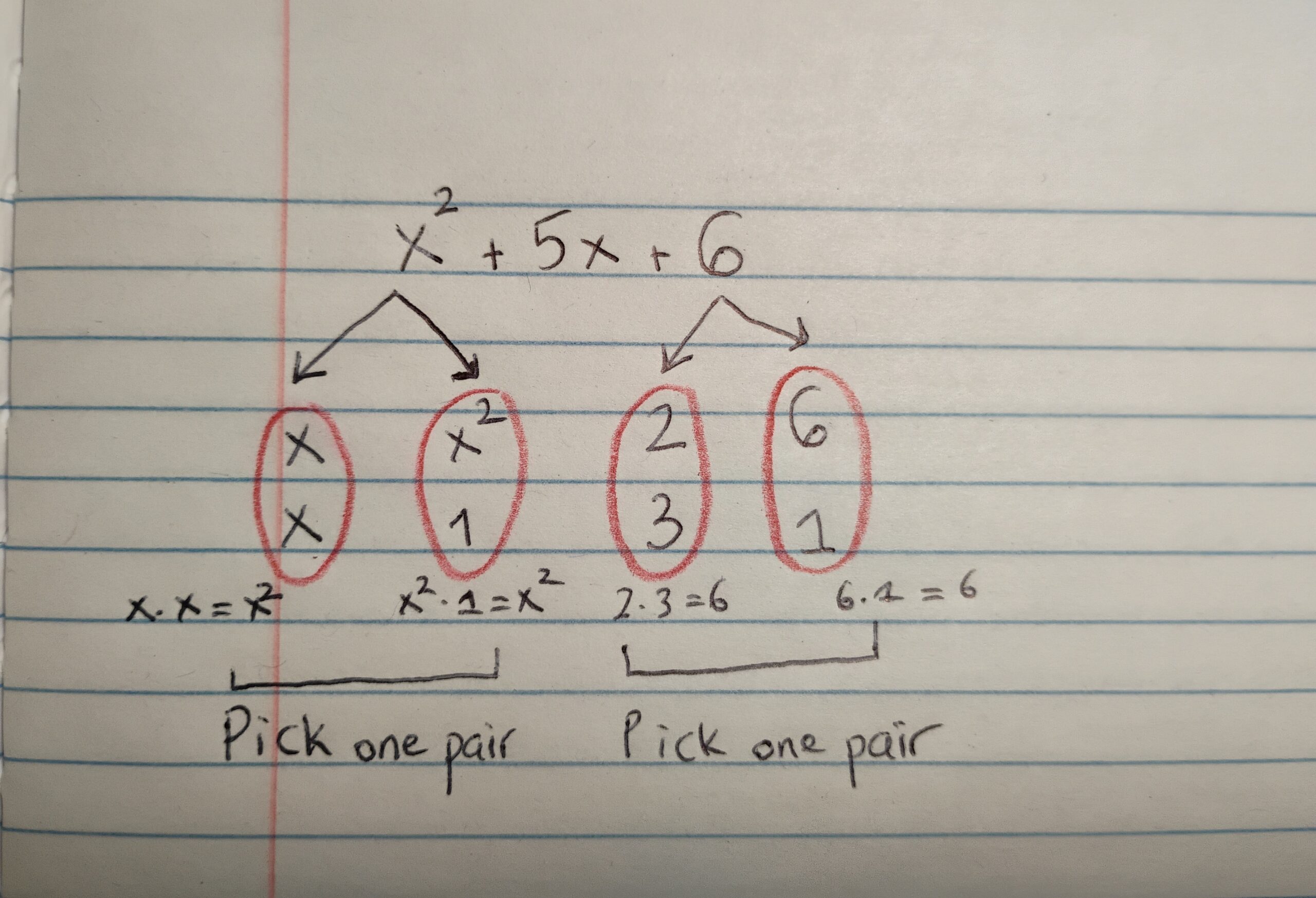
For the x² term, list every pair that multiplies to give it. Do the same for the constant.
You don't know yet which pairs are the right ones, so there's some trial and error here. A couple will fail — that's part of the work, not a mistake.
Step 2 — Test with diagonals
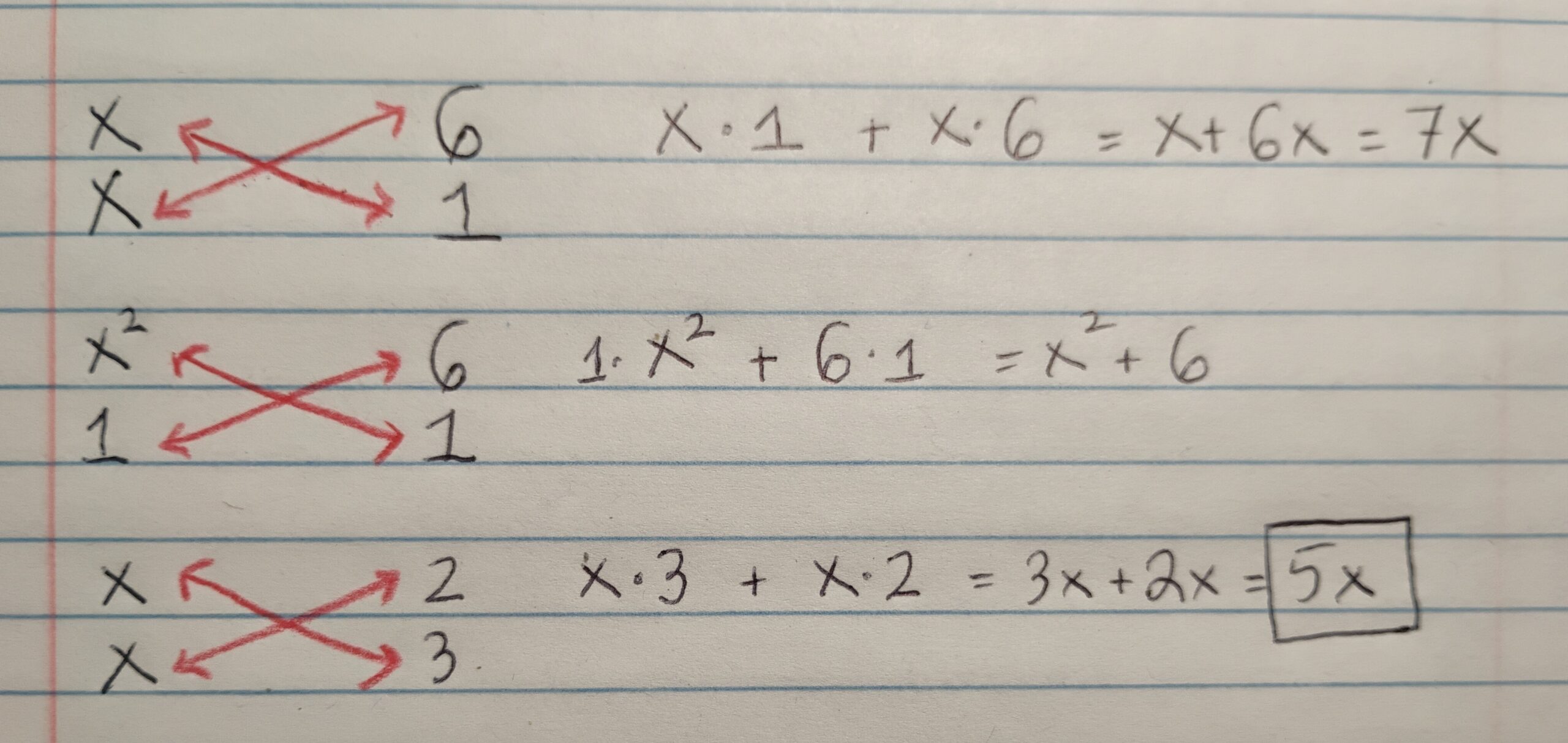
Pick one pair from the left and one from the right. Draw diagonal arrows between them, multiply, and add the results. If the sum equals your middle term (Bx), you found the right pairs. If not, try the next combination.
Step 3 — Read off the factors, then solve
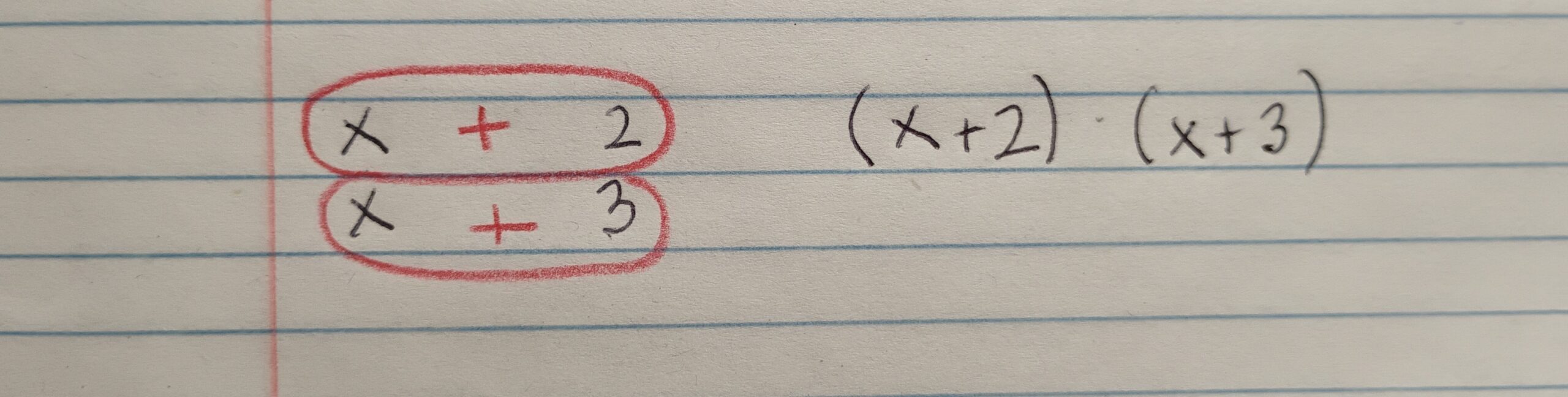
Rewrite the winning pairs vertically, then connect them horizontally. Each row becomes one set of parentheses.
You're not done yet — now find the roots.
The factored form isn't the answer. Ask what makes each set of parentheses equal zero, since that's the whole point of the Zero Product Property:
x + 2 = 0 → x = −2
x + 3 = 0 → x = −3
Step 4 — Check in ten seconds
Put one root back into the original equation. For x = −2: (−2)² + 5(−2) + 6 = 4 − 10 + 6 = 0. If it doesn't come out to zero, the sign on one of your numbers is flipped. Checking one root catches almost every factoring error.
Three Patterns Worth Recognizing on Sight
Difference of squares
No middle term, and both terms are perfect squares: x² − 49 = (x − 7)(x + 7). The diagonals cancel, which is why the x term disappears.
Perfect square trinomial
Both parentheses come out the same: x² − 10x + 25 = (x − 5)². You get one repeated root, not two.
Shared factor (GCF)
Every term has an x or a common number: x² − 3x = x(x − 3). Pull it out front first — never divide it away.
Common Mistakes I See When Solving Quadratics by Factoring
Stopping at the factored form. (x − 3)(x − 4) = 0 is not the answer. x = 3 and x = 4 are.
Factoring before moving everything to one side. x² + 5x = 6 has to become x² + 5x − 6 = 0 first. The Zero Product Property only works against zero.
Sign errors on the constant. If the product is negative, the two numbers have opposite signs. Say it out loud before guessing.
Forgetting to pull out a shared term first. x² − 3x becomes x(x − 3), which gives a root at x = 0 that's easy to lose.
Misreading a factor with a number in front of the x. The factor (2x − 1) gives x = 1/2, not x = 1. Set it equal to zero and solve it like any other equation.
Practice Problems
Find all real roots by factoring. Show your factored form, then give both roots. Every problem on this sheet factors.
Working with a student? Problems 1–10 take about 15 minutes; 11–15 usually take as long again. The answer key shows the reasoning for each one.
Part A — Leading coefficient of 1 (problems 1–10)
- 1. x² − 7x + 12 = 0
- 2. x² + 8x + 15 = 0
- 3. x² − 2x − 8 = 0
- 4. x² + 5x − 14 = 0
- 5. x² − 11x + 30 = 0
- 6. x² − 49 = 0
- 7. x² − 10x + 25 = 0
- 8. x² − 36 = 0
- 9. x² + 12x + 36 = 0
- 10. x² − 3x = 0
Part B — Leading coefficient greater than 1 (problems 11–15)
- 11. 2x² + 5x − 3 = 0
- 12. 3x² − 10x + 8 = 0
- 13. 2x² − 7x + 3 = 0
- 14. 6x² + x − 2 = 0
- 15. 4x² − 12x + 9 = 0
Worked Answer Key
Reasoning shown, not just answers — so if a student gets stuck, they can find exactly where a step went wrong.
Questions Students Ask Me About Factoring
How do I know if a quadratic can be factored?
Work out B² − 4AC. If it's a perfect square, the quadratic factors over the integers. If it isn't, no amount of trial and error will help — go to the formula.
What changes when the leading coefficient isn't 1?
Nothing about the method. You just have more pairs to list on the left side, because 6x² can come from 2x · 3x or 6x · x. Problems 11–15 above are exactly this case.
Why did I only get one root?
Both sets of parentheses came out identical, so both give the same answer. That's a perfect square trinomial, and it means the parabola touches the x-axis at exactly one point.
Do I have to set the equation equal to zero first?
Yes. Factoring x² + 5x = 6 as it stands tells you nothing, because the Zero Product Property only works when the product equals zero. Move everything to one side first.
Is factoring or the quadratic formula better on a test?
Whichever you finish correctly. Factoring is faster on clean numbers and is what most Algebra 1 tests are checking for; the formula never fails but takes longer and invites arithmetic slips.
Tutor's note
When a student stalls on factoring, it's almost always the sign rules on the constant term. Have them say it out loud before guessing: positive product means same signs, negative product means opposite signs. That one habit removes most of the trial and error.
Aligned to Common Core standards HSA-SSE.B.3.a (factor a quadratic to reveal its zeros) and HSA-REI.B.4.b (solve quadratic equations by factoring). Typically covered in Algebra 1 and revisited in Algebra 2. Teachers and parents are welcome to print and copy this sheet for classroom or home use.
Related Worksheets
When it won't factor: Solving Quadratics With the Quadratic Formula
How many roots to expect: Using the Discriminant to Find the Number of Roots
The other way to solve any quadratic: Completing the Square Worksheet
Finding the vertex from standard form: Vertex and Axis of Symmetry Worksheet
Putting all the pieces on a graph: Graphing Quadratic Functions Worksheet
Worksheet + answer key · Free to print for classroom and home use
Need help with Algebra I or II? I tutor students in their homes in Fremont, Newark, and Union City.
Call or text (510) 453-0350